The 2026 U.S. Open starts Thursday and Spark has created a way for you and your friends to have a little fun in your own 2026 U.S. Open pool. It’s very simple...
⚡️Create your group
⚡️Share the link to invite your friends
⚡️Pick your players and have fun!
All pool entries must be completed by 6:30am EDT on Thursday, June 18. Please note Spark is only providing the technology to run the pool and does not provide prizing of any kind. Have fun and thanks for playing Spark Golf!
I started programming decades ago when I was 12 years old. At first, it was just a game to me. Over time, as I acquired more skills, it became part of my identity. While others played basketball or the violin, I wrote code.
It is so deeply ingrained in my identity that when I once stopped programming regularly, I became depressed. Shamefully, it took me years to realize that I need to program weekly to stay happy.
Today, the best AI models can write C++ code better than most computer science professors. They are certainly better programmers than my teenage self, who learned without access to the internet.
Why play the violin when anyone can find a recording of a great violinist with little effort?
This is not a new problem for human beings. What happened to bowmen when the musket became standard military issue?
Do you keep showing up on the battlefield with your bow? A bow has advantages over a musket—and bows continued to improve even after the musket’s invention. Yet the writing was on the wall: the future of the battlefield did not belong to the bow.
I could also recount the story of portrait painters who struggled with the rise of photography.
Programmers are not alone in facing a transformation of their craft. Graphic designers, lawyers, writers, and nearly everyone in the laptop class are impacted. Some do not mind, because their craft was always primarily about achieving professional success. Others are more troubled.
Let us be fair. For the last 30 years, the West pursued globalist policies that continually moved industrial jobs elsewhere, leaving many young men without much-needed opportunities. We told them not to worry—their economic losses were more than offset by government checks.
And this gets to the core of the issue. Getting the job done is only part of what we care about. Perhaps more importantly, we want meaningful lives, which often come through skill development and its fruitful application. Money alone is not enough—it never was. We also crave status, recognition, and a sense of empowerment.
As I look at software programming today, I can accomplish in five hours what would once have taken me three days. Sometimes I can do in 15 minutes what used to take three hours. Other times—especially when tackling something difficult that plays to my strengths—I do like Luke Skywalker: I turn off the targeting computer and code without AI for the best results.
At the same time, I see many people (including some of my students) trapped in an illusion of competence. They prompt an AI and generate low-quality code—not because the models are bad, but because a tool is only as good as the person wielding it.
What is coming? I cannot predict the future with certainty, but the following seems possible:
1. We may end up with the equivalent of a laptop-class rust belt. People who used to write reports and PowerPoint decks for a living could become obsolete. Teachers might find students turning to AI instead, reducing them to little more than relatively useless bureaucrats. IT specialists might see their entire purpose wiped out by a new AI model. They may still earn a decent living, but their social status could crater—just as it did for factory workers in the West from 1980 to today. What goes around comes around.
2. During the globalization era, the financial industry boomed in the West, and to this day some of the most prestigious and highly paid jobs are in finance. A similar phenomenon is likely unfolding in this AI era. Many of those benefiting will have a background in programming. The people who can build in a month what once took a year will be able to automate tasks that previously weren’t worth automating.
What about the sense of purpose and competence? Speaking for myself, it is not gone. If anything, I feel I can leverage my hard-earned skills even more effectively than before. More importantly: I am still having a lot of fun programming.
"I also get some programmers are eager to tune it out. The hype drones on, the fantastical claims are still far off, and there's uncertainty where this leaves the profession. But that's not reason to miss out on this incredible moment in human history!" https://t.co/guMzuZqgMw
You can't let the slop and cringe deny you the wonder of AI. This is the most exciting thing we've made computers do since we connected them to the internet. If you spent 2025 being pessimistic or skeptical on AI, why not give the start of 2026 a try with optimism and curiosity?
@ryanmouquegolf 💯 agree on match play, but also the best team during the regular season doesn’t even usually win in other sports and we think nothing of it, so why is that such a problem in golf?
@Skulledwedge I like the idea that only the top 50 finishers at Memphis advance to the next round. Maybe give the top 10 a bye at Memphis, so they don’t have to play if they don’t want to, but can if they want to earn more money. Like playoffs in other sports, but the bye is optional.
Still, they need to find a way to add room for some leeway in these types of situations because there isn’t a person in the world who thinks that should be a penalty. If it is deemed unintentional and there is no significant change to the lie, there should be no penalty
I agree 100% that he doesn’t deserve a penalty. The statement from the R&A says “did the ball come to rest on another spot”. Couldn’t you make the argument that although the ball did rotate slightly that it still stayed in the same “spot”? I guess it depends how define “spot”.
I agree 100% that he doesn’t deserve a penalty. The statement from the R&A says “did the ball come to rest on another spot”. Couldn’t you make the argument that although the ball did rotate slightly that it still stayed in the same “spot”? I guess it depends how define “spot”.
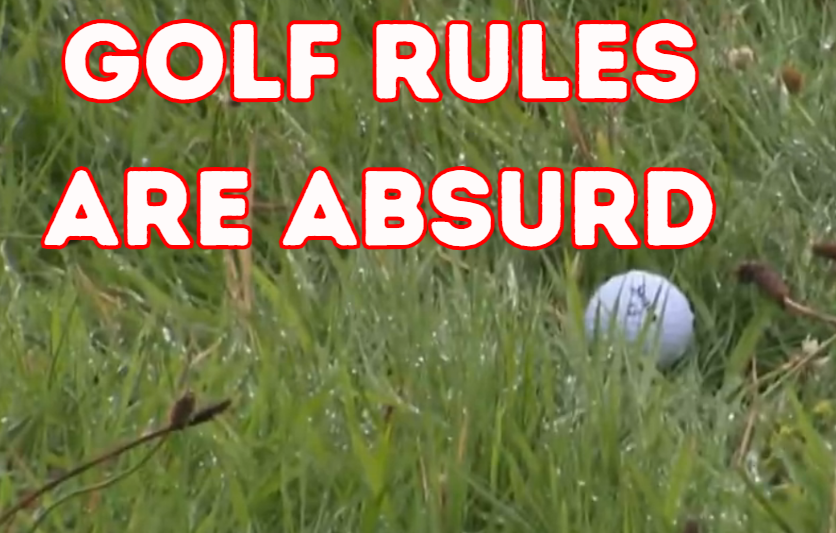
Shane Lowry, a Two-Shot Penalty, and the Absurdity of Golf’s Rules
Today we all know that Shane Lowry received a two-shot penalty. His ball moved ever so slightly after he took a practice swing in the rough. It didn’t roll forward. It didn’t come to rest in a better position. It didn’t offer any kind of advantage. But because the rules say movement equals penalty, the officials had no choice.
By the strict definition of the rule, the call was correct. But this is where golf's rules become divorced from common sense. What happened to Lowry should not be a penalty. There needs to be space in the rulebook for judgment. If the movement of the ball gave no benefit, there should be no consequence.
The "No Subjectivity" Defense
Some people will argue that subjectivity cannot be allowed. They will say players will cheat if given the chance. That argument falls apart pretty quickly.
Golf already includes plenty of subjective moments. Players make judgment calls all the time. For example, when a ball crosses into a penalty area, the player must decide exactly where it last crossed the margin. That is hard to know precisely. But somehow, we live with those gray areas and keep playing. The game survives.
Golf also takes enormous pride in its culture of honesty. Players are trusted to call penalties on themselves. We hear this all the time. Golfers are different, they say. Golfers play with integrity, they say. But then we are told that we cannot trust a player or an official to decide if a one-millimeter oscillation in deep rough had any effect on the shot? That logic doesn’t hold.
The “Gotcha” Culture
Too often, the rules feel less like guardrails and more like traps. It is as if there is always a USGA or R&A official hiding behind a tree, just waiting to jump out and yell, “Gotcha!” The rules can be so technical and inflexible that they lose sight of what really matters.
The deeper problem is structural. The USGA and R&A are self-appointed governing bodies. They have no competition. They can operate however they choose. That is the nature of a monopoly.
When there is no pressure to evolve, the result is rules like the one that penalized Lowry. No competitive gain. No intent to cheat. Still, two shots added to the card.
A Better Way Forward
To be clear, I am not hoping for more division in professional golf. I am not cheering for chaos. While I am not a fan of how LIV fractured the sport, I do think there is room for change elsewhere.
I would support the creation of a new governing body. One that understands the difference between a technical infraction and a meaningful one. One that can bring a modern, thoughtful approach to the rules. One that follows science. What happened to Shane Lowry should not be a penalty. Any reasonable observer can see that.
The game deserves rules that reflect the way it is actually played. This is not about weakening standards. It is about applying fairness and logic.
Because what happened today was not fair.
It was just foolish.