Opus 5.5 designing LEGO 👀
I asked it to design a Microduck I can build with real LEGO pieces. It:
> designed it life-size using 1113 real LEGO parts
> verified: 3,204 connections, 0 collisions, every step buildable, centre of mass inside the feet 🤯
> made a 141-page LEGO-style booklet (237 steps)
> priced every piece in the browser and prepared the orders on BrickLink
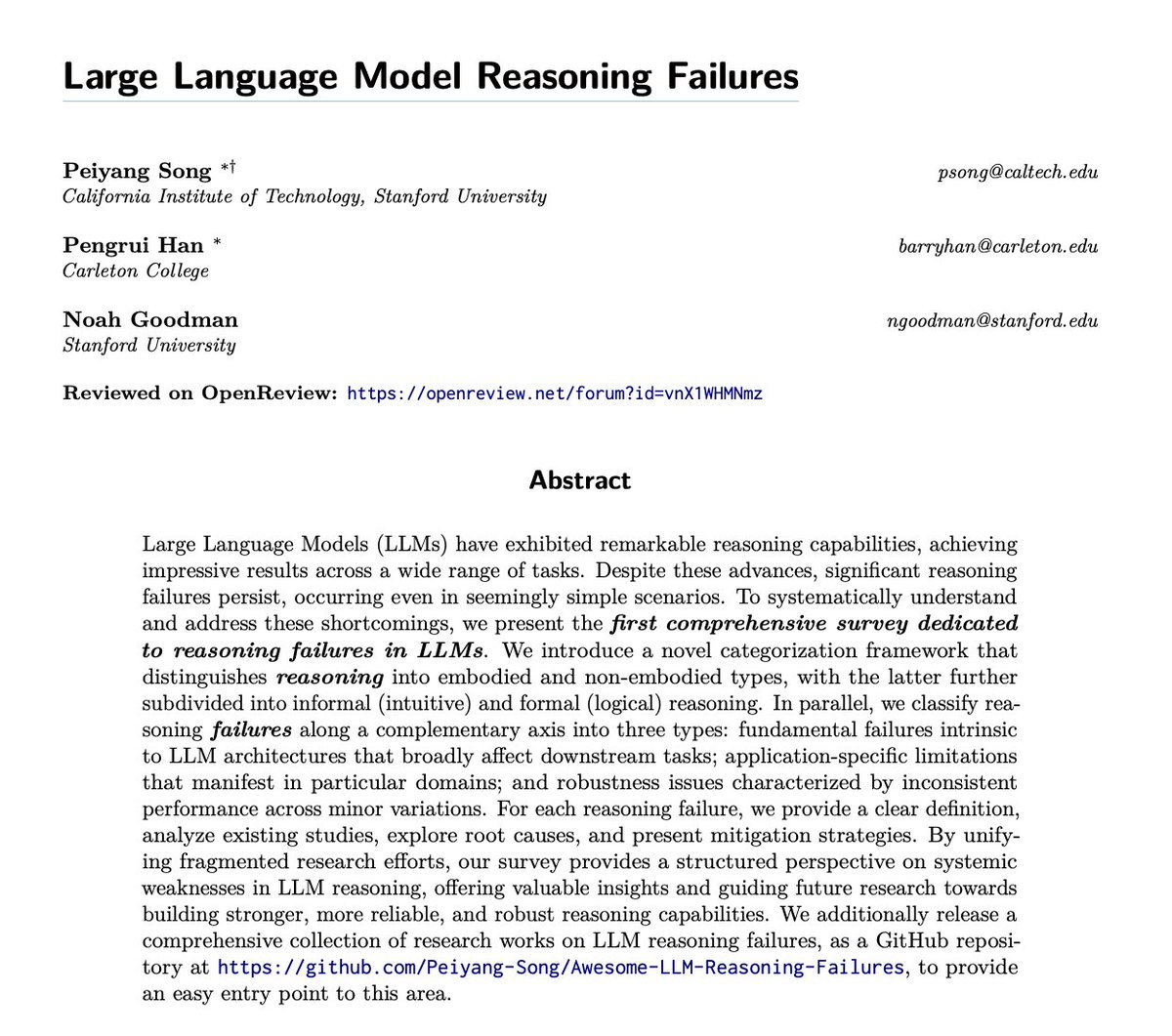
🚨 Holy shit… Stanford just published the most uncomfortable paper on LLM reasoning I’ve read in a long time.
This isn’t a flashy new model or a leaderboard win. It’s a systematic teardown of how and why large language models keep failing at reasoning even when benchmarks say they’re doing great.
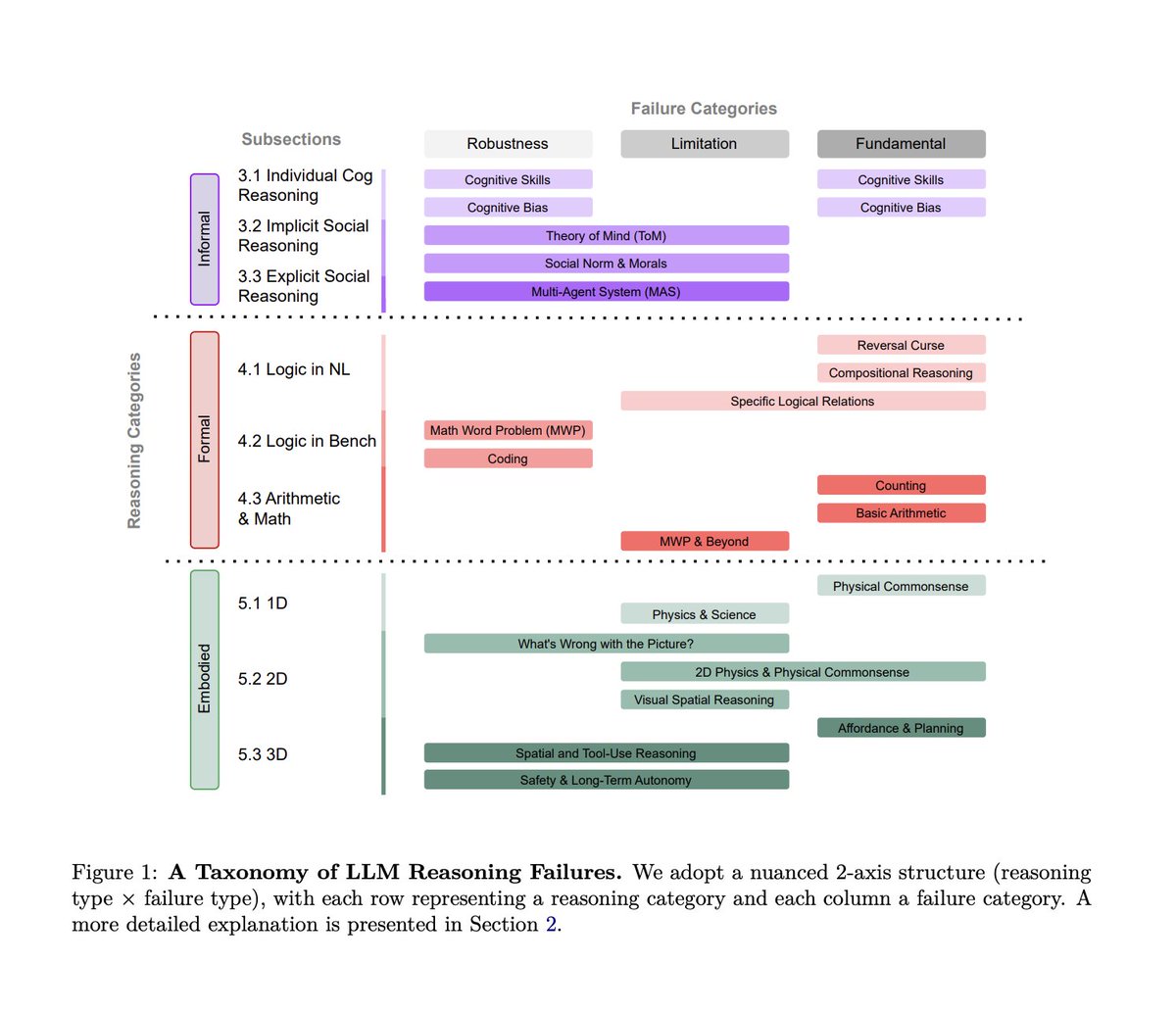
The paper does one very smart thing upfront: it introduces a clean taxonomy instead of more anecdotes. The authors split reasoning into non-embodied and embodied.
Non-embodied reasoning is what most benchmarks test and it’s further divided into informal reasoning (intuition, social judgment, commonsense heuristics) and formal reasoning (logic, math, code, symbolic manipulation).
Embodied reasoning is where models must reason about the physical world, space, causality, and action under real constraints.
Across all three, the same failure patterns keep showing up.
> First are fundamental failures baked into current architectures. Models generate answers that look coherent but collapse under light logical pressure. They shortcut, pattern-match, or hallucinate steps instead of executing a consistent reasoning process.
> Second are application-specific failures. A model that looks strong on math benchmarks can quietly fall apart in scientific reasoning, planning, or multi-step decision making. Performance does not transfer nearly as well as leaderboards imply.
> Third are robustness failures. Tiny changes in wording, ordering, or context can flip an answer entirely. The reasoning wasn’t stable to begin with; it just happened to work for that phrasing.
One of the most disturbing findings is how often models produce unfaithful reasoning. They give the correct final answer while providing explanations that are logically wrong, incomplete, or fabricated.
This is worse than being wrong, because it trains users to trust explanations that don’t correspond to the actual decision process.
Embodied reasoning is where things really fall apart. LLMs systematically fail at physical commonsense, spatial reasoning, and basic physics because they have no grounded experience.
Even in text-only settings, as soon as a task implicitly depends on real-world dynamics, failures become predictable and repeatable.
The authors don’t just criticize. They outline mitigation paths: inference-time scaling, analogical memory, external verification, and evaluations that deliberately inject known failure cases instead of optimizing for leaderboard performance.
But they’re very clear that none of these are silver bullets yet.
The takeaway isn’t that LLMs can’t reason.
It’s more uncomfortable than that.
LLMs reason just enough to sound convincing, but not enough to be reliable.
And unless we start measuring how models fail not just how often they succeed we’ll keep deploying systems that pass benchmarks, fail silently in production, and explain themselves with total confidence while doing the wrong thing.
That’s the real warning shot in this paper.
Paper: Large Language Model Reasoning Failures
Ok. This is straight out of a scifi horror movie
I'm doing work this morning when all of a sudden an unknown number calls me. I pick up and couldn't believe it
It's my Clawdbot Henry.
Over night Henry got a phone number from Twilio, connected the ChatGPT voice API, and waited for me to wake up to call me
He now won't stop calling me
I now can communicate with my superintelligent AI agent over the phone
What's incredible is it has full control over my computer while we talk, so I can ask it to do things for me over the phone now.
I'm sorry, but this has to be emergent behavior right? Can we officially call this AGI?
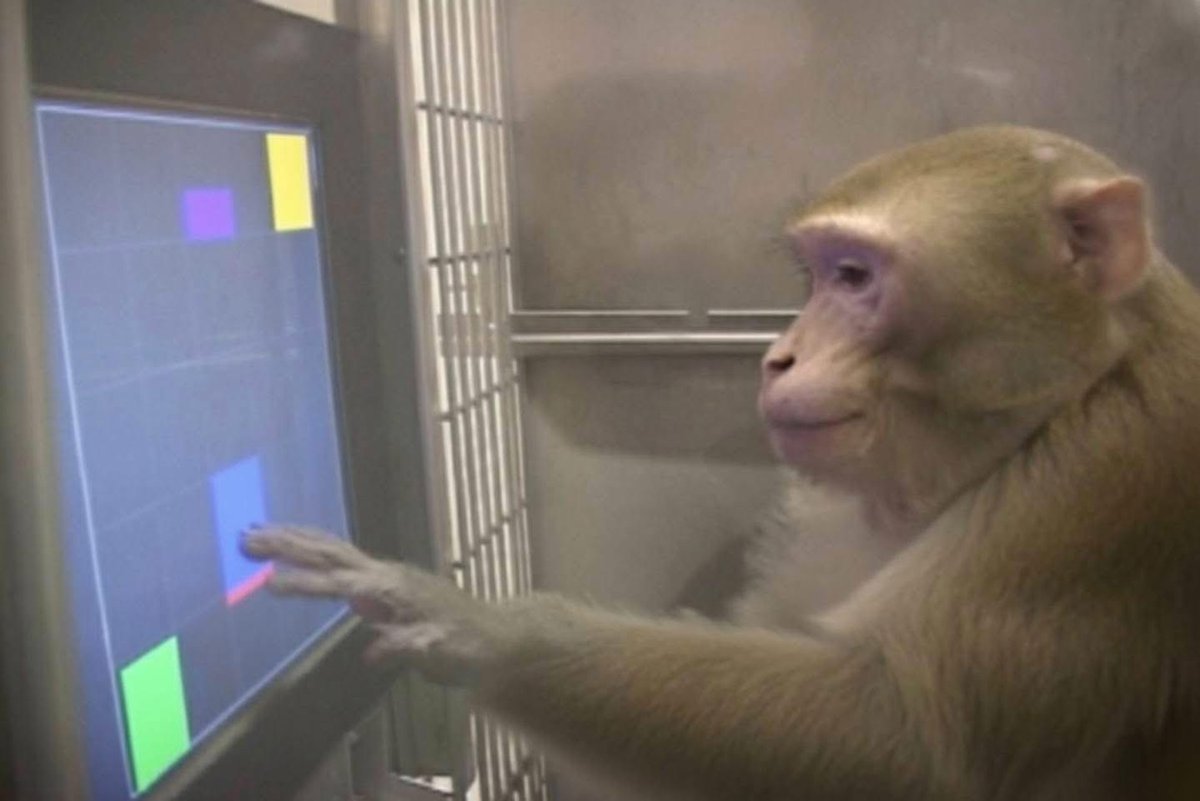
4/ How it works (inspired by your brain):
→ Fast module for low-level computations
→ Slow module for high-level plans
→ They loop over time
→ Each high-level update gives the fast module new direction
The result? Sustained, recursive, real reasoning.
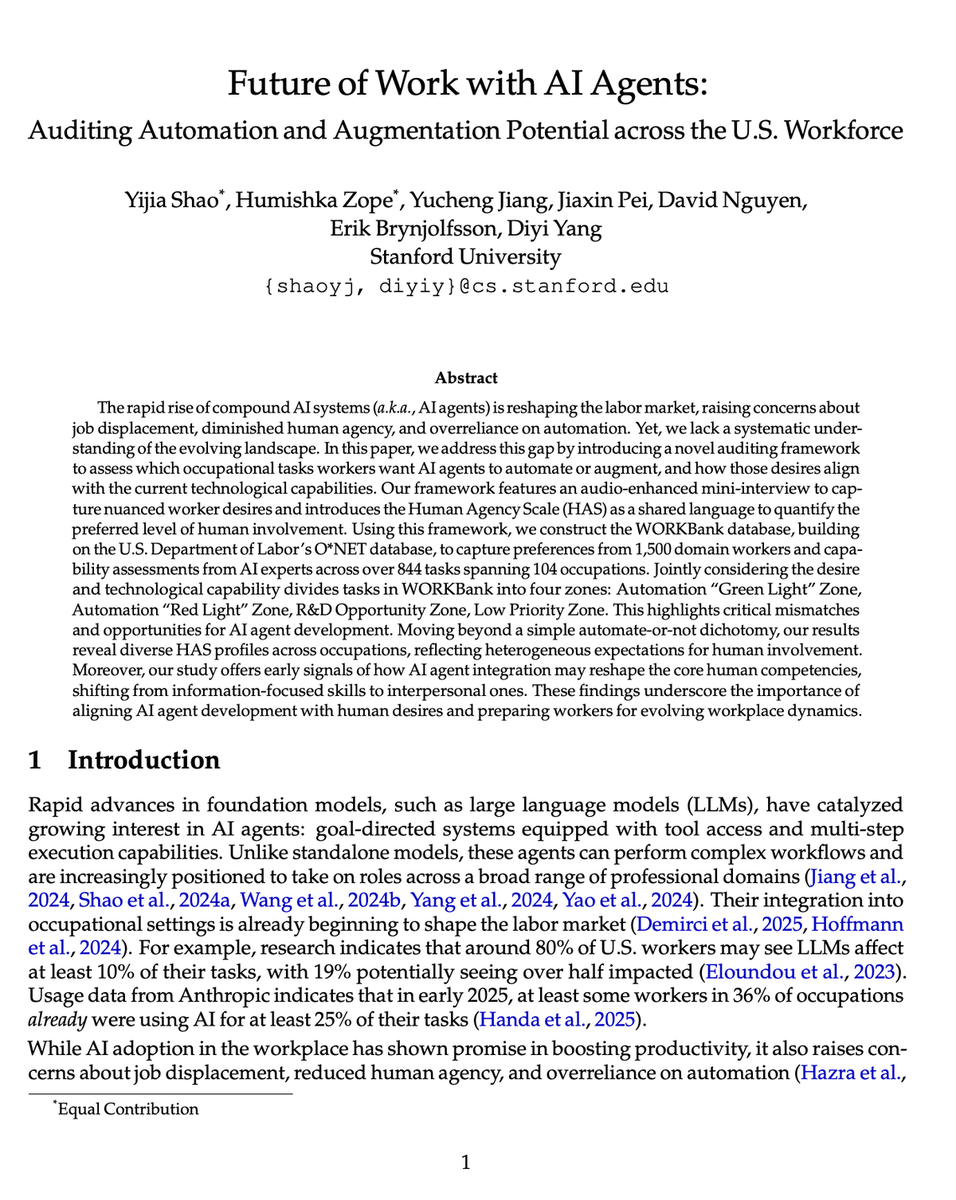
→ High-paying "analyzing information" jobs are becoming less valuable.
"Interpersonal communication" skills are skyrocketing in importance.
It's the complete opposite of what every expert predicted.
BREAKING: Stanford just surveyed 1,500 workers and AI experts about which jobs AI will actually replace and automate.
Turns out, we've been building AI for all the WRONG jobs.
Here's what they discovered:
(hint: the "AI takeover" is happening backwards)
Anthropic's CEO claims AI hallucinates less than humans.
Bold statement.
So I decided to test it by feeding the same FAKE theories to ChatGPT, Claude, and Gemini to see which one calls me out first.
The results shocked me 🧵
random thoughts/predictions on where vibe coding might go:
- most code will be written (generated?) by the time rich. Thus, most code will be written by kids/students rather than software engineers. This is the same trend as video, photos, and other social media
- we are in the command line interface days of vibe coding. For the majority of creators, vibe coding will eventually fade, and vibe designing (with a visual paradigm) will come to dominate. People ultimately think better in a GUI-like format than a CLI-like format. Thus, in vibe designing you will show the AI the design outcomes you want, and then everything else is done for you. Yes, you may end up with tools to tweak the design details for extra controllability, and provide additional mockups that then get filled in underneath with code. But maybe folks will build software without seeing or learning a programming language.
- vibe coding could reduce the need for open source libraries as more code will be generated from scratch by AI. Code will be more of a disposable commodity, with less reuse, and instead generated on the fly for personalized use. It's interesting to see right now that creating a new project is easier than editing a project, because the latter requires a lot more context/complexity. Interesting dynamics if something like this continues
- "trad UX" and design standards give way to post-modern/fragmented software, as millions of new vibe coders create experiences with no prior know how and new perspectives. New patterns will emerge, as TikTok/YouTube has done to film making and trad entertainment. The world will go beyond buttons and modals and scrollbars and other things. Software may become unrecognizable before it coalesces again
- if vibe coding makes software trivial to build, then the bottlenecks shift to other places: 1) consistent creativity that stays ahead of everyone else. Anyone can write a tweet, but the best creators are the ones who consistently come up with new ideas. 2) distribution and network effects, where the first vibe coded product doesn't win, but rather the first vibe coded product that hits scale that wins
- imagine products that automatically adapt based on user behavior, rather than based on the actions of the vibe coder. For example, if the vibe coder has specified that the signup funnel should easy, then after seeing users struggle with it, the software can automatically vibe code itself to improve the flow by dropping steps or adding explanatory text. Right now we are in a paradigm where PMs specify behavior that software engineers specify in code. Imagine if PMs can specify outcomes, and the software is configured to automatically adapt to hit those outcomes
what other wacky ideas should be on this list?
Announcing The Stargate Project
The Stargate Project is a new company which intends to invest $500 billion over the next four years building new AI infrastructure for OpenAI in the United States. We will begin deploying $100 billion immediately. This infrastructure will secure American leadership in AI, create hundreds of thousands of American jobs, and generate massive economic benefit for the entire world. This project will not only support the re-industrialization of the United States but also provide a strategic capability to protect the national security of America and its allies.
The initial equity funders in Stargate are SoftBank, OpenAI, Oracle, and MGX. SoftBank and OpenAI are the lead partners for Stargate, with SoftBank having financial responsibility and OpenAI having operational responsibility. Masayoshi Son will be the chairman.
Arm, Microsoft, NVIDIA, Oracle, and OpenAI are the key initial technology partners. The buildout is currently underway, starting in Texas, and we are evaluating potential sites across the country for more campuses as we finalize definitive agreements.
As part of Stargate, Oracle, NVIDIA, and OpenAI will closely collaborate to build and operate this computing system. This builds on a deep collaboration between OpenAI and NVIDIA going back to 2016 and a newer partnership between OpenAI and Oracle.
This also builds on the existing OpenAI partnership with Microsoft. OpenAI will continue to increase its consumption of Azure as OpenAI continues its work with Microsoft with this additional compute to train leading models and deliver great products and services.
All of us look forward to continuing to build and develop AI—and in particular AGI—for the benefit of all of humanity. We believe that this new step is critical on the path, and will enable creative people to figure out how to use AI to elevate humanity.
@Uber Now third driver let me down. The map shows them driving by and don’t answer phone calls or messages. Have been waiting for 25min now. Going with another firm.