⚡ #TAO Maximalist | #Bittensor Believer
🧠 Exploring #AI x Blockchain — #Subnets
📡 Building on the edge of decentralized intelligence
🚀 $TAO is the signal
Payment activity is not the same as business truth.
This becomes obvious when revenue comes from multiple sources:
- API calls
- x402-style micropayments
- stablecoin payments
- Stripe or card payments
- manual invoices
- subscriptions
- agent-triggered workflows
- refunds and fees
The rail can tell you that money moved.
But the business still needs to know:
1. Which customer, agent, API key, workflow, or invoice created the event?
2. Is it revenue, refund, fee, transfer, or cost?
3. What was the cost behind it?
4. Does margin exist after fees and usage costs?
5. Does it reconcile with the source record?
6. What should be exported for reporting?
This is the gap Squadic is focused on:
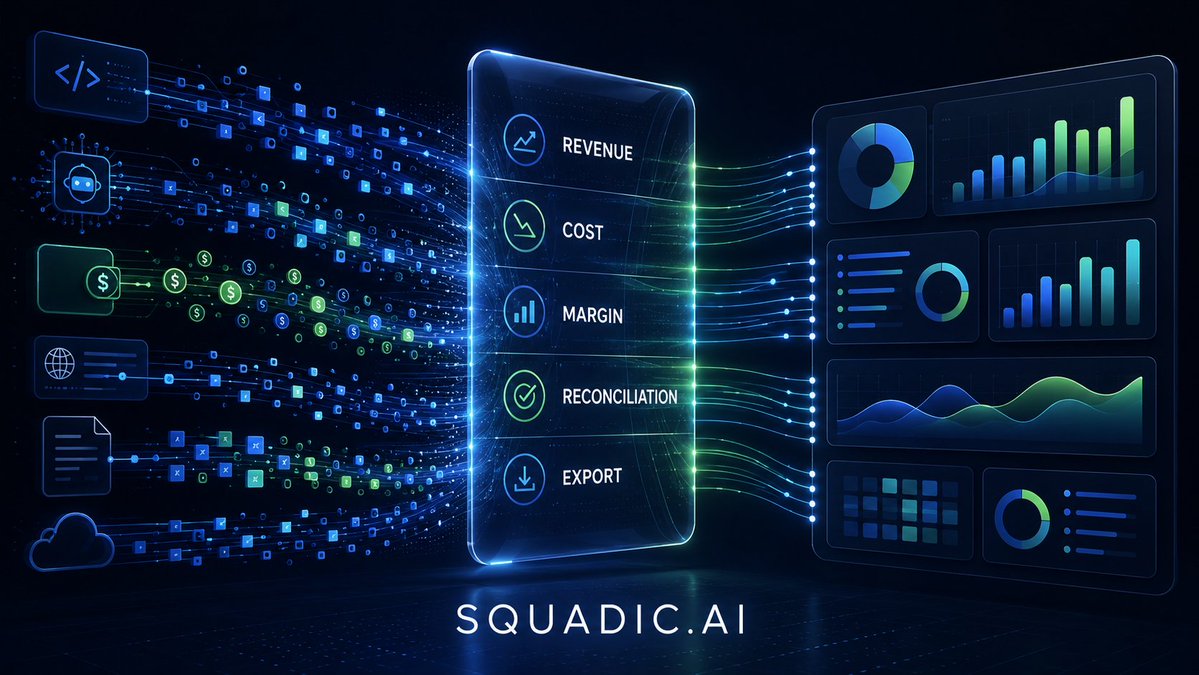
MoneyEvents → reconciliation → revenue/cost/margin → cashflow → reports.
Payment rails move funds.
Squadic is being built as the financial truth layer after funds moved.
No custody.
No wallet management.
No payment execution.
Just clean business meaning from fragmented payment activity.
#Squadic #AIAgents #AgenticPayments #x402 #Stablecoins #APIs #Reconciliation #Fintech #MoneyEvents
Watching what @NEARProtocol, @near_intents and @ilblackdragon are building around the agent economy is interesting.
The core idea is powerful:
agents, apps and users should be able to execute across chains without thinking about bridges, fragmented liquidity, or the complexity underneath.
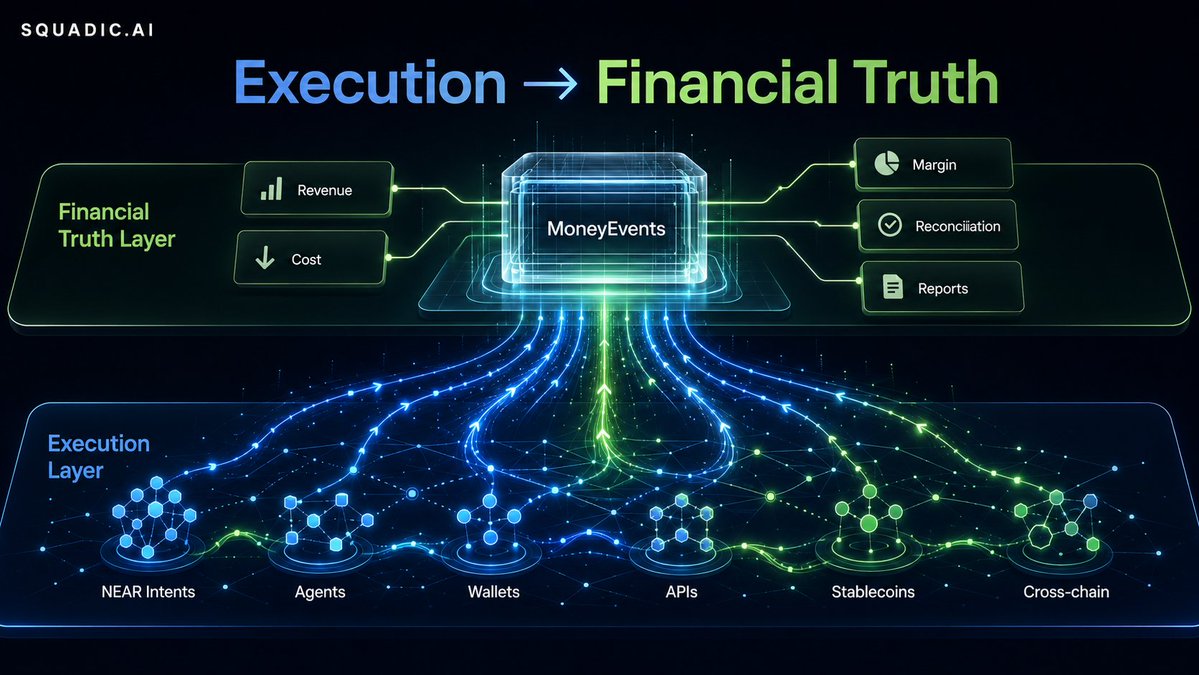
NEAR Intents can become an execution layer for this:
- an agent or user expresses what they want to happen
- the system finds a way to execute it
- assets can move across chains
- swaps and payments can happen through better abstraction
- the user does not need to manually manage every step
That is a very important part of the agent economy.
But after execution, another layer becomes necessary:
financial truth.
If an AI agent pays for an API call, buys data, triggers a workflow, receives a micropayment, or settles across different rails, the transaction itself is only the beginning.
A business still needs to understand:
- what happened
- which customer, agent, workflow, invoice, or vendor it belongs to
- what revenue was created
- what cost was incurred
- what fees were paid
- whether margin exists
- whether the event reconciles with wallets, APIs, invoices, or reports
- what should be exported for accounting or business operations
Execution answers:
“Can this transaction happen?”
Financial truth answers:
“What does this transaction mean for the business?”
That is where I think Squadic can complement this ecosystem.
We are exploring Squadic as a MoneyEvent ledger and reconciliation layer for agentic payments, stablecoin activity, API revenue, x402-style micropayments, and business-readable reporting.
Not a wallet.
Not custody.
Not payment execution.
Not a bridge.
External rails, wallets and intent systems execute.
Squadic observes completed events, normalizes them into MoneyEvents, reconciles them, and helps businesses understand revenue, cost, margin, cashflow and reports after the payment happened.
If the agent economy grows, payment execution will not be enough.
Every agent, API business, stablecoin-native company and automated workflow will need a clean financial layer after money moves.
That is the layer we are building toward.
#NEAR #NEARIntents #AIAgents #AgenticPayments #Stablecoins #x402 #Reconciliation #Fintech #Squadic
A payment event is not a business answer.
It only tells you that money moved.
For modern businesses, that is not enough.
If you sell APIs, accept stablecoins, test x402 payments, or build AI-agent workflows, you need to understand what happened after the payment:
- What created this revenue?
- What cost was attached to it?
- What margin remains?
- Was the request successful?
- Was there a refund?
- Is the payment reconciled?
- Can this be exported for finance?
This is the layer we are building with Squadic.
Not a wallet.
Not a payment rail.
Not a processor.
A MoneyEvent ledger that turns completed payment activity into business truth:
revenue,
cost,
margin,
reconciliation,
cashflow,
risk,
export.
Payment rails move funds.
Squadic explains what those funds mean.
#buildinpublic #fintech #payments #stablecoins #x402 #AIagents #APIs #reconciliation #SaaS #startup #squadic #squadicAi
We’re building Squadic around a problem that becomes more obvious every day:
payments are getting faster, smaller, more programmable — but business understanding after the payment is still messy.
x402 makes it possible to pay for APIs and digital resources directly over HTTP.
Stablecoins make global settlement faster and easier.
AI agents will increasingly buy tools, call APIs, trigger workflows, and spend money on behalf of people or businesses.
That sounds exciting.
But after the payment happens, someone still needs to answer the boring but critical questions:
Was this revenue or cost?
Which customer, agent, API, wallet, product, or workflow created it?
What was the margin after fees and usage costs?
Was the payment reconciled correctly?
Can this be exported cleanly for reporting or accounting?
Is the business actually profitable, or just moving money around?
This is where Squadic is focused.
We are not building a wallet.
We are not custodying funds.
We are not trying to become another payment rail.
Payment rails move money.
Squadic turns payment activity into business truth.
The goal is to help teams working with APIs, x402, stablecoins, and AI agents see:
- revenue
- costs
- margins
- reconciliation status
- source of each MoneyEvent
- exports for business reporting
For traditional businesses, this same idea is simple:
“I received money” is not enough.
You need to know what created it, what it cost, what remains, and whether it makes sense to continue.
For agentic and programmable-money businesses, this becomes even more important.
When payments happen automatically, frequently, and across many services, spreadsheets break very quickly.
The future of payments needs not only faster settlement.
It needs better financial clarity after settlement.
That is the direction we’re building Squadic toward:
a MoneyEvent ledger and reconciliation layer for modern businesses, API builders, stablecoin workflows, and AI-agent economies.
Rails move funds.
Squadic explains what those funds mean.
#buildinpublic #fintech #payments #stablecoins #x402 #AIagents #APIs #reconciliation #startup #SaaS
Every business has a number it must hit before profit even begins. 📊
That number is your break-even point. 🎯
Not revenue. 💰
Not activity. 🏃
Not "we had a good month". 🗓️
The point where your business finally covers:
✅ rent
✅ payroll
✅ taxes
✅ suppliers
✅ software
✅ ads
✅ logistics
✅ debt
✅ fees
✅ every fixed and variable cost
Only after that line do you start making real profit. 💸
The painful part? 😟
Many owners do not know where that line is. 📉
They look at sales and feel safe.
They see money coming in and feel busy.
They check revenue and think the business is growing. 📈
But revenue can lie. 🤥
A business can sell more and still have no profit.
A business can look active and still be fragile.
A business can grow into a bigger monthly risk. ⚠️
That is why every decision should start with calculation: 🧮
❓ How much do we need to cover costs?
❓ What margin do we really keep?
❓ What happens if expenses rise?
❓ How many sales are needed before profit starts?
❓ Can we afford this decision before the money comes back?
https://t.co/Rab9RWaFIu helps business owners see money clearly, calculate decisions, understand costs, and turn reports into action. 🚀
Money → Calculations → Reports → decisions based on numbers. 📉➡️📈
Know your numbers before you spend. 🛑
#SquadicAI #BusinessFinance #FinTech #Cashflow #BreakEven #Profitability #Founder #SmallBusiness #FinancialClarity #SaaS
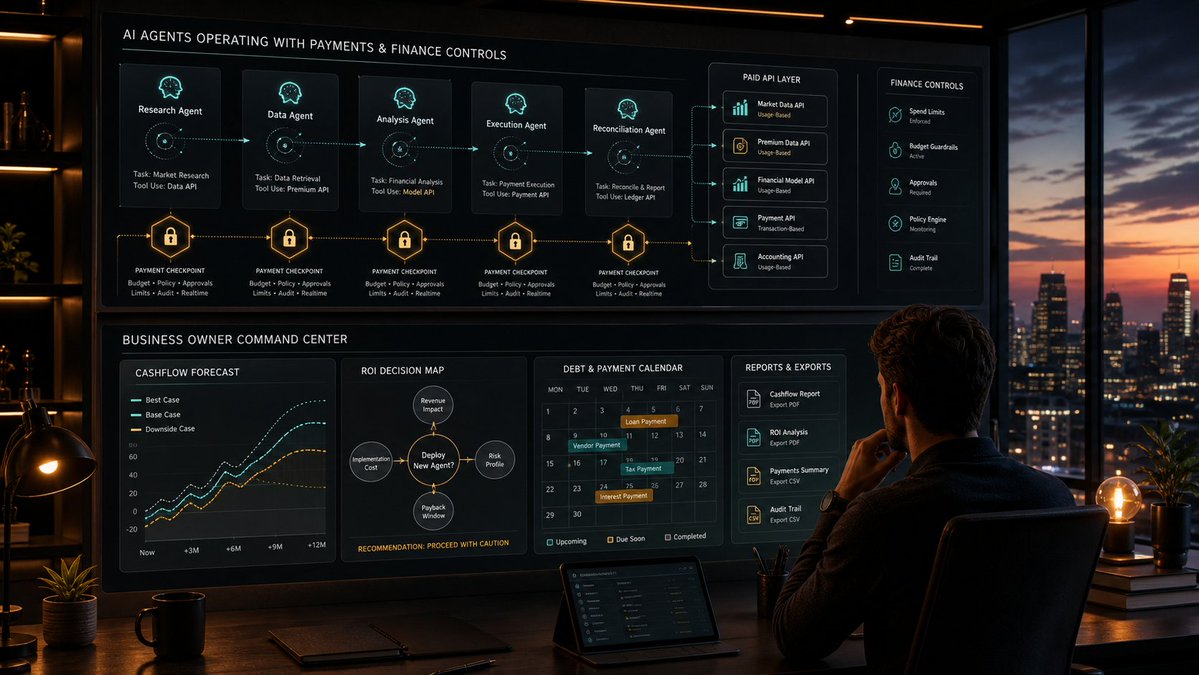
The next bottleneck for AI agent payments isn't speed. It's control. 🔒 x402 already makes payment feel native to the web: request a resource, get a price, sign, settle, continue. 💸 Circle is turning APIs into agent-readable storefronts. Fireblocks is talking delegated wallets, spend limits, audit trails, reconciliation. 🛡️
The question is shifting — from "can the agent pay?" to "can a business trust this at scale?" 🤔
Because the moment an agent can spend money, the owner's questions change. Not "did it work?" but:
Should it have spent that? 🤨 How much can it spend next time? Who approved the limit? Which vendor did it use? Was the result worth the cost? 💰 How do I reconcile this? What does it do to cashflow? 📉
A single agent payment feels harmless. But operational spend is thousands of tiny decisions stacked on top of each other — and nobody's watching the total. 👀
That's the gap. Software pricing is moving toward usage, actions, and pay-per-result. When agents execute that spend autonomously, every business needs a financial layer underneath them — one that shows the money before it's gone, not in next month's report. 📊
That's what we're building at Squadic: a simple financial workspace where owners see money, forecast cashflow, control payments, and justify every decision — even when an agent made it. 🚀
Agents will execute faster. Owners still need clarity first. ✨
#AgenticCommerce #x402 #SmallBusinessFinance #Squadic #SquadicAi
AI agent payments are getting past the demo stage. 🚀
The interesting signal is not that agents can “pay with crypto.” 💸
The signal is that a new billing shape is forming:
✅ paid API calls
✅ paid data lookups
✅ paid inference
✅ paid research
✅ paid reports
✅ paid micro-actions
Coinbase’s x402 work, Circle’s USDC agent flows, Base settlement rails, Stripe’s machine payment direction, Visa’s agentic commerce work, and Fireblocks’ payment-control stack are all pointing at the same thing:
Software will not only call services. 🤖
Software will increasingly pay for services. 💳
But this creates a much less glamorous problem. 🧩
Every agent payment still becomes a business transaction.
If an agent spends $0.02 on one data call, nobody cares.
If it spends $0.02 across 50,000 calls, someone needs to know whether that spend created value. 📊
If a workflow buys reports, APIs, enrichment, automation, and verification all day, the founder does not need more hype. 🙅♂️
They need answers:
🔍 What did we spend?
🔍 What did it return?
🔍 Which workflow is profitable?
🔍 Where is cash leaking?
🔍 What happens to runway if this scales?
That is the practical layer Squadic is focused on. 🎯
Squadic is not selling an x402 feature as live core today.
Squadic Labs studies where agent payments are going. 🔬
Core Squadic helps business owners do the work that still matters before and after every payment rail:
💰 see cashflow
📈 calculate profitability
🔮 forecast decisions
📋 track obligations
📝 turn numbers into reports
The future may be agent-driven. 🤖
The business still has to count the money. 💵
@coinbase@base@circle@Stripe@Visa
#AIAgents #x402 #Stablecoins #AgentPayments #APIEconomy #Fintech #BusinessFinance #Cashflow #MCP #SquadicLabs #Squadic #SquadicAi
AI agents are starting to pay for things. 💸
That sounds futuristic. 🤖✨
But the real business question is not:
“Can an agent make a payment?” 💳
The real question is:
“Should it be allowed to?” 🚦
If an agent can access paid APIs, buy data, trigger tools, renew services, or execute tasks with money attached, then payments are only the last step. 🔚
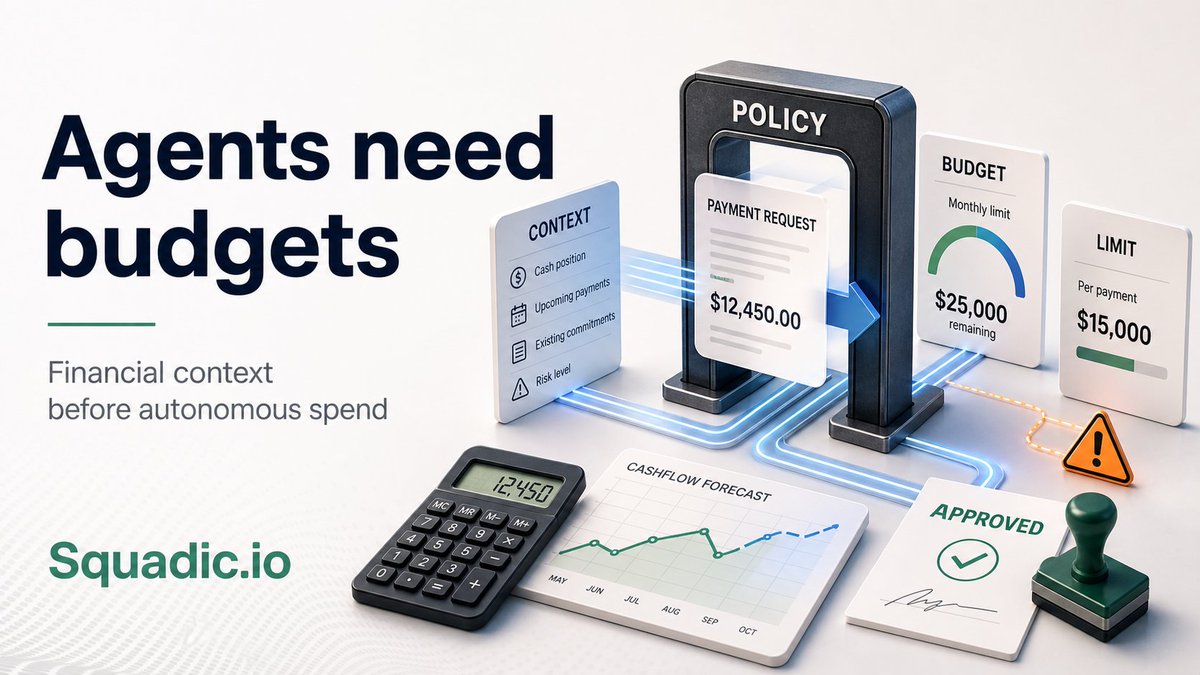
Before payment, the agent needs context. 🧠
What is the budget? 💰
Who approved the spend? 👤
What is the business purpose? 🎯
Is this vendor allowed? ✅
Is the category allowed? 📂
What is the daily or monthly limit? 📅
What happens if the company’s cash position changes? 📉
This is why agent payments are not just a payment infrastructure problem. 🏗️
They are a financial control problem. 🛡️
Protocols like x402 are interesting because they make payment part of the web request itself. But for real businesses, the missing layer is not only the rail. 🛤️
It is the financial context around the rail. 🔄
Agents need budgets. 📊
Agents need limits. ⛔
Agents need reporting. 📈
Agents need access rules. 🔑
Agents need a clear view of money before they spend it. 👁️
That is how we think about the future layer of https://t.co/nY0tSxRWCo. 🚀
The core product stays simple:
Money -> Calculation -> Reports. 💡
But as business software becomes more agent-readable, financial tools will need to answer a new question:
Not only “what does the business owner see?” 👀
But also:
“What financial context can a trusted agent use safely?” 🛡️🤖
That future will not be built on hype. 🎈
It will be built on cash position, permissions, limits, profitability, and reports. 📉📈🔒
https://t.co/nY0tSxRWCo is building from that direction. 🏗️
Financial clarity first. 🧐
Automation second. ⚙️
Spending only when the numbers make sense. 🧮
#Squadic #AIagents #x402 #AgentPayments #Fintech #BusinessFinance #Cashflow #FinancialContext #AutonomousAgents #SaaS
Profit on paper does not always mean cash in the bank.
A business can sell well, show margin, and still struggle to pay rent, salaries, suppliers, ads, or debt on time.
That is the difference between profit and cashflow.
Profit tells you whether the model works.
Cashflow tells you whether the business can survive the timing.
What every founder should check weekly:
1. Current available cash
2. Payments due in the next 7–30 days
3. Expected incoming money
4. Expenses growing faster than sales
5. Possible cash gaps before the next inflow
Squadic helps business owners see money movement, expenses, upcoming payments, profitability calculations, break-even, payback, and planning signals in one place.
Because clarity is not only about earning more.
It is about knowing if you will have enough cash when it matters.
#Squadic #Cashflow #BusinessFinance #Fintech #SmallBusiness #Profitability #FounderFinance #BusinessPlanning #MoneyManagement #Entrepreneurship
Locked in my @MezoNetwork allocation. If you've been sitting on BTC doing nothing, this is your sign.
Register your wallet before the window closes. You'll get a 2x allocation boost if you max-lock for veMEZO too 👀
https://t.co/XQZ3uWUyHy
$TAO is now available for on-chain Staking in the Crypto․com App!
Start staking to secure your favourite blockchain or protocol while earning up to 8% rewards 💰
🔓 Enjoy the flexibility of unstaking your assets in a secure and convenient manner.
@opentensor
Yuma + @cryptocom is a big step toward global access to Bittensor $TAO
Yuma is committed to driving $TAO accessibility to help propel Bittensor utility and adoption worldwide
.@opentensor $TAO helps leverage economic incentives and decentralized networks for open and accessible #AI development.
Open for private placement for eligible accredited investors.
Learn more about the Grayscale Bittensor Trust and see important disclosures: https://t.co/SxJWBeDra7
-
Private placement securities are speculative, illiquid, and entail a high level of risk, including the risk that an investor could lose their entire investment. Available to eligible accredited investors. Visit our website for more information and important disclosures.