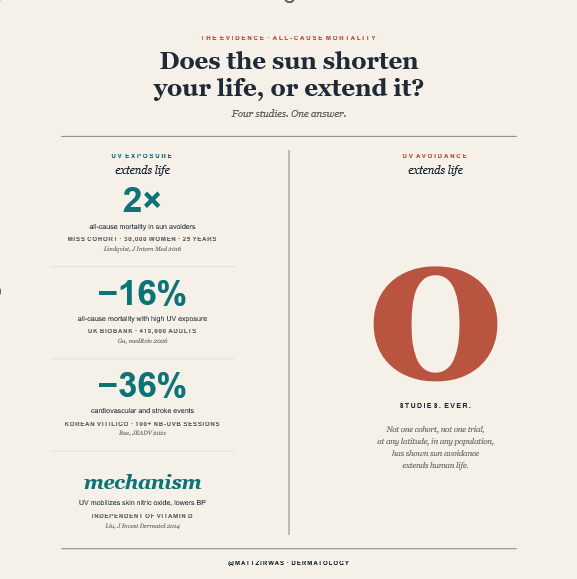
Dermatology is wrong about the sun.
And it's killing people.
I'm a dermatologist. 226 publications. I should know.
Avoiding the sun increases the risk of dying as much as being a smoker.
We can fix it.
For decades, dermatology's message has been simple: avoid the sun. Wear sunscreen. Seek shade. UV causes skin cancer. End of discussion.
That message is incomplete and outdated.
People are dying because of it. Lots of people.
The evidence has gotten strong enough that the field needs to update it.🧵
"Over 20 years, the percentage of seniors getting flu shots increased sharply from 15% to 65%. It stands to reason that flu deaths among the elderly should have taken a dramatic dip."
Students who took notes by hand scored ~28% higher on conceptual questions than laptop note-takers.
Writing forces your brain to process and compress ideas instead of copying them.
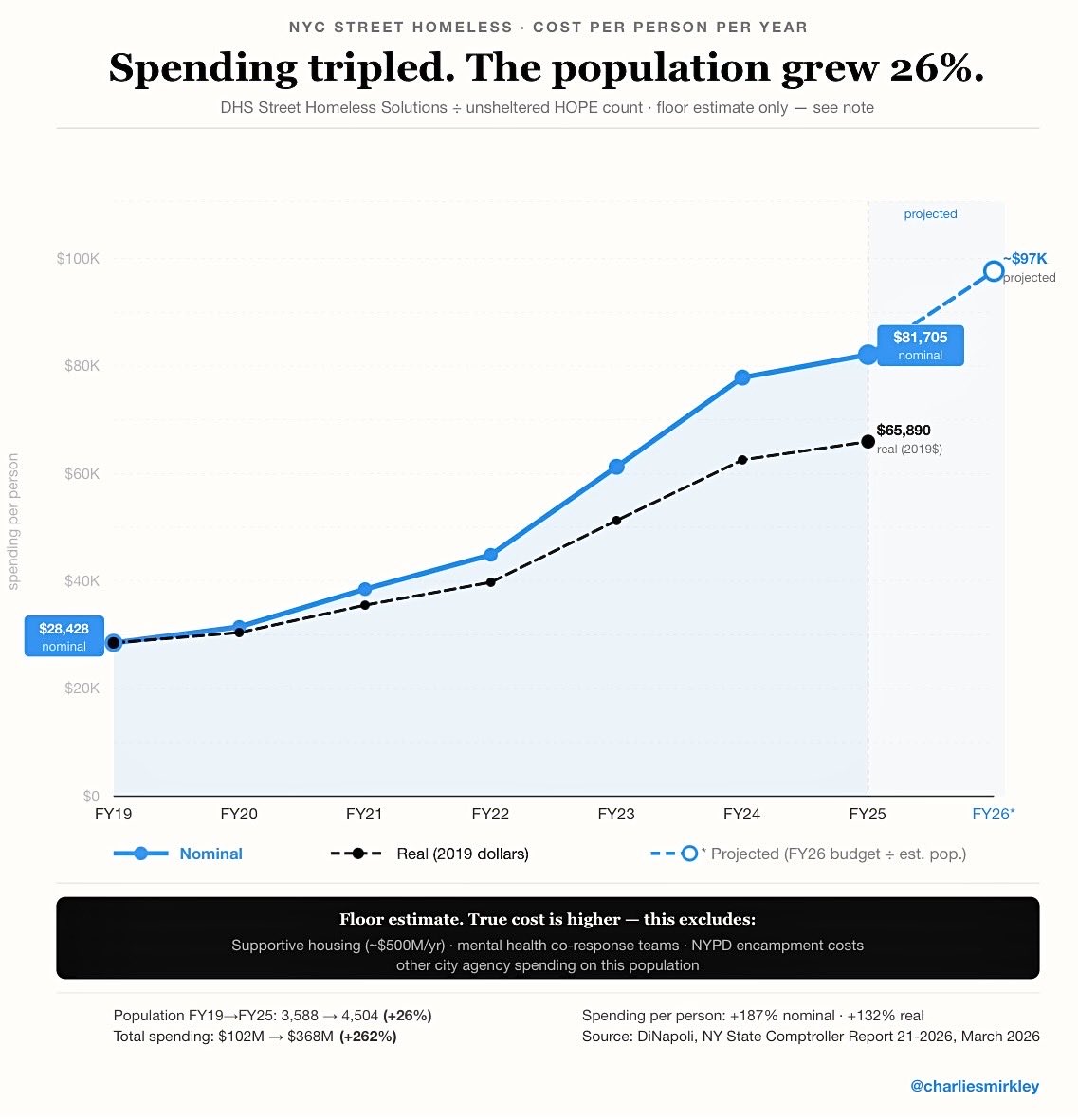
NYC spends more per homeless person than the median NYC household earns. $81,705 per person in FY2025.
And $81,705 is a floor. It excludes supportive housing (~$500M/yr), mental health response teams, and NYPD encampment costs.
The city projects ~$97K per person in FY2026.
You can’t make this up
Minnesota Democrats are requesting studies on “The benefits of shoplifting”
Minnesota State Representative Krista Knudsen exposes “Today in the Labor Committee, Representative Dave Pinto requested a study for the benefits of shoplifting”
She says they were discussing how to stop organized shoplifting in Minnesota, and Democrats instead requested a study to see if they could find the benefits of shoplifting
“There are no benefits to shoplifting for the people that are being shoplifted from. I have no idea what else to say. I'm shocked —- Who benefits from shoplifting? The criminals”
I just gave a closed-book, pen-and-paper midterm exam in my 300-level course at UBC with 100 students. All exams were graded by an experienced graduate-level TA according to a rubric.
*** The average was 64/100.***
My class averages at UBC are usually 80-85.
Context:
• This was the first midterm, covering ONLY 4 weeks of material.
• Students had a list of possible questions in advance: no surprise questions.
• Questions included (a) 3 concept definitions, (b) 3 paragraph-long questions, and (c) a 1.5-page essay.
• I have taught this class multiple times. Nothing in my teaching style changed this semester.
• We read entire paragraphs of text in class, so students don't have to do something on their own that wasn't covered during the lecture.
• Students take a 10-question multiple-choice quiz at the end of every class (30% of the final grade).
• Attendance is 95-99% every class. Attention during lectures and participation in pair-work activities are very high → anticipating the end-of-class quiz.
*** But unfortunately, I suspect many students are not reading the material on the syllabus. They are asking LLMs to summarize it instead.***
After the midterm, students reported:
• They thought they knew concept definitions but couldn't produce them on paper.
• They thought they understood the arguments but struggled to connect them or identify points of agreement and disagreement.
My view:
It might be “cool” or “innovative” to teach students to summarize readings with ChatGPT or write essays with Claude. But we may be doing them a disservice: reducing their ability to retain material, think creatively, and reason from what they know. If you only read what AI has summarized for you, you don’t truly "know" the material.
Moving forward:
We have a second midterm coming up. I don't know how to convey to students that the best way to do better on the exam is to rely on and improve their own reading skills.
@MattSmethurst Let the Word, carried by the Spirit, reshape your feelings from the root. Truth about God doesn’t just fuel your emotions — it reorders them. That is where lasting transformation begins. Without it, fleeting feelings are all you have.
🚨BREAKING: MIT hooked people up to brain scanners while they used ChatGPT.
What they found should concern every single person reading this.
ChatGPT users showed 55% weaker brain connectivity than people who didn't use it. Not after years. After just four months.
Here's how they tested it. 54 people were split into three groups: one used ChatGPT to write essays, one used Google, and one used nothing but their own brain. They wore EEG monitors that tracked their brain activity in real time across four sessions over four months.
The brain-only group built the strongest, most widespread neural networks. Google users were in the middle. ChatGPT users had the weakest brains in the room. Every time.
Then the memory test hit. Participants were asked to recall what they'd just written minutes earlier. 83% of ChatGPT users couldn't quote a single line from their own essay. They wrote it. They couldn't remember it. The words passed through them like they were never there.
It gets worse. In the final session, ChatGPT users were told to write without AI. Their brains were measurably weaker than people who never used AI at all. 78% still couldn't recall their own writing. The damage didn't go away when the tool was removed.
Meanwhile, brain-only users who tried ChatGPT for the first time? Their brains lit up. They wrote better prompts. They retained more. Their brains were already strong enough to use AI as a tool instead of a crutch.
The researchers also found that every ChatGPT essay on the same topic looked almost identical. More facts, more dates, more names. But less original thinking. Everyone using ChatGPT produced the same generic output while believing it was their own.
MIT gave this a name: cognitive debt. Like financial debt, you borrow convenience now and pay with your thinking ability later. Except there's no way to pay it back.
The question isn't whether ChatGPT is useful. It's whether the price is your ability to think without it.
Eliminating processed foods and artificial additives from children's diets can lead to substantial reductions in ADHD symptoms for a significant portion of affected kids—often up to 78% in key studies—offering a promising, non-medication approach for many families.
Groundbreaking research, including the landmark INCA study (Impact of Nutrition on Children with ADHD) published in The Lancet, has demonstrated a clear link between diet and behavioral symptoms in children with attention-deficit hyperactivity disorder (ADHD). This randomized controlled trial involved young children (aged 4–8 years) diagnosed with ADHD and tested a restricted elimination diet—a highly structured regimen that removes most processed foods, artificial colors, preservatives, additives, and common potential triggers while focusing on a limited set of hypoallergenic whole foods (such as rice, specific meats, certain vegetables, pears, and water).
In the open-label phase, 41 children followed the elimination diet for 5 weeks, while a control group received general healthy eating instructions. Results showed that 32 out of 41 children (approximately 78%) in the diet group achieved a clinically meaningful response, defined as at least a 40% reduction in ADHD symptoms based on validated rating scales (like the ADHD Rating Scale, assessed by masked raters including parents, teachers, and clinicians). This translated to notable improvements in core symptoms such as inattention, hyperactivity, and impulsivity, as well as often co-occurring oppositional defiant disorder behaviors.
A subsequent double-blind crossover challenge phase with responders further strengthened the evidence: when excluded foods were reintroduced, symptoms relapsed in over 60% (around 63%) of cases, confirming a direct causal connection for many participants rather than placebo effects or spontaneous changes. The study's authors concluded that a strictly supervised restricted elimination diet serves as a valuable tool to determine whether food sensitivities contribute to ADHD in individual children.
The proposed mechanism involves artificial additives (e.g., synthetic food dyes like Red 40 or Yellow 5, preservatives, and other chemicals in ultra-processed foods) potentially disrupting neurotransmitter function, gut microbiome balance, or the gut-brain axis—pathways increasingly linked to neurodevelopmental conditions like ADHD.
While not every child responds (response rates hover around 60–64% across the full sample in the INCA trial, with the 78% figure applying specifically to completers in the diet arm who showed strong improvement), the effect sizes in responders are often large—comparable to or exceeding those seen with stimulant medications in some analyses—and come without pharmaceutical side effects.
This approach is not positioned as a universal cure or replacement for all treatments. Experts stress that elimination diets must be implemented under professional supervision (ideally with a pediatrician, dietitian, or ADHD specialist) to avoid nutritional deficiencies, ensure balanced intake, and properly identify trigger foods during reintroduction. Combining dietary changes with other evidence-based strategies—such as reducing excessive screen time, promoting regular physical activity, and ensuring adequate sleep—can amplify benefits for focus, emotional regulation, and overall well-being.
For parents exploring natural or complementary options to support their child's attention and behavior, starting with a careful reduction in processed and additive-laden foods (while prioritizing whole, nutrient-rich alternatives) could represent a meaningful first step—potentially unlocking noticeable breakthroughs without relying solely on medication.
[Pelsser, L. M., et al. "Effects of a restricted elimination diet on the behaviour of children with attention-deficit hyperactivity disorder (INCA study): a randomised controlled trial." The Lancet, vol. 377, no. 9764, 2011, pp. 494–503. DOI: 10.1016/S0140-6736(10)62227-1]
God built holy interruptions into our lives so we'd remember: He is our provider, not our productivity. When Jesus said, "It is finished," He freed us from endless striving. Your worth isn't your output. Rest isn't earned—it's worship. Will you trust Him enough to stop?
@Wisdom_HQ I would tell my son that the smile on the dark figure should be on him, and the evil face should be on the dark figure. The dark figure, whoever he is and whatever he says, is NOT his friend. Then I would walk him through Matthew 10:29-31 and tell him how much I love him.
So much here. Why is this happening? Intentional? Slow terrorism? Simple neglect? And why is it only being discovered? Bottom line: I'm not buying candy anymore.
NEW: Florida testing reveals higher levels of arsenic in 78% of popular candy brands.
"Three Musketeers, Snickers, Skittles, Nerds, Kit Kats and Jolly Ranchers, in 26 of the 33 traditional candy brands tested, arsenic was detected at elevated levels…"








![Rainmaker1973's tweet photo. Eliminating processed foods and artificial additives from children's diets can lead to substantial reductions in ADHD symptoms for a significant portion of affected kids—often up to 78% in key studies—offering a promising, non-medication approach for many families.
Groundbreaking research, including the landmark INCA study (Impact of Nutrition on Children with ADHD) published in The Lancet, has demonstrated a clear link between diet and behavioral symptoms in children with attention-deficit hyperactivity disorder (ADHD). This randomized controlled trial involved young children (aged 4–8 years) diagnosed with ADHD and tested a restricted elimination diet—a highly structured regimen that removes most processed foods, artificial colors, preservatives, additives, and common potential triggers while focusing on a limited set of hypoallergenic whole foods (such as rice, specific meats, certain vegetables, pears, and water).
In the open-label phase, 41 children followed the elimination diet for 5 weeks, while a control group received general healthy eating instructions. Results showed that 32 out of 41 children (approximately 78%) in the diet group achieved a clinically meaningful response, defined as at least a 40% reduction in ADHD symptoms based on validated rating scales (like the ADHD Rating Scale, assessed by masked raters including parents, teachers, and clinicians). This translated to notable improvements in core symptoms such as inattention, hyperactivity, and impulsivity, as well as often co-occurring oppositional defiant disorder behaviors.
A subsequent double-blind crossover challenge phase with responders further strengthened the evidence: when excluded foods were reintroduced, symptoms relapsed in over 60% (around 63%) of cases, confirming a direct causal connection for many participants rather than placebo effects or spontaneous changes. The study's authors concluded that a strictly supervised restricted elimination diet serves as a valuable tool to determine whether food sensitivities contribute to ADHD in individual children.
The proposed mechanism involves artificial additives (e.g., synthetic food dyes like Red 40 or Yellow 5, preservatives, and other chemicals in ultra-processed foods) potentially disrupting neurotransmitter function, gut microbiome balance, or the gut-brain axis—pathways increasingly linked to neurodevelopmental conditions like ADHD.
While not every child responds (response rates hover around 60–64% across the full sample in the INCA trial, with the 78% figure applying specifically to completers in the diet arm who showed strong improvement), the effect sizes in responders are often large—comparable to or exceeding those seen with stimulant medications in some analyses—and come without pharmaceutical side effects.
This approach is not positioned as a universal cure or replacement for all treatments. Experts stress that elimination diets must be implemented under professional supervision (ideally with a pediatrician, dietitian, or ADHD specialist) to avoid nutritional deficiencies, ensure balanced intake, and properly identify trigger foods during reintroduction. Combining dietary changes with other evidence-based strategies—such as reducing excessive screen time, promoting regular physical activity, and ensuring adequate sleep—can amplify benefits for focus, emotional regulation, and overall well-being.
For parents exploring natural or complementary options to support their child's attention and behavior, starting with a careful reduction in processed and additive-laden foods (while prioritizing whole, nutrient-rich alternatives) could represent a meaningful first step—potentially unlocking noticeable breakthroughs without relying solely on medication.
[Pelsser, L. M., et al. "Effects of a restricted elimination diet on the behaviour of children with attention-deficit hyperactivity disorder (INCA study): a randomised controlled trial." The Lancet, vol. 377, no. 9764, 2011, pp. 494–503. DOI: 10.1016/S0140-6736(10)62227-1]](https://pbs.twimg.com/media/HCgD8s4aUAACq1i.jpg)





