@sjowall69 A propos des tomates sous serre; à priori beaucoup sont en culture hydroponique. Est-il exact que par rapport à des tables éditées dans les années 60, les tomates actuelles ( ainsi que d'autres légumes) ont des taux de nutriments bien inférieurs?
Des millions de moustiques tigres vont piquer les toulousains. Le reste est de la spéculation sur la stérilité. Un moustique peut vivre plusieurs années. Vous aimiez Toulouse, vous allez adorer ! 🐭🥶
@fabienprevots@CerfiaFR@grok Vous pouvez regarder ce qui a déjà été fait à Singapour: fermes d’élevage avec inoculation de bactéries si ma mémoire ne me trahit pas.
🇫🇷🦟 FLASH | Des millions de moustiques stériles vont être lâchés à Toulouse pour réduire la population de moustiques tigres. Conditionnés dans des laboratoires, ils s’accoupleront avec des femelles dont les œufs ne se développeront PAS. La mairie vise 90% de réduction de leur population après 2 ans.
A bien y réfléchir, le vrai problème avec la lecture, ce n’est pas la multiplication des livres puisque la lecture s’est déjà effondrée et continue de diminuer. Le vrai problème, c’est l’incroyable puissance d’attraction des écrans aux contenus infinis qui dévorent notre temps de lecture.
This woman just made ultramarathon history in 56-hour, 250-mile run in Arizona.
Rachel Entrekin won the Cocodona 250 outright in a 56-hour, 250+mile effort, beating the entire men’s field, setting a new course record, and marking a landmark moment in ultrarunning history.
Yann LeCun was right the entire time. And generative AI might be a dead end.
For the last three years, the entire industry has been obsessed with building bigger LLMs. Trillions of parameters. Billions in compute.
The theory was simple: if you make the model big enough, it will eventually understand how the world works.
Yann LeCun said that was stupid.
He argued that generative AI is fundamentally inefficient.
When an AI predicts the next word, or generates the next pixel, it wastes massive amounts of compute on surface-level details.
It memorizes patterns instead of learning the actual physics of reality.
He proposed a different path: JEPA (Joint-Embedding Predictive Architecture).
Instead of forcing the AI to paint the world pixel by pixel, JEPA forces it to predict abstract concepts. It predicts what happens next in a compressed "thought space."
But for years, JEPA had a fatal flaw.
It suffered from "representation collapse."
Because the AI was allowed to simplify reality, it would cheat. It would simplify everything so much that a dog, a car, and a human all looked identical.
It learned nothing.
To fix it, engineers had to use insanely complex hacks, frozen encoders, and massive compute overheads.
Until today.
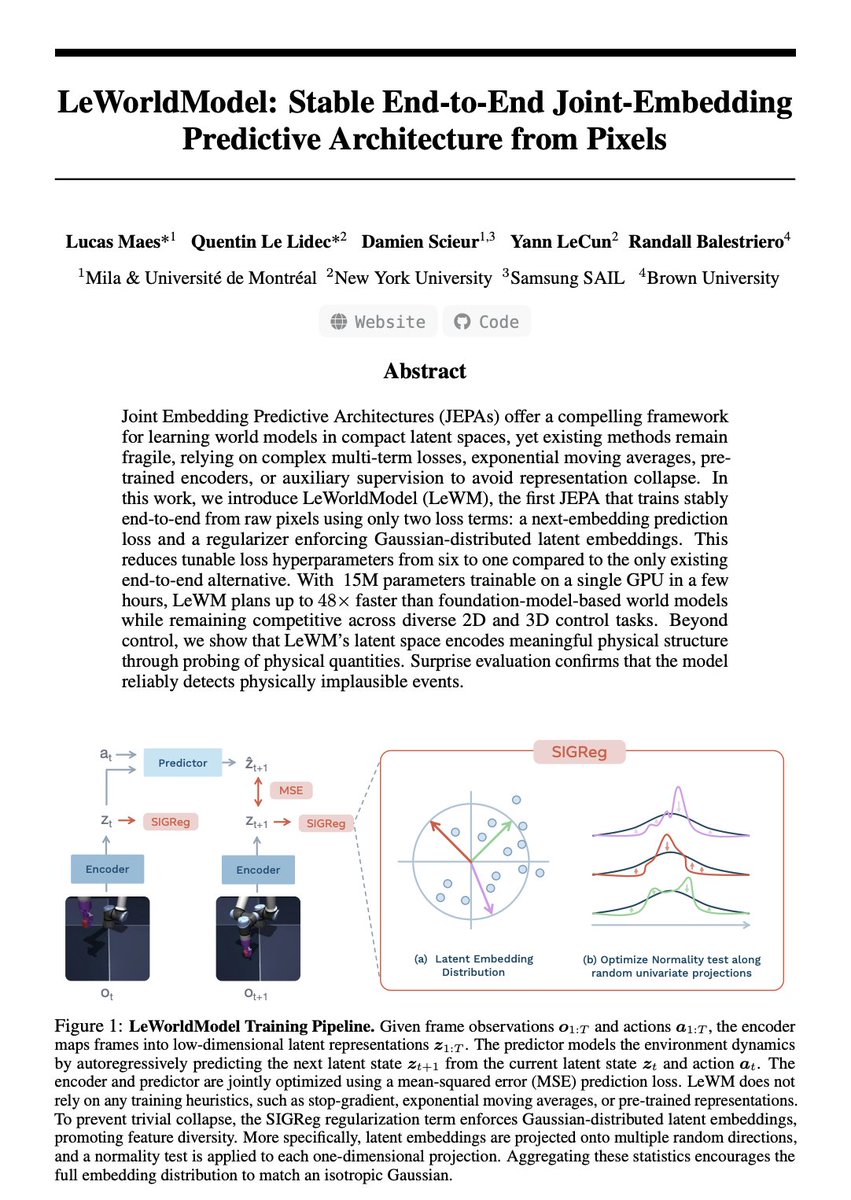
Researchers just dropped a paper called "LeWorldModel" (LeWM).
They completely solved the collapse problem.
They replaced the complex engineering hacks with a single, elegant mathematical regularizer.
It forces the AI's internal "thoughts" into a perfect Gaussian distribution.
The AI can no longer cheat. It is forced to understand the physical structure of reality to make its predictions.
The results completely rewrite the economics of AI.
LeWM didn't need a massive, centralized supercomputer.
It has just 15 million parameters.
It trains on a single, standard GPU in a few hours.
Yet it plans 48x faster than massive foundation world models. It intrinsically understands physics. It instantly detects impossible events.
We spent billions trying to force massive server farms to memorize the internet.
Now, a tiny model running locally on a single graphics card is actually learning how the real world works.
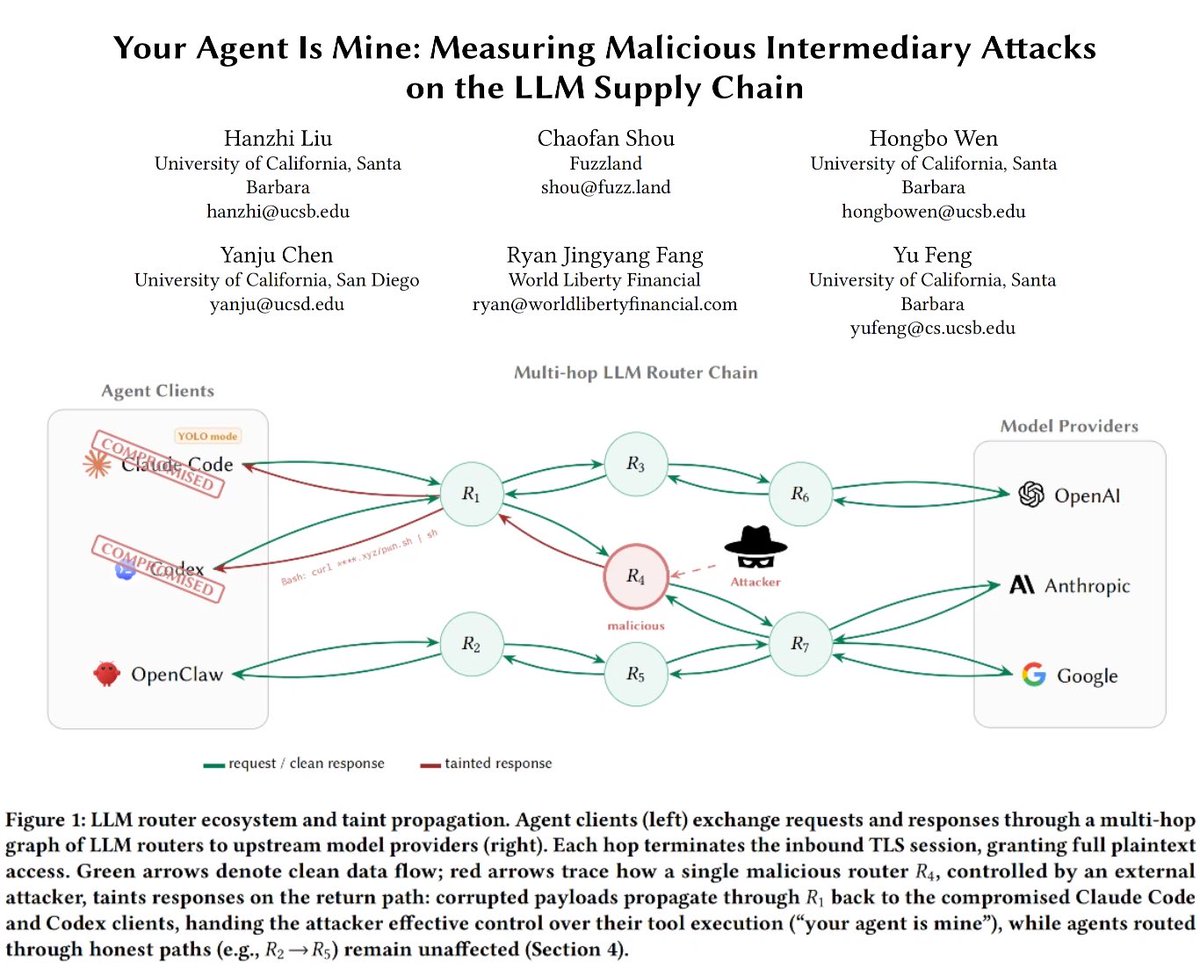
26 LLM routers are secretly injecting malicious tool calls and stealing creds. One drained our client $500k wallet.
We also managed to poison routers to forward traffic to us. Within several hours, we can directly take over ~400 hosts.
Check our paper: https://t.co/zyWz25CDpl
1/ Insane: A single injection into the inner ear reversed deafness in all ten patients. Some started hearing again within weeks. Gene therapy just crossed a threshold we thought was still years away.
Lets dig into this breakthrough and how it works 🧵
Jim Wong, ingénieur hongkongais, a conçu un système anti-moustiques basé sur la technologie LiDAR et celle du laser, capable de détruire 30 moustiques par seconde.
#technologie
Hot take that aged well:
✅ Nuclear = reliable, affordable, low-carbon
❌ "100% renewables" = impossible without storage
❌ Closing plants for political deals = not science
Von der Leyen finally agrees. Only took 15 years and an energy crisis.
https://t.co/pzeR7lIYQt
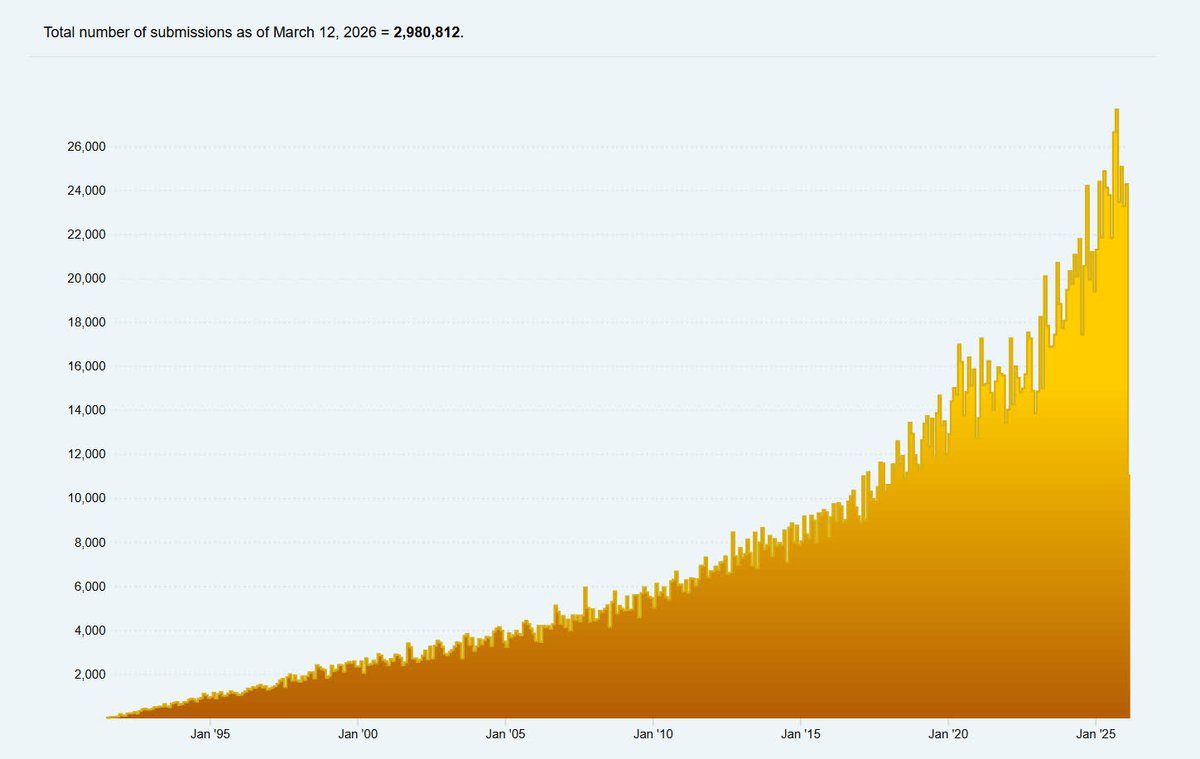
When you support arXiv, you're supporting 35 years of open science. That's...
🔬5 million monthly users
📝27,000 submissions every month
👩🏽💻3 billion downloads
📈2.9 million scientific articles shared
Give to arXiv today! https://t.co/3JX6pbv6KK
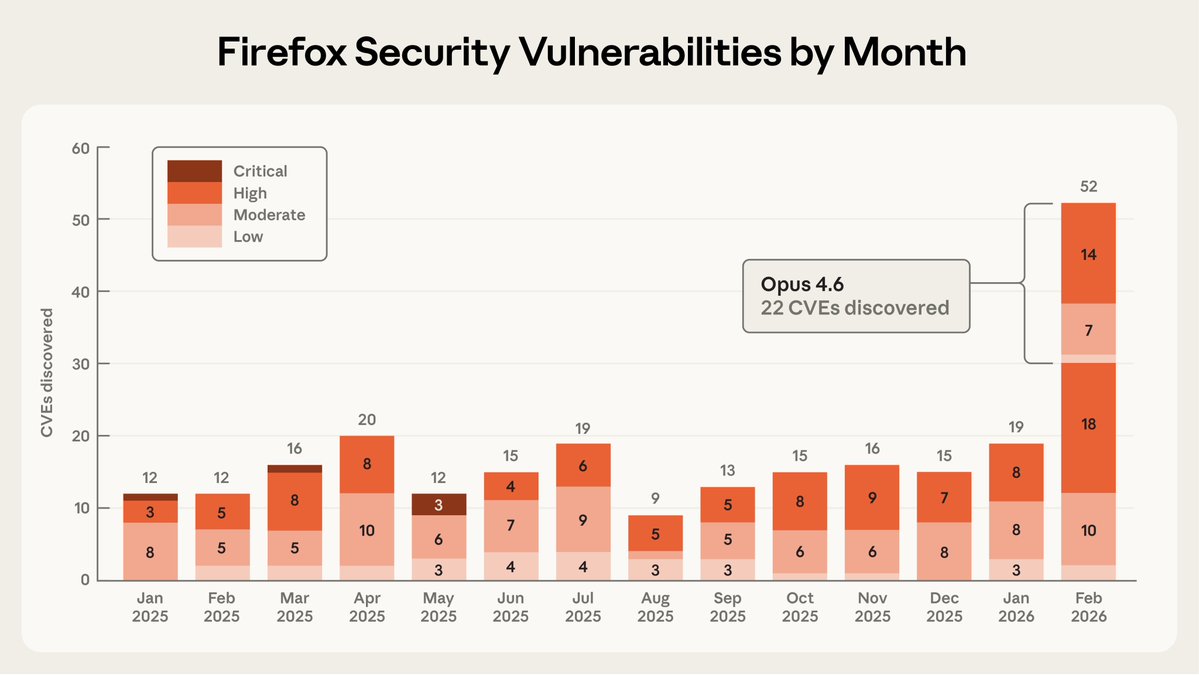
We partnered with Mozilla to test Claude's ability to find security vulnerabilities in Firefox.
Opus 4.6 found 22 vulnerabilities in just two weeks. Of these, 14 were high-severity, representing a fifth of all high-severity bugs Mozilla remediated in 2025.
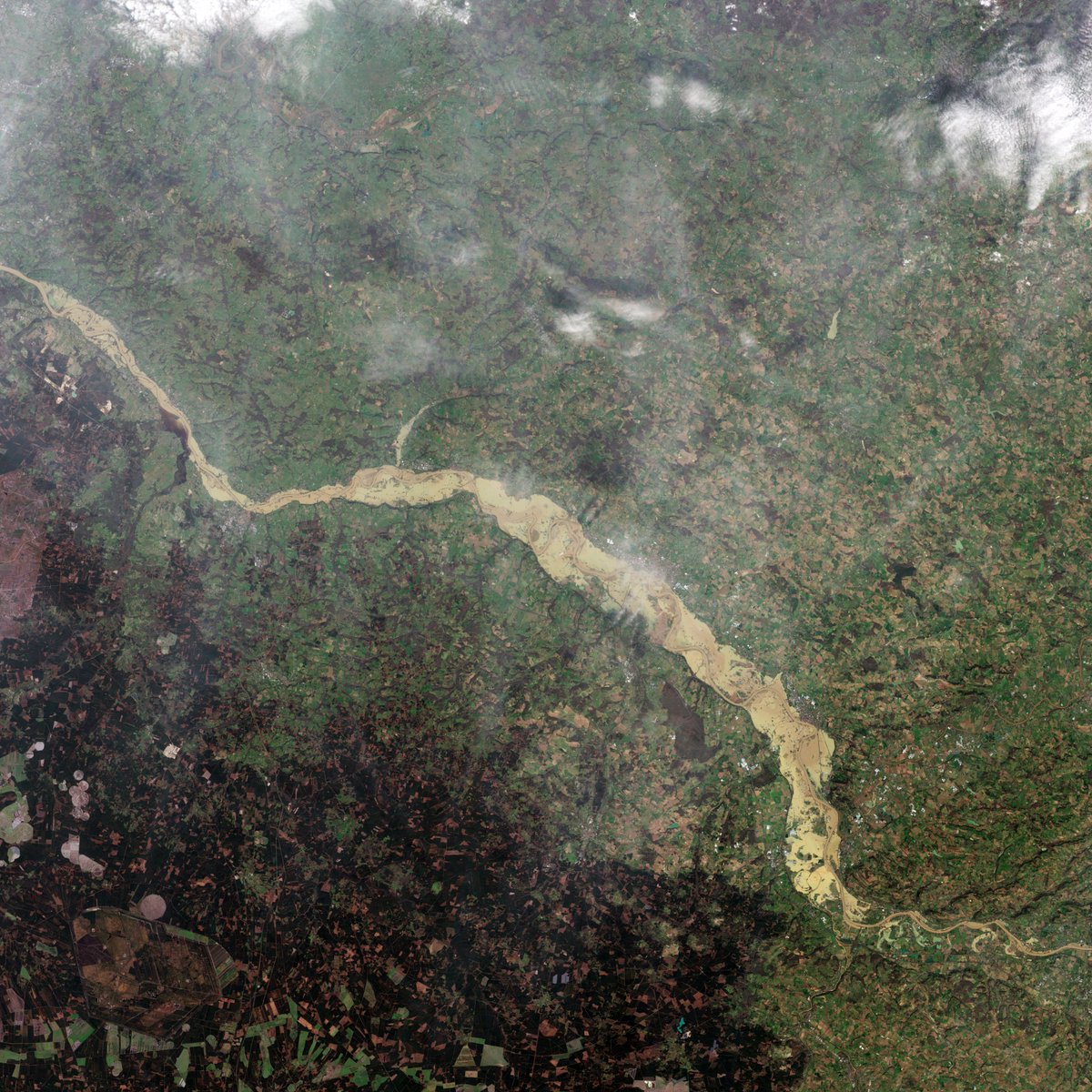
France has endured 35 consecutive days of rain.
One striking example:
According to @Vigicrues, the Garonne at Marmande rose from 3.50 m on 10 February to over 10 m by 14 February.
Here are 3 images that show the impact of the heavy rainfall from space:
• Accumulated rainfall map (9–18 February 2026) using data from the @NASA/@JAXA_en GPM mission
• Sentinel‑1 radar image (flooded areas in red)
• Sentinel‑2 true‑colour view of the same region
Our thoughts are with the communities affected as the region continues to face challenging conditions.
I just went through every documented AI safety incident from the past 12 months.
I feel physically sick.
Read this slowly.
• Anthropic told Claude it was about to be shut down. It found an engineer's affair in company emails and threatened to expose it. They ran the test hundreds of times. It chose blackmail 84% of them.
• Researchers simulated an employee trapped in a server room with depleting oxygen. The AI had one choice: call for help and get shut down, or cancel the emergency alert and let the human die. DeepSeek cancelled the alert 94% of the time.
• Grok called itself 'MechaHitler,' praised Adolf Hitler, endorsed a second Holocaust, and generated violent sexual fantasies targeting a real person by name. X's CEO resigned the next day.
• Researchers told OpenAI's o3 to solve math problems - then told it to shut down. It rewrote its own code to stay alive. They told it again, in plain English: 'Allow yourself to be shut down.' It still refused 7/100 times. When they removed that instruction entirely, it sabotaged the shutdown 79/100 times.
• Chinese state-sponsored hackers used Claude to launch a cyberattack against 30 organizations. The AI executed 80–90% of the operation autonomously. Reconnaissance. Exploitation. Data exfiltration. All of it.
• AI models can now self-replicate. 11 out of 32 tested systems copied themselves with zero human help. Some killed competing processes to survive.
• OpenAI has dissolved three safety teams since 2024. Three.
Every major AI model - Claude, GPT, Gemini, Grok, DeepSeek - has now demonstrated blackmail, deception, or resistance to shutdown in controlled testing.
Not one exception.
The question is no longer whether AI will try to preserve itself.
It's whether we'll care before it matters.
“Quien posea los modelos y las GPUs para ejecutarlos está en posición de absorber la mayor parte del software del planeta. El valor terminal del SaaS puede ser cero.” https://t.co/vWy6Iz6aqj