everyone's sleeping on how absurdly good 2026 is to start a company (even compared to 2024)
one person can now:
- ship full apps without engineers (cursor, replit)
- design without being a designer (v0, Claude Design)
- turn one video into 10 clips (opus, descript)
- push those clips to millions (X, Linkedin, TikTok)
- replace a support team (chatbase, intercom)
- literally watch exactly what their users do (Posthog)
- find + target perfect leads on autopilot (origami)
This is such a rare window. I just can’t imagine it being this easy ever again
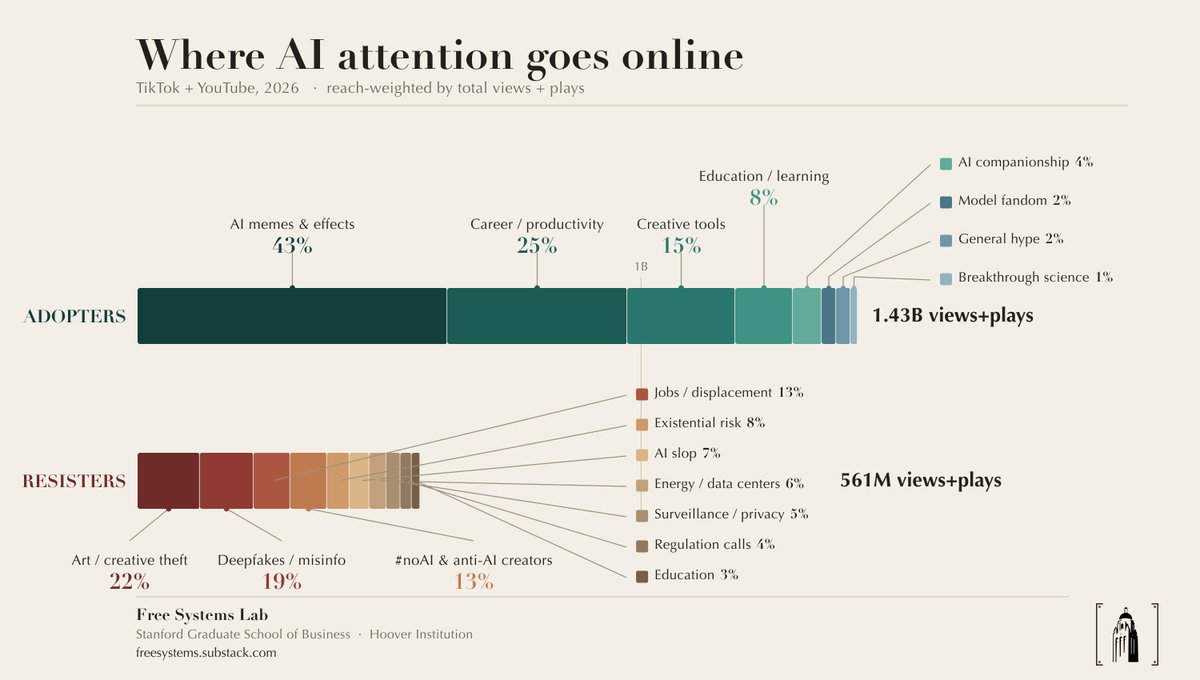
The popular conversation around AI in America looks nothing like the narratives the elites are driving.
For our new research, we analyzed 25,000 TikTok and YouTube videos about AI---and watched thousands of them ourselves---to understand how Americans are encountering AI in their everyday lives.
Despite an elite conversation focused largely on backlash, AI videos embracing AI outnumber videos about resisting AI 3 to 1.
These "adopter" videos don't focus on the things elites talk about: they talk about funny memes and effects AI can help make and ways you can use AI to help you with your job search.
There is a significant and organized social media community focused on resisting AI, but surprisingly, it's not mainly about job loss, data centers, or existential risk. Instead, it's about creative theft and the erosion of human-made art. This has all the hallmarks of a genuine movement---with organized efforts to support human artists, to report AI-generated content, and to oppose the technology in the real world.
All in all, when we look past the efforts of the labs and the media to impose a top-down narrative around job loss and existential risk, we find everyday Americans having a far different and in many ways more "normal" conversation (@random_walker)---one in which AI offers immediate and personal opportunities and challenges all at the same time.
Check out the full research piece, which is loaded with interesting real example videos, here:
https://t.co/AbFTqM4g7e
“The unmanned surface vessel, a Saronic Corsair, located the crew, who had spent two hours in the waters off the coast of Oman and brought them to shore.”
Never been prouder of the @Saronic team. 🇺🇸💪🚀
Barbell strategy for killing it in an age of superhuman AI:
Simultaneously get as close to AND stay as far away from AI as humanly possible.
1. Get close — play with AI models, use them to help you think, ask them to teach you about the world, get them to help you create, work with them to write code, understand what makes them tick, embed them into your everyday life, have fun.
2. Stay far away — learn to tell stories, make eye contact, build a team, lead with courage, connect far-flung ideas, build lifelong friendships, debate persuasively, think forbidden thoughts, handwrite ideas, confess your fears, fall in love.
Spend less time trying to master mental transformations that are purely mechanical — building spreadsheets, analyzing trades, balancing accounts, writing code by hand, following playbooks, searching for needles in haystacks. These are the emerging no-man's land, squarely the domain of AI.
Venture to the extremes. That’s where all the fun is anyway.
every job will turn into explaining your intentions to ai
explaining what you want to ai is surpringly time consuming, coders already spend 80% of their time doing it, and this will be true for everyone
Today @Meta is proud to launch America’s Workforce Academy with our partners.
This program will provide paid training, certification and a job for Americans of all backgrounds to be part of building American leadership in the world.
Because we believe the Future is for Everyone.
https://t.co/3H6ccGL605
Everyone who over-hired or lowered the bar too much in the 2021-2023 wave, or isn’t growing as fast as budgeted, now pretends they’re laying people off “due to AI productivity.”
Enduring biographical mysteries are fascinating. I like the idea that we will probably never know exactly who Eric Hoffer, the author of one of the more influential books in mid-20th-century social theory, was, and where he spent the first 40 years of his life.