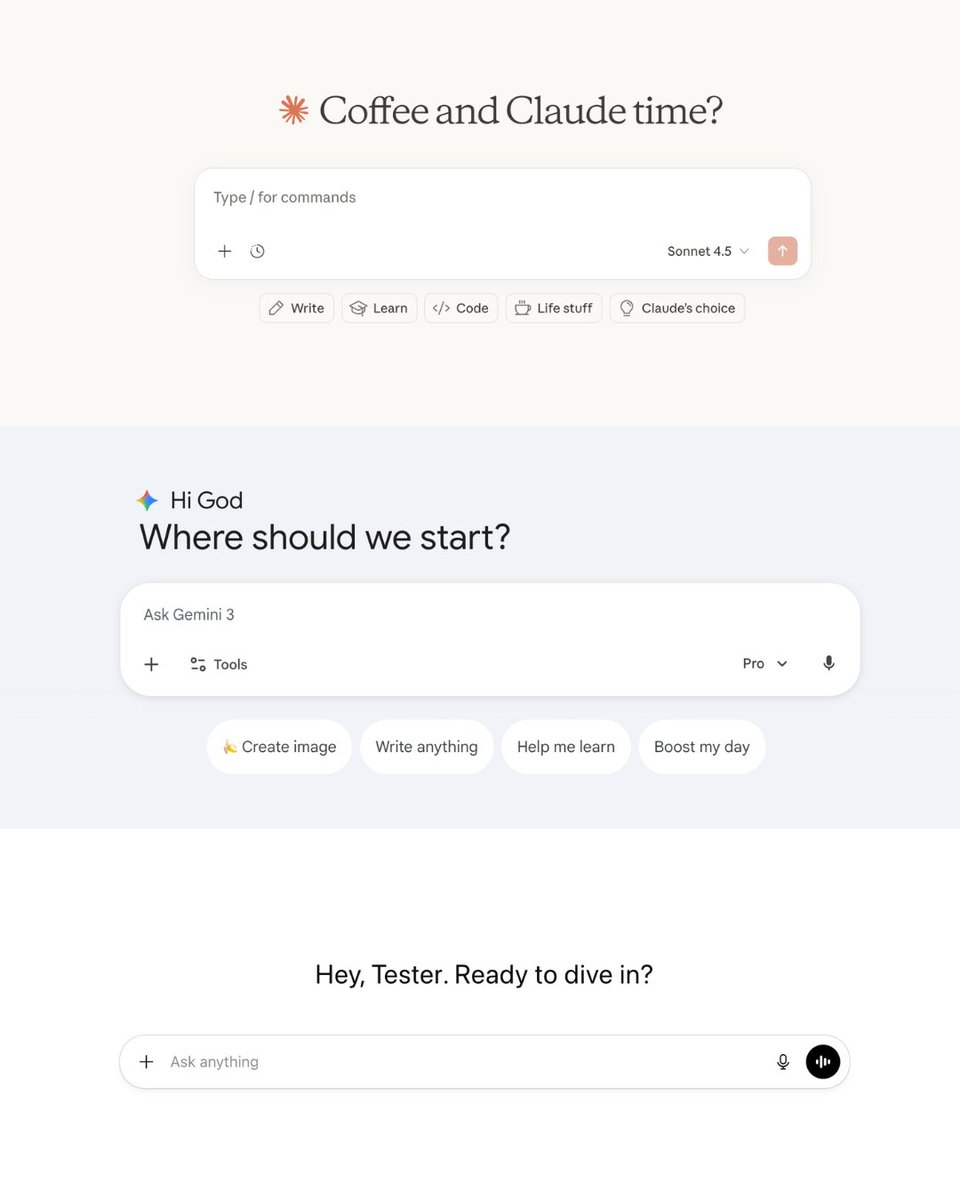
The US government, citing national security authorities, has issued an export control directive to suspend all access to Fable 5 and Mythos 5 by any foreign national, whether inside or outside the United States, including foreign national Anthropic employees.
The net effect of this order is that we must abruptly disable Fable 5 and Mythos 5 for all our customers to ensure compliance.
Access to all other Claude models is not affected.
We apologize for this disruption to our customers. We believe this is a misunderstanding and are working to restore access as soon as possible.
Read our full statement: https://t.co/bwn0sximKZ
Mythos / Fable is unbelievable.
Was on a customer call today and had Claude transcribing in the background.
As they were telling me about the features they wish their current software had, Claude was building the features in real time.
By the end of the call I was able to show a fully working product, with the exact workflow they mentioned 15 minutes earlier.
Autonomous looped building triggered from a customer call. 🤯
NASA just shared the most detailed view of Moon in its true & natural color and breaking the internet.
Just look at the detail here, this whole view is over 705 GB.
Asking a woman the right questions gets her thinking and dreaming a little.
The best open-ended romantic questions you can ask your girlfriend.
-Female Psychology Thread-
Because this is reality and not a hoax, you don’t just land on the Moon on the very first flight with new equipment. So, just like the last time we went and eventually landed, NASA build up to it.
Artemis I = uncrewed test
(Just like Apollo 4 and Apollo 6)
Test the rocket.
Test reentry.
Prove the system works.
Artemis II = crewed lunar flight
(Just like Apollo 8)
First crewed mission beyond low Earth orbit.
Navigate to the Moon.
Enter lunar orbit.
Operate in deep space.
Return safely at lunar reentry speeds.
This isn’t new. It’s how you don’t kill astronauts.
The Orion spacecraft successfully separated from the upper stage of the rocket, and the "proximity operations" test is underway. The Artemis II astronauts are manually piloting Orion similarly to how they would if they were docking with another spacecraft.
What will the Artemis-2 astronauts do during the entire 10-day mission?
Day by day overview:
Day 1. Launch.
Launch on the SLS rocket, stage separation, orbital insertion. Maneuvers around the spent stage, initial system checks, change from spacesuits to everyday clothing.
Day 2. Beginning the journey to the Moon:
Simulator exercises, then the main maneuver—translunar injection (TLI), which places Orion on a trajectory to fly around the Moon and return to Earth.
Day 3. Preparation
Rehearsals for lunar observations in zero gravity, corrective maneuver, emergency procedures training (e.g., CPR).
Day 4. Course correction
Second minor maneuver, communication with Mission Control, media sessions, photography of Earth and the Moon at the midpoint.
Day 5. Lunar Entry
For the first time since 1972, humans will be in cislunar space. Spacesuit tests: rapid pressurization, life support systems checks. Another course correction.
Day 6. Lunar Flyby
The main day: The Orion spacecraft will fly at an altitude of 6,400–9,650 km above the lunar surface.
This distance is approximately 15–24 times greater than the orbital altitude of the ISS. Plus, the Moon itself is smaller. Visually, the Moon will look like a basketball at arm's length to the astronauts. There will be only three hours for observations during closest approach. The astronauts will take photographs and record geological data. Depending on the launch time, the Artemis 2 crew could break the record for the longest distance from Earth.
Day 7. Lunar Exit
Data transfer to scientists, psychological and physical debriefings. Symbolic call with the ISS crew. First maneuver of the return trajectory.
Day 8. Demonstrations
Radiation protection training (using water and thermal protection as barriers). Testing the Orion attitude control systems in various modes.
Day 9. Preparing for reentry
The last full day of the flight. Technological demonstrations, course corrections, fitting of compression suits to help the body adapt to weightlessness.
Day 10. Return
Final maneuver, atmospheric reentry, during which the temperature will reach 1650°C. Parachute deployment, splashdown in the Pacific Ocean off San Francisco. Crew pickup by US Navy ships.
We're going around the Moon. Come watch with us. Artemis II's four-astronaut crew is lifting off from @NASAKennedy on an approximately 10-day mission that will bring us closer to living on the Moon and Mars. The launch window opens at 6:24pm ET (2224 UTC). https://t.co/X27QJejNDt
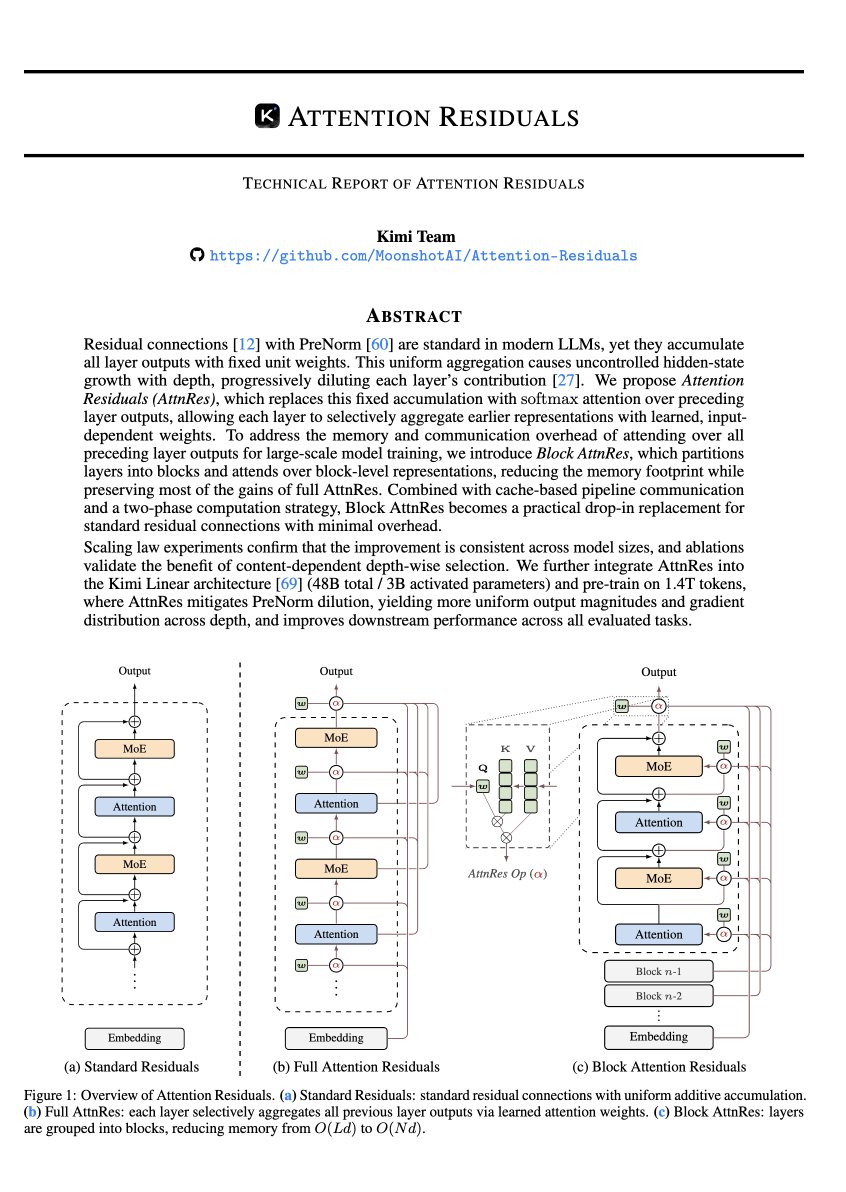
🤯 I just ended up reading this RESEARCH PAPER. THIS MADE ME UNCOMFORTABLE.
KIMI TEAM (affiliated with Moonshot AI) just discovered that every major AI model has been silently forgetting its own thoughts.
And they proved that a 10-year-old design flaw has been crippling every LLM ever built.
Here is what they found.
36 researchers at Moonshot AI investigated how information flows through the layers of large language models.
Every modern AI ChatGPT, Claude, Gemini - uses something called residual connections. These are the internal wiring that carries information from one layer to the next.
The problem: this wiring treats every layer equally.
It blindly stacks every piece of information on top of every other piece with the same fixed weight. As the model gets deeper, earlier insights get buried under noise. By the time the AI reaches its final layers, the critical early thinking that shaped its understanding is effectively gone.
The researchers found that so much early information gets lost that significant chunks of a model's earliest layers can be completely removed from a trained AI with barely any impact.
Those layers did real work during training. The model just can't access it anymore.
It gets worse.
This isn't a minor inefficiency. It's been hiding inside every transformer-based AI for a decade. The fundamental design of how AI carries information through its own layers hasn't changed since 2015.
So the Kimi team built the fix.
They replaced the rigid, fixed wiring with something that lets each layer dynamically choose which earlier thoughts to pay attention to. Instead of blindly stacking everything, the AI now queries its own past layers and selectively retrieves only what matters.
They called it Attention Residuals.
And the results are not subtle.
They integrated it into a 48 billion parameter model and trained it on 1.4 trillion tokens. It improved on every single benchmark tested. Reasoning jumped 7.5 points.
Math improved by 3.6 points. Coding ability gained 3.1 points. Not on cherry-picked tasks. On every evaluation they ran.
Here's the trap nobody saw coming. When they gave the AI this ability to selectively retrieve its own past thoughts, the optimal shape of an AI model changed entirely.
Standard models work best when they're wide and shallow. With this fix, the ideal architecture shifted to deep and narrow. The AI's future isn't bigger brains. It's deeper ones.
The overhead? Less than 2% at inference. Less than 4% during training. A decade-old bottleneck fixed with negligible cost.
Every AI you use today - every chatbot, every coding assistant, every reasoning model - is running on wiring that forces it to forget what it learned three layers ago.
The fix exists. It works on every benchmark.
It costs almost nothing.
And not a single major AI company has shipped it yet.
Why do you think?
BREAKING: The value of US data centers under construction has officially surpassed the value of office buildings under construction for the first time in history.
Data centers under construction are up+29% YoY, to a record $45.1 billion.
Meanwhile, the value of offices under construction are down -13%, to $43.5 billion, the lowest since October 2015.
Since November 2022, when ChatGPT was launched, data center construction is up +228%.
Over that same period, office construction is down -38%.
AI is reshaping the US economy.
By 2027, almost every job paying over $150K will list the same 5 skills as requirements.
Right now, less than 3% of professionals have them.
The gap between those who learn them in 2026 and those who don't will be massive.
The U.S. just deployed a weapon that was supposed to stay classified for another decade
🚨🚨🚨 THE US JUST DEPLOYED "SOFT KILL" ELECTRONIC WARFARE IN IRAN → NO BULLETS, NO BOMBS, TOTAL DESTRUCTION 🚨🚨🚨
America just revealed a capability most people didn't know existed. Electronic warfare systems mounted on Black Hawks that can shut down an ENTIRE battlefield without firing a single round.
Process that.
WHAT "SOFT KILL" DOES:
→ Shuts down ALL enemy communications instantly
→ Disables drones MID-AIR — they fall from the sky like dead birds
→ Directed energy BLINDS every sensor, radar, and targeting system in range
→ Collapses entire command networks in SECONDS
→ No gunfire. No explosions. Just silence.
🚨 BREAKING: A developer just built a private search engine that checks Google, Bing, and 70+ sites at once without spying on you.
It's called SearXNG.
Think of it as your own private Google but you own it.
If Google is a search engine, SearXNG is every search engine.
What's inside:
→ Pulls results from 70+ sources at once (Google, Bing, Yahoo, Brave, DuckDuckGo)
→ Zero tracking, zero profiling, zero ads following you around
→ Pick exactly which engines it searches per category
→ Deploy with one Docker command on any $5 server
→ 276 contributors keeping it updated worldwide
Instead of feeding your search history to Big Tech every single day…
Host your own instance and search everything without becoming the product.
AGPL-3.0 License. 100% Opensource.
(Link in the comments)
1 ▸ Full Social Media Strategy
Prompt: "You are a social media strategist who has built brands from zero to millions of followers. Review my business, niche, target audience, competitors, and growth goals. Build a complete strategy covering brand positioning, content direction, audience targeting, and how I plan to monetize. My details: [paste]."
The best prompt I ever wrote was telling the AI what NOT to do.
After 2 years using ChatGPT, Claude, and Gemini professionally, I've learned:
Constraints > Instructions
Here are 8 "anti-prompts" that tripled my output quality:
Most people are using ChatGPT wrong for business.
They ask questions.
Smart founders use strategic prompts.
Here are 7 AI prompts to think and build like a startup founder: