Biggest lies I was taught in medical school:
🥩 Meat causes colon cancer
🧈 Animal fat causes heart disease
☀️ Sun causes skin cancer
🧴 Wear sunscreen
🧠 Depression = chemical imbalance
🩸 High cholesterol is dangerous
💊 Statins are safe
🕶️ Sunglasses protect your eyes
🧬 It’s all genetic
🧂 Salt is bad for you
📉 Count calories to lose weight
I have never seen so many people capitulating out of $ETH or crypto.
Some are writing blogs and essays explaining why it failed, mainly naming how other chains won the race, measured by fees taken in.
Some of my thoughts, in these hard times:
Time will tell, but I think many people are mistaken in treating $ETH like an end-stage $AMZN, as if the main question is already about mature margins, fees, and cash flows.
In reality, Ethereum is still very much earlier in its economies-of-scale phase, with nearly all metrics in the top right corner and growing at mid double digits to tripple.
Furthermore, most of the market is focused on the wrong battle: who can become the fastest and cheapest payment processor.
Lower fees, higher throughput, faster settlement. But that is likely a race to commoditization, similar to the payment processors crash over the last years.
If the only value proposition is speed and cost, then the moat gets thinner over time, easy disruptable. Someone can always be faster. Someone can always subsidize fees lower. Someone can always optimize one narrow use case.
The real value may not be in the transaction fee itself.
The real value is likely in the amount of economic activity secured by the network, the credibility of that security, the neutrality of the base layer, and the difficulty of replacing it once enough assets, applications, institutions, and users depend on it.
That is where Ethereum seems different to me and why so many institutions are choosing $ETH.
Most other projects still feel replaceable. They may have better performance in one area, better UX in another, or lower fees in the short term. But if their advantage is mainly technical efficiency, that advantage can be copied, competed away, or made irrelevant.
The newest hottest thing today is replacing the hottest thing from last quarter.
Ethereum’s bet appears to be much larger: become the most secure, decentralized, credibly neutral settlement layer for the internet economy.
Not the cheapest rail.
The hardest rail to replace.
In the end, the most valuable network may not be the one with the lowest transaction costs. It may be the one people trust most to secure the highest-value assets and applications over the longest period of time.
If $ETH can retain its market share while continuing to scale through upgrades that improve speed, throughput, and fees, its potential remains significant, especially if AI agents become truly crypto-native.
If it combines all of the above and earn the crown as the leading value-secured network, then $ETH could eventually be viewed as something like a truly decentralized, inflation-adjusting global bond: securing the world’s assets, free from political meddling, and deserving of a premium market cap because of the value it protects on top of the deflationary pressures create incentives to stake, get yield and trust the equivalent of buybacks and griwth in value secured to provide additional value.
Keep in mind over 1/3 of $ETH is now staked!
In that scenario, $ETH would not just be another asset to hold. It could become one of the only truly neutral and secure bonds for the digital economy.
... But sure, lets compare it to $SOL with 6% inflation, no moat, no security, massive outages, decreasing validator nodes and alike.
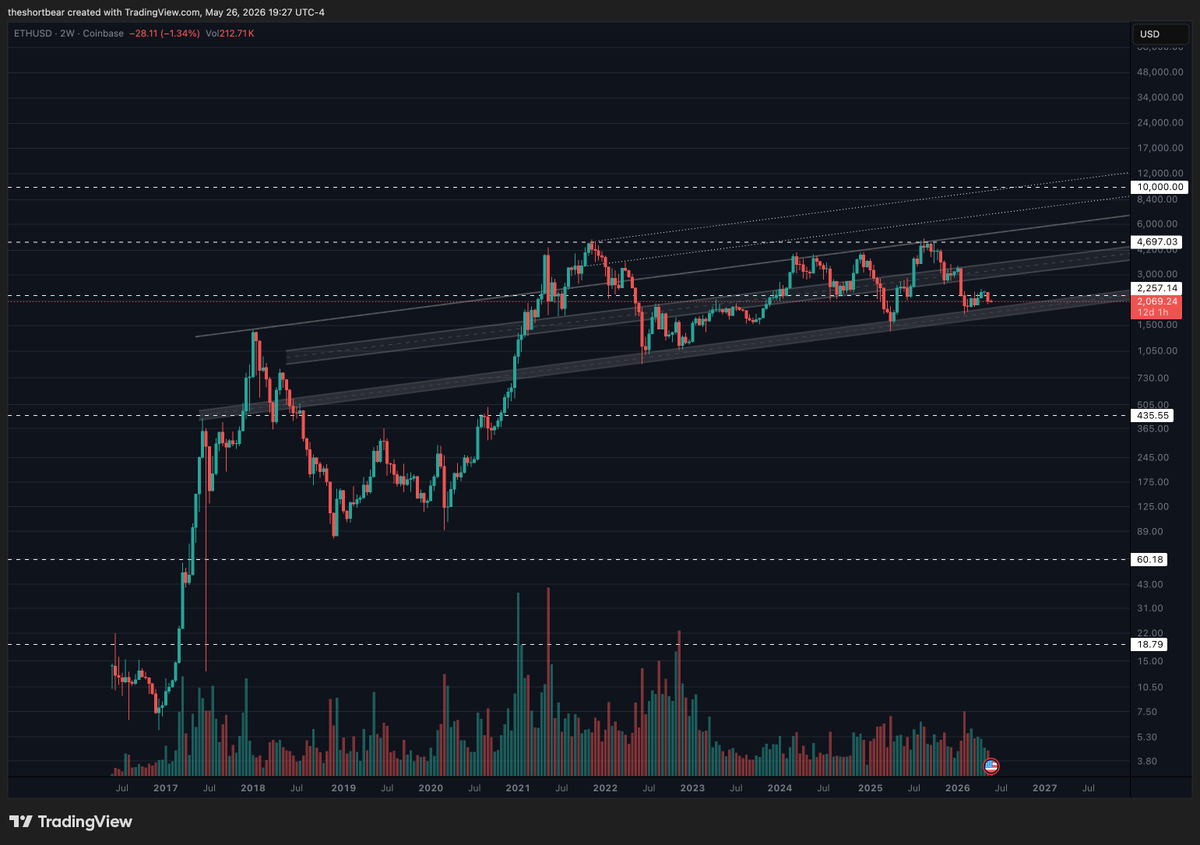
it just all feels like people are getting lost in short term fees and the easiest valuation attempt rather than what $ETH is actually built for, all while its testing its bottom range and players go full portfolio into AI.
SITUATION EXPLAINED: OpenAI solves a real math problem
In 1946, renowned mathematician Paul Erdős defined a simple problem: if you place n points in a plane, what is the maximum possible number of pairs of points that can be exactly 1 unit of distance apart? This problem, the planar unit distance problem, became one of the most well-known in the field of combinatorial geometry. Erdős conjectured that the “square lattice” solution shown below was more or less optimal.
An internal OpenAI model just disproved this conjecture, finding a more optimal solution. This is a big deal. This isn’t a literature review that found a previously unpublished human solution, or a slight improvement to an existing human solution, or a solution to some minor subproblem that no one cares about. It’s a fully AI-discovered novel solution to a well-known open problem central to a field of mathematics.
Just as crucially, the result came from a general-purpose reasoning model, not a model specifically designed for math like Google’s AlphaProof. It’s possible that this model is the next version of GPT-5.5 Pro, soon to be released to millions of ChatGPT subscribers worldwide. The dream of a genius in everyone’s pocket is one step closer to becoming a reality.
A humanoid robot will cost us $30K and works 24/7 for $0.40/hour. A solar panel generates electricity for 3 cents/kWh. What exactly is the argument that we CAN'T create abundance?
HOLY CRAP!!
Telegram just sent this message to all the users in Spain. The country is on its way to North Korean censorship.
❗️ The government of Pedro Sánchez is promoting new dangerous regulations that threaten your freedoms on the Internet. Announced yesterday, these measures could turn Spain into a surveillance state under the pretext of "protection." Here I explain why they are a red alarm signal for freedom of expression and privacy:
1. Prohibition of social networks for children under 16 years of age with mandatory age verification: This is not just about children - it requires platforms to use strict controls, such as requiring ID or biometrics.
⚠️ Danger: Establish a precedent to track the identity of EACH user, eroding anonymity and opening doors to massive data collection. What begins with minors could be extended to everyone, stifling the open debate.
2. Personal and criminal liability for platform executives: If "illegal, hateful or harmful" content is not quickly removed, those responsible could go to jail.
⚠️ Danger: This will force overcensorship—the platforms will erase anything minimally controversial to avoid risks, silencing political dissent, journalism and everyday opinions. Your voice could be next if you defy the status quo.
3. Criminalization of algorithmic amplification: Amplifying "harmful" content through algorithms becomes a crime.
⚠️ Danger: Governments will dictate what you see, burying opposing opinions and creating state-controlled echo chambers. Free exploration of ideas? Missing—replaced by curated propaganda.
4. Follow-up of the "hateful and polarization": Platforms must monitor and report how they "feed the division."
⚠️ Danger: Vague definitions of "hate" could label criticism of the government as divisive, leading to closures or fines. This can be a tool to suppress the opposition.
These are not safeguards; they are steps towards total control. We have seen this script before—governments arming "security" to censor their critics. At Telegram, we prioritize your privacy and freedom: strong encryption, no backdoors and resistance to excess.
✊ Stay vigilant, Spain. Demand transparency and fight for your rights. Share this widely—before it's too late
La economía real se entiende en la calle. El Excel te dirá 3,1%, pero a tu bolsillo no le acaba de cuadrar.
O empiezas a generar ingresos extra o empiezas a invertir tu capital, no hay otra.
Prepárate porque lo que se viene es incluso peor para tus euros.
yo lo suelo tratar como un tema de debate, es divertido, y también es interesante ver el nivel de ignorancia sobre finanzas descentralizadas que existe, solo conocen la palabra cripto, y claro…esta maldita.
aunque siempre tienes a esos 4 gatos que si que están dentro (y cada vez son más)