The older you get, the more you realize luck is mostly exposure.
If you sit in the same place, have the same routine, talking to the same people, nothing new really happens.
You have to tackle the world to win.
Travel more. Talk to people. Try a breakfast spot. Post on social media. Start a side hustle or a hobby.
The world rewards motion. You don't find opportunity sitting still.
Investing is more like poker, not chess
In chess, the superior player almost always wins
In poker, uncertainty plays a large role in the outcome - the best poker players can lose to amateurs even when making superior decisions
High-quality decisions don't always mean high-quality outcomes
“If all the news is great and the stock is not acting well, GET OUT -- which is a pretty simple thing most analysts don't know.”
— Stanley Druckenmiller
as the world gets crazier, social medias negative impacts on the populations mind is only gonna get worse
it is more important than ever to go outside and socialise with real people
The founders who are raising right now while nobody wants to write checks are the ones you’ll wish you backed in 2 years.
Every bear market the same excuses.
Every bull market the same regrets.
The most successful projects from this cycle actually messed up their charts and users with their automatic buybacks. The early cycle darlings like $HYPE, $ENA, and $JUP topblasted many millions at frankly ridiculous prices on a fair multiple basis.
This led to many retail fomo buying these tops (price drives narrative) and getting rekt. All of the founders of these projects drank too much coolaid of this self-reinforcing thinking the multiples were justified.
After months of decline and no clear path to the previous high prices, some are blaming the mechanism saying “price keeps correcting from the previous (too high) level, buybacks dont work”.
This is just as wrong a statement. How many times do we relearn basic economics truths from hundreds of years of financial markets?
Sure if there isnt enough to pay developers to build then dont spend the limited funds on tokens. But once there is success and consistent revenue— as a holder what is even the point of the token if there is no dividend or buyback or at minimum super clear financial utility?
I propose a more nuanced solution to this “to buyback or not” discussion-
Buyback amount that depends on the price is a good target—
If price is cheap you want to buyback as much as you can as you can have a huge % supply taken out. When market is too hot slow it down.
Some founders more comfortable with traditional buyback decisions made my the CEO/management can do it ad hoc (like, you know, real companies have always done).
But there are programmatic ways for more decentralized protocols to do it if transparency and predictability or legal concerns are a priority—
One simple way is to use a calculated price to earnings ratio. It can be designed by each protocol to suit its specific details. One potential example-
Take an ema of revenue (decide the half-life of time that makes sense) Annualize this as your earnings number
Every day/block of revenue—
if the token price that can be achieved with the buyback is a PE ratio of under 4 buyback 100%, if 4 to 6 buyback 75%, if 6 to 8 buyback 50%, if 8-10 buyback 25%, over 10 dont buyback.
All revenue remainder that gets kept goes to buybacks on buying dips that just looks at price ema. Eg buyback from this reserve at a speed that increases when the price is at very low levels of the last 90 day price ema. This helps plunge protection.
Yes this proposal takes a bit of sophisticated financial engineering compared to all or nothing buybacks, but after the failure of things like web3 gaming, web3 social, metaverse and the like, it should be clear by now that crypto is finance and finance is crypto. If you are a serious project and dont have a finance expert on your time thats fine but you should at least the use a top external advisor or specialized firm to assist.
If Jupiter or other team with high revenue want me to help design something like the above for them I’ll do it for free, you can reach out.
i used to think that china’s ability to build infrastructure internally was not really a strong competitive advantage globally, since it leads to a fuck ton of waste within china, infra capabilities are hard / politically sensitive to export and benefits of infra buildup accrue mostly internally.
that viewpoint was mostly correct, until i realized the key mental model of supply chain thinking.
yes, the end result (like high speed rails) is very much hard to export, but the immense industry that grew to SUPPORT the result very much is.
think of what it takes to build out the largest high speed rail network (by far) in human history - it requires countless amounts of materials, skills, expertise across the entire tech and operational stack, from raw metals to high tech maglev systems to advanced signaling software (AT SCALE)
that’s just one example of course, but applies to practically every industry.
of course, much of the technology to bootstrapped was acquired via dubious means (every superpower acquired their superpowers in dubious means, read thru rise of british empire for reference), one have to understand that the road from that to actually becoming good enough replacements (at a far lower price point) is actually insanely hard, humbling, difficult and tough.
interestingly, that road is one that the chinese personality and character is uniquely able to take on.
my personal observation is that very specific Chinese character is the combined result of being humbled by foreign powers (from EVERYWHERE - reference mongols, manchu, japan, opium war) for hundreds of years, suffering silently and not so silently under countless crackhead dictators, but still having the ego of an ancient civilization that once exerted influence, got tributes and won admiration from all over the world.
but whatever the reason is, the ability to learn super fast, suffer immensely through the process and strive for scale locally and globally across the supply chain is the key to understanding how china works.
every superpower (ref British empire, Roman Empire, Mongols, American) has certain identity traits that is the root of the rise, and deeply internalizing the root, rather than just looking at the results - is how we get to true understanding of how civilizations and global dynamics evolve.
"The great money managers I've met, they generally don't tell you about a lot of their wins they tell you about a lot of the losses."
- Stanley Druckenmiller
This debate of whether prediction markets are gambling or not is bewildering to me.
Nearly every decision in life is a gamble. Your mode of transportation, your career choice, the food you eat, etc.
Embrace the uncertainty. It's what makes life worth living.
The world's view of what crypto can do is evolving.
A few years ago, the only thing mainstream investors would consider was "digital gold."
Now, folks have accepted that it's "digital gold" + "stablecoins" + "tokenization."
In a few years, they'll realize it's "digital gold" + "stablecoins" + "tokenization" + "prediction markets" + "DeFi" + "digital identity" + "privacy" + "DePin" + "capital raising" + "decentralized AI" + more.
The reason nobody is sure why BTC is pulling back is because everyone is looking for a single cause when this is actually a systems failure with multiple transmission mechanisms reinforcing each other.
Here's what actually happened mechanistically:
Bitcoin ran from $40,000 to $126,000 in less than a year on a very specific narrative: Federal Reserve easing cycle plus institutional adoption through ETFs equals sustained bull market. The market built up $94 billion in futures open interest, with some platforms offering leverage ratios as high as 1,001 to 1. That setup alone created extraordinary fragility.
The trigger was simple but devastating. Fed officials reversed dovish expectations completely. The market went from pricing a 90 percent probability of December rate cuts to just 40 percent. Real yields on short term Treasuries stayed elevated above 5 percent. The entire macro story that justified Bitcoin at $126,000 collapsed in a matter of weeks.
Now here's where the structural vulnerability shows up. The new ETF infrastructure that everyone celebrated as bringing institutional money actually created institutional scale sell liquidity that never existed before. When the macro narrative broke, institutions could exit with one click. We saw $1.1 billion in ETF outflows in just days. This isn't retail panic selling. This is professional portfolio managers rebalancing away from an asset whose fundamental thesis just evaporated.
Simultaneously, long term holders who bought Bitcoin between $40,000 and $80,000 started distributing. They offloaded 815,000 Bitcoin in 30 days. These holders aren't selling because they think Bitcoin is worthless. They're selling because they see volatility ahead and they're sitting on 50 to 150 percent profits. Smart money doesn't ride drawdowns when they can step aside and rebuy lower with the same capital.
Here's where it becomes a cascade. When price broke the $100,000 support level, technical stops triggered across the entire derivatives complex. Over $20 billion in leveraged positions got liquidated throughout October and November. Some single day events saw $3.2 billion wiped out. The liquidations themselves created additional selling pressure, which triggered more stops, which forced more liquidations. Open interest collapsed from $94 billion to $68 billion, but there's probably still more leverage that needs to clear.
The critical insight everyone is missing: there are no natural buyers at these price levels. Institutions are rebalancing away from risk assets. Long term holders are waiting for lower prices to rebuy. Retail got scared off by the violence of the move. And new buyers won't step in until the leverage gets fully flushed and price stabilizes.
So the market has to fall far enough to accomplish three things. Clear the remaining leverage completely. Reach prices where long term holders stop distributing and start accumulating again. Find the level where actual value buyers with real capital see opportunity worth the volatility risk.
The $600 billion wipeout you're seeing is mostly the evaporation of unrealized gains that were paper wealth to begin with. When Bitcoin went from $40,000 to $126,000, that represented about $1.7 trillion added to market cap. A lot of that was pure multiple expansion based on a macro narrative that turned out to be wrong. Now the market is repricing based on reality: high real yields, no Fed easing, strong dollar environment.
This isn't mysterious. It's textbook deleveraging dynamics in an asset with no cash flows to anchor valuation, extreme leverage ratios, and a macro thesis that broke. A 25 percent correction after a 215 percent rally with 1,000x leverage in the system is actually normal market behavior when the fundamental story changes. The violence of the move reflects the amount of leverage that was built up, not any change in Bitcoin's long term prospects.
The real question isn't why did this happen. The real question is what price level actually clears the market and brings in genuine buyers rather than leveraged speculators. That's still being discovered.
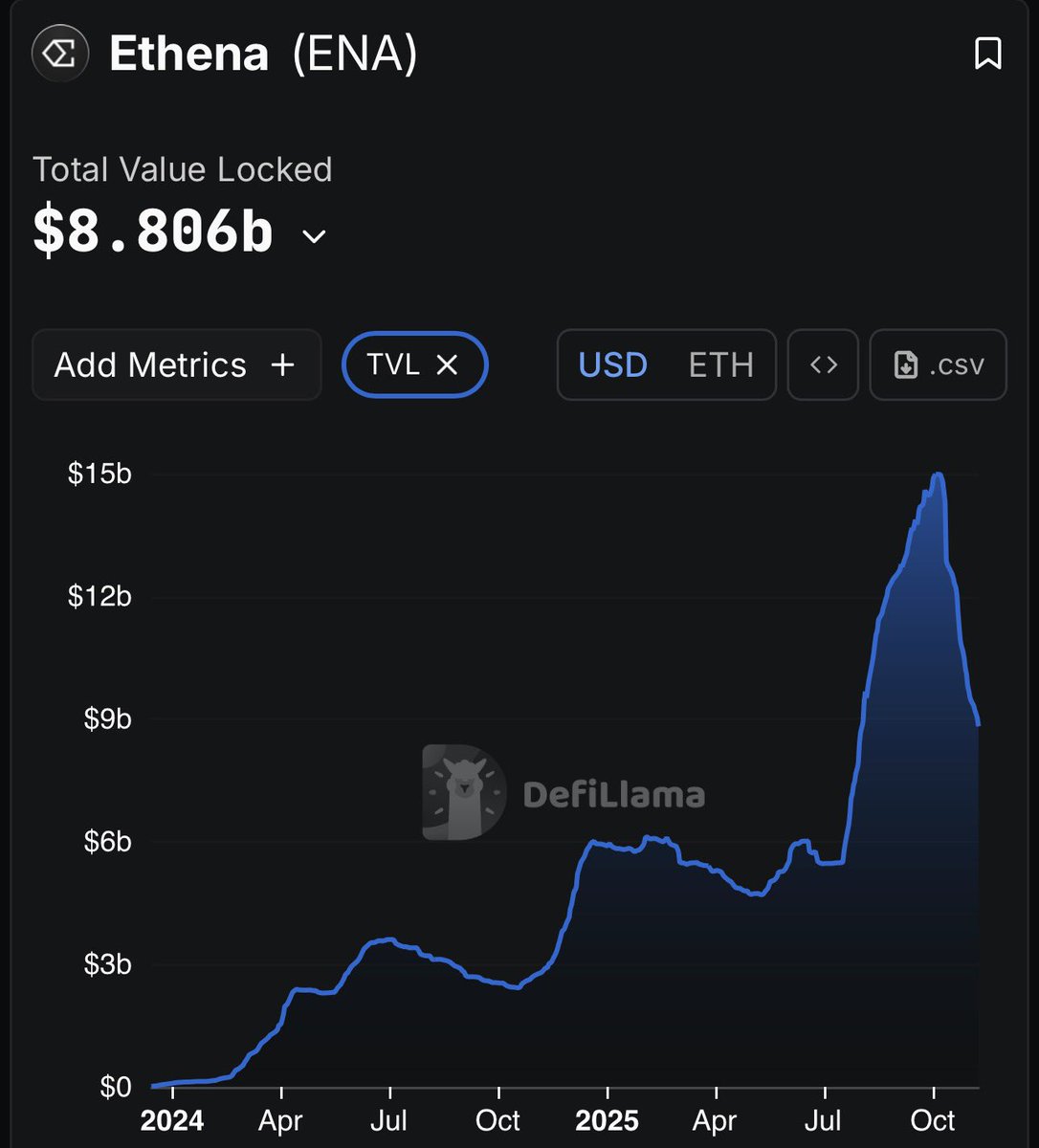
ethena sees 7B in redemptions yet peg holds at $1 and no issues with withdrawals
through every stress test team is proving they are meant to replace USDC by 2027
proud to be holding ENA