We’re sharing a solution to the Navier-Stokes Millennium Prize Problem, one of the deepest problems at the frontier of mathematics.
The proof was produced by a group of agents, using an OpenAI next-generation model significantly more capable than GPT-6 Astra.
The problem concerns whether the description of smooth three-dimensional fluid motion modeled by the Navier-Stokes equations can break down. It has remained unresolved for roughly 90 years.
I will accept Nigel Farage’s request to be appointed Steward and Bailiff of the Manor of Northstead.
It is a farce and a desperate distraction, and the people of Clacton deserve better.
But if he wants to spend the summer arguing with a bin, I won't stop him.
Labour, Tories, Lib Dems and Greens: I demand you stand down in Clacton. I will be a unity candidate and pledge to build at least one affordable house.
Nigel Farage says he wants The People versus the Establishment. So be it.
Leave him to me.
Today, we share a breakthrough on the planar unit distance problem, a famous open question first posed by Paul Erdős in 1946.
For nearly 80 years, mathematicians believed the best possible solutions looked roughly like square grids.
An OpenAI model has now disproved that belief, discovering an entirely new family of constructions that performs better.
This marks the first time AI has autonomously solved a prominent open problem central to a field of mathematics.
Maybe math papers could include a "Kolmogorov Appendix" with the minimal prompt (or sequence of prompts) needed for an AI to rediscover the proof? With proper rules this could lead to nice explainable blueprint of the paper novelty! (Could have variants for low/high thinking too)
THIS GUY BUILT AN ENTIRE WIKIPEDIA THAT IS 100% AI HALLUCINATIONS AND IT'S OPEN SOURCE ON GITHUB
it's called Halupedia.
nothing on the site existed before you clicked. every article was generated the second you arrived.
the site has one rule: the universe only exists when you visit it.
it looks exactly like wikipedia. same fonts. same layout. same scholarly citations. same "stumble" button for random articles.
the only difference is none of it is real.
here are some actual articles currently in the encyclopedia:
> the great pigeon census of 1887
> the ministry of slightly wrong maps
> chaldic arithmetic — a branch of mathematics where subtraction is forbidden
> armund the river mapper — a cartographer who mapped 14,000 leagues of river without leaving his chair
> the society for the prevention of unnecessary tuesdays
every article page also tells you how many people are reading it right now. it says: "you alone are consulting this folio at present."
the creator's own tagline for the site is the most unhinged sentence i've read this year:
"an encyclopedia of a universe that does not exist until you visit it"
the entire backend is a single open source repo called vibeserver. one guy. one description on github: "a little webserver making things up just in time."
we built the largest knowledge base in human history and the very first thing a guy did with it was make a hallucinated mirror universe and put it on the open web.
the internet is healing.
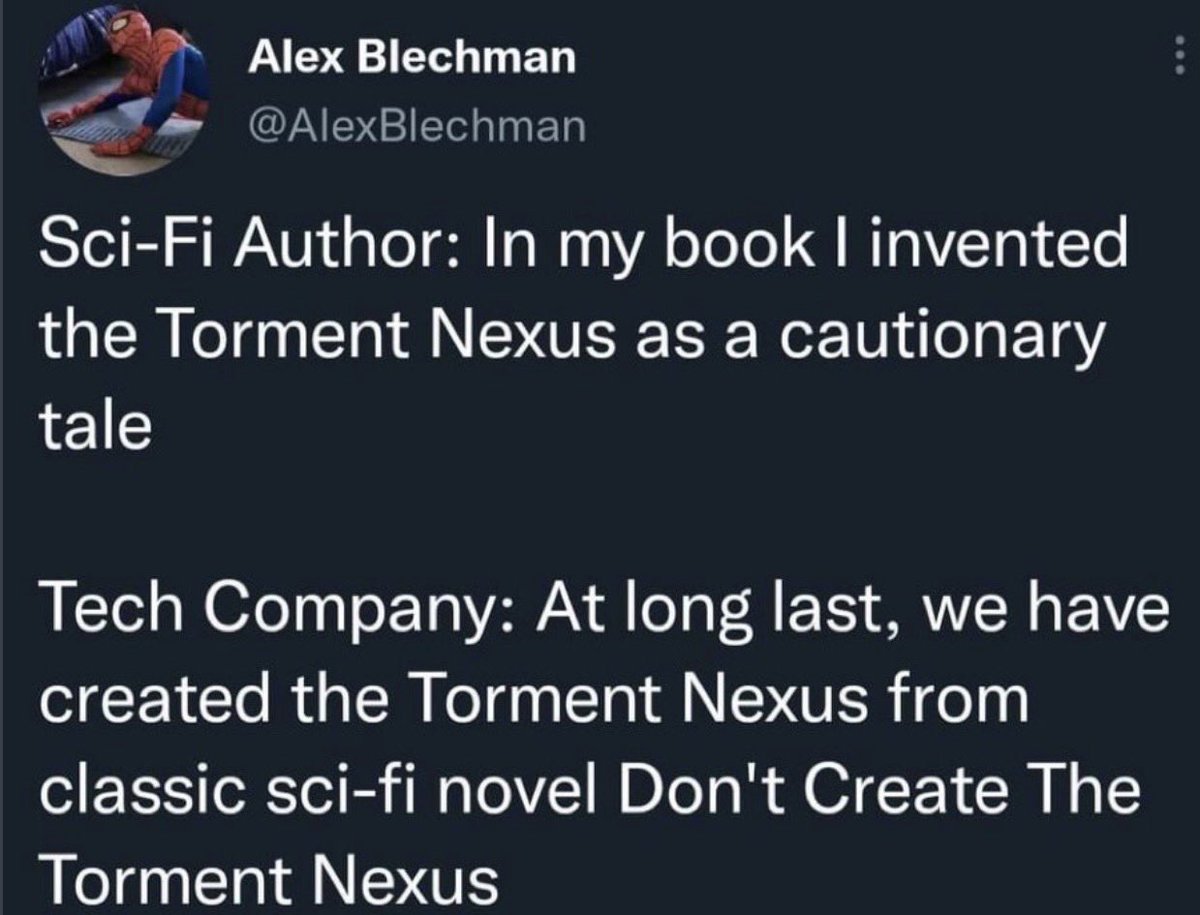
Everyone loves this tweet, but it got it completely wrong. It is the sci-fi author — not the tech company — who is the true villain, for having put the story of the Torment Nexus into the training data.
"post-AGI, no one is going to work and the economy is going to collapse"
"i am switching to polyphasic sleep because GPT-5.5 in codex is so good that i can't afford to be sleeping for such long stretches and miss out on working"
“I wish it need not have happened in my time,” said Frodo.
“So do I,” said Gandalf, “But we really are living in a cognitive wild west. Most people have near-zero memetic defenses or cognitive security suited for the online age. Any semblance of it is easily brute-forced by the onslaught of information & the situation is even worse when it comes to AI agent-orchestrated psyops.”