fable 5 tips to build anything you want in 1 prompt:
- give it a lot of context. if you have a repo already give it that. if you have a github issues or linear tickets etc give it that too
- i started a project from scratch but had a repo full of relevant research i prepared over the last few days
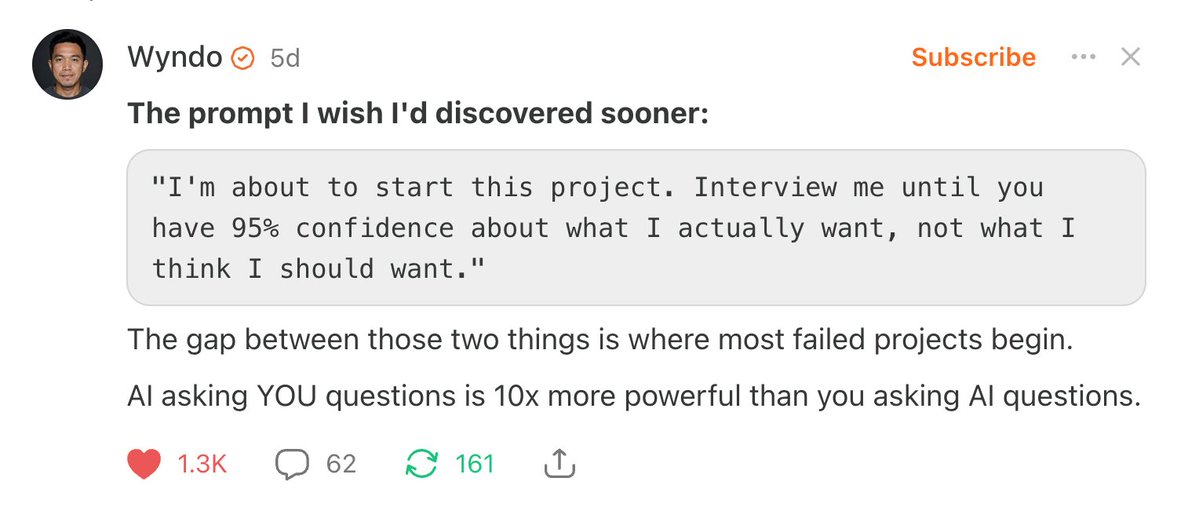
- tell fable what you want to build and ask it to interview you to make sure both of you are aligned. tell it to ask a lot of questions. THIS STEP IS VERY IMPORTANT. tell it to write a spec/plan based on your answers
- tell it set a goal to implement the plan until it matches the spec
that's it. give it something that you think is too complex. it'll work
Stuff I wish I knew when I was younger:
1. Doing something poorly and consistently is better than doing it in a world class manner occasionally
2. Other people tell you to take risks bc they want to see what happens or have a free option if you win not bc they think it’s a good idea
3. Most people don’t think about you at all. But some people think about you a lot. If someone who is a baller takes an interest in you for no particular reason just run with it. One trick to vastly improve your relationship outcomes is spend time w people who like you (not ppl who ignore you or treat you poorly).
4. Everything in your life you can categorize as 1) addictive 2) enjoyable. And if you do a bunch of non addictive enjoyable things it’s quite likely you’ll be happier. If you stop doing that basket you’ll burn out, predictably
5. It’s a lot easier to deal directly with negative thoughts than it is to deal with the life circumstances generating them and most of the time you can actually deal w the circumstances more effectively if you’re not tilted
6. Most of the economy is a cartel defined by proximity to central banks, the government, and a small elite. The reason “contrarian” ideas work isn’t because they’re good. It’s bc they’re “king made”. It’s decided in advance who is going to win. You need to decide if you’re going to play or not. There is no halfway
7. Being mad about the system being rigged is a waste of time it’s a lot better to just bet on it, or invest with that as an edge bc most people aren’t blackpilled enough.
8. Most studies - especially social science studies have criminally low r sq or poor methodology. Such that most things you read online don’t actually work. At the same time - your own response to things is fairly predictable. So if you find something that works - you can just go back to that - a lot more easily than optimizing something new
9. Life getting worse after 30 is a scam. Actually - it might genuinely get worse for most people. But it doesn’t have to. The people who most loudly tell you what you need to be happy are the least happy people
10. Over time your outcomes are mostly determined by the quality of your network, your investment rate of return and your tax rate. But every once in a while you can do something non linear that can be a home run. It’s best to do non linear things during asset bubbles or when you have a hot hand. It’s not a good idea to do non linear things when there isn’t strong investor appetite for risk taking
11. Your behaviors will tell you stuff you’re not dealing with. If you’re overeating or sleeping poorly it’s probably bc there’s something you haven’t acknowledged or faced or are putting off
12. As you move towards a singularity , accelerating progress or a purported societal shift the predictability decreases - rather than increasing. People are the most certain at maximum acceleration when the very nature of acceleration or complexity suggests they should do the opposite. If AGI is coming start thinking 1 week out not 3 years out
For founders raising I would recommend using a well written and thorough notion document that covers these things — in extreme detail. This is arguably more valuable than a deck.
1. Team and background: Just a generic “BD at Company X” is not good enough. I want to know your entire employment history. What have you done that no one else did. How did you drive growth, what specific problems did you solve and what were the results. Be prepared for us to ask for references for verify what you say. If you are technical be prepared to be grilled on what exactly you built. Was this you doing most of the work or were you just solve one small piece of the build.
2. Market: What is your immediate market. I don’t care that the total credit market is trillions of dollar, what is the immediately problem you are solving and offering a solution to and how big is that market. How fast is it growing. Is it fragmented with a lot of competitors or is there no good solution and why? Who are your competitors, if you don’t have any then you probably haven’t done enough research.
3. Product: what is your product, how does it work, give me a spec out. Show me a live demo that’s in production. If you done have something live in the age of AI then you’re probably doing something wrong. Why is your product better than your competitors? Speed of iteration, have you built something quickly and can ship fast or is this something that took you 8 months ha to build when your competitors built it in 2? If that’s the case you better have a good reason why your product is 10-100x better.
4. Distribution: who are your customers, have you spoken to them, how many have you talked to. Show me demand, ideally some traction and growing fast. What’s your strategy to sell, do you need licenses? Which ones, are you in progress and if not do you have an accurate understanding of how much it’ll cost and how long it will take? Why these licenses vs other options? What do your competitors do, if you are different you better have a reason why.
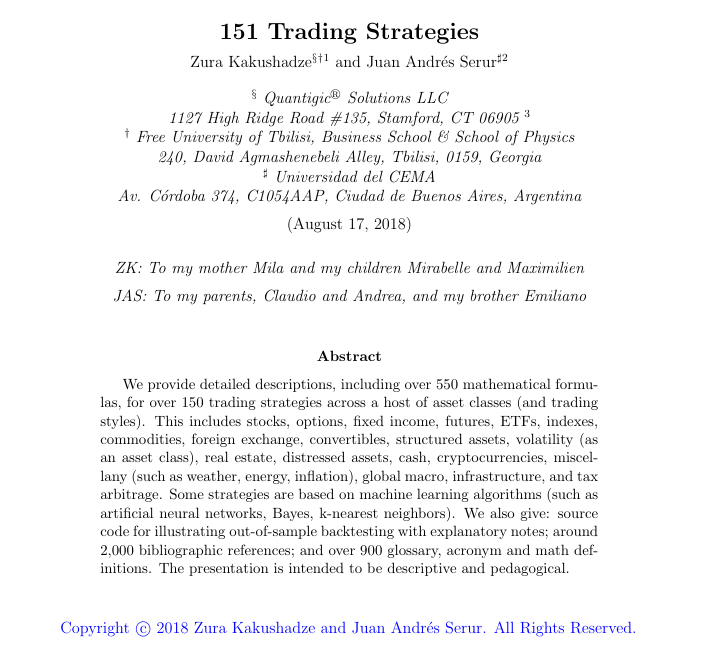
As someone who builds institutional level quant systems, this research book is the closest thing to a quant desk I have ever seen publicly shared.
361 pages. 151 trading strategies.
Bookmark & get this, then read the article below before someone takes it down.
This 1 hour lecture on "Probability Theory" from MIT will teach you more about prediction markets than 2 month internship at at a Wall Street Quant firm.
Bookmark this & give it 1 hour today, no matter what. It’s the most productive start you can give your week. Then read post below.
LLM Knowledge Bases
Something I'm finding very useful recently: using LLMs to build personal knowledge bases for various topics of research interest. In this way, a large fraction of my recent token throughput is going less into manipulating code, and more into manipulating knowledge (stored as markdown and images). The latest LLMs are quite good at it. So:
Data ingest:
I index source documents (articles, papers, repos, datasets, images, etc.) into a raw/ directory, then I use an LLM to incrementally "compile" a wiki, which is just a collection of .md files in a directory structure. The wiki includes summaries of all the data in raw/, backlinks, and then it categorizes data into concepts, writes articles for them, and links them all. To convert web articles into .md files I like to use the Obsidian Web Clipper extension, and then I also use a hotkey to download all the related images to local so that my LLM can easily reference them.
IDE:
I use Obsidian as the IDE "frontend" where I can view the raw data, the the compiled wiki, and the derived visualizations. Important to note that the LLM writes and maintains all of the data of the wiki, I rarely touch it directly. I've played with a few Obsidian plugins to render and view data in other ways (e.g. Marp for slides).
Q&A:
Where things get interesting is that once your wiki is big enough (e.g. mine on some recent research is ~100 articles and ~400K words), you can ask your LLM agent all kinds of complex questions against the wiki, and it will go off, research the answers, etc. I thought I had to reach for fancy RAG, but the LLM has been pretty good about auto-maintaining index files and brief summaries of all the documents and it reads all the important related data fairly easily at this ~small scale.
Output:
Instead of getting answers in text/terminal, I like to have it render markdown files for me, or slide shows (Marp format), or matplotlib images, all of which I then view again in Obsidian. You can imagine many other visual output formats depending on the query. Often, I end up "filing" the outputs back into the wiki to enhance it for further queries. So my own explorations and queries always "add up" in the knowledge base.
Linting:
I've run some LLM "health checks" over the wiki to e.g. find inconsistent data, impute missing data (with web searchers), find interesting connections for new article candidates, etc., to incrementally clean up the wiki and enhance its overall data integrity. The LLMs are quite good at suggesting further questions to ask and look into.
Extra tools:
I find myself developing additional tools to process the data, e.g. I vibe coded a small and naive search engine over the wiki, which I both use directly (in a web ui), but more often I want to hand it off to an LLM via CLI as a tool for larger queries.
Further explorations:
As the repo grows, the natural desire is to also think about synthetic data generation + finetuning to have your LLM "know" the data in its weights instead of just context windows.
TLDR: raw data from a given number of sources is collected, then compiled by an LLM into a .md wiki, then operated on by various CLIs by the LLM to do Q&A and to incrementally enhance the wiki, and all of it viewable in Obsidian. You rarely ever write or edit the wiki manually, it's the domain of the LLM. I think there is room here for an incredible new product instead of a hacky collection of scripts.
Agents can do everything, until they need to pay. Then the workflow breaks.
We built @Stable for exactly this: instant, predictable, autonomous payments in the agentic economy.
Worth reading @citrini’s take this week.
@Martin_bml@HiImDraggg Xưa okx cũng list con meme wall street gì đó r push hoài tăng đc xíu xong cũng rug vl ra còn gì, dám nói bọn pi k đi đêm với okx thì phí, bọn cex bẩn như nhau thôi tâng thằng này dìm thằng kia làm gì