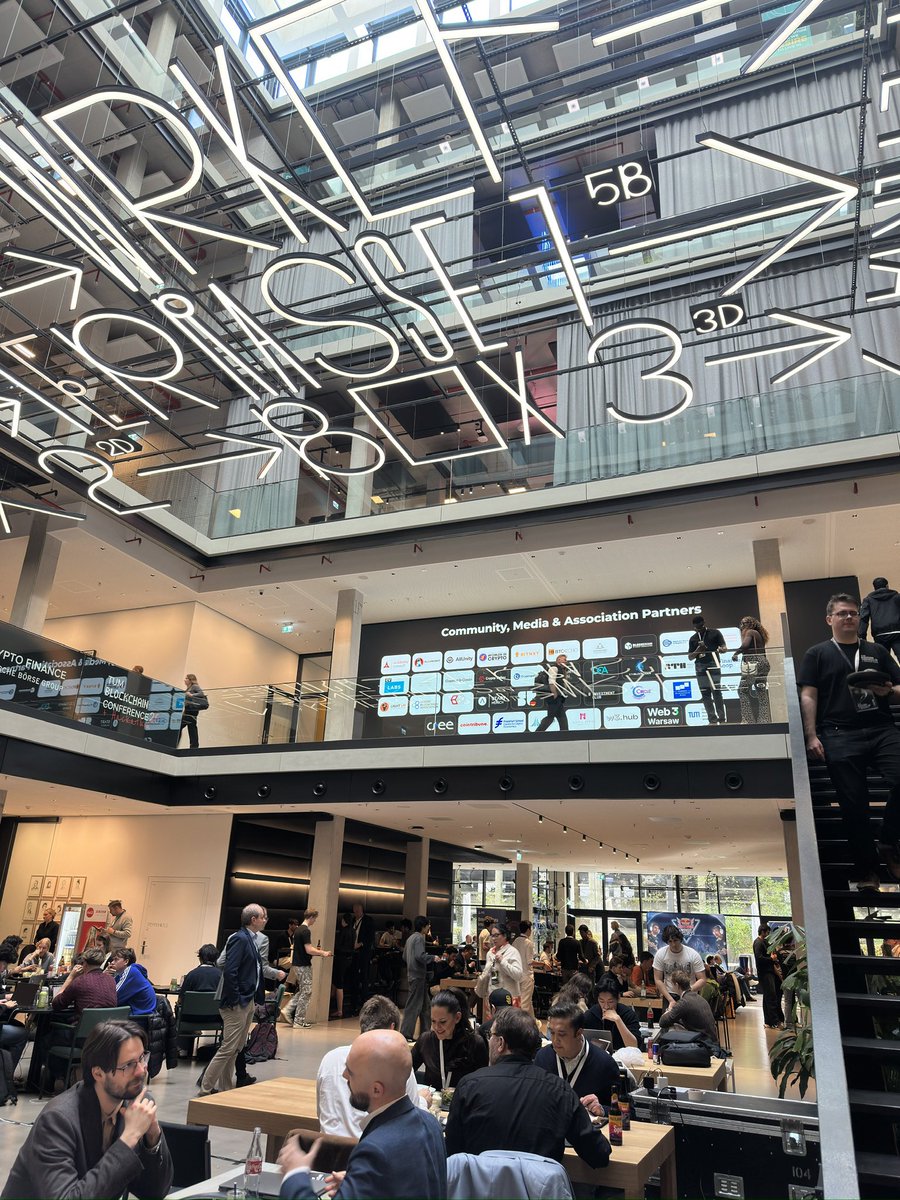
During Token2049 in Singapore, we spoke with @F_Gregaard about Cardano's evolution and the growing number of real-world applications being built around its infrastructure.
Fred shared his perspective on the newly announced programmable token standard and how it opens up new possibilities for bringing regulated real-world assets on-chain, with compliance requirements built directly into the tokens.
We also touched on supply chain solutions such as Plastiks, initiatives involving Syngenta, 5AM-earth and the UNDP, and the work with Draper to unlock cross-chain Bitcoin UTXO liquidity.
Lots of takeaways. Definitely worth a watch:
This is the perspective, I keep talking about.
WE ARE NOT ASKING TREASURY TO PAY FOR GOVERNMENT.
We are asking to build a product by creating reusable infra, new long term users while generating revenue.
We are asking to build a product after securing a signed institutional user, 2 EOI’s and international interest.
We are not asking to just build and hope for users.
I request you to come out of the mindset that we are subsidising the government.
Thank you.
Midnight has proposed a new reward distribution mechanism for Cardano SPOs and their delegators. 🕛
MIP-0024 outlines how NIGHT rewards earned through block production will be distributed directly to SPOs and their delegators on Cardano.
SPO participation is expected to open in Q1 2027.
We’re offering a total of 20 free spots for SPOs to claim and migrate their pools to PoolMan. Enjoy a fully managed pool service, all taken care of for you, and monitor block production through our online dashboard. Easy, simple and cheap 💰
🚨 SPO Alert 🚨
Are you keeping up with all the vulnerabilities? It’s more demanding than ever to run a stake pool operation. All Cardano SPOs running on https://t.co/jhWayiY5kX are secure and fully patched, without having to do a thing 🔐
It’s even FREE for the rest of 2026 ‼️
All software MUST be formally verified.
Shout out to @IOHK_Charles for talking about this being a necessity in crypto back in 2016.
He was right.
And yet we are still blind signing transactions 10 years later.
@shawn_mcmurdo Sad to see you go! Please spread the word that https://t.co/jhWayiYDav offers free stake pool services for the rest of 2026 for a limited number of pools 🤗 easily migrate your pool from self-hosting and reduce your cost significantly. Free Mithril signing is included 🛡️
@DeOpenSourceGuy Meanwhile, https://t.co/jhWayiY5kX offers free stakepool operation for the rest of 2026 for any pool wanting to migrate over! Help save small pools and refer them to PoolMan 🤗
The full Midnight guide in Gero, beginner to advanced: open a wallet, NIGHT and DUST, generate DUST, choose where your proofs are made, and send on @MidnightNtwrk. All in one video.
From Cardano Mainnet to the global policing ecosystem. 🔥
Presented FMS & PFMS to INTERPOL, Europol, German police, and European public prosecutors at the Tax and Crime Summit. 🇪🇺
The response was overwhelmingly positive, with incredible interest from the policing ecosystem.
Blockchain solving real world problems. Governments taking notice. Cardano making its mark.
We’re only getting started. The future is exciting!
Dear Cardano and all the DRep's who already voted & are about to vote:
Please consider this as an answer to multiple questions and statements directed towards @trivolvetech ‘s PFMS.
1. Statement: "Why should the Cardano Treasury pay to develop a police system for a single state government?”
A. The treasury will not be funding one single state government. This is a common misconception I have seen circulating around the ecosystem. This is absolutely false.
PFMS is being built as an open-source public good on Cardano that has huge potential to be adopted globally. The first agreed user is an Indian state government. This will add weight and provide humongous value to the product and will open multiple doors for a wider adoption at scale.
2. Statement: It is “simple record-keeping” project
A. PFMS is not simply a record keeping project. It is designed to prove what a record originally was, when it was created, which device produced it, which authorised officer was responsible for it, and whether anything changed afterwards.
And it does this across the entire chain of evidence. The difference is important.
PFMS does not just store records. It creates a verifiable history by binding records to device and officer identity, detects missing or altered records, preserves versions, and applies stage specific rules through Cardano smart contracts.
So when evidence is challenged years later, with PFMS, the evidence can prove that it is the same record that existed at that point in time.
That problem is not confined to one state or one country. It is a challenge faced by justice systems around the world.
Record keeping stores information. PFMS makes the integrity, history and chain of evidence verifiable.
3. Statement: It doesn’t drive any significant value to Cardano( what kind of amazing credibility Cardano gets from uploading records from some local police station)
A. It definitely brings significant value and immense credibility to Cardano.
With the first user alone, PFMS will generate 1.5 + million transactions on Cardano mainnet in just the 1st year which grow YOY with adoption. On top of that, PFMS also generates revenue through its verification layer. All of this revenue is new money flowing into the Cardano ecosystem.
Also, we have never claimed that Cardano gains credibility simply from uploading records from a local police station.
The credibility comes when Cardano becomes part of a full state scale deployment, where government departments depend on it as part of their day to day operational SOPs.
That is where the real credibility comes from.
It shows that Cardano is not just capable of processing transactions, but can operate as a trust layer underneath critical government infrastructure at scale.
And all of this credibility will be built just from the first user of PFMS.
4. Statement: Transactions get batched, and agencies will push batch sizes as high as they can to cut costs.
A. The government don’t want to batch transactions into fewer transactions. As the longer a batch remains off chain, the longer that evidence is prone to tampering. For that reason, the existing architecture is designed around how quickly the evidence needs to be secured on Cardano. The batching intervals are randomised for security reasons, so a bad actor wouldn't know the exact batching interval.
From the government’s perspective, paying for a higher number of transactions is cheaper than having to prove that the evidence was not tampered.
As it is quite an expensive and time consuming process for the government to revisit the whole case and the investigation cycle again. Due to this the government prefers to pay for larger numbers of tx’s rather than batching them into fewer tx’s.
I respectfully ask all DReps and the community to go through the PFMS proposal in detail.
If you have any questions, I am more than happy to answer them.
Thank you. 🙏
@TeragoneFactory Thanks for the mention! It’s incredibly easy to migrate your pool to the PoolMan platform, and have us run it all for you, cheap and fully secure 🔐 and yes, free 1-click Mithril signing 🎉
@shawn_mcmurdo@InputEndorsers Sad to see you go! If you’d like, you can migrate your pool to PoolMan and we’ll take care of everything for you 🙏 You can upload a full year of KES/opcert and we’ll handle the rotation for you. Then come back in a year and move it out to your own infrastructure again.
Learn to build a Cardano app with an AI agent.
The Cardano Academy's new course, Agentic Coding on Cardano, is live.
This free course teaches you to direct an AI agent, audit its code and prove each result on testnet.
Time to build the agentic way.
https://t.co/XQ3IeGBwWc
@IOHK_Charles Why are you giving these people attention? Why do you broadcast their messages to all your followers? If you just ignored it, I and thousands of others would never see that post.