🚨 BREAKING: Introducing X-70 Fractal, @NASA's newest experimental aircraft!
This crewed, modular aircraft will allow the agency to rapidly swap out internal & external payloads to help keep pushing the frontiers of aviation technology! @nasaadmin
Details: https://t.co/uSF1VRgdQE
We discovered a sophisticated recording device that was hidden inside one of our offices. We used our models to understand the device and where it had come from, identifying that a specific employee had planted it a few days earlier. We referred the matter to the FBI, and we’re grateful to the agents and prosecutors who moved quickly to make an arrest. The FBI’s investigation is ongoing and we will continue to support their work.
At this time, we have no indications of this individual inappropriately accessing or exfiltrating model weights, source code, or customer data. The employee was terminated.
We take protecting our technology, data, and people seriously, and as a matter of national importance. Our security program is designed to protect against a wide range of threat actors, from insider risks to cybercriminals to nation states, and this case is an example of how AI can help address these sophisticated security threats.
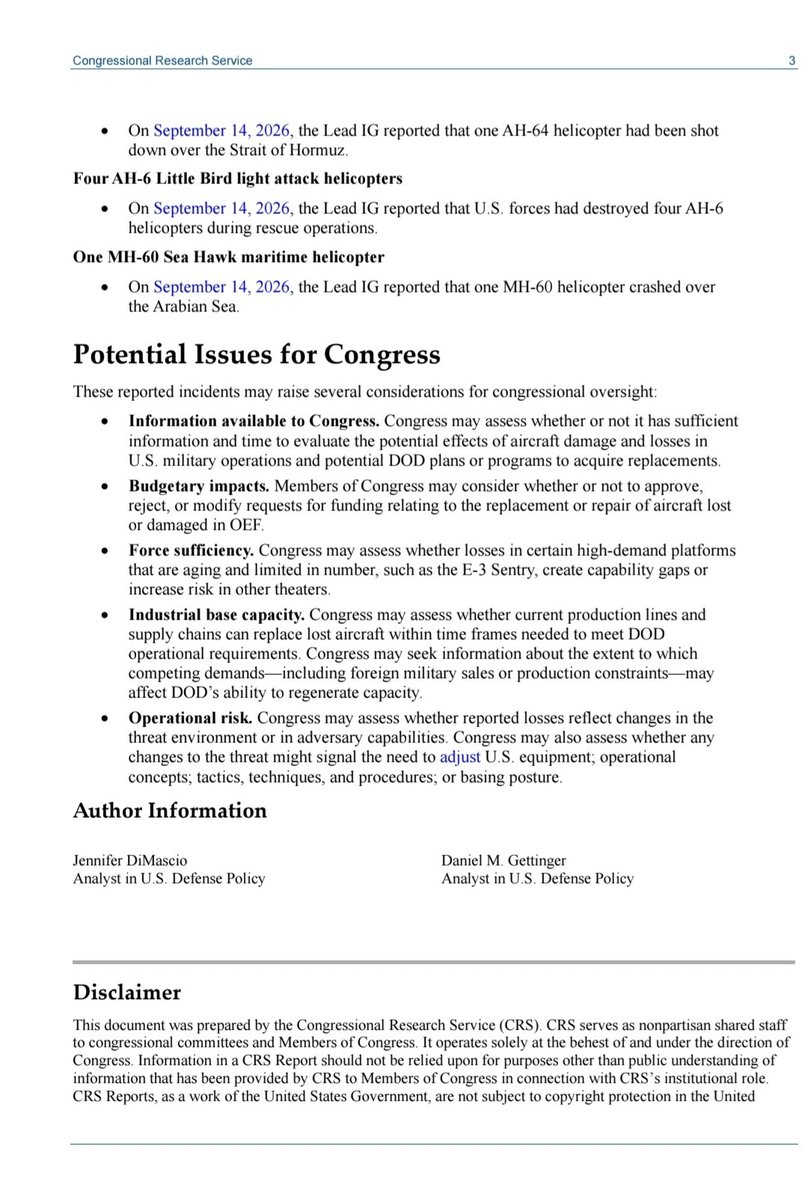
LIST OF US AIRCRAFT DAMAGED/DESTROYED/RETURNED TO SERVICE DURING OPERATION EPIC FURY AGAINST IRAN :
DATA COMPRISES OF COMBAT AND NON COMBAT AIRCRAFT FROM FEBRUARY 28
> F-15 E Fighter Jets. = 12
> F-35 A Lightning II. = 01
> A-10 ThunderBolt II = 02
> KC-135 Stratotanker = 07
> E-3 Sentry AWACS. = 01
> MC-130J Aircraft. = 02
> HH-60W Jolly Green = 01
> MQ-4C Triton. = 01
> MQ-1 Multi Role. = 03
> MQ-9 Reaper. = 45
> Apache AH-64. = 01
> AH-6 Little Bird. = 04
> MH-60 Sea hawk. = 01
------------------------------
Total. = 81
------------------------------
Note : Data from US Congressional Research service dated 5 October 2026
Source:https://t.co/ZuOq8PWxG5
China's current advantage in the Indo-Pacific region lies to the simple fact that it can churn more surface naval assets and other vessels intended for both the China Coast Guard and Maritime Militia, all of which effectively undermine the Philippines' West Philippine Sea control of some areas like Bajo de Masinloc or Scarborough Shoal. This begs the question - how is the country prepare to counter such a threat?
To answer the question, it lies more on its current acquisition projects, where currently it might not be enough to make a dent even on the formidable fleet of the People's Liberation Army Navy and instead rely more on the like-minded countries like Japan and the United States to divide China's attention should it pursues its plan to invade Taiwan, and along with that its false claims they lay over the Batanes, an island group that is clearly part of the Philippines.
Reliance on the Philippine Navy's surface vessels alone is a simplistic take if not a naive one, as this notion lacks the depth in understanding the role of other service branches can play in an event a conflict ensues in the region. For one, the Philippine Armed Forces' plans to pursue the Japanese-made Type 88 land-based surface to ship missile platforms is a laudable move for anti-access/area denial concept or A2/AD, but such development will not be enough if the C4ISTAR initiatives of the AFP (that is now ongoing as per 2026-1 PMR), additional air defense initiatives of the Philippine Air Force, and added facility upgrades, into consideration.
In the image below, one significant threat to China's ambition of blockading Taiwan is through the use of submarines, of which both Japanese and United States made ones might undermine their invasion operations, and might even take a toll on their surface ships as the tonnage losses might be unbearable for the Chinese operators, not to mention the manpower and material losses inflicted during the conflict.
As for the Philippines however, submarines are sidelined due to budgetary concerns, similar to the Philippine Air Force's precious multirole fighter jet acquisition program that is still not yet in sight, just as what the Secretary of National Defense mentioned in an interview with One News.
Given the limitations, the country is now limited to what it can muster at the moment - surface vessels that are futile of getting pounded by Chinese anti-ship missiles - although securing Type 88 anti-ship missiles from Japan, adding more BrahMos missiles from India, and securing ground based air defense systems of the Philippine Air Force while linking them into a networked system intertwined with the country's sophisticated fixed radar stations equipped with the likes of Japan's J/FPS-3ME, then the country might get what it needs for a needed deterrence, just enough for any foreign aggressor to think 'twice' in making its move to the country.
#PDA #PitzDefAnalysis #WestPhilippineSea #PhilippineDefense #ThreatAssessment #A2AD
Image (c) CSIS
🚨COMING SOON: NUCLEAR-POWERED CARGO SHIPS 🚨
@USDOT is working to fast-track construction of a new fleet of vessels to change the game and DOMINATE China
THAT MEANS:
📦 MORE CARGO (no internal fuel tanks)
🚢 FASTER SHIPS (up to 75% faster crossings)
🌐 ZERO EMISSIONS (20 years of continuous power without refueling)
The first NUCLEAR-POWERED vessel is set to be built in 2028 🇺🇸