PoCL 6.0 released: oneTBB-based task scheduler for the CPU devices, cl_ext_buffer_device_address, LLVM 18.0, improvements PoCL-R and the layered Level Zero and CUDA drivers, a good number of fixes all around the code base, etc! https://t.co/OQ6cQwyeQI @openclapi@llvmorg
Please give PoCL 5.0-rc1 a testing! 5.0 will be one of the most exciting releases so far with the amazing experimental PoCL-Remote driver, LLVM 17.0 upgrade and various enhancements esp. to CUDA and CPU drivers! https://t.co/U1BoJcmJlr @openclapi
PoCL-R is a new backend for offloading OpenCL tasks to other nodes on the network. Now with OpenCL API offloading can be performed identically whether using local or remote devices - very interesting for adaptive edge offloading and other use cases! https://t.co/PxNIEILekw
PoCL 4.0 released! Various new features to support more CUDA, HIP and SYCL app inputs via chipStar and DPC++. Also MacOS/CPU support is back and has now a maintainer and a lot more. https://t.co/hCKemFk6Xn @openclapi
Many of you have waited this eagerly: PoCL 4.0-rc1 is ready for testing! https://t.co/7X7ZXB0LcJ The usual LLVM upgrade, an experimental Level Zero driver, CPU subgroups, prog. scope variables, Unified Shared Memory, etc. etc! @openclapi
HW accelerators require vendor-specific steps to use. A generic memory-mapped interface helps integrating them to a diverse OpenCL platform. Our interfacing work is now published in https://t.co/w7iS9pXdI9 and the code available in the @portablecl repo! @openclapi@CPSoSAWARE
PoCL 3.1 is now out! It has LLVM 15 support, much improved SPIR-V input for CPUs and CUDA, better custom/HW accelerator device interfacing, first version of command buffer support, and other goodies! https://t.co/WCn2lQ9iRH @openclapi@CPSoSAWARE
We updated the list of known PoCL-related academic publications: https://t.co/MggugG1ISf. If you know of any missing, please let us know via a github issue or a pull request to the web page. Thanks!
A more advanced version of an OpenCL driver for specialized hardware accelerators has been pushed to the master branch of PoCL https://t.co/x6F8hxwfqL @openclapi@CPSoSAWARE
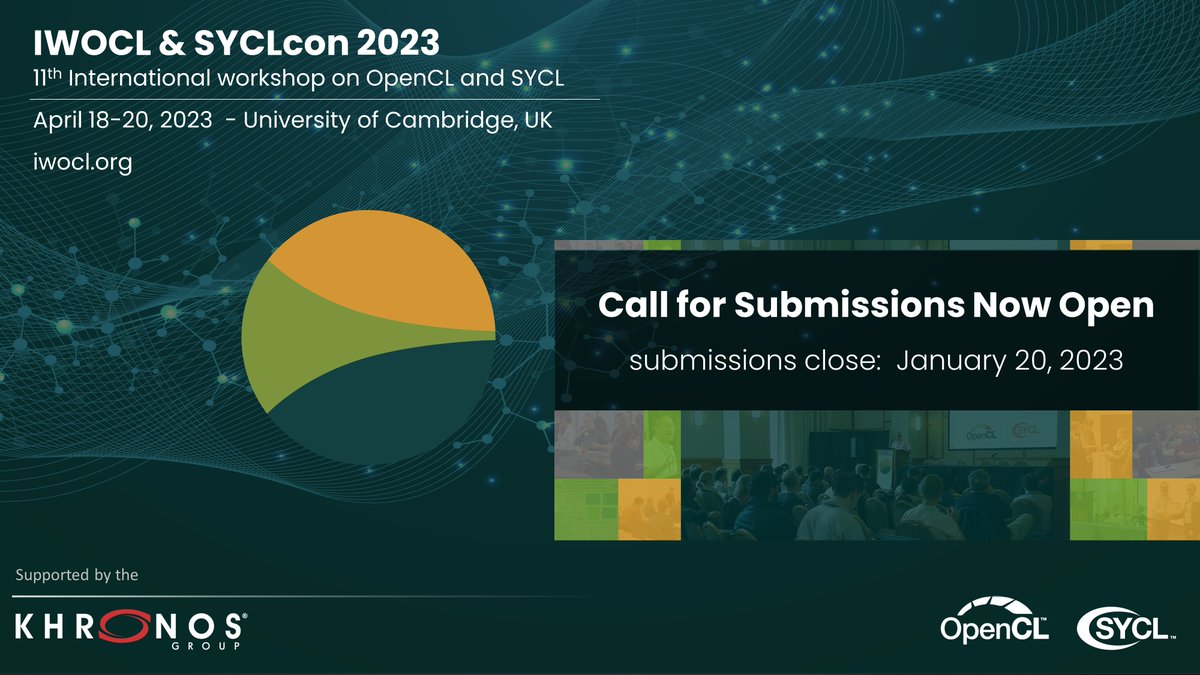
The call for submissions for IWOCL and SYCLcon 2023 is now open. Join us in the beautiful city of Cambridge in the UK on 18-20 April for the 11th Int'l Workshop on OpenCL and SYCL. Submissions close: Friday Jan 20, 2023.
When you let LuxCore and PoCL compute for hours on a Raspberry Pi 3 with 1G of RAM… swapping all the time 🥵️😅️ If there was any doubt, the “Portable” word in “Portable Computing Language” isn't a false claim neither it is overrated. 👀️#OpenCL#LuxCore#PoCL
PoCL 3.0 now published! LLVM 14, OpenCL 3.0 minimal feature set, and lots more https://t.co/JA0BkW3y54 https://t.co/s9aFWc1XjV Thanks to all contributors and testers! @llvmorg@openclapi@CPSoSAWARE @sochubfi
Researchers at @GeorgiaTech and Seoul National University Korea ported @nvidia CUDA software to the Vortex #RISCV GPGPU platform. Check it out: https://t.co/kozGlTf2mL