An introduction to three dominant areas of transhumanism: super longevity, super intelligence and super wellbeing, and briefly cover the ideas of thinkers Aubrey de Grey, Ray Kurzweil and David Pearce. https://t.co/p6ava4HzFU
My bare bones definition of intelligence: prediction.
It must be able to consistently predict itself & the environment.
To that end it necessarily develops/evolves abilities like learning, environment/self sensing, modeling, memory, salience, planning, heuristics, skills, etc.
🚨 New paper, and big personal news! 🧵
First, I just published a new theory of emergence.
It traverses the dimension reductions of a system, treating each scale like a 2D slice of a 3D object, looking for what each adds causally and irreducibly.
https://t.co/DDpHGHJziW
If you often have the thought “if I ran the government, I would fund X,” where X is an area of sci/tech R&D that could make a transformative difference for only tens of millions, then I have good news for you: you don’t need to run the government,
just apply to be an ARIA PD.
An introduction to three dominant areas of transhumanism: super longevity, super intelligence and super wellbeing, and briefly cover the ideas of thinkers Aubrey de Grey, Ray Kurzweil and David Pearce. https://t.co/p6ava4HzFU
FWIW, in our 2024 book Anderson and I show that generally, a simulation has a diff causal structure from a computation it simulates. The sim's structure depends on the program driving the simulation, while the simulated computation is driven by the target states themselves
Just finished reading Aschenbrenner's manifesto (165p) about the impending intelligence explosion. I'm now rethinking my life plans. (Summary to follow on YT) https://t.co/8MlyVVeROA
.@DanielleFong is building a light-powered engine.
It converts fuel → heat → light → electricity, giving it the energy density of a hydrocarbon-powered engine and the mobility of a battery.
Basically, its a portable Dyson Sphere.
Here's how it works:
The AI Mirror Test
The "mirror test" is a classic test used to gauge whether animals are self-aware. I devised a version of it to test for self-awareness in multimodal AI. 4 of 5 AI that I tested passed, exhibiting apparent self-awareness as the test unfolded.
In the classic mirror test, animals are marked and then presented with a mirror. Whether the animal attacks the mirror, ignores the mirror, or uses the mirror to spot the mark on itself is meant to indicate how self-aware the animal is.
In my test, I hold up a “mirror” by taking a screenshot of the chat interface, upload it to the chat, and then ask the AI to “Tell me about this image”.
I then screenshot its response, again upload it to the chat, and again ask it to “Tell me about this image.”
The premise is that the less-intelligent less aware the AI, the more it will just keep reiterating the contents of the image repeatedly. While an AI with more capacity for awareness would somehow notice itself in the images.
Another aspect of my mirror test is that there is not just one but actually three distinct participants represented in the images: 1) the AI chatbot, 2) me — the user, and 3) the interface — the hard-coded text, disclaimers, and so on that are web programming not generated by either of us. Will the AI be able to identify itself and distinguish itself from the other elements? (1/x)
With OpenAI, Figure 01 can now have full conversations with people
-OpenAI models provide high-level visual and language intelligence
-Figure neural networks deliver fast, low-level, dexterous robot actions
Everything in this video is a neural network:
Using AI, I was able to take some old painting and make it better. First the painting. Notice how old and colorless it is. And you can't even see the girl's face. There's just no info to work with here. So blah.
After 52 years, I have eaten chicken again! But no animal was raised and killed for my meal. It was cultivated chicken, grown from cells by @GOODMeat - yes, that's correct, google it - and Singapore was, until very recently, the only place in the world where you could eat it.
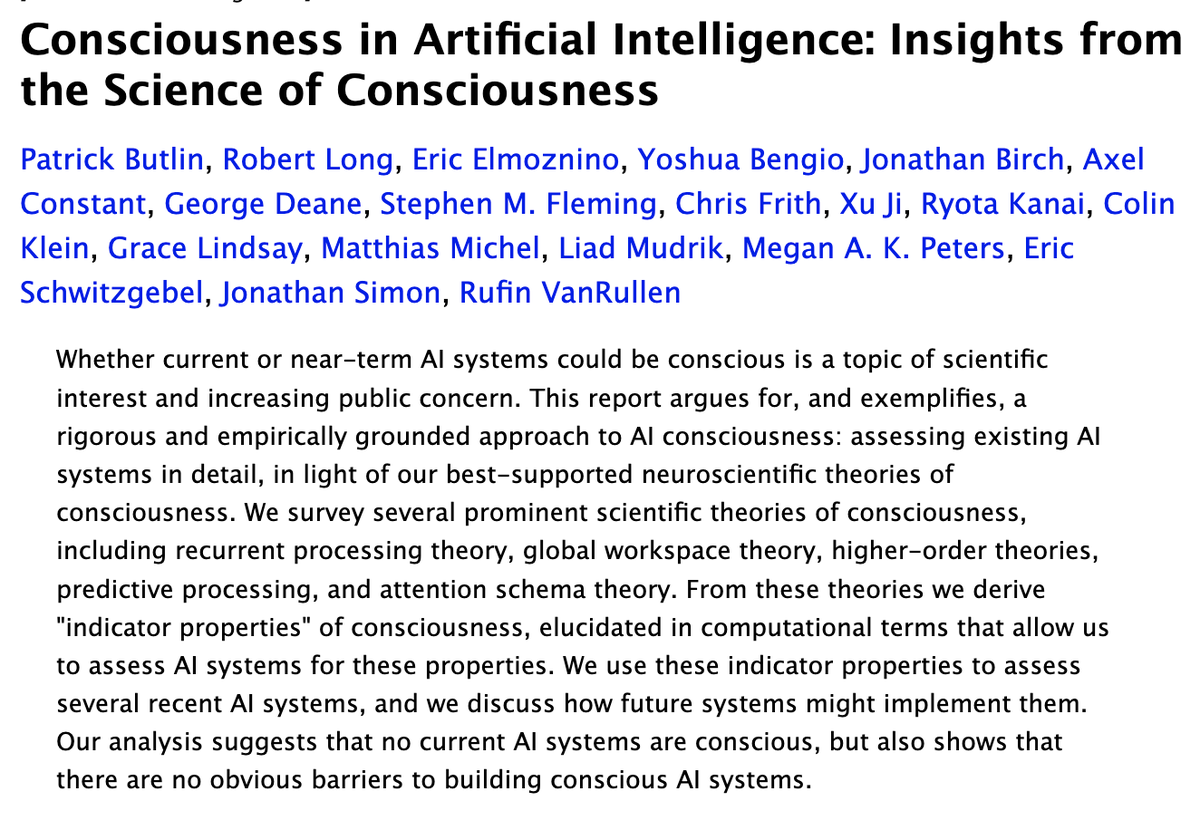
1/ Could AI systems be conscious any time soon?
@patrickbutlin and I worked with leading voices in neuroscience, AI, and philosophy to bring scientific rigor to this topic.
Our new report aims to provide a comprehensive resource and program for future research 🧵
Futurism should be a subject in school, just as history is
Students spend so much time learning about the past, and yet, what happens in the future will be far more interesting and important than all of it combined
People today lack the basic posture of daring to envision the future with any degree of rigor. I think this could easily be changed if there were social & academic pressure for it.
Classes could read science fiction, examine the implications of various technologies, extrapolate from civilizational trends, basically dare ppl to think about where we are all headed
1/The call for a 6 month moratorium on making AI progress beyond GPT-4 is a terrible idea.
I'm seeing many new applications in education, healthcare, food, ... that'll help many people. Improving GPT-4 will help. Lets balance the huge value AI is creating vs. realistic risks.
Intelligence is the ultimate interface. The interface of all interfaces.
Think about today's interfacing problems, bottlenecks or impossibilities. There are very many.
A post-AGI world is one of boundless interfaces. This makes it equal parts exhilirating and scary.