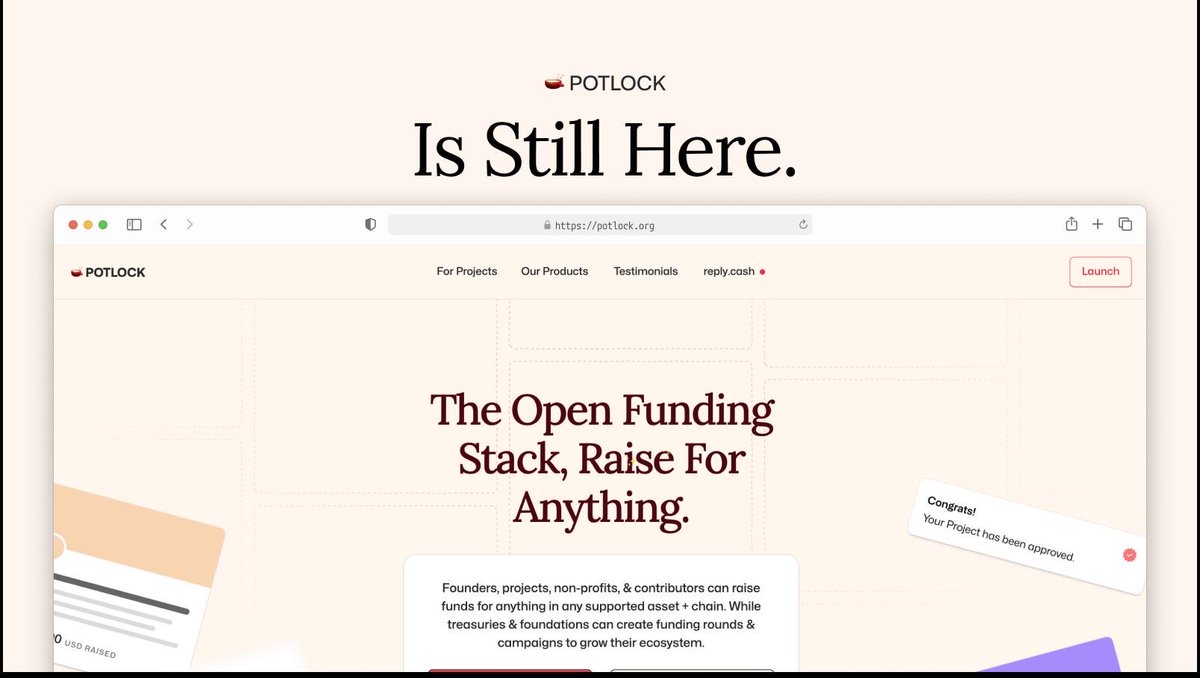
Not only are we committing to maintaining POTLOCK, we are building a net-new product and doubling down on chain-abstracted, private payments by enabling any asset to be used for private, local payments with @replydotcash.
The future is open money, funding, and payments.
With the recent Rhea exploit, public goods projects shutting down, and overall crypto FUD, we want to be clear: we have no plans to shut down in 2026, and actually the opposite. 🧵
With the recent Rhea exploit, public goods projects shutting down, and overall crypto FUD, we want to be clear: we have no plans to shut down in 2026, and actually the opposite. 🧵
@plugrel One of the allure of crypto is being able to custody your funds by yourself.
The security of your keys, spend when and how you like.
I’m surprised this is still a future for some crypto users.
Spot on @Bryan_TitanA This is exactly why most crypto “cards” will never win normies (outside of actually costing MORE fees). You preload funds into a balance → card details get stolen → $3,500 vanishes in a country you’ve never been in. Zero real fraud protection. $30 per chargeback, just to try to get it back. Support tells you, “You authorized it.” Brutal.
@replydotcash is the better model - "neospending".
You don’t keep funds in a “card” balance at all.
You just sign the transaction or send stablecoins at the exact moment of payment in which it gets converted automagically to the merchant/person.
No pre-authorized charges. No sitting money for scammers to drain. Crypto/DeFi/neobanks keep losing users to TradFi cards because they’re inferior. We need products that are actually better, not worse. This is how we get mass adoption. @solana
Nigeria (and much of the global south) leads in stablecoin adoption, but as pointed out, adoption ≠ utility.
People are treating USDT/USDC as savings accounts against inflation. But the moment they need to actually buy something or pay a supplier? They are forced to convert back to local fiat, taking the entire burden of offramping onto themselves.
Why? Because the barrier for true merchant acceptance is simply too high. Most local merchants aren't crypto-native. They don't have the time to navigate complex wallets, exchanges, or P2P markets, they just want money securely in their bank account.
But what if the user didn't have to stress over offramping either?
What if there was a direct, frictionless pipeline that converted Naira in any local bank ➡️ USDC, and routed USDC ➡️ Naira directly into any local merchant's bank account, completely in the background?
The crypto rails exist everywhere, but the user-friendly billing layer has been missing.
At @replydotcash, we couldn't agree more with this assessment, which is exactly why we're building that missing layer. We're bridging the gap between stablecoin adoption and stablecoin utility by making crypto instantly and easily spendable in the real world, without the friction. 🌍💸
Kenya runs on M-Pesa, but sending money there from abroad is still slow and expensive.
If you're paying freelancers, vendors, or moving USDC into KES, delays shouldn’t be part of the process.
Here’s how to send USDC directly to M-Pesa in minutes using reply(dot)cash
🧵👇
We are proud to announce that we have integrated Zcash (ZEC) donations on campaigns via @near_intents.
This means you can donate or raise funds for your own ideas with Zcash with optional privacy.
Full announcement: https://t.co/q0alOVev79
Thread 🧵👇
Treasury management? How you organise and control the funds you already have
Fundraising? How you bring new funds in.
Both need to be multichain, transparent, and simple.
Solving one without the other isn't enough.
Not only do we manage shared funds through our Foundation & are early users to @TrezuApp but on POTLOCK, DAOs can create campaigns or get anyone to raise multichain donations directed to them. Whether it’s raising/managing funds, @NEARProtocol is the home of crosschain capital 🤝
Not only do we manage shared funds through our Foundation & are early users to @TrezuApp but on POTLOCK, DAOs can create campaigns or get anyone to raise multichain donations directed to them. Whether it’s raising/managing funds, @NEARProtocol is the home of crosschain capital 🤝
🌙 Introducing the RamadanHacks General Prize Campaign on POTLOCK.
RamadanHacks is a global online hackathon bringing together builders, designers, and innovators in the Islamic tech space.
The general prize pool is now live on POTLOCK and open for donations.👇
RamadanHacks idea: Quran memorization tracker with AI feedback.
Record your recitation. Get tajweed corrections. Track progress over time.
Tech + tradition.
YC Goes On-Chain: What It Means for African Tech & reply cash
Y Combinator recently made headlines with a major operational shift: starting with the Spring 2026 batch, the accelerator will accept stablecoin payments (specifically USDC) for its investments.
For many in Silicon Valley, this is an interesting experiment. For African founders, it’s a game-changer. And for reply cash, it’s the ultimate validation of our thesis: Stablecoins are superior financial rails.
The Problem: The "Wire Transfer" Tax
Historically, when an African startup enters YC (or raises US-based capital), the celebration is often followed by a logistical headache: receiving the money.
Traditional SWIFT wire transfers to African banks can take 3-7 business days to settle. Worse, they often incur high forex fees, intermediary bank charges, and sometimes get flagged for "compliance reviews" that freeze funds for weeks. For a startup that needs to move fast, this friction is a massive bottleneck.
The Shift: Instant Settlement
By moving to USDC on blockchains like Solana, Ethereum, or Base, YC is effectively removing the banking layer from the funding process.
Speed:* Funds arrive in seconds, not days.
Cost: Transaction fees are pennies, not $50+ wire fees.
Control: Founders hold the funds directly in self-custody or multi-sig wallets.
Closing the Loop: Where reply cash Fits In
This is where the impact on reply Cash becomes clear.
Startups don't just sit on capital; they spend it. They need to pay rent in Nairobi, salaries in Lagos, and vendors in Kampala. Even if a startup raises in USDC, the local economy runs on M-Pesa, MTN Mobile Money, and local bank transfers.
This creates a massive demand for an efficient *Off-Ramp*.
reply cash is built exactly for this moment. We bridge the gap between the on-chain treasury that YC is normalizing and the on-the-ground reality of African commerce.
1. YC sends USDC to the startup's wallet.
2. Startup needs to pay a vendor in Kenya or an employee in Ghana.
3. reply cash allows them to send that USDC directly to the recipient's M-Pesa or Mobile Money account.
The recipient doesn't need a wallet. They don't need to know what "Gas" or "Solana" is. They just receive local currency on their phone, instantly.
The End of Day Impact
At the end of the day, YC's move signals a mature ecosystem. We are moving away from "crypto as speculation" to "crypto as infrastructure."
For https://t.co/VPPl9wAHG3, this means:
Increased Volume: More startups holding USDC means more businesses needing to off-ramp to local rails.
Normalized Workflow: Paying expenses via stablecoins becomes standard practice, not a niche workaround.
Faster Velocity of Money: Capital flows from Silicon Valley to a developer in Uganda in minutes, not weeks.
The loop is finally closing. YC handles the entrance, and reply cash handles the exit.