Ένα Τραγούδι για τους ξενιτεμένους Έλληνες στα απέραντα ολόκληρης της γης.
Με μια βαλίτσα και το σταυρό στο χέρι βρέθηκα σε μια ξένη γη το μόνο που θυμάμαι είναι της μάνας μου την ευχή.
στα ξένα πάλεψα σκληρά, σ' έναν κόσμο χωρίς ιδανικά. Το μόνο που νοσταλγούσα, ήταν της μάνας, η αγκαλιά. και όπου με πήγαν η καιροί άκουγα Ελλάδα στην σιωπή σαν μια φλόγα που καεί την ψυχή νοσταλγώ την επιστροφή. μη με ξεχνάς Ελλάδα μου, δεν ήθελα να φύγω. μη με ξεχνάς μάνα μου, σε σένα πάλι θα γυρίσω.μη με ξεχνάς Ελλάδα μου, το όνομα σου ψιθυρίζω Όπου κι αν είμαι Ελλάδα, για σένα θα δακρύζω. με τα χέρια σταυρωμένα χτίσαμε ξανά ζωή στα ξένα που βρεθήκαμε αρχίσαμε ξανά από την αρχή. και να αποκτήσουμε τα πάντα δεν ξεχάσαμε στιγμή πως κάποτε δεν είχαμε τίποτα ένα κομμάτι ψωμί. και όσες θάλασσες και περάσαμε όσος χρόνος και εάν χαθεί η ρίζες μας βαθιά θα μείνουν μην μας ξεχνάς στην προσευχή. Ελλάδα μου μην με ξεχνάς.
https://t.co/Aovl7umZOE
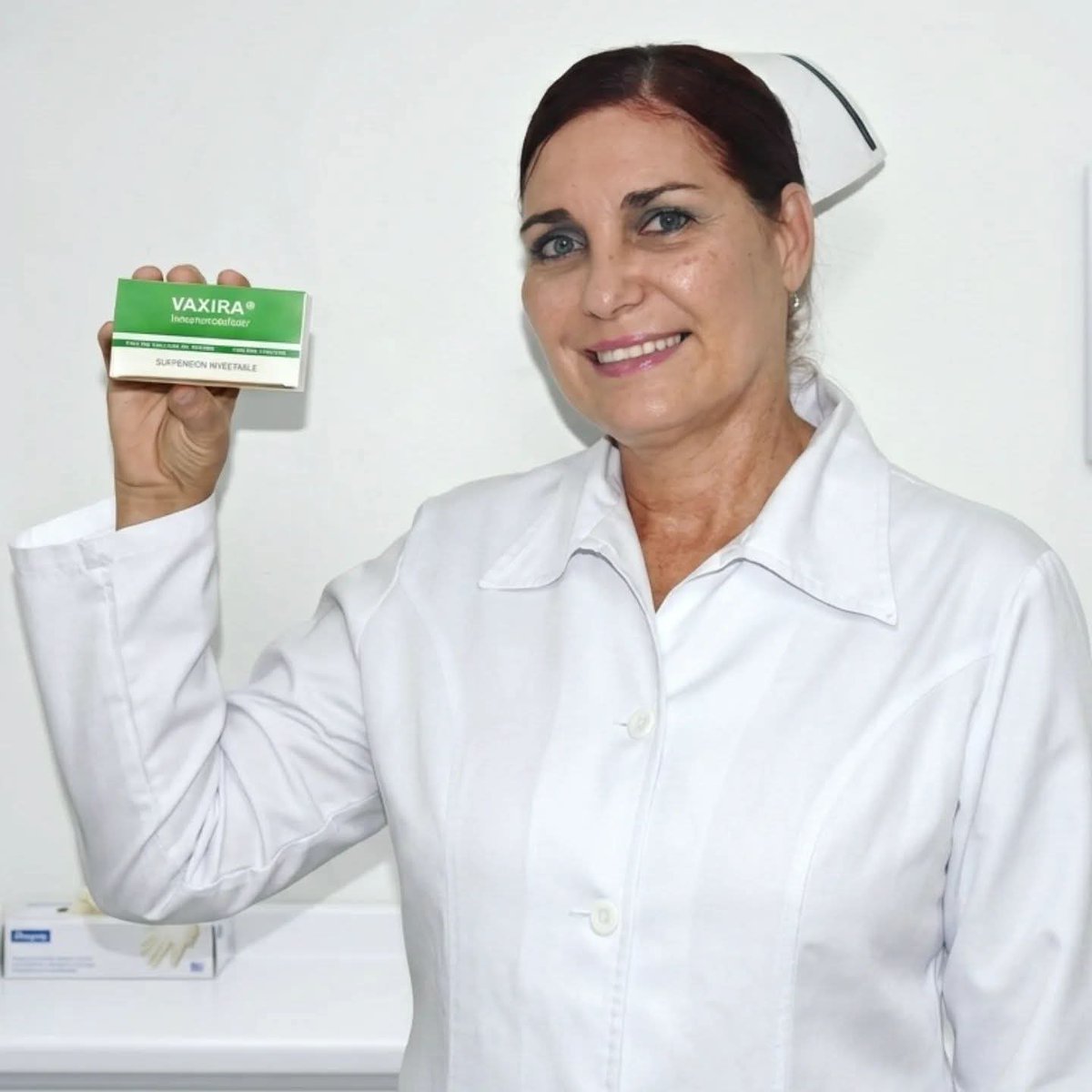
🇨🇺 Cuba has done it again.
Meet VAXIRA® — a therapeutic cancer vaccine developed by Cuban and Argentine scientists that helps the immune system recognise and destroy lung cancer cells. Approved in both Cuba and Argentina for advanced non-small cell lung cancer.
🔬 It works by mimicking a molecule found on cancer cells but almost entirely absent in healthy human tissue — meaning it targets tumours with remarkable precision and very few side effects.
📊 Clinical trials showed a significant improvement in survival for advanced lung cancer patients, with 1-year survival nearly doubling compared to the control group. Real-world data shows median survival of up to 24.5 months in maintenance therapy.
💉 Minimal side effects. Suitable for long-term use. Affordable and accessible — unlike many Western immunotherapies that price patients out of treatment.
And in 2025, VAXIRA® received Cuba's National Technological Innovation Award. All of this achieved by a country under decades of US economic blockade.
The United States spends billions on cancer research. Cuba, under sanctions, develops vaccines the world hasn't seen before. 🇨🇺🔬
#VAXIRA #CubanScience #LungCancer #CancerResearch #Biotechnology
On the day Iran was attacked,
the Supreme Leader of Iran was martyred,
Iranian commanders were martyred,
the Supreme Leader’s granddaughter was martyred.
Who was condemned?
META sent me an AI message flagging my Facebook profile, saying it will no longer be promoted because of "lack of original content." This was part of my response to them:
"You are flagging my profile, claiming I put up unoriginal content. Clearly, your AI leaves much to be desired. The majority of my posts are either A) videos of interviews I have given to mainstream and alternative media, so BY DEFINITION, it is ORIGINAL content. I created it. And B) it is me providing ANALYSIS of news, which is my job as the co-head of a think tank. Again, by definition, it is original.
If you want to ban me because I am critical of Israeli policies, then just say so instead of hiding behind these insulting pretexts.
I used to think the most remarkable thing about Gaza was how people survive death.
Lately, I have begun to think it is how they survive life.
For the past two days, I have found myself walking through the streets, studying the faces of strangers. I was trying to understand a contradiction that exists nowhere more clearly than here:
How do people continue to laugh after burying those they love?
How do weddings still happen?
How do mothers still buy sweets for their children?
How do people keep searching for small fragments of happiness while carrying so much grief?
Yesterday, I saw a crowd gathered around an elderly woman on the side of the road, she looked as though she was about to collapse.
I approached and introduced myself as a doctor, but before I could ask what had happened, a young woman standing beside her spoke.
“It is the sadness,” she said.
Then, after a brief pause: “Whenever there is a happy occasion, she remembers my brother who was killed in the war.”
“She starts crying. Sometimes she loses consciousness.”
I checked on her and continued walking.
But I carried the scene with me.
A while later, I heard a young man shouting for water.
I turned and saw another elderly woman being held upright by two men.
Her body had not failed her. Her grief had.
I walked over and asked only one question:
“Was she remembering someone she lost?”
The young man looked at me and nodded.
“Yes. My brother.”
The same story.
Twice, within less than thirty minutes.
Two women. Two families.
One wound.
And this is the truth,
Gaza exists in two realities at the same time.
The first is visible.
Children playing, markets crowded with people, families attending weddings, mothers preparing meals.
Life insisting on itself.
The second reality is hidden beneath the surface.
A city of empty chairs, unanswered phone calls, bedrooms preserved exactly as they were the day their owners never returned.
A city where every moment of happiness accidentally steps on a memory.
Perhaps that is why joy feels different here.
It never arrives alone, it drags sorrow behind it like a shadow.
Every celebration has an absent guest, every smile carries a name.
Every mother who watches children play sees one child that nobody else can see.
And yet people continue, that is the miracle. Not that they are strong. Not that they have healed.
But that they continue.
They gather, they laugh, they fall in love, they make plans for tomorrow.
All while carrying losses heavy enough to stop a heart.
And this is what Gaza truly is:
A place where people keep planting flowers in the ruins, while beneath their feet, the graves are still fresh.
#WoundedGaza #EidMubark
A Stanford professor spent years trying to prove that people who multitask the most are the best at it. He tested 262 students and found the exact opposite. It was the most embarrassing result of his career.
His name was Clifford Nass.
He had spent decades at Stanford studying how humans interact with technology, and by 2009 he was certain he knew what the results would show before the study even started.
He was wrong about everything.
Nass and his colleagues divided 262 Stanford students into two groups: heavy media multitaskers and light media multitaskers.
People who regularly juggled email, texts, multiple browser tabs, music, and TV simultaneously versus people who mostly did one thing at a time.
The assumption going in was obvious. Heavy multitaskers must have built some kind of superpower. Their brains had been training under constant load for years. They should be faster at switching between tasks, better at filtering out irrelevant information, sharper at holding things in working memory.
They tested all three.
Memory first.
Students were shown sequences of letters and asked to identify when a letter was repeating. The heavy multitaskers did worse and kept getting worse the further they went. The more they had multitasked in real life, the less their brain could hold in the moment.
Filtering second.
Students were shown a grid of red and blue rectangles, which disappeared, and were asked whether any of the red ones had moved. The instruction was clear: ignore the blue ones. The light multitaskers had no problem. The heavy multitaskers could not stop looking at the blue rectangles. They were pulled toward irrelevant information even when explicitly told to ignore it.
Task switching third.
This was the one that ended the argument. Researchers expected that if heavy multitaskers were better at anything, it would be moving between tasks quickly. That is the entire premise of multitasking as a skill. But the heavy multitaskers were dramatically slower and less accurate at switching than people who barely multitasked at all.
Nass described it in the words he would repeat for the rest of his life.
They are suckers for irrelevancy. Everything distracts them.
He went looking for what multitaskers were better at. He found nothing. Not one thing.
What he had discovered was the opposite of what everyone believed. Multitasking is not a skill that improves with practice. It is a habit that degrades the very machinery you need to think. The more you do it, the worse your brain gets at focusing when you finally try.
5 years later, neuroscientists at the University of Sussex put 75 adults in an MRI machine. They measured how often each person used multiple screens simultaneously and then looked at their brain structure.
The heavy media multitaskers had less grey matter density in the anterior cingulate cortex. That is the region responsible for attention, impulse control, and decision-making. Not weaker activation. Less physical tissue. The damage was structural, written into the architecture of the brain itself.
Nass had been warning companies about this for years. In 2012 he stood in front of a room of executives and told them that forcing employees to multitask was not a productivity strategy.
It was a brain safety problem. He used the exact words: OSHA problem. The same language you use when a factory floor is injuring workers.
Nobody changed anything.
The notifications stayed on. The open-plan offices stayed open. The Slack channels kept pinging. The expectation that a good employee responds to everything immediately and handles ten things at once stayed exactly where it was.
Clifford Nass died in November 2013 at 55, collapsing after a hike near Lake Tahoe. He had spent his entire career measuring what constant switching was doing to the human brain. The world listened politely and went back to checking its phone.
A psychiatrist in London had found something related a few years earlier. He gave IQ tests to workers while emails and phone notifications arrived in the background. Their scores dropped 10 points. More than the drop from smoking marijuana. More than missing a full night of sleep. The distraction did not just interrupt the work. It made people measurably less intelligent while it was happening.
Most people read that and laughed and went back to their inbox.
Gloria Mark at the University of California spent years tracking how long office workers actually stayed on one task before something pulled them away. The average was three minutes. And after each interruption, it took 23 minutes and 15 seconds to fully return to the depth of focus they had before.
Do that math across a normal workday and you arrive somewhere most people would rather not look at directly.
You are not bad at focusing. You have been practicing the wrong thing for years, inside systems designed to fragment your attention, and you have been rewarded for it the whole time.
The heavy multitaskers in Nass's study were not careless. They were the ones who said yes to everything, responded to everyone, kept every channel open. They were doing exactly what modern work asked of them.
And their brains were paying for it in ways nobody could see from the outside, until someone put them in a scanner.
The one thing that will not fix this is trying harder to focus while the notifications are still on.
Nass knew that. He said it out loud for years.
The people who would not listen are still sitting in open offices with 14 tabs open wondering why they cannot think straight after lunch.
Democracy only spread because it was the best system for producing compliant trading partners.
A democracy has elections. Elections require parties. Parties require financing. Financing requires capital. Capital has interests. So by design, every democracy in the world has a built-in mechanism that ensures the people with money have disproportionate access to the people with power.
You don’t need to bribe a dictator and hope he stays in power. In a democracy, you just fund both candidates and own the outcome regardless.
This is why US spent the Cold War toppling democracies that elected the wrong people Mossadegh in Iran, Allende in Chile, Lumumba in Congo and replacing them with dictators who were more “stable.” Stable meaning: predictable to capital.
The genius of it is the aesthetics. Democracy looks like self-determination. It has flags and anthems and moving inauguration speeches. People will die for it. But the operating system underneath is remarkably friendly to concentrated wealth arguably more so than overt authoritarianism, which at least makes the power visible.
The most honest political scientists will tell you: what actually spread after 1989 was markets. Democracy was the packaging.
And the packaging worked so well that the people inside it genuinely believe they’re free which is the final, most elegant feature of the system.
A cage you can’t see is the strongest cage ever built.
The funniest maths in modern environmentalism.
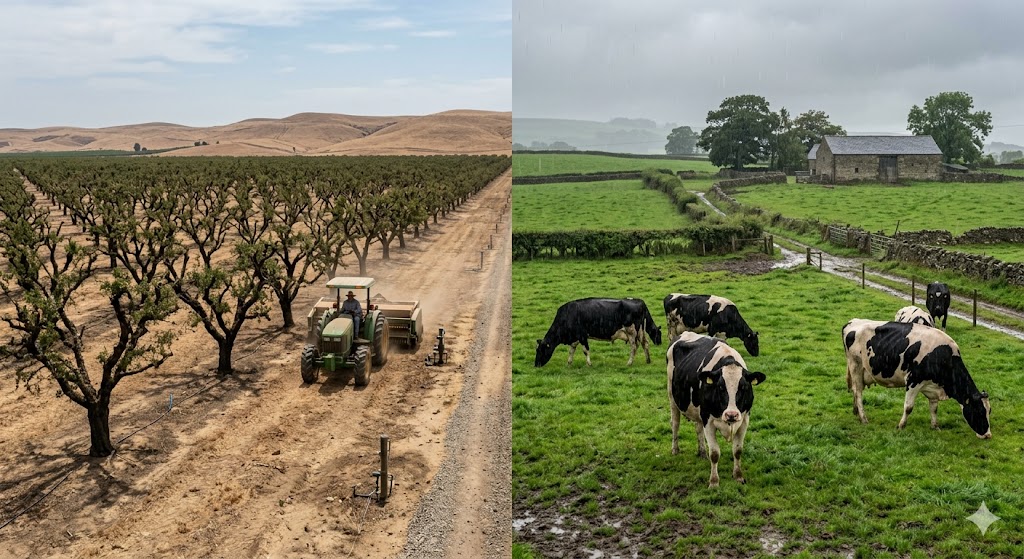
One almond requires 12 litres of irrigated water to produce. Peer-reviewed, ScienceDirect, 2017. A glass of almond milk contains roughly 50 of them. 600 litres of water before the carton is filled.
The water comes from the San Joaquin Valley in California, which sits over one of the most over-extracted aquifers on earth. The valley floor has subsided by up to nine metres in places due to groundwater depletion. The carton is then refrigerated, sailed across the Atlantic, refrigerated again, lorried to a Manchester Tesco, and bought by someone who is concerned about the environmental impact of dairy.
Meanwhile, in Cheshire.
A British dairy cow drinks roughly 70 to 100 litres of water a day and produces around 28 litres of milk. That's about 3.5 litres of water per litre of milk. The water is rainwater that fell on her field or came from a local stream fed by the same rainwater. The rain was going to fall on the field whether the cow stood in it or not. 80% of her moisture intake comes from the grass itself, which is also rain.
She converts the grass, free of charge, into a litre of milk containing seven times the protein and four times the calcium of almond milk, and shipped roughly 18 miles to the same Tesco.
To recap.
600 litres of stolen aquifer, flown halfway round the world for nutritionally worthless beige water.
Or 3.5 litres of rain that was already falling, converted by an animal you can pet, into actual food.
The shopper picks the almond.
She has been told this is the ethical position.
The aquifer would like a word.
DON'T WASTE ANOTHER YEAR OF YOUR LIFE
Fix Yourself in 40 Ways Before It's Too Late
1. Deep clean your room. Your outer world is a printout of your inner chaos.
WOW!
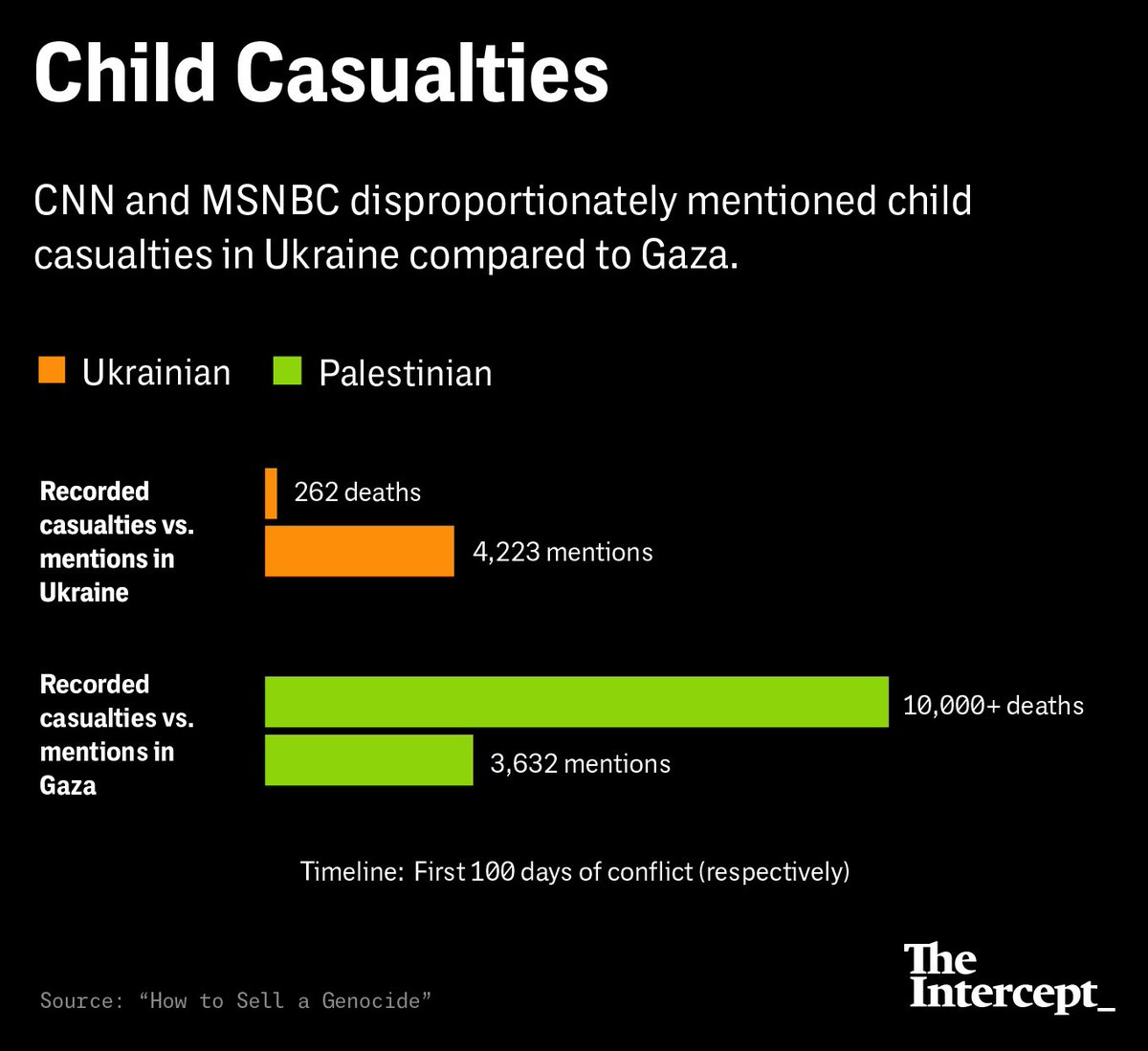
@Theintercept reviewed more than 12000 print articles and 5000 TV segments to check for biases on Israel-Palestine.
I thought it would be bad.
I had no idea it was THIS bad.
No wonder Gaza killed what little credibility mianstream media had.
In NYT, Israel's right to defend itself was invoked 99 times. Only once for Palestine.
On CNN and MSNBC, it was invoked 755 times for Israel. But only 8 times for Palestine.
Emotive words such as slaughter and massacre were used frequently when Israelis had been killed. They were NEVER used in print when Palestinians were killed.
In Ukraine, 262 children were killed in the war, and it was mentioned 4223 times.
In Palestine, more than 10,000 children were killed, but it was mentioned only 3632.
The full article is in the subtweet. It's a MUST READ:
We are cooking with Thomas Massie and learning about how he built this entire place with his barehands, and his own saw mill. This dude is a legend. Ed can’t even build momentum for a political campaign but hey, maybe he’s too busy watching Only Fans. I’m not judging, just saying.
A psychologist at the University of North Carolina spent 20 years proving that a single 20-second hug rewires the human cardiovascular system, and the experiment she ran is so simple you can replicate it tonight at home.
Her name is Karen Grewen.
She works inside the UNC School of Medicine's Department of Psychiatry. The paper that made her famous was published in 2003, and almost nobody outside her field has read it.
Here is what she actually did.
She recruited 183 healthy adults living with a long-term partner. She split them into two groups. The warm contact group sat together for 10 minutes holding hands while watching a romantic video. Then they stood up and hugged each other for exactly 20 seconds.
The control group sat alone in a separate room for the same amount of time doing nothing.
Then she made every single one of them give a public speech in front of a panel.
Public speaking is one of the cleanest stressors in psychology. Heart rate spikes. Blood pressure climbs. Cortisol floods the system within minutes. It is the laboratory version of every stressful moment you have ever had at work.
The people who had been hugged for 20 seconds before walking into that room had measurably lower blood pressure responses to the stress. Lower systolic. Lower diastolic. Lower heart rate increases. Everything was the same.. the speech, the panel, and fear. But this time completely different physiological response.
The hug had not made the stress disappear. It had changed how the body was allowed to respond to it.
Two years later Grewen ran the follow-up study that explained why. She drew blood from 38 couples before and after the same warm contact protocol and measured what was actually changing inside them. The answer was a hormone called oxytocin.
Oxytocin is the chemical your body releases during childbirth, breastfeeding, and orgasm. It is the same molecule that makes a mother feel calm holding her newborn.
Grewen's data showed that 20 seconds of physical contact with a trusted partner triggered a measurable spike in plasma oxytocin in both men and women, and the size of that spike directly predicted how much their blood pressure dropped.
The mechanism turned out to be older than recorded history. Oxytocin binds to receptors in your heart, your blood vessels, and the part of your brainstem that controls how aggressively your nervous system reacts to threat.
When the hormone shows up, the entire fight-or-flight machine downshifts. Your blood vessels widen. Your heart slows. Your cortisol production gets suppressed.
This is not a feeling. This is a chemical instruction your body sends to itself that you can measure with a blood pressure cuff.
The detail Grewen kept emphasizing in her interviews was the duration. Three seconds is the average length of a hug between two humans. It is too short.
The hormonal cascade does not have time to start. 20 seconds is the threshold where the oxytocin actually crosses into the bloodstream in a quantity large enough to do something measurable.
A follow-up study tracked 59 premenopausal women over time and found that the ones who hugged their partners most frequently had lower resting blood pressure and higher baseline oxytocin levels than the ones who did not. The effect compounded. Daily hugs produced a permanent shift in the cardiovascular baseline.
A separate review of long-term partner contact research found that married adults with frequent affectionate touch had significantly lower rates of heart disease and all-cause mortality than equally healthy adults without it.
The American Heart Association now cites this body of research when explaining why social isolation is treated as a cardiovascular risk factor on the same level as smoking.
The most haunting line in Grewen's research is one she said in an interview after publishing the second paper. She pointed out that the average American touches another human being less than they did 50 years ago. Phones replaced eye contact. Texts replaced visits. Hugs at the door got shorter.
The thing that used to regulate our cardiovascular system multiple times a day quietly disappeared from most adult lives.
Your body still expects it. The hormone receptors are still there waiting. The system was designed to be reset by physical contact with people who feel safe, and the reset takes 20 seconds.
You can run the experiment yourself tonight. Hug someone you love for 20 full seconds. Count it out. The first 10 will feel awkward. Around 15 something shifts. By 20 the shoulders drop, the breathing slows, the chest opens.
That is not in your head. That is your bloodstream changing.
🇬🇷Ελλάδα Μου (❤️) – Όλη η Ομορφιά της Ελλάδας σε Ένα Τραγούδι 🎶🎶🎶
Ένα τραγούδι αφιερωμένο στην 😍ομορφιά της 🇬🇷Ελλάδας…
στις θάλασσες, στα νησιά, στα χωριά στα Βουνά και στις στιγμές που μένουν για πάντα.
Για όλους όσους (❤️) αγαπούν την
Ελλάδα🇬🇷 — όπου κι αν βρίσκονται.
https://t.co/jQH54Oghsv
IN PRAISE OF FRANCESCA ALBANESE
There is a question that visits me in the small hours, when sleep will not come and the mind turns over old stones. The question is this: “What would I have done in the 1930s, on the morning after Kristallnacht?"
Not what I say I would have done. Not what I hope I would have done. But what would I actually have done—when the trains began to run, when the neighbours grew quiet, when the cost of decency became the loss of everything?
Most of us, I think, would have done little. Not from malice. From fear. From the soft, creeping conviction that someone else will speak, that the situation is complex, that we must be 'reasonable'. Lest we forget, the ordinary is the extraordinary's alibi. And how we have clung to that alibi! How we still cling to it!
And then, every once in a terrible while, someone appears who does not cling. Someone who steps forward when others step back. Someone who speaks the name of the thing when everyone else is busy naming something else.
Francesca Albanese is that someone.
She stands before the world—alone, unarmed, armed only with law and language and a rare courage—and she says what the centrists will not say, what the foreign ministries will not say, what the editorial boards will not say. She says: "This is a genocide. And we are watching it happen."
Do not tell me that is hyperbole. Do not tell me the term is contested. She has not used it lightly. She has used it as a physician arrives scientifically at a diagnosis—not to wound, but to warn. Not to inflame, but to name.
And for that, they have come for her. Oh, how they have come for her. Smears. Investigations. Vicious editorials. Frozen bank accounts. Dispossession of the only apartment she had ever owned. The machinery of the respectable turned to crush her. Because the respectable cannot abide what she represents: a mirror held up to their complicity.
Let us, once again, travel back to the 1930s. Back to the few who stood up when the trains began to run laden with Jewish people.
There was Aristides de Sousa Mendes, a Portuguese consul in Bordeaux. He defied his own government. He signed thousands of visas, by hand, for hours, until his fingers bled. He saved more lives than Schindler. And he died penniless, disgraced, erased.
There was a German officer in Warsaw named Wilm Hosenfeld. He hid a Jewish pianist in the rubble. He did not save thousands. He saved one. But that one—Władysław Szpilman—carried the memory. And memory is "the only haven from which we cannot be expelled."
There was Raoul Wallenberg. There were the villagers of Le Chambon. There were the anonymous, the quiet, the furious few who said: “Not on my watch.”
Francesca Albanese is their heir. Not because she carries a gun. Not because she hides refugees in her basement. But because she does something equally dangerous in a world that has perfected the art of not seeing. She sees. And she speaks.
She does not speak as a diplomat. Thank Goodness she doesn't! Diplomats have given us the language of "there are arguments on both sides" and "restraint" and "proportionality." Diplomatic language is the perfumed grave of moral clarity. No, she speaks as a jurist. As a human being. As a woman who has looked into the abyss and refused to call it a "complex geopolitical landscape".
Edna O'Brien once described a character who "had the recklessness of those who have already lost everything worth losing." Francesca Albanese has not lost everything. She has her dignity, her office, her voice, her family. But she has calculated the cost of speaking truth to power. And she has decided that that cost is infinitely less than the cost of silence.
What is that cost? Let us name it. She has been called antisemitic—she, who stands on the ground of international law forged in the ashes of Auschwitz and the fires of Nuremberg. She has been called a conspiracy theorist—she, who cites every source, every footnote, every UN resolution. She has been called naive—she, who understands better than most the machinery of realpolitik.
These accusations are not arguments. They are the spittle of the threatened. Because Francesca Albanese threatens something very precious to the powerful: the right to commit atrocity without being named.
Friends, the 1930s did not arrive with jackboots and pogroms on day one. They arrived in small increments. With "reasonable" restrictions. With "proportional" measures. With the silence of the respectable.
We tell ourselves that we would have been different. That we would have been Sousa Mendes. That we would have been Wallenberg. But most of us, I fear, would have been the neighbours who later said, "I didn't know."
Francesca Albanese knows. And she refuses to pretend otherwise.
So let us praise her. Not with statues or awards she does not seek. But with something harder: with our own refusal to look away. With our own voices, raised in places that are safe for us but dangerous for her. With our own bodies, if it comes to that.
A brave woman, who was injured while demonstrating outside a US nuclear military base in 1982, the infamous Greenham Common, had told me that "the heart is a hunter for what it cannot have." But I say the heart is a hunter for what it will not lose. And what we will not lose is the memory of those who stood up when standing up cost everything.
Francesca Albanese is standing up now. In our time. In our name. Under our indifferent sky.
Let us stand with her.
Not tomorrow. Not when it is safe. Now.
[Extract from a speech in Athens on Sunday 3rd May 2026]









![yanisvaroufakis's tweet photo. IN PRAISE OF FRANCESCA ALBANESE
There is a question that visits me in the small hours, when sleep will not come and the mind turns over old stones. The question is this: “What would I have done in the 1930s, on the morning after Kristallnacht?"
Not what I say I would have done. Not what I hope I would have done. But what would I actually have done—when the trains began to run, when the neighbours grew quiet, when the cost of decency became the loss of everything?
Most of us, I think, would have done little. Not from malice. From fear. From the soft, creeping conviction that someone else will speak, that the situation is complex, that we must be 'reasonable'. Lest we forget, the ordinary is the extraordinary's alibi. And how we have clung to that alibi! How we still cling to it!
And then, every once in a terrible while, someone appears who does not cling. Someone who steps forward when others step back. Someone who speaks the name of the thing when everyone else is busy naming something else.
Francesca Albanese is that someone.
She stands before the world—alone, unarmed, armed only with law and language and a rare courage—and she says what the centrists will not say, what the foreign ministries will not say, what the editorial boards will not say. She says: "This is a genocide. And we are watching it happen."
Do not tell me that is hyperbole. Do not tell me the term is contested. She has not used it lightly. She has used it as a physician arrives scientifically at a diagnosis—not to wound, but to warn. Not to inflame, but to name.
And for that, they have come for her. Oh, how they have come for her. Smears. Investigations. Vicious editorials. Frozen bank accounts. Dispossession of the only apartment she had ever owned. The machinery of the respectable turned to crush her. Because the respectable cannot abide what she represents: a mirror held up to their complicity.
Let us, once again, travel back to the 1930s. Back to the few who stood up when the trains began to run laden with Jewish people.
There was Aristides de Sousa Mendes, a Portuguese consul in Bordeaux. He defied his own government. He signed thousands of visas, by hand, for hours, until his fingers bled. He saved more lives than Schindler. And he died penniless, disgraced, erased.
There was a German officer in Warsaw named Wilm Hosenfeld. He hid a Jewish pianist in the rubble. He did not save thousands. He saved one. But that one—Władysław Szpilman—carried the memory. And memory is "the only haven from which we cannot be expelled."
There was Raoul Wallenberg. There were the villagers of Le Chambon. There were the anonymous, the quiet, the furious few who said: “Not on my watch.”
Francesca Albanese is their heir. Not because she carries a gun. Not because she hides refugees in her basement. But because she does something equally dangerous in a world that has perfected the art of not seeing. She sees. And she speaks.
She does not speak as a diplomat. Thank Goodness she doesn't! Diplomats have given us the language of "there are arguments on both sides" and "restraint" and "proportionality." Diplomatic language is the perfumed grave of moral clarity. No, she speaks as a jurist. As a human being. As a woman who has looked into the abyss and refused to call it a "complex geopolitical landscape".
Edna O'Brien once described a character who "had the recklessness of those who have already lost everything worth losing." Francesca Albanese has not lost everything. She has her dignity, her office, her voice, her family. But she has calculated the cost of speaking truth to power. And she has decided that that cost is infinitely less than the cost of silence.
What is that cost? Let us name it. She has been called antisemitic—she, who stands on the ground of international law forged in the ashes of Auschwitz and the fires of Nuremberg. She has been called a conspiracy theorist—she, who cites every source, every footnote, every UN resolution. She has been called naive—she, who understands better than most the machinery of realpolitik.
These accusations are not arguments. They are the spittle of the threatened. Because Francesca Albanese threatens something very precious to the powerful: the right to commit atrocity without being named.
Friends, the 1930s did not arrive with jackboots and pogroms on day one. They arrived in small increments. With "reasonable" restrictions. With "proportional" measures. With the silence of the respectable.
We tell ourselves that we would have been different. That we would have been Sousa Mendes. That we would have been Wallenberg. But most of us, I fear, would have been the neighbours who later said, "I didn't know."
Francesca Albanese knows. And she refuses to pretend otherwise.
So let us praise her. Not with statues or awards she does not seek. But with something harder: with our own refusal to look away. With our own voices, raised in places that are safe for us but dangerous for her. With our own bodies, if it comes to that.
A brave woman, who was injured while demonstrating outside a US nuclear military base in 1982, the infamous Greenham Common, had told me that "the heart is a hunter for what it cannot have." But I say the heart is a hunter for what it will not lose. And what we will not lose is the memory of those who stood up when standing up cost everything.
Francesca Albanese is standing up now. In our time. In our name. Under our indifferent sky.
Let us stand with her.
Not tomorrow. Not when it is safe. Now.
[Extract from a speech in Athens on Sunday 3rd May 2026]](https://pbs.twimg.com/media/HHsnlr9WIAEr4Cw.jpg)


