A huge amount of effort went into this paper by the community and by a dedicated group of lead authors, I played a teeny tiny part in it, but delighted to see it published https://t.co/DcFAhRqTxK
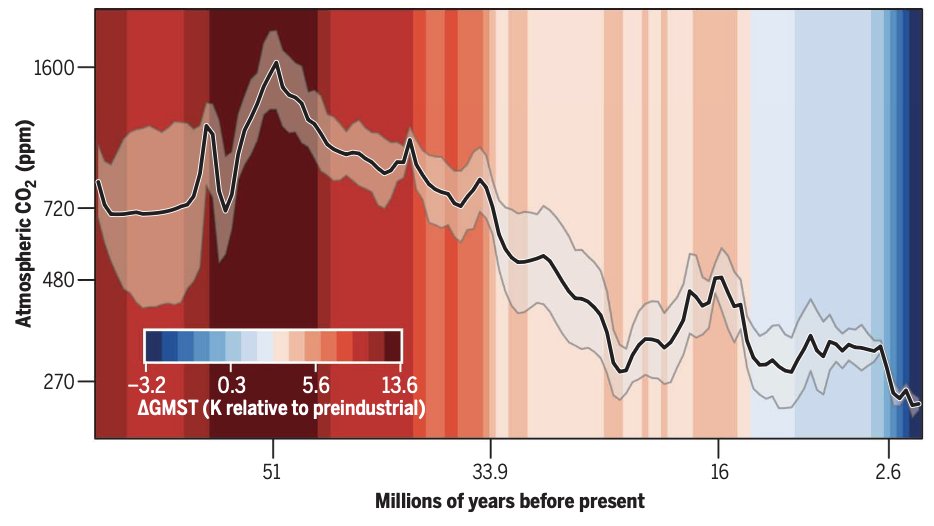
Massive new review of ancient atmospheric CO2 levels and corresponding temperatures by a consortium of 80+ researchers coordinated by @columbiaclimate@LamontEarth geochemist Bärbel Hönisch lays out daunting picture of where Earth's climate may be headed. https://t.co/KQ75NKRNbo
"In summary, the Cenozoic compilation confirms a strong link between CO2 and GMST across timescales from 500 kyr to tens of millions of years,..." https://t.co/SRF2Rp1Mx9
Just out, a 66 million year history of atmospheric CO2. Key take away: CO2 hasn't been at today's levels for at least 3 million years. These high CO2 worlds in the geological past had less ice and *much* higher sea levels 📈🌊 #COP28 https://t.co/BYPWWAuoAR
Seismica by the numbers! 💯
We’ve completed two issues, the current third issue has several articles available, and our special issue on the is also in progress. Check them all out here:
https://t.co/GBg0meXnxA
Great news: We officially have a publisher!
@CUOpenResearch has just accepted our proposal. We're very much looking forward to working with them to further Diamond Open Access in Geochemistry/Cosmochemistry.
Also, keep voting for the logo! https://t.co/Wd5ojZL8Dt
@KeepItRheol @NatalyaGomezEPS It doesn’t roll off the tongue, but frolleague seems to fit the description. (Also congrats @NatalyaGomezEPS !)
https://t.co/GalTAW5yQc
Huge shout out to the journal Seismica @WeAreSeismica, a new community-driven diamond open-access journal. That diamond 💎 means it is free to read (without subscription), and there are no article processing fees for authors.
Excited to share a new paper by @gcoffey_ that compiles estimates of friction heating from earthquakes across many faults to show how the energy budget of large and small earthquakes are different. Published in all OA and no-pub-fee @WeAreSeismica: https://t.co/9xOKIFeh8E
In small earthquakes (<1-10 m of slip), the earthquake energy budget is dominated by frictional heating, while in large earthquakes (>1-10 m of slip) energy is more equally split between frictional heating, radiating seismic waves, and damage (fractures).