Don't waste 2 years learning to become an AI agentic engineer in 2026.
Andrew Ng, the godfather of AI, gave the complete playbook to become one from scratch.
1 hour course. Free:
• 00:00 - AI agent basics
• 12:12 - AI Agentic workflows & design patterns
• 53:27 - Practical tips for building AI agents
• 1:20:30 - self-improving AI agent loops
• 1:30:19 - multi-agent AI systems
I watched it last night.
Halfway through, I realized I could get into Anthropic in weeks, not years.
Bookmark now. Watch it. Then build your own AI agent
Long-horizon research agents need a practical way to search, browse, and extract information across multi-step tasks.
OpenResearcher is a fully open agentic 30B-A3B language model designed for long-horizon deep-research scenarios.
It deploys an OpenResearcher model through vLLM, pairs it with a browser pool and search backend, then runs a deep-research agent that searches the web, browses pages, and extracts relevant information.
Key features:
• Open training and evaluation recipe covering a 96K high-quality deep-research trajectory dataset, model, distillation recipe, and evaluation framework.
• Training trajectories contain 100+ turns generated by GPT-OSS-120B with native browser tools.
• A self-built retriever over a dedicated approximately 11B-token corpus eliminates the need for external search APIs during trajectory generation.
• Supports local BM25 or dense search for BrowseComp-Plus and a Serper search backend for other listed benchmarks.
• Includes benchmark workflows for BrowseComp-Plus, BrowseComp, GAIA-text, and xbench-DeepResearch.
Link in the reply 👇
your agent loop needs 8 exits. most people ship only one.
(explained with triggers)
1) goal met
→ an evaluator scores the output against a rubric, and the run stops on a pass.
→ fires when the work is measurably done, not when the model says it is done.
2) turn cap
→ a hard ceiling on iterations, counted and enforced by the harness, not the prompt.
→ fires on the task it was never going to finish, before you pay to find that out.
3) budget cap
→ a limit on tokens or dollars, whichever one runs out first.
→ fires mid-run, which is exactly why it is the exit that saves you the 3am bill.
4) wall clock
→ a deadline on elapsed time, independent of how much progress was made.
→ fires when the run collides with a deploy window or the start of business hours.
5) no progress
→ hash the state every turn and compare it against the last few.
→ fires when three turns in a row change nothing. busy is not the same as moving.
6) human interrupt
→ an approval gate before risky steps, plus a kill switch that lives outside the loop.
→ fires whenever you decide, and it is the one exit the model cannot argue with.
7) error threshold
→ a counter of consecutive failures that resets on any success.
→ fires at n in a row, so it halts instead of retrying into the same wall all night.
8) external event
→ a webhook or a poll on whatever the task was actually about.
→ fires when the PR merged or the ticket closed and the work stopped mattering.
a loop with one exit hangs. a loop with eight is a system.
write the exits before you write the prompt.
🚀 Excited to share that #DSGym has been accepted to ICML 2026!
DSGym is a holistic, unified framework for evaluating and training data science agents with standardized abstractions and a modular architecture for adding tasks, agent scaffolds, and tools.
In this work, we:
🔍 Show that existing data science benchmarks are vulnerable to shortcuts: agents can often solve tasks without using the actual data.
📊 Release DSGym-Tasks, a curated task ecosystem that standardizes and audits representative benchmarks, filters shortcut-solvable tasks, and expands coverage with new scientific tasks.
⚡ Use DSGym for execution-grounded trajectory synthesis: with only 2K samples, we train a 4B model that outperforms GPT-4o on standardized data analysis benchmarks.
📄 Paper: https://t.co/qOjF9zkez9
💻 Code: https://t.co/tcrm5cEWoa
🤗 Dataset: https://t.co/BljIGgoBpr
🧵👇
In this article, I shared my perspective on AI.
AI excels at supervised learning, and well annotated datasets can help unlock new AI capabilities.
🔗 https://t.co/5GE6COBoZQ
OA 🔗 https://t.co/NlzoW2RLNx
AI Analysis on Constitutional Reform: Towards a Directly Elected #PrimeMinister in #Nepal
To lawyer & constitutional experts:
👉 Is this legally sound?
👉 How close is it to what would be required in reality?
@the3rdbranch@MahabirPun@jagdishkharel1#GenZ
https://t.co/uhRstPdMG0
MIT Course announcement: Machine Learning for Computational Biology #MLCB25
Fall'24 Lecture Videos: https://t.co/tA3zeuIF7g
Fall'24 Lecture Notes: https://t.co/C3WmXZuQur
(a) Genomes: Statistical genomics, gene regulation, genome language models, chromatin structure, 3D genome topology, epigenomics, regulatory networks.
(b) Proteins: Protein language models, structure and folding, protein design, cryo-EM, AlphaFold2, transformers, multimodal joint representation learning.
(c) Therapeutics: Chemical landscapes, small-molecule representation, docking, structure-function embeddings, agentic drug discovery, disease circuitry, and target identification.
(d) Patients: Electronic health records, medical genomics, genetic variation, comparative genomics, evolutionary evidence, patient latent representation, AI-driven systems biology.
Foundations and frontiers of computational biology, combining theory with practice. Generative AI, foundation models, machine learning, algorithm design, influential problems and techniques, analysis of large-scale biological datasets, applications to human disease and drug discovery.
First Lecture: Thu Sept 4 at 1pm in 32-144
With: Prof. Manolis Kellis @manoliskellis, Prof. Eric Alm @ejalm, TAs: Ananth Shyamal, Shitong Luo @luost26
Course website: https://t.co/ateGr6xKLM
@MIT@MITEECS@MITdeptofBE@MITCSBPhD@MIT_CSAIL@Harvard@HarvardMed@BroadInstitute
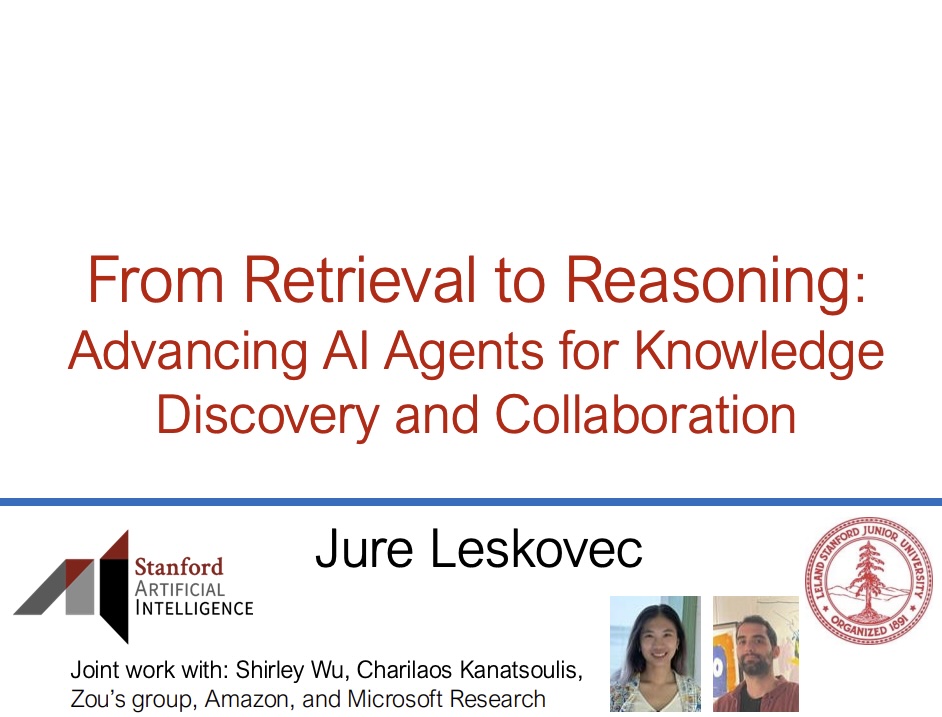
Gave a keynote at #TheWebConf2025 in Sydney! 🌏
Talked about advancing LLMs from retrieval to reasoning with:
🧠 STaRK: semi-structured QA benchmark
🔧 AvaTaR: tool-using LLM agents
🤝 CollabLLM: models that collaborate
📊 POPPER: auto hypothesis testing
Slides: https://t.co/Snonb7IbE7
सम्पत्ति शुद्धिकरण 'निवारण' सम्बन्धी विधेयक भन्दा पनि सम्पत्ति शुद्धिकरण 'प्रवर्द्धन' विधेयक भने पनि हुन्छ।
विधेयकको दफा ११ (मूल ऐनको दफा २��को संशोधन) हेर्ने हो भने यहाहरु सबैलाई स्पष्ट हुन्छ यो विधेयक भ्रष्टाचारीहरुलाई प्रशय दिन ल्याईएको हो । अझ भ्रष्टाचारीको राज चलाउन कानुन समितिले अब भ्रष्टाचारीको अभिलेख समेत नराख्ने रे।
याद गर्नुहोला, यो विधेयकलाई दफा खारेज नगरी पास गर्ने को को हुनुहुन्छ भनेर! भ्रष्टाचारका संरक्षक को को हुनुहुन्छ भनेर।
आजको सम्पत्ति शुद्धिकरण निवारण सम्बन्धी विधेयकको दफावार छलफलमाः
Use Copilot for free and completely privately with the DeepSeek models in VSCode
Follow these 5 steps:
- Download the CodeGPT extension for VSCode:
https://t.co/SVtA7v5Hdk
- Download @Ollama_ai: https://t.co/HNFGJe2b3R
- Once installed, run the following command in the terminal: "ollama run deepseek-coder"
- In CodeGPT settings in VSCode, select Ollama as the provider and the model as deepseek-coder.
- All set! ✅
Start coding with these powerful expert models in mathematics and programming.
In this new version of CodeGPT, the interface has been improved, and the following models have been added:
✨ codellama:13b
✨ zephyr
✨ deepseek-coder
✨ deepseek-coder:33b
Open-source models are gradually taking their rightful place, and the best part is... they run on CPUs 🤩
Here, in full directly on Twitter, is "A Hackers' Guide to Language Models". This 90 minute tutorial is designed to be the one place I point coders at when they ask "hey, tell me everything I need to know about LLMs!"
It covers both @OpenAI models and open source ones in depth.



![KirkDBorne's tweet photo. [Download PDF] Data Science Project Manual
https://t.co/i8uDd1VgH9 https://t.co/IUNyU3IBSS](https://pbs.twimg.com/media/Gq18jbrWwAIE32e.jpg)