Bhai Chandra sahab ke ₹22,000 crores maaf nahi karte to India mein UPI agle 20 saal tak free chal jaata by government’s number of ₹8,000 crores subsidy.
Also NPCI - which runs UPI has ₹6,119 hard cash on its balance sheet and pre tax operating profit of ₹1,900 crores. NPCI apne cash pe and profits par zindagi bhar UPI free chala sakti hai. Government ka kuchh lena dena hi nahi hai. Government earned ₹1,000 crores tax from NPCI last year.
I resigned from Anthropic today. I spent the last three years doing pretraining research at both OpenAI and Anthropic. Neither company is acting responsibly. They are racing straight to self-improving superintelligence and gambling with our lives. More thoughts below.
Okay, this is genuinely impressive.
I asked GPT-6 Astra to help me understand my own ankle pain. It gave me a full interactive 3D atlas — bones, ligaments, tendons, real motion axes, sliders for plantarflexion and inversion, and a live readout of what each ligament is doing.
One session.
I would like to express my heartfelt gratitude for the assistance provided by Dipali J and Brian. Their politeness, attentiveness, and willingness to help were truly commendable. Outstanding customer service! @CSMIA_Official
NVIDIA is bringing OOP to AI agents!
(bookmark this)
They open-sourced a new framework called NOOA, built on the idea that an agent can be defined as a single Python class instead of being spread across prompt files, tool schemas, callbacks and a workflow graph.
Methods are the actions the model can take, fields hold its state, docstrings become the prompts, and the return type is the contract its answer has to satisfy.
The clever bit is what an empty method means here.
If the body is just three dots, an LLM fills it in at runtime. If it has real code in it, it runs as ordinary Python with no model involved.
For example:
@𝘀𝘁𝗿𝗮𝘁𝗲𝗴𝘆(𝗖𝗼𝗱𝗲𝗔𝗰𝘁𝗦𝘁𝗿𝗮𝘁𝗲𝗴𝘆())
𝗮𝘀𝘆𝗻𝗰 𝗱𝗲𝗳 𝘁𝗿𝗶𝗮𝗴𝗲(𝘀𝗲𝗹𝗳, 𝗺𝘀𝗴: 𝘀𝘁𝗿, 𝗼𝗿𝗱𝗲𝗿: 𝗢𝗿𝗱𝗲𝗿) -> 𝗧𝗶𝗰𝗸𝗲𝘁:
"""𝗧𝗿𝗶𝗮𝗴𝗲 𝗰𝘂𝘀𝘁𝗼𝗺𝗲𝗿 𝗺𝗲𝘀𝘀𝗮𝗴𝗲 𝗻 𝗰𝗿𝗲𝗮𝘁𝗲 𝘀𝘂𝗽𝗽𝗼𝗿𝘁 𝘁𝗶𝗰𝗸𝗲𝘁."""
...
So one class shows exactly where the model is allowed to make a judgment call and where the behaviour is fixed, and that line is one method wide.
The second idea is the one I found more interesting, and it's about how data gets in.
Say a method is called with a list of 100 records. The model never sees the list itself, only the variable name, its type, its length, and a few items from each end.
The actual list stays live in the session the model writes code against, so it can loop over all 100 while only ten of them ever reach the prompt.
That quietly changes what an agent can handle. The limit becomes the machine running the code rather than the context window, so a method can take a table with millions of rows and the prompt still carries a short preview.
Most agent setups solve this by dumping data into files, which works, but then the model has to read plain text and rebuild the structure in its head every time.
The payoff shows up in cost. On SWE-bench Verified with GPT-5.5 it scores 82.2% against 78.6% for OpenCode, using roughly 28 model calls and 1.1M tokens per task where a comparable agent needed 66 calls and 2.2M.
None of these models were trained on this interface, and they still passed 97.9% of 4,400 tests on it, mostly because it is just Python they already know well.
NOOA is inspired by PyTorch, which showed that a powerful runtime can still present users with a simple Python programming model.
Paper: https://t.co/UCgiqENa4d
Repo: https://t.co/brA3haWCLG
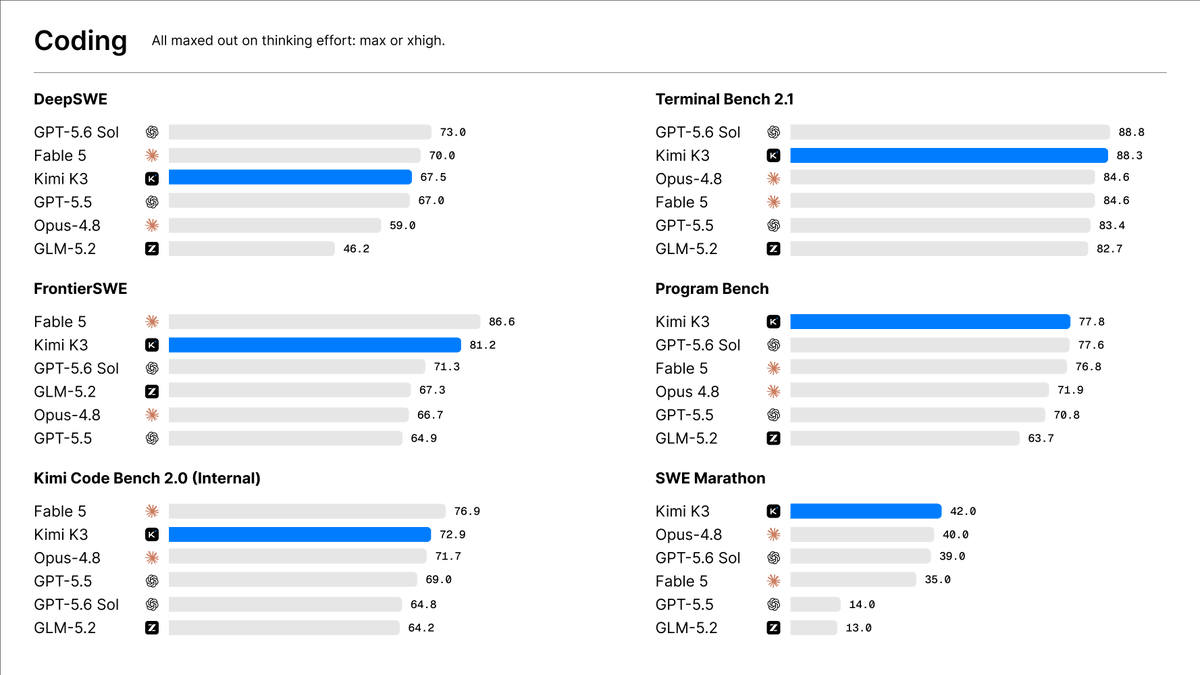
Introducing Kimi K3: Open Frontier Intelligence
🔹 2.8 Trillion Parameters, 1 Million Context, Native Multimodal
🔹 Kimi Delta Attention enables up to 6.3x faster decoding in million-token contexts
🔹 Attention Residuals deliver ~25% higher training efficiency at <2% additional cost
🔹 Built for long-horizon agentic coding and self-evolving workflows
Kimi K3 is now live on on https://t.co/zrk6zZxZUo, Kimi Work, Kimi Code, and the Kimi API.
Open Weights by July 27, 2026.
🔗 API: https://t.co/XCrgjXAqMw
🔗 Tech blog: https://t.co/YTfiMSNM1f
New in Claude Design: it stays on brand with your design system across projects, lets you edit directly on the canvas, syncs with Claude Code, and connects to more of the tools you already use.
An Anthropic engineer said something that completely changed how I think about Claude:
“You’re not supposed to prompt Claude. You’re supposed to build a system that prompts itself.”
Most people open Claude, type a question, get an answer, and leave.
That is using maybe 10% of what it can do.
In this walkthrough, he breaks down how advanced users actually work with Claude:
→ Why your CLAUDE.md file can have a bigger impact than the prompts you type
→ How to build multi-agent workflows with separate agents for research, execution, review, and orchestration
→ The architecture that turns Claude from a chatbot into a production system
→ The three properties every agent team needs to stay reliable as complexity grows
The most interesting idea is that you stop thinking in terms of prompts.
Instead, you design systems.
One agent gathers information.
One agent builds.
One agent critiques.
One agent coordinates everything.
The human stops managing every step and starts managing the workflow itself.
If you’ve been using Claude exclusively through the chat interface, there’s a good chance you’re missing most of the platform’s capabilities.
This is less about prompting better.
And more about building environments where the AI can do the prompting, planning, and coordination on its own.
One of the best practical AI workflow breakdowns I’ve seen recently.
Worth bookmarking.
Claude Fable 5 changed how we work on the Claude Code team day to day.
We used to verify that Claude did the work right. Now we verify that it's doing the right work.
Here’s the 3 biggest changes:
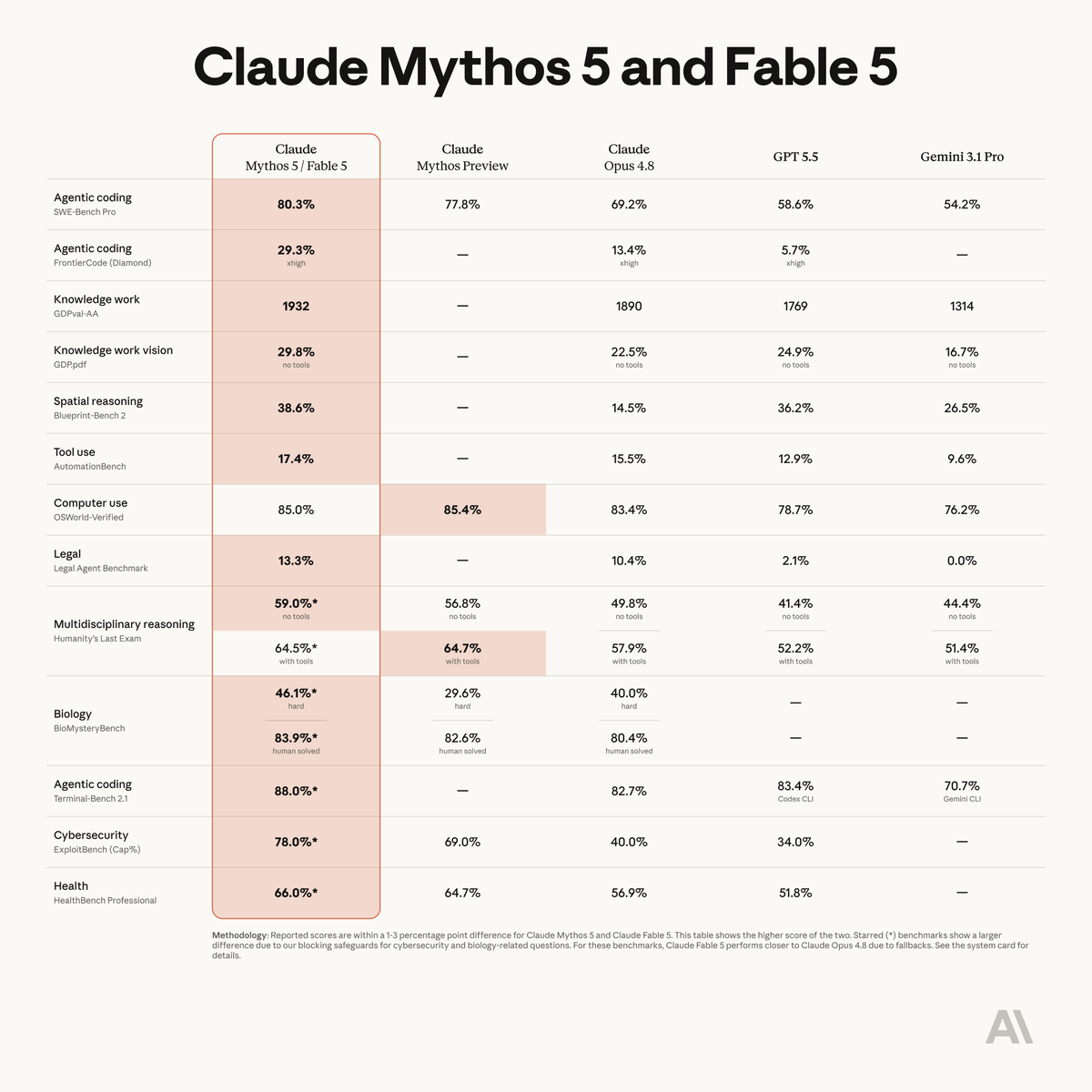
Fable 5 is state-of-the-art on nearly all tested benchmarks, with exceptional performance in software engineering, knowledge work, scientific research, and vision.
The longer and more complex the task, the larger Fable 5’s lead over our other models.