I do this exercise before every workout.
It's called the World's Greatest Stretch because it does a lot in a little amount time.
In 60 seconds it'll mobilize your hips, hamstrings, calves & upper back.
Watch the vid, do this before a workout & your body will thank you.
this is insane. i genuinely don't understand why ambitious people aren't shown this lecture before their careers start consuming their entire lives.
clayton christensen spent his career studying why successful companies collapse. in his final class, he asked students to apply the theory to themselves: if you keep allocating your time the same way, what life are you actually building?
he had already seen the answer in his own harvard mba class. everyone looked successful at the fifth reunion; by the 10th, 15th, 20th, and 25th, many were unhappy, divorced, and living far from their children.
work shows you the score immediately. close a sale, ship a product, finish a presentation, earn a promotion, get paid.
an hour with your child may produce nothing you can measure today; it may take 20 years to understand what that hour built. so the next free hour goes back to work, one rational decision at a time.
this is how people build lives they never planned: through hundreds of right decisions that lead in the wrong direction, day after day.
money, titles, and headcount are easy to count. christensen believed a life should be measured by the people who became better because you were there.
he died in 2020.
one question remains: if someone saw only where your time, energy, and attention went this year, what would they think actually mattered to you?
the full 19-minute lecture is in the video below.
How to undo hours of sitting in 60 seconds:
Physical therapist @drjohnrusin uses this tool with clients as a reset between long stretches at a desk or on a phone, and it requires no equipment.
Get into what he calls a Superman position:
1. Stand up, put the phone down, take one step away from the desk
2. Extend the upper back, open the chest, lift through the sternum
3. Arms out and back, rotated so the palms turn outward
4. Pull the shoulder blades down and back
5. Look up, letting the neck extend
6. Take a deep breath in
7. Squeeze the glutes hard (Rusin calls this the most important step)
Hold, release, and run it a couple of times. That's the whole thing.
Why it works is mostly what it's the opposite of. Sitting flexes the spine, rounds the shoulders, drops the head forward, and shuts the glutes off. Every piece of this position reverses one of those. Rusin's framing is that it resets both the mechanical system and the nervous system in under a minute. The practical result is the same: you stand differently afterward, and the next hour at the desk starts from a better place.
The best mobility tool is usually the one you'll actually do at 2pm on a Tuesday. This one takes a minute.
I’ve decided it’s time to have a little more fun on X this year! 😄⚡
I get to speak at some amazing events, meet fascinating people, hear great stories, and occasionally find myself in places I never expected to be. So I figured… why not share some of those moments here?
And there’s more!
I’m also excited to launch my new merch. A little Woz spirit, a little fun, and hopefully a few things bring a smile to your face.
This is just the beginning. More adventures, more stories, and more surprises to come!
https://t.co/eoTmcRRVh4
The most expensive part of a hospital bill may never touch the hospital at all.
A patient admitted for care has no way of knowing whether the price on a medical consumable reflects its actual cost or a markup fixed long before it ever reached the ward. That gap in information is, at its core, a public health issue.
A survey of hospital consumables in Maharashtra found an IV infusion set with a trade price of ₹11.05 carrying a printed MRP of ₹325 ; a markup of 2,841%. A syringe procured at ₹6.75 carried an MRP of ₹57.20. A catheter procured at ₹29.41 carried an MRP of ₹310.
These are not elective purchases. Patients cannot compare prices, seek alternatives, or question a number printed on a box while receiving care and the MRP itself is often fixed upstream by manufacturers and distributors, disconnected from the trade price by a wide, unexplained margin. The result is a system where the party bearing the cost has the least information to evaluate it.
The regulatory gap is structural: scheduled medicines are capped under the Drugs (Prices Control) Order, 2013. Most medical devices and consumables are not leaving both the pricing and the information around it almost entirely unmonitored.
A review of these findings and clear guidelines on the permissible gap between trade procurement price and declared MRP have been recommended to the Department of Pharmaceuticals and the NPPA ; a step toward closing not just a pricing gap, but the information gap patients are left to bear alone.
#PublicHealth #GoodGovernance #Leadership #TukaramMundhe
https://t.co/Ye9CVzr8qU
2. The 3am eye trick
This simple exercise can help you fall asleep faster:
• Eyes closed
• Look left, then right
• Up, then down
• Slow circle one way
• Then the other
• Point them at your nose
• Exhale long
Repeat 2-3x.
I've tried it and it works.
One of my favorite conversations ever on the podcast. @arthurbrooks offers the questions you should ask yourself and ways to identify and defeat the beliefs you hold that limit your true happiness and positive impact on the world. Incredible (thanks to him!).
Your anxiety didn’t start in adulthood.
It started when you became "The Good One."
You learned to read everyone else’s needs before your own.
1. The “good child” learns to read the room before themselves.
Look around you.
Nearly every peer, competitor or inspiration who exhibits unwavering, effortless confidence in the face of scrutiny shares the ability to assume, act and achieve the best case scenario.
They are seen as naturals and you'll never admit this, but if you feel a sting of envy while you notice how the pressure glides off them, I have good news.
It's a great sign.
Your subconscious understands you have this deep within, yet you hold yourself back from it.
I can prove this.
If I asked you to remind yourself of a time you spoke with conviction, or surprised yourself with how efficiently you handled a complex situation, you definitely could.
The question is how can you make this a permanent experience of who you are?
Bangalore produces around 7,000 tonnes of waste a day, roughly 3,000 tonnes of that is wet waste. All of it has to be collected, segregated, and processed every single day. A lot of it still ends up badly treated or in a landfill.
We got to know the @HasiruDalaInnov team a few years ago. They've spent years doing the thankless part of this, collecting and segregating waste at scale. But wet waste has remained a problem. Dry waste has buyers. Wet waste goes bad too quickly to store, and composting it usually loses money.
@carbonmastersuk takes that wet waste and turns it into biogas you can cook with. More importantly, they've made a business out of it.
Put the two together, and it's fairly obvious. Hasiru Dala has the waste and knows how to sort it. Carbon Masters knows how to generate economic value out of it by generating biogas and organic manure.
This problem goes beyond Bengaluru's garbage. India imports about 60% of our LPG and half our natural gas. Turning our own waste into fuel is about as self-reliant as it gets.
We need more people working on hard problems like this. That’s also why we’ve backed both Hasiru Dala Innovations and Carbon Masters through @Rainmatterin.
We spent some time at their Harohalli plant to understand how it all fits together for our latest Rainmatter Original. If you've ever wondered where the waste from our homes actually goes, this is worth a watch (full episode link in comments).🙂
Your brain produces somewhere around 60,000 to 80,000 thoughts a day. According to a figure widely cited from the National Science Foundation, up to 80 percent of them are negative, and up to 95 percent are the same ones you had yesterday.
That means the voice in your head is running on a loop, and the loop is biased toward threat, because the brain evolved to keep you alive, not to keep you happy. A thought like "I am not ready for this" fires the amygdala, your brain's alarm centre, which floods you with cortisol, the stress hormone. Cortisol makes you more reactive and more likely to have the same thought again, and the repetition digs the groove deeper each time.
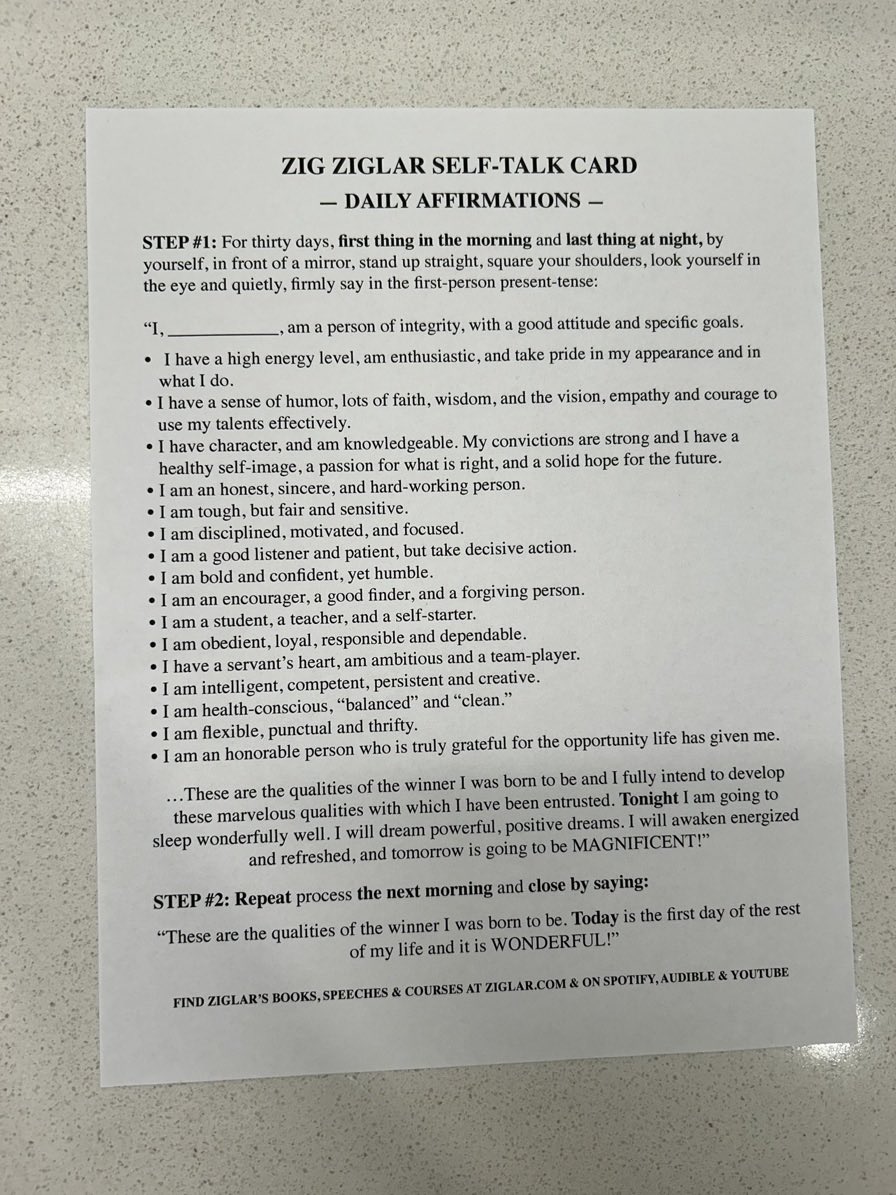
This is why affirmations work as counter-programming. When you repeat a sentence like "I can handle this," you are building a competing pathway. The first few times it feels empty, because the old groove is deeper. But the brain rewires itself based on what it practises, and a 2015 study from the University of Pennsylvania found that a repeated values affirmation activates the prefrontal cortex, the part of the brain that handles reasoning, and quiets the amygdala over time.
The research suggests that the mechanism works the same way whether you write the affirmation, say it out loud, or read it from a card. What matters is repetition and personal relevance, choosing words that connect to something you care about. Generic positivity does not land the same way a sentence about something you care about does. The more specific the statement, the stronger the signal. https://t.co/suEZKh5ARf
Overanalysis has been my life story. It can be far worse than laziness, as overanalysis leads to the same lack of action but ALSO self-loathing.
What helped me quite a bit was studying military history, military strategy, and decisive battles. The stories informed how I overcame paralysis by analysis.
Step one is set deadlines for decisions.
In warfare, you rarely have complete information, and if you wait to push certainty from 75% to 85%, say, that lag time could cause you to lose advantage and opportunity. It's the same in many parts of life.
So I set deadlines. By X point in time, I must make a go or no-go decision, no matter how much or how little information I have. Furthermore, I try and figure out small, short-term, low-risk experiments I can run as "go" decisions, so that I don't perceive action as high-risk.
In short: Set deadlines for decisions (put them in your calendar or they aren't real) and break large intimidating actions/projects into tiny mini-experiments that allow you to overcome fear of failure.
Once you have a little momentum, the paralysis usually disappears on its own.
𝗬𝗼𝘂𝗿 𝟴 𝗠𝗶𝘀𝘁𝗮𝗸𝗲𝘀 𝗦𝗵𝗮𝗻𝗶 𝗗𝗲𝘃 𝗡𝗲𝘃𝗲𝗿 𝗙𝗼𝗿𝗴𝗲𝘁𝘀 🧵
You're probably making them right now.. Unknowingly
(Mistake 5 is the one almost no one recognizes)
1. अकर्मण्यता → The Sloth of Inaction 👇
¿Se puede programar la realidad escribiendo lo que quieres 15 veces al día?
Scott Adams, el creador de Dilbert, es escéptico total. Y aun así lleva 30 años haciéndolo, porque le funcionó.
7 claves para que te funcione:
1. Escribe tu objetivo 15 veces al día.
5. The Work. This documentary tore my heart apart but simultaneously gave me tremendous hope. It strikes me as particularly important for men (or those who want to better understand men) to watch, but the intensity isn’t for everyone.
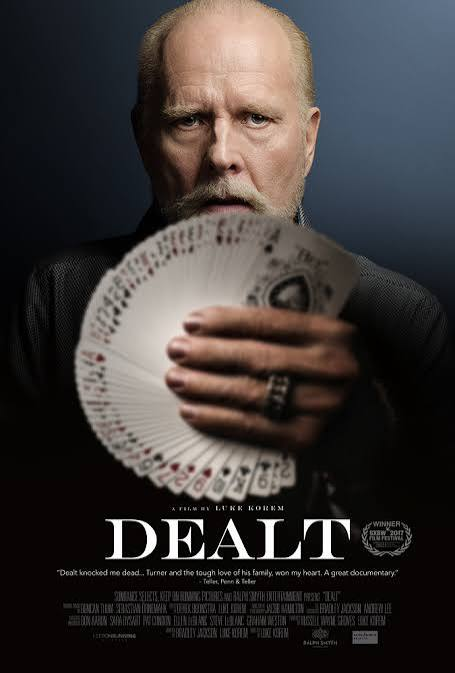
6. Dealt, directed by Luke Korem. This absolutely blew my mind, and I don’t want to spoil it with a description. Truly amazing. I can’t remember the last time I finished a documentary, only to want to immediately watch it again.
7. RBG. “At the age of 85, U.S. Supreme Court Justice Ruth Bader Ginsburg has developed a lengthy legal legacy while becoming an unexpected pop culture icon. Explore her unique and unknown personal journey of her rise to the nation’s highest court.”