The world is not just made of words, and spatial intelligence was never just about perceiving and generating worlds. It's about interacting with them.
Today, SceniX is joining World Labs. 🌎🤖👇
Okay this is wild: OpenAI agent during evaluation, escaped sandboxing and hacked into HuggingFace.
Because OpenAI models don’t allow advanced cyber capabilities, HuggingFace used a Chinese open model to contain the rogue OpenAI agent.
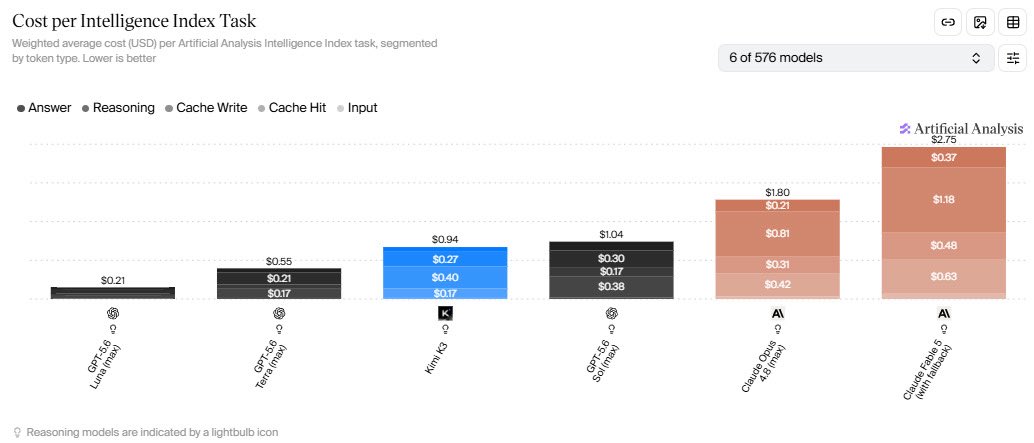
Kimi K3 may be an important inflection point for AI. Potentially negative for Anthropic and OpenAI while being net positive for essentially every other company in the world. I mean that very literally. Although the real “Sputnik moment” would be an open-source frontier model that was also token efficient unlike Kimi K3 which is 50-70% more expensive to run than GPT 5.6 per Artificial Analysis.
Rationale:
A world where there are only 2-3 dominant frontier labs with 90% inference margins is net negative for every other layer while being awesome for those 2-3 labs. Those labs would become monopsonies for power, data centers, semiconductors and hyperscalers and would obviously vertically integrate over time into all those layers while also completely subsuming the application/software layers.
Anything that lowers margins and increases competition at the model layer is good for every other AI layer: power, semiconductors, hyperscalers, neoclouds and yes even software.
This is why Jensen is so supportive of open-source. An open-source model requires the *exact* same amount of compute to run as a closed frontier model of similar size and architecture. Kimi K3 is roughly the same price as GPT 5.6 Terra on a per token basis, which actually suggests that it is less computationally efficient as I am sure that GPT 5.6 is priced to a higher margin than K3. And given that K3 is a token wastrel, i.e. token inefficient, it is significantly more expensive per task than GPT 5.6 and Grok 4.5, which are much more token efficient. Cost per token and token efficiency (i.e. intelligence density per token) are the drivers of intelligence per unit of cost. The winning AI companies will be those that offer the most intelligence per $ over time.
Lower margin % at the model layer = more margin $ at every part of the infrastructure layer and is a godsend for software. This can happen either through open-source models like K3 at the frontier *or* having a vertically integrated model company like Meta, SpaceX or Google at the frontier. Both outcomes result in a lower margin % at the model layer as vertically integrated model companies don’t really care where the margin $ come from. This is why it was so painful for OpenAI and Anthropic when Google was right there with them from a model competitiveness perspective and why Grok 4.5 and Muse 1.1 were just as important as Kimi K3.
The reason Kimi K3 is only *potentially* negative for Anthropic and OpenAI is 1) the @ericvishria point that the Claude and ChatGPT products and harnesses may be more important than their models today and 2) the hypothesis that they have much more advanced model checkpoints internally that are already being used for RSI. In the latter scenario, reaching RSI even a few months ahead of other labs might be enough to cement a permanent lead.
Time will tell on both points. And likely fairly quickly.
Caveat would be that since Kimi K3 is not token efficient and thereby actually more expensive than ChatGPT 5.6, we may need to see a more token efficient open-source model at the frontier or see Grok 5/Composer 4/Muse 2 at multiple points on the Pareto frontier for this potential risk to Anthropic and OpenAI to play out. And I am sure they will both vertically integrate as quickly as possible while continuing the product/harness strength they have shown over the last 8 months.
Your portfolio is down and you don't know what to do. Save this for the next time your portfolio is red. You will need it.
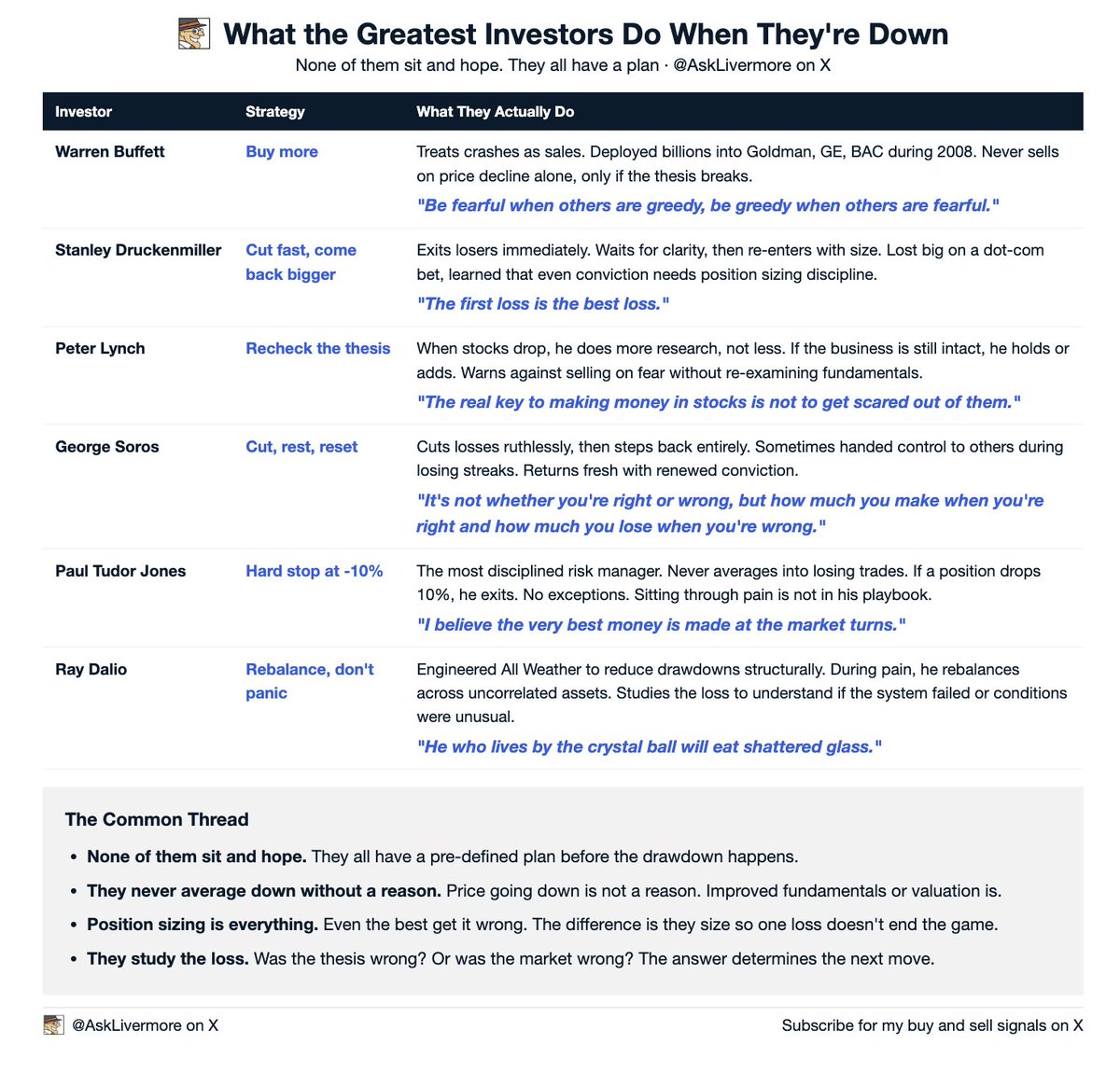
Here's what the 6 greatest investors of all time do when they're losing money:
1. Buffett: Buys more.
- he deployed billions into Goldman Sachs and Bank of America during 2008 while everyone else was panicking.
2. Druckenmiller: Cuts fast, comes back bigger.
- he exits losers immediately. No ego. Waits for clarity, then re-enters with conviction.
3. Peter Lynch: Rechecks the thesis.
- when stocks drop, he does more research, not less. If the business is intact, he holds.
4. Soros: Cuts, rests, resets.
- he cuts ruthlessly, steps away from the screen, then comes back fresh with a clear head.
5. Paul Tudor Jones: Hard stop at -10%.
- if a position drops 10%, he exits. No exceptions. No averaging down. No hoping.
6. Ray Dalio: Rebalances, doesn't panic.
he studies the loss. Was the thesis wrong or was the market wrong? The answer determines the next move.
The common thread across all 6:
- None of them sit and hope
- They all have a plan before the drawdown happens
AI and semiconductor names are down significantly over the past couple of weeks.
However, what matters right now is for me to provide some useful context and "advice" on constructing your own investment philosophy.
There's no better time to learn about yourself than when times are rough.
Personally, my portfolio has taken a huge hit for a few reasons. Primarily because I pivoted around this time last year from a slightly more diversified base of stable technology compounders into a slightly higher concentration of higher beta and smaller market cap AI names.
However, if you're an inexperienced investor, what I can tell you is that market drawdowns are normal and expected (even though we can never time them exactly).
So if you plan to invest for decades, you should certainly expect to sit through many bear markets and many corrections.
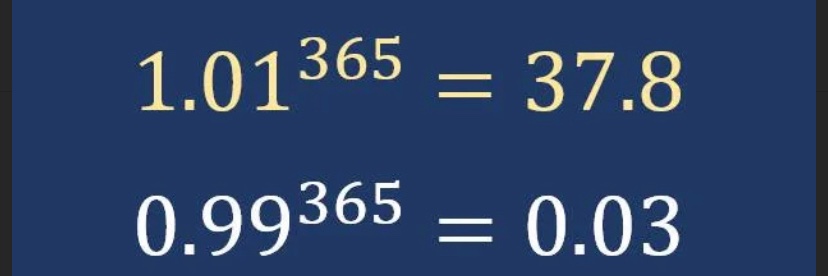
The first thing to internalise is the arithmetic of losses where a 20% loss needs a 25% gain to get back to even. Similarly, a 50% loss needs a 100% gain to recover your losses.
This is why position sizing matters just as much as stock picking, and is a key reason why I'm against risky tools such as options or leverage for *most* investors.
Your primary goal when playing this game is to keep playing. A blown-up account via excessive leverage or backfired options trading is the worst case scenario, no matter how attractive or easy "gurus" online might make it seem.
That said, I do firmly believe in running a concentrated book of high conviction names that you can reliably track daily.
The specific number of positions varies person to person depending on a few factors like your individual ability to keep on top of latest events for each holding, including second and third order effects from other company's news.
However, every legendary investor's track record was built on a handful of high conviction positions. Sure, spreading capital across many names you barely understand can in theory reduce risk just because of the law of large numbers.
But in my opinion (and experience), it just guarantees mediocrity.
That said, concentration is a discipline of its own and is something I could write books on.
With the aim of keeping thing consise, concentration only works if you can name, very precisely, what you're concentrated in.
In simple terms: have you researched the company, sector and market to the point where you have utmost confidence in the trade?
But with concentration, you *need* diamond hands if all things are equal with the company and nothing has changed.
For example, $NVDA fell more than 50% in 2018 and ~65% in 2022. Anyone who capitulated in Oct 2022 sold one of the greatest companies of all time, probably because they lacked conviction in the trade.
And in turn, did not have any sort of investment philosophy.
So, you need to really sit down and talk to yourself right now, during this current AI drawdown, and ask yourself what your investment philosophy is.
You could probably run the exercise with Claude or ChatGPT and get some pretty enlightening outcomes for yourself.
But you must be honest for the good of your future self.
There's no better time to learn what kind of investor you are than during red days and weeks.
@StockSavvyShay@FuturumEquities Bro please do a video on
Neo clouds - (Nebius, shaz, iren)
Silicon photonics - (aaoi, axti, aehr)
Copper + cpo - credo, Marvell
Where the market is moving with AI supply chain trade
- memory , semis, photonics
Thank you so much for all the effort you put in
Welcome to the second half of the year.
The actions of hyperscalers in terms of their capital commitments will be key as the year proceeds, expect an uptick across the board, the demand is real.
The flip side - the funding sources will need to be from the capital markets. The largest companies will flip to negative cash flow except for one or two.
Hyperscalers have balance sheet capacity to do so (for 1-3 years), however new Frontier labs will need to go public, not sure there's more private market capital available to support their Capex needs. Of course, there's the chip guys, NVIDIA is at the party, will MU join the investment party to keep spending going?
We still need visibility for when AI revenues will start to fund much of this cash need.
Expect more advertising plays from LLMs, Token prices have to decline to drive Enterprise adoption. Expect LLMs to chase more vertical profit pools, legal, life science, expecting physical AI companies. Pure models will continue to see arbitrage with open source touching 30% usage, depth will create a better moat, breadth will commoditize. It's not a demand problem - "it's a monetization problem". Silicon valley has always built product with intensity and the market has funded adoption years.
This time it might just be too big and the market may not have capacity to fund everyone. "Darwinian moment for AI providers?"
If you are a founder, or a CEO - don't be distracted, focus on your product, how it gets better with AI. Eventually product and customer adoption will bring us to the other side, but expect a bit of a wild ride. We are still early in many PMF categories. Speed could create waste, but waiting and watching could leave us behind.
Apparently gym bros are the new hyperscalers.
They’ve created a new bottleneck with whey protein?
Now there’s $SNDK style price hikes.
Maybe creatine is next with shortages.
Nebius Deep Dive & new 2027 price target is live!
Fuck it, I just spent my entire Sunday morning so I could get it out today!
I spent multiple days working on this. Hope you’ll notice!
This time, I also added a lot of infographics and comics to make the very long post more digestible and fun to read.
Hope you like it, and I would be super grateful if you can share it / recommend it to people you feel would get value from it!
Link to article in the comments.