Gaurav Tyagi did his PhD in Microbiology at V. P. Chest Institute, Delhi. His six papers were all on TB microbiology—one first-author review and five mostly distant middle-author credits. He then joined JNU's Special Centre for National Security Studies but to teach what? (1/4)
Almost all central universities have been appointed with mediocre, or even downright incompetent professors in the past 10+ years. And it is not a claim made lightly. Look at this example.
The only criteria it seems is the ideological leaning, not scholarship or intellectual brilliance. The fraud happening in our education system is unravelling by the day, and it is us, the young generation, that is suffering. Corruption and incompetence of those in government is foreclosing any possibilities of a bright future for most students and young gen.
@Cockroachisback
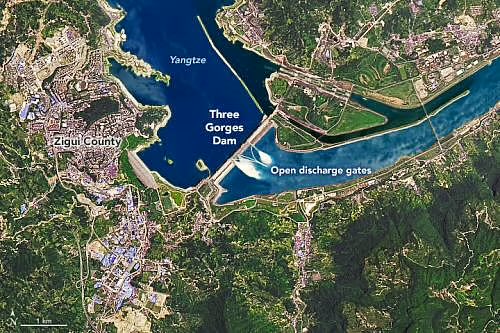
There is a wall of concrete in China holding back so much water that 2 scientists sat down and calculated what it does to the length of a day on Earth.
It does something. They measured it.
The Three Gorges Dam sits on the Yangtze. Its reservoir holds about 40 cubic kilometres of water, roughly 10 trillion gallons, and it holds it 175 metres above sea level.
That is 39 trillion kilograms of water, lifted up and parked in one place.
The physics is the same as a figure skater. Arms pulled in, they spin faster. Arms out, they slow down. Move mass away from the axis of a spinning object and it slows.
Earth is a spinning object.
In 2005, Benjamin Fong Chao at NASA Goddard and Richard Gross at the Jet Propulsion Laboratory worked out the numbers. A full Three Gorges reservoir would lengthen every day on Earth by 0.06 microseconds, and shift the position of the pole by about 2 centimetres.
The reservoir first reached that level in October 2010.
Nobody has ever missed a train because of it. That is not the point.
The point is the category of thing that normally does this.
The 2004 Sumatra earthquake, the one that caused the Indian Ocean tsunami, shortened the day by 2.68 microseconds. The 2011 Japan earthquake sped the planet up by about 1.8 microseconds.
Those are earthquakes. Tectonic plates. Forces that build over millions of years.
The dam did it with standing water, because somebody decided to put it there.
And it is not alone. A study out of Harvard found that the water held behind roughly 7,000 dams built since the 19th century has shifted the position of the North Pole by about 1 metre, and very slightly lowered global sea level, because all that water is sitting on land instead of in the ocean.
Groundwater does it too. Between 1993 and 2010, humans pumped out around 2,150 gigatonnes of it. That raised sea level by more than 6 millimetres and moved the Earth's rotational axis about 80 centimetres to the east.
We are already at the scale where the planet responds.
Now the part that matters for anyone living in India or Bangladesh.
In July 2025, machinery arrived at the edge of a canyon in Medog county, in southeastern Tibet. Premier Li Qiang announced the start of construction on what will be the largest hydropower project on Earth.
It is on the Yarlung Tsangpo. The river drops about 2,000 metres in the space of 50 kilometres there, through one of the deepest canyons in the world. That drop is the reason engineers want it.
The projected output is around 3 times that of Three Gorges. The cost is put at about 170 billion dollars. Completion is expected around 2035.
The Yarlung Tsangpo does not stay in Tibet. It crosses into India, where it is called the Brahmaputra, and then flows into Bangladesh.
Millions of people plant and harvest according to when that river rises and falls. Fish migrate on it. The silt it carries builds the land they farm on.
All of that is decided upstream, in another country, by whoever operates the gates.
Nobody has publicly calculated what a structure 3 times the size of Three Gorges does to the spin of the planet.
And it is going into the Himalaya, which is the most seismically active mountain range on Earth, and which spent this week demonstrating exactly how fast water can come down it.
The old assumption was that geology moves slowly and humans move fast, on separate timescales that never really touch.
That assumption is finished. We are now building at the scale where the Earth notices.
Every year millions of Indians pay life insurance premiums thinking they are protecting their families
That money, because policies run 20 to 40 years, gets invested in long dated government bonds, which is how the government funds roads, railways, hospitals, and defense. Life insurers collectively hold about 25% of all central government dated securities, roughly Rs 28 lakh crore.
This share stayed stable even as total government debt grew 40% in three years. Insurers kept buying at the same pace government kept borrowing. No other buyer class is this reliable.
LIC alone holds 19% of all central government dated securities, more than RBI itself at 12.3%. Its March 2025 filing shows 63% of its non-linked policyholder money sits in sovereign bonds.
Total assets are Rs 54.5 lakh crore, roughly $570 billion. IRDAI tags it as Domestic Systemically Important Insurer because its distress would directly hurt government ability to borrow. Banks get this level of policy attention routinely.
Insurance holds nearly as much government debt but gets framed as a household protection topic, not a sovereign finance topic.
Life insurance penetration in India dropped from 3.2% of GDP at its 2022 peak to 2.7% in FY25, falling three years in a row. Three regulatory changes between 2023 and 2024 hit at once.
Commission structures for agents were changed, high value policies got new taxes, and product repricing was made mandatory. Each was defensible on its own. Together they slowed new premium collection.
Less premium means less money flowing into government bonds. Government borrows Rs 14.82 lakh crore per year. Its most patient buyer is shrinking.
Plus there are others Reasons too :) I didn't know LIC hold this much ....
"I don’t agree with Godard when he says that the cinema is a gun. You can’t topple a govt by making one Potemkin. You can’t do that with ten Potemkins. All you can do is create an environment in which you can discuss a society that is growing undemocratic, fascistic." Mrinal Sen
Brazenness is an unique feature of any autocratic regime. It doesn't hide what we could find offensive otherwise. It makes a spectacle out of it. It can't be more brazen than this. They couldn't wait for even a week to appoint the very officers who were supposed to be neutral and were responsible for carrying out a free and fair election. There are people who are still treating it as a bad optics. Let's be clear it's never about optics, it is about doing it in the open, sending a message - it has been done, now do what you could do! For me, Bengal election represents a watershed moment of Modi era. Not merely for the communal vitriol used by a certain political party, but for the systemic hijacking of the whole electoral process. The constitutional body which was supposed to be neutral, and more or less it maintained its neutrality post-independence seem to have become now just another tool/agency in the hand of the current regime. I have been pointing out the difference between poll manipulations (in terms of violence such as booth loot or distribution of money or liquor or any other similar thing) committed by political actors and the systemic collusion between the regime and the commission where Commission becomes a stakeholder, not a neutral constitutional body. This compromised neutrality destroys the very sanctity of electoral process. Communalism propagated by parties is one thing, but the communalisation of the system is entirely different thing. Special roll observer appointed as advisor, Chief election officer appointed as Chief Secretary immediately after result proves that the allegation made by other political stakeholders about the integrity of the officers involved in the whole lectoral process were not out of nowhere. It indicates towards the most disturbing development - systemic hijack of the whole electoral process, right from the preparation of rolls to the counting of votes.
Mukul Rohatgi, who served as the Attorney General of the Narendra Modi govt between 2014-17, says Tamil Nadu Governor is interpreting the term “a govt must prove its majority on the floor of the House” as the “floor of my house”.
Roberto Rossellini on Socrates and why written culture is an authoritarian instrument:
"Socrates didn’t leave even a single written word. Which is another of the characteristics that make him a man absolutely modern. Because his wasn’t a case of laziness but of choice. Socrates was against writing, and it seems to me that his attitude furnishes an element of thinking that’s rather contemporary. Writing immobilizes and freezes thought, makes it stable, definitive, thus dead.
Written culture is an authoritarian instrument: it admits no contradiction, it doesn’t concede any possibility for dissent or reply to those who enjoy it. Oral culture is instead dialectical, mobile, continuously becoming: an instrument to collective communication and, we say, democratic . . . Today we have other instruments that can renew oral culture: audiovisual means. We can get back to the dialogue."
("My Method: Writings and Interviews", Roberto Rossellini, 1992)
P.S: Remembering the legendary Italian filmmaker Roberto Rossellini on his 120th birthday!
Clip from:
Socrates (1971)
Director: Roberto Rossellini
"Governor's task is to see that a Government is formed and not to try to form a government." TN Governor should simply invite TVK leader Vijay to form the government as he has emerged as the largest party after recently concluded assembly election. People's mandate is clearly with him. Many opposition leaders are rightly pointing out that the majority has to be proven on the floor of the assembly, not in the hall of Governor's house. 'Discretion' in the phrase 'discretion' of the Governor has to remain discretion in the true sense of the word. It means discernment or ability to judge a situation finely without going beyond constitutional norms and well-settled conventions. Governors can't fancy things while using their discretion. Sarkaria commission has laid out the order of the preference for choosing a Chief Minister in case of no party achieving a majority mark on its own. The order of preference is as follows: 1. An alliance of parties that was formed prior to the election. 2. The largest single party staking a claim to form the government with support of others, including "independents." 3. A post-electoral coalition of parties, with all the partners in the coalition joining the government. 4. A post-electoral alliance of parties, with some of the parties in alliance forming a Government, and the remaining parties, including "independents" supporting the Government from outside.
TVK's Vijay fulfills the condition for second preference and he should be called to form the government. Majority has to be proven in the house also because majority in the house means the MLAs present in the house during the floor test. In case few MLAs abstain from voting, the numbers would come down and Vijay will pass the floor test. That government will be a minority government but a constitutionally valid government. He will have to do some maneuvering to get the legislation passed and to win the confidence motion if it is introduced mid-term. Narsimha Rao's government was a minority government but he completed a whole five year term with all the maneuvering. TN Governor should stop acting on behest of his bosses in Delhi and act as a Governor with discretion.
However, I think every party has the right to contest election, even if it is effectively for the sake of loosing only or making someone else loose. Rahul Gandhi's rhetoric was empty and rudderless. Congress's decision to fight all seats were also meaningless given the fact that they are supposed to be at the helms of a national opposition. No point talking about CPM. They don't have any such national responsibility or agenda and they are anyway burning with vengeance ever since they were defeated by TMC. They haven't even settled upon their theoretical understanding of Fascism. Their leaders are still in dilemma which (theoretically accurate) word to use to capture today's situation of India. Anyway, they need some more time to spend in Berlin's archive or libraries of Rome to figure out historical nitty-gritty. Fascism or for that matter any authoritarian regime capitalises upon base emotions and immediate identity. That's why it mobilises people swiftly. Hate is powerful as it is based upon raw emotions like fear, anger, disgust. It's easy to capitalise upon them, hard to supress. Any politics willing to counter it would have to go beyond base emotions and that could only be done by cultivating sentiments which are durable. Politics based on love, truth or peace is difficult to practice. Love appears simple but, in fact, it is quite complex. Truth is tortuous. Peace requires immense patience. But, we must not forget that India is also a caste society. So Hate-love doesn't remain confine to religious identity but transcend to caste identities too. Rahul Gandhi's "mohabbat ki dukan" is surficial. It's ephemeral because it's not carefully cultivated, it touches upon people's fleeting feelings and then evaporates quickly. Modi's politics is malleable but sustained and carefully crafted. It's true, none of these would work as effectively if they weren't in power. Usually, people in power become loose in their pursuit beyond a point. But the majoritarian regime today has a project to finish. And they will keep on going. It's infinitely difficult to fight fascist regime. There's a weight attached to this word. Instead of just repeating it, it would do good if we become aware of the meaning and consequences of living under such a regime.
'Anti-incumbency' is the most (mis)used word since day before yesterday. But those using this word so much in the context of Bengal must learn some other words too. For instance, garrymandering, logical discrepancy, judicial complicity, electoral integrity, institutional propriety, delimitation, hate-mongering, communal polarisation, structural rigging, Special Intensive Revision, selective use of central agencies, campaign finance, voter rolls manipulation, universal suffrage, level playing field, free and fair election, basic structure doctrine et cetera. I am not saying that the election in Assam and Bengal was totally rigged and the results were predetermined. But the way the election took place and the whole process unfolded in these two states, it would have been surprising if we ended up with any other outcome. We knew from the very beginning, with the start of SIR in Bengal, what was in the offing. Removal of 91 lakh votes in the name of SIR in one go, addition of 7 lakh votes as supplementary list after the completion of electoral rolls, then disenfranchising 27 lakh people while their appeals are pending before a tribunal makes the whole electoral process dubious and thus constitutionally illegitimate. SC could have given these people a chance to vote in this election pending the final decision of the tribunal or it could have extended the date of election. But all this could have happened if a free and fair election was to be conducted. What is to be reckoned here is the fact that when the electoral process itself is compromised, other factors hardly matter. Not only the rolls are purged suitably, but the sanctity of counting process also violated. In such situations, even if you win against all odds, you loose actually as you end up legitimising a compromised process. I think Mamta Banerjee missed at this point. She shouldn't have gone to election. Delimitation played the same role in Assam which SIR did in Bengal. Delimitation exercise in Assam left the opposition with a significant structural disadvantage to begin with. Delimitation affected many seats in Assam, but there were a dozen seats where opposition didn't stand even a chance. Rest of the factors whether it be targeted payments to women or blatant communal polarisation remain so evident that it doesn't even require an explanation. There is no point wasting time talking why the results are different in Kerala and Tamil Nadu. It wasn't simply possible in Kerala and Tamil Nadu because of BJP's limited electoral presence and the political climate of these two states. Despite all the effort put together by BJP, central government and a heavily biased ECI, Bengal election remained the most closely contested election of this decade. Leave alone the loudmouth who are suddenly pinning down everything to anti-incumbency, a day before the result nobody could predict the final electoral outcome in Bengal. Mamta Banerjee fought tooth and nail. There are things where I think her strategies faltered. And there will be ample time to talk about them. But those who are feeling quite contented in pointing out how she made way for BJP and helped them in the nascent stage of their growth are missing a basic thing about politics - nobody remains forever pure in politics. No one who does electoral politics can be absolved of original sin (collaborating for power). I think Mamta's bet on 'Bangla identity' and bifurcation of 'us and them' didn't work this time because of two things: (a) an already significant presence of BJP in assembly and ever deepening inroads made in society with its communaly charged rhetoric; (b) those who are fighting from BJP aren't outsiders but they are Bengali themselves. It neutralised TMC's 'us and them' line significantly when the society is already ideologically split from within. Anyhow, in my estimation no one can outdo BJP in playing chauvinism card. CPM and Congress's desperation to oust Mamta from power made BJP's work relatively easy.
It defies both logic & judicial propriety to cling on to a case by a judge.
An impartial judge has no attachment or personal interest in a case.Nor is any prestige involved in judicial functioning.
So Why hold on to a case & make TAMASHA to damage judiciary’s image beyond repair.
What is needed today is courage of thought! Reading Svetlana was a life-changing experience. Her accounts are so exact and vivid that you feel as if you were transported back to the time she is talking about. A journalist, an oral historian par excellence. She calls herself a historian of the untraceable. She brings back the stories of people, no conventional journalist or historian would have even imagined to work upon. Those considered ordinary, dispensable, marginal become the perspective, the vantage point of looking at an event or a phenomenon. After reading her I learnt one thing that we never learn! As a civilisation, our society (east or west) is based on the idea of repetition, repeating without learning. Horrors remain the same, forms change. We keep on repeating. Chernobyl happened. Not enough! Union carbide. No worries! Another reactor, another boiler, maybe a broken dam this time. Nagasaki! Hiroshima! Still so much talk about nukes. One war is never enough, another war! New tragedies, more casualties! Anyway, reading someone like Alexievich is important because she won't let you settle with any utopia. She wrote Secondhand Time and made us understand the weight of daily life under communism. Showing the actual face of any totalitarian system. But she wrote Enchanted by Death too. And this was about people who simply couldn't live without communism. They couldn't come to terms with the fall of Soviet order and they decided to end their life. Some succeeded, some didn't.
This is what authentic solidarity towards a fellow journalist looks like. No manipulation, lies or fraud pretending to be solidarity as we see in sections of the Delhi media; only truth.
I often think about this foreword by @johnpilger to Wilfred Burchett’s book. Peerless.
UNESCO’s silence over the israeli bombing of Iran’s centuries-old world heritage historical sites and ancient landmarks is totally ‘unacceptable’ https://t.co/eIoygGhDQp