Anthropic engineer:
"You're not supposed to watch Claude Code work. You're supposed to wake up and review what it shipped."
In 22 minutes she builds the entire workflow live on camera.
Most people close their terminal and everything stops.
This setup keeps shipping while you sleep.
Watch the video, then save the exact setup below👇
a16z just dropped the billion-dollar opportunities in AI for 2026.
three partners. three theses. same underlying bet.
Marc Andrusko: the prompt box is dying.
next-gen apps observe what you're doing and act on your behalf.
TAM shifted from $ 400B software spend to $ 13T labor spend.
market got 30x bigger.
Stephanie Zhang: stop designing for humans.
start designing for agents.
agents read every word on the page. visual hierarchy stops mattering.
GEO is the new SEO.
Olivia Moore: voice agents ate the phone in 2025.
healthcare, banking, recruiting, 911 calls.
voice AI beats humans on compliance every single time.
some companies now slow their agents down to sound human.
every thesis converges on the same layer.
the harness around the model is where the leverage compounds.
full breakdown of how the shift happened below.
YC's Spring 2026 RFS explicitly calls for "AI-native agencies" as a startup category.
Most people skimmed right past it.
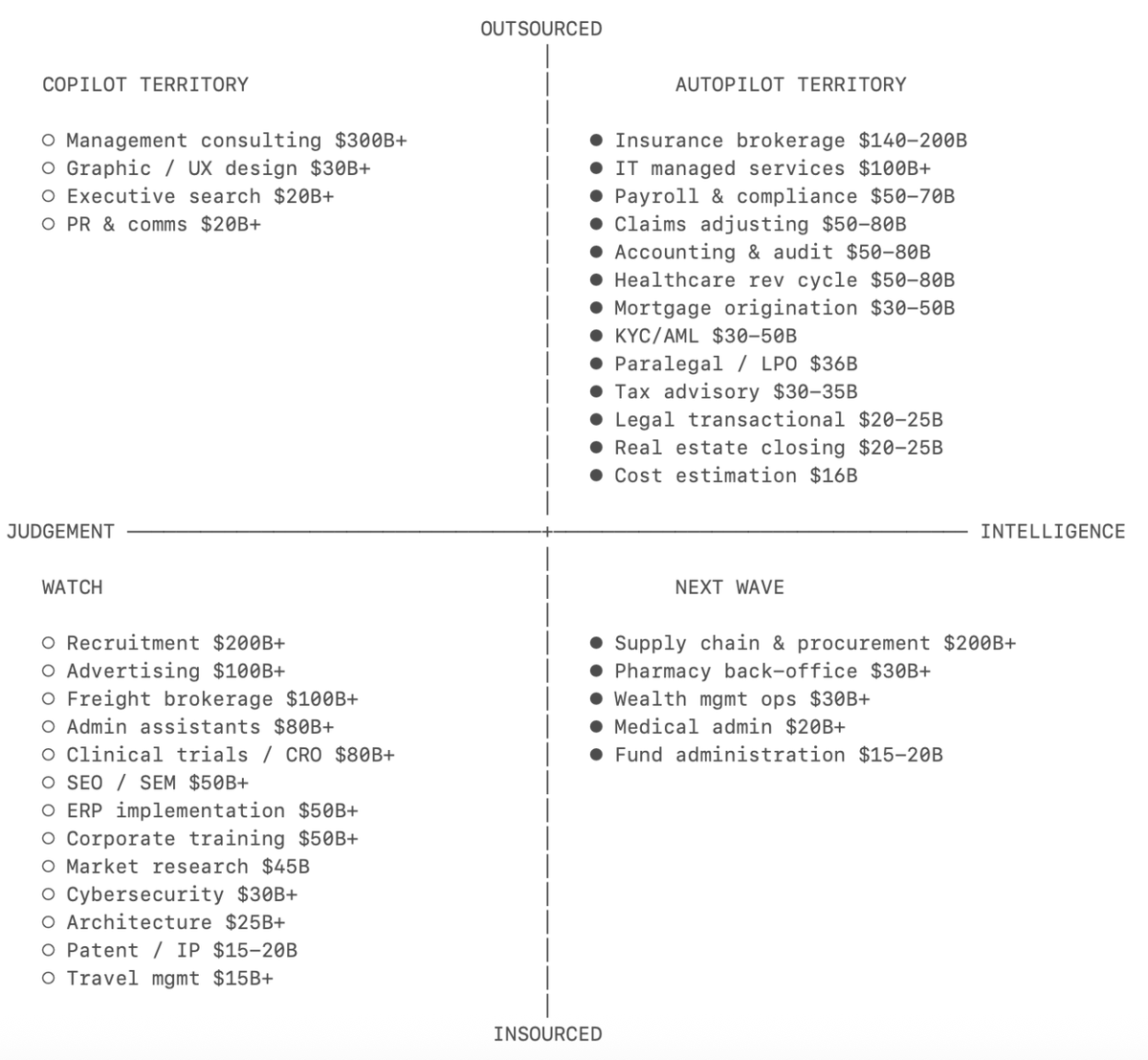
Sequoia's recent thesis paper argued the same thing: the next $1T company might be a services company, not software.
Two of the most influential investors in tech converging on the same bet is worth paying attention to.
The core argument: stop selling tools, start doing the work. Traditional SaaS sells seat licenses. AI-native agencies sell completed outcomes — and capture the full value of the deliverable, not a $99/mo subscription.
The categories ripe for this first are the ones with structured, repeatable workflows: marketing, accounting, legal research, customer support. High labor cost + high process standardization = exactly where AI agents perform best.
The distinction most founders miss: an agency that bolts AI onto existing workflows is just cost-optimizing. An AI-native agency is architected from zero around model capabilities — different unit economics, different org chart, different scaling curve.
YC isn't asking for "AI-powered" anything. They're asking for companies where AI does the actual work and humans orchestrate.
That's a fundamentally different business model than what 90% of AI startups are building right now.
Sequoia's thesis that the next $1T company will sell work, not software, is the most important reframe in AI right now.
The argument: if you sell a copilot, you're competing with every new model release. But if you sell the outcome — books closed, contracts reviewed, claims handled — every AI improvement makes your margins better, not your product obsolete.
The key insight most people miss: for every $1 spent on software, ~$6 is spent on services.
The entire SaaS playbook was about capturing the software dollar. The AI playbook is about capturing the services dollar — at software margins.
Not "AI for accountants." The AI accounting firm.
Not "AI for lawyers." The AI law firm.
The companies that figure this out won't look like SaaS companies. They'll look like services firms rebuilt on software infrastructure.
That's a fundamentally different company to build, fund, and scale. And most founders are still building copilots.
Back in 2003, a German film crew filming in the Gobi Desert captured an incredibly moving moment: after a tough two-day birth, a mother camel rejected her newborn.
A nomadic family then performed the ancient Hoos singing ritual passed down for generations.
Once the song ended, the camel shed tears and finally accepted her baby.
This powerful scene became one of the most memorable parts of the Oscar-nominated documentary The Story of the Weeping Camel.
Harshita Arora (@aroraharshita33) just became a General Partner at Y Combinator, making her the youngest in the accelerator’s history. She’s 25 years old, which is young enough that most VCs her age are still grinding as associates, hoping to make principal in five years if they’re lucky.
She also dropped out of school at 15, which is the kind of detail that would normally disqualify you from every traditional path to venture capital.
Between dropping out and becoming a partner... she discovered coding at 13, built a crypto portfolio tracker at 16 that Apple featured in the App Store, got it acquired, and won India’s Bal Shakti Puraskar (one of the country’s highest honors for young achievers).
Then she got an O-1 visa, moved to SF, and applied to YC with her co-founder.
Their idea got killed by Covid three weeks into the batch. They had zero background in trucking, zero background in payments, but had a dead startup with 3 months left to figure something out.
So Harshita spent weeks visiting truck stops across California, talking to drivers, watching how they paid for fuel, and realizing that the entire payments infrastructure for trucking was totally broken. Ancient systems, hidden fees, rampant fraud, still running on technology from the 1990s despite moving billions of dollars.
She built AtoB to fix it. Stripe for Trucking. A modern fuel card with transparent pricing, instant payouts, and financial tools that don’t feel like punishment.
Today AtoB is a Series C company serving over 30,000 fleets across the US, processing millions in payments daily, and building the financial infrastructure that the backbone of the economy actually deserves.
Now she’s a YC partner at 25, which is absurd when you consider that most VCs spend a decade climbing the ladder at banks or consulting firms, collecting the right credentials, and Harshita skipped the entire ladder and built a $700M company instead.
Credentials stop mattering when you build something that works, and this is one of the embodying principles of YC, so it is great to have seen her so active this last year in supporting YC batches as visiting partner, and now a GP.
Maybe as batches skew younger (like my post yesterday) partners will too...
🚨 do you understand what andrej karpathy just quietly published..
karpathy.. founding team at openai, former head of AI at tesla.. just said something that breaks the entire software industry in one paragraph..
in the LLM agent era.. there's less need to share specific code or apps.. instead you share the IDEA.. and the other person's agent customises and builds it for their specific needs..
let me show you why this is the most important thing posted online today..
the entire software industry is built on one assumption: building software is hard.. that's why you pay $49/month for notion.. $99/month for salesforce.. $299/month for whatever SaaS is sitting in your company's tab right now.. the scarcity of building = the value of the product.. it's been that way since 1995..
karpathy invented "vibe coding" in 2025.. the idea that you stop writing code and start describing what you want.. tools like cursor, claude code, and openclaw turned that into reality.. you talk to your computer.. it builds.. it ships.. it runs your workflows while you sleep..
and now he's saying even THAT is the old way..
now you don't share the app.. you share the IDEA FILE.. a document describing what you want to build and why.. and every person's AI agent reads it.. builds their own custom version.. tuned to their exact needs.. for free.. in minutes..
the scarcity of building just hit zero.
every SaaS company built for "normal users" is now competing against a blank text file and an agent with 4 hours to spare..
the winners of the next decade won't be the best builders..
they'll be the best thinkers.. the people who know what to build, why it matters, and how it should feel..
that's how paradigm shifts actually arrive.
this is today’s reminder that every single business in the world is still up for grabs
it’s an incredible time to be building AI native companies
happy building
The era of the one-person $1B company is here.
This is how you structure your team of AI agents:
- Engineering: code, testing, DevOps
- Design: UI/UX, brand assets
- Marketing: content, SEO, social
- Sales: lead gen, outreach, demos
- Support: tickets, docs
- Data: metrics, analysis
1 founder.
6 agent departments.
0 employees.
Slow. Then all at once.
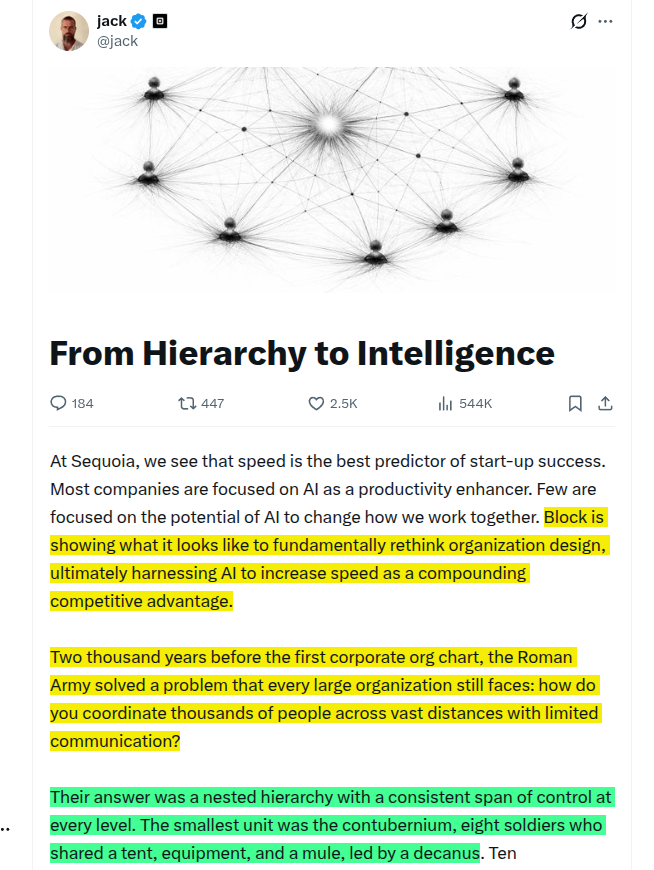
🤯 Jack Dorsey's Block just laid out a plan to replace much of corporate hierarchy with AI coordination.
Middle management exists to coordinate work, but AI can now handle that instantly. There is no longer a need to move information up and down layers. Block is replacing hierarchy with AI systems, so decisions come from real-time data instead of meetings.
The old org chart exists because people are slow, narrow-band routers of context, so companies add managers to pass information up and down.
Block’s claim is that a company world model can track work continuously, while a customer world model built from transaction data can track what people and merchants actually need.
A sufficiently good company model can take over much of that routing function. In a remote-first firm where work already leaves digital traces, AI can, at least in principle, maintain a live picture of projects, bottlenecks, resources, and outcomes.
That lets an intelligence layer assemble financial capabilities like lending, payments, cards, and payroll into custom solutions at the moment demand appears, instead of waiting for a product roadmap.
The human job shifts from relaying status to building capabilities, owning cross-team problems as DRIs, and acting as player-coaches who improve craft and judgment.
The real bottleneck in big companies is not effort but coordination, and Block is aiming at coordination itself.
Money is behavior with fewer illusions attached. If you can see how customers and merchants actually spend, borrow, save, and repay, you are no longer guessing from survey answers or product roadmaps.
From that view, products become less central than capabilities. Payments, lending, payroll, or card issuance are modular parts, and intelligence is the layer that composes them when the model detects a real customer need.
Great report @sequoia - glad to share that @m37labs is one of the few AI native services firm that has built AI OS for PR Comms industry and many more industries now in pipeline ! @ZorawarPurohit
✨🇨🇳A Chinese company, Unipath, has launched a household robot that is now in real-home use. It can wake users up on time, operate home appliances, organize storage spaces, and even cook meals automatically.