We’ve been building in stealth at @AGI_Inc.
Today, we’re ready to share it.
Meet AGI Mobile. An AI that can actually use your phone.
You talk. It executes.
It uses any apps faster than you.
This is what Siri was meant to be.
Limited early access. 👉 https://t.co/crmQhsZieG
I just read a paper that completely broke my brain.
It describes a system that solved an AI task with over 1,000,000 sequential steps... with ZERO errors.
Using AI models that are known to be flaky and make mistakes.
How is that even possible? 🤯
We all know LLMs have an error rate. Even 99.9% accuracy is a death sentence for long tasks.
Imagine you need 1,000 correct steps in a row. With a 99.9% success rate per step, your chance of finishing the whole thing is only ~36%.
At a million steps? Forget it. It's statistically impossible.
So for years, the race has been to build bigger, "smarter" models to get that per-step error rate closer to zero. We're trying to build a perfect genius.
But this paper ("Solving a Million-Step LLM Task with Zero Errors") does the complete opposite. It's a total paradigm shift.
Here's the "holy shit" moment:
Stop trying to make the AI perfect. Instead, build a system that's immune to its imperfections.
How?
Smash the problem into the tiniest possible pieces. (They call it Maximal Agentic Decomposition).
Have a team of simple, cheap AIs vote on the answer for each tiny piece.
It's less like hiring one world-class chef and praying they don't have an off day, and more like designing the McDonald's kitchen.
The system guarantees the burger is the same every time, even if any individual worker could mess up.
The reliability comes from the process, not the person.
They tested this on the Towers of Hanoi puzzle—a classic benchmark where AIs fail spectacularly as the task gets longer.
They set it up for 20 disks. That requires 1,048,575 perfect moves in a row.
(seriously, over a million steps)
A single AI trying this would be a comedy of errors.
But their system of "micro-agents" voting on every single move... nailed it. Flawlessly.
And the plot twist? The most expensive, "state-of-the-art" models weren't even the best for the job. A smaller, cheaper model (gpt-4.1-mini) was more cost-effective because the tasks were so simple.
This is a huge deal for AI safety, too.
A single, god-like AI is a black box. It's unpredictable.
But a system of a million simple agents? You can inspect it. You can audit each step. The agents have no grand "worldview"—their entire existence is to solve one tiny puzzle and then disappear. It's controllable.
So next time you're building something with an LLM, maybe stop asking "how can I prompt the model to be smarter?"
And start asking: "How can I design a system where it's okay for the model to be dumb?"
The real power isn't just in the model. It's in the architecture you build around it.
This isn't just about AI. It's a fundamental lesson in engineering and problem-solving.
You don't always need perfect components to build a perfect machine. You just need a damn good design.
...which makes you wonder what else we're trying to solve by chasing individual perfection instead of building better systems.
Two weeks ago I fixed one of my teeth with algorithms I wrote a couple of years ago!
I got hooked by 3D scanning when I started to work for a software shop in Zurich that was programming 3D computational geometry algorithms for denture scanning to produce crowns (and more). Back then, a typical reconstruction pipeline was like: scan the patient’s teeth using an intraoral scanner, reconstruct the surface mesh, design the restoration digitally, and finally mill the crown out of ceramic.
We were working mostly with point clouds and meshes, but it wasn’t just math, it was craftsmanship translated into a digital process. Every micron mattered. You could literally see how a good algorithm meant a better fit in someone’s mouth.
Gaussian Splatting isn’t about surface reconstruction, it’s about appearance reconstruction. It doesn’t care about explicit topology, it captures how light interacts with the scene. In a sense, it’s the opposite philosophy of the dental world: instead of modeling what the object is, it models how the object looks.
3D Gaussian Splatting enables applications like training self driving cars, teaching robots to understand their environment, creating virtual worlds, or monitoring real sites. It represents scenes as millions of small Gaussians rendered in real time without the need for meshes or textures.
Coming from a world where precision geometry was everything, this shift felt natural. It’s still about reconstruction, but with a different goal: not manufacturing a perfect object, but reproducing how the world actually looks.
Two weeks ago I got my first dental crown, made with the same software, reconstruction algorithms, and Swiss precision I once helped develop. I haven’t worked there in two years, but sitting in that chair and seeing the process from the other side was a proud moment. It reminded me why I love this field.
I built an AI system that automates product video creation for entire e-commerce catalogs.
(Saves $30K per collection shoot, increases conversion rates by 40% on sites)
Here's how the automation works:
→ Firecrawl scrapes product photos from any e-commerce collection page
→ Google's Veo 3.1 generates professional model videos showing fit and movement
→ Each animation starts and ends with the original photo for seamless looping
→ Videos are automatically organized and stored in Google Drive
→ Everything processes in batches while you handle other business priorities
This system can transform how fashion companies showcase products and consistently drives higher engagement from potential customers.
Static product photos just don't cut it anymore. Customers want to see how clothes actually fit and move before they buy.
Want the complete blueprint? Here are the steps:
1. Like & RT this post ✅
2. Follow me for more e-commerce automation insights
3. Comment "FIT"
I'll send you the entire n8n workflow, all the prompts, and a full setup video for free.
No more expensive video shoots or wondering if your product photos are converting.
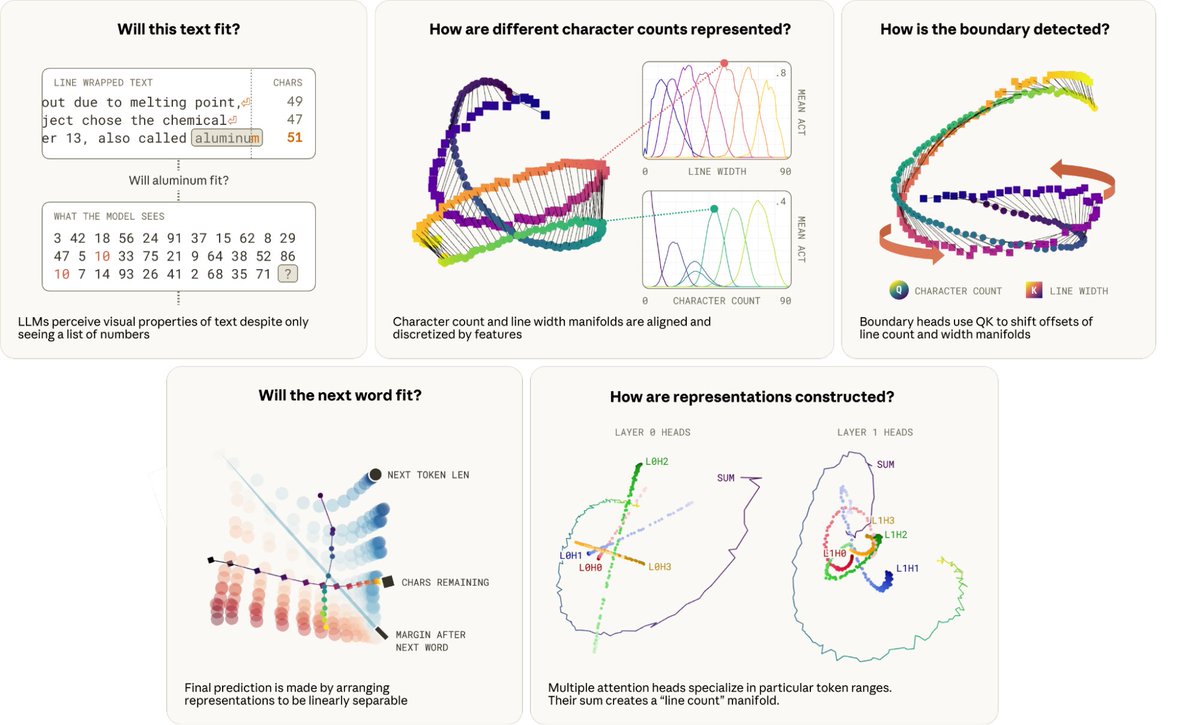
New paper! We reverse engineered the mechanisms underlying Claude Haiku’s ability to perform a simple “perceptual” task. We discover beautiful feature families and manifolds, clean geometric transformations, and distributed attention algorithms!
“Everyone knows” what an autoencoder is… but there's an important complementary picture missing from most introductory material.
In short: we emphasize how autoencoders are implemented—but not always what they represent (and some of the implications of that representation).🧵
Anyone is interested in doing this project with me for @lossfunk?
Bootstrap a strong reasoning model via self-improvement.
Idea is simple:
1. Generate many reasoning chains via high-temperature sampling
2. Retain correct ones
3. Use the recent DivPO method for promoting diversity of responses (essentially it is DPO where most diverse is "good" and least diverse is "bad")
4. Go to step 1
My hunch says this should improve reasoning scores because the model can now reason in a variety of ways.
In 2015, Notion was on the brink of bankruptcy.
So the founders escaped to Japan for 2 years…
Today, Notion is a $10B empire that Google, Microsoft & Apple envy and can't survive without...
Here are the 3 philosophies they found in Japan: 🧵
I interviewed for LLM/ML research scientist/engineering positions last Fall. Over 200 applications, 100 interviews, many rejections & some offers later, I decided to write the process down, along with the resources I used.
Links to the process & resources in the following tweets
I've tried all (36) AI Coding Agents & IDEs 😵💫
[CreateXyz, Cursor, Softgen, Windsurf, Wrapifai, Copilot, Lovable, Bolt, v0, Replit, MarsX, AmazonQ, Pear, Devin, Github Spark, IDX, Webdraw, Claude 3.7 Sonnet & more]
The most complete list ever made:
In China’s fast-moving AI market, these startups are stealing the spotlight🔥
Dubbed 'The Big X' —where X is a number that changes with the breakneck growth of China’s AI market — it could be 6 today, 7 tomorrow 👀
Let's dive in 👇
Zhipu AI (智谱) @thukeg@ChatGLM
✨Founded 5 years ago and linked to Tsinghua University. It has contributed open-source models such as CogVideo and GLM4.
✨Active in both To-B & To-C market, its app "Qingyan" is the first in China’s large-scale model industry to offer video call functionality for individual users.
✨It has raised 11 funding rounds and is valued at over 20 billion RMB.
https://t.co/v7Tqu5kFHl
https://t.co/8goCfOE6JW (零一万物) @01AI_Yi
✨An AI company founded by former Google executive Kai-Fu Lee, has contributed models like Yi 34B, Yi-VL, and Yi Coder to the open-source community while also maintaining a closed model: Yi-large.
✨ Focused on To-C market, their app "PopAi" has also been launched overseas.
✨In August, the company reportedly secured hundreds of millions of dollars in new investment.
https://t.co/qNtHn0dtvZ
OpenBMB (面壁智能)@OpenBMB
✨A key company under the Tsinghua-affiliated group. It has contributed the MiniCPM series of open End-Side models, which is now their main development focus.
https://t.co/TTJMuUk5cD
DeepSeek (深度求索)@deepseek_ai
✨An AI company backed by a quantitative fund, DeepSeek is among the few in China dedicated to the technological innovation!
✨They have contributed powerful models like deepseek-coder, deepseek-VL and deepseek math etc.
✨Their new MLA framework reduces memory usage to just 5%-13% of traditional MHA, igniting a "price war" in China’s LLM market. https://t.co/GC85G3fKX9
Baichuan AI (百川智能)@BaichuanAI
✨Once a major player in the open-source space, adopted a 'super models + super applications' strategy early on, launching various models and applications.
✨It is the only top AI startup in China focused on the medical field.
✨The founder - Wang Xiaochuan, was named one of Time's 100 AI this year. https://t.co/DHN6WriZRN
StepFun (阶跃星辰)
✨A new player in the Chinese AI market, released their first open project - OCR2.0 last week.
✨The company is currently valued at over $2.4 billion. Their main products for the To-C market are Yuewen and Maopaoya.
https://t.co/aECHKxFiNv
MiniMax (稀宇科技)
✨A Shanghai-based startup, MiniMax is developing products like "Hailuo AI" and "Talkie"(on oversea market) while actively expanding its To-B operations in Belt and Road countries.
MoonShot (月之暗面)
✨Led by a star founder with a strong technical background from Tsinghua University, MoonShoot is currently valued at around $3.3 billion.
✨Its flagship product "Kimi" has gained immense popularity for its long-context capabilities.
✨The company has also launched two apps overseas: Ohai and Noisee.
All languages covey information at a similar rate when spoken (39bits/s).
Languages that are spoken faster have less information density per syllable!
One of the coolest results in linguistics.
Microsoft just killed Cursor today with the launch of GitHub Spark and introduced major updates to GitHub Copilot.
More details in the thread 🧵
📹 credit from Microsoft.
Excited to share our latest work on discrete flow matching! A new framework that achieves SOTA non-autoregressive generation. For example, pass@1 on HumanEval is 6.7/11.6 and 6.7/13.1 on MBPP.
Paper: https://t.co/oJLgsBiyys
[1/n]
xLSTM excels in times series prediction. "Our xLSTMTime model demonstrates excellent performance against state-of-the-art transformer-based models as well as other recently proposed time series models." https://t.co/8SwLdBtFed