Origin, our code hosting platform, is now live.
It's fast, easy to use, and deeply integrated with Cursor.
Get started by syncing your repos from GitHub.
The most fun in programming was the autocomplete era. Much better than the current slot machine + code review. It's a pity they stopped making better and better autocomplete models.
This is what it looks like when a 20-year-old open source company stops debating AI and starts building with it, messily, honestly, out loud.
An agentically coded Sheets app made by a non-engineer made Frappe sit up.
Three months later, that curiosity turned into our first-ever LLM demo day. 22+ products and features, built using agentic development, shown side by side by developers and non-developers. A Tally migrator, a newsletter tool, a whiteboard, and a whole section of important features for Cloud, Framework & ERPNext.
Some are rough, while some are already shipped. All born out of curiosity and a few late nights. We're not sure where this is going, what it will become or how it'll change the world of software. Either way, we're here and talking about it.
Here's a sneak peek, watch the whole thing here https://t.co/yWCv4VYZMQ
My biggest takeaways from @Netflix's Chief Product and Technology Officer Elizabeth Stone:
1. Elizabeth believes that “systems thinking” is becoming the most important skill in the AI era. In engineering and product, this means people who can see across business domains and build the common capabilities that let many teams move quickly. In design, it means experience designers who create templates and design systems so that non-designers can ship work that stays coherent and on-brand. The underlying driver is velocity: when more people are doing more types of work at higher speed, you need to be good at building common scaffolding.
2. Systems thinking is learnable: zoom out one level from your specific problem. Given a task, step back one click—what bigger problem does this serve the business, will it scale across the product surface areas, should it become a platform capability? The companion habit: do your job in a way that helps your manager do theirs. This will force you to think about how all the pieces fit together.
3. Expect a storming phase before a forming phase. The role confusion people feel right now (“What is my job anymore?”) is the predictable middle of any transformative technology. Elizabeth’s advice: focus on high-quality source-of-truth data, guardrails on what ships, and constant internal reinforcement that humans own what they create.
4. The top AI labs converged on Netflix’s culture. High agency, high talent density, top-of-market pay, bottom-up thinking, fast experiments—the traits Lenny hears constantly from AI labs were in Netflix’s early culture deck. Elizabeth’s explanation: excellence comes from hiring exceptional people, trusting them to do great work, and holding them accountable.
5. Netflix’s culture is centered around building “excellence as an operating system.” High talent density, radical transparency, context not control, and the keeper’s test. These work together to create an environment of trust and accountability, without bureaucracy. But it’s also uncomfortable. It requires tolerating people making decisions you’d make differently, resisting the reflex to add process when things go wrong, and letting people carry the weight of their own choices. Elizabeth describes the hardest part as “being comfortable in that discomfort.”
6. The keeper’s test is as much about recognizing great people as it is about removing the wrong ones. The test—“If this person told me they were leaving, would I fight to keep them?”—is often cited in its difficult form: the moment you realize someone isn’t the right fit. But Elizabeth uses it predominantly as an entry point for honest performance conversations that are deeply positive. Most of the time the answer is “I would fight so hard to keep you,” which creates the opening to articulate strengths, discuss impact, and name what’s working. Good feedback hygiene needs a forcing function; the keeper’s test provides one.
7. Specialization is trending down—adaptable generalists are trending up. We’re shifting away from narrow stack-layer specialists (pure frontend, pure backend) toward people who can navigate fluidly across layers. The same logic applies to business domain knowledge: the mindset of “I’m a payments expert, full stop” is less valuable than “I know payments well enough and I’m willing to imagine what the future version of this looks like.” The meta-skill is learning to learn, not locking into a single lane.
8. Netflix’s approach to AI fluency is a universal principle, not a level-specific expectation. Rather than rewriting career ladders to specify what AI competence looks like at each level, Netflix added a single aspiration across all roles and levels: AI fluency. What fluency means varies by function and seniority, but the non-negotiable minimum is the same everywhere—an open-minded, experimental mindset, genuine curiosity, and comfort with ambiguity.
Ee Sala Nu Cup Namdu! ❤️🔥🏆
Welcome to the RCB Era, ladies and gentlemen! 😎
You waited, you believed and you stayed… this one’s for you again, 12th Man Army! 🥹❤️
#PlayBold#ನಮ್ಮRCB#IPL2026
Introducing https://t.co/ycxJEf1z7w!
A new space where I explore how the best apps in the world are built.
First piece:
How's Linear is so fast? a technical breakdown.
https://t.co/9Vu1syrn1i
I've been spending my weekends building Skyeline. It's in free beta. Check it out: https://t.co/iA7A9RcDvb
I wanted a cleaner way to version prompts, test them, route across providers, and trace what actually happened when something broke.
Here's a quick walkthrough. ↓
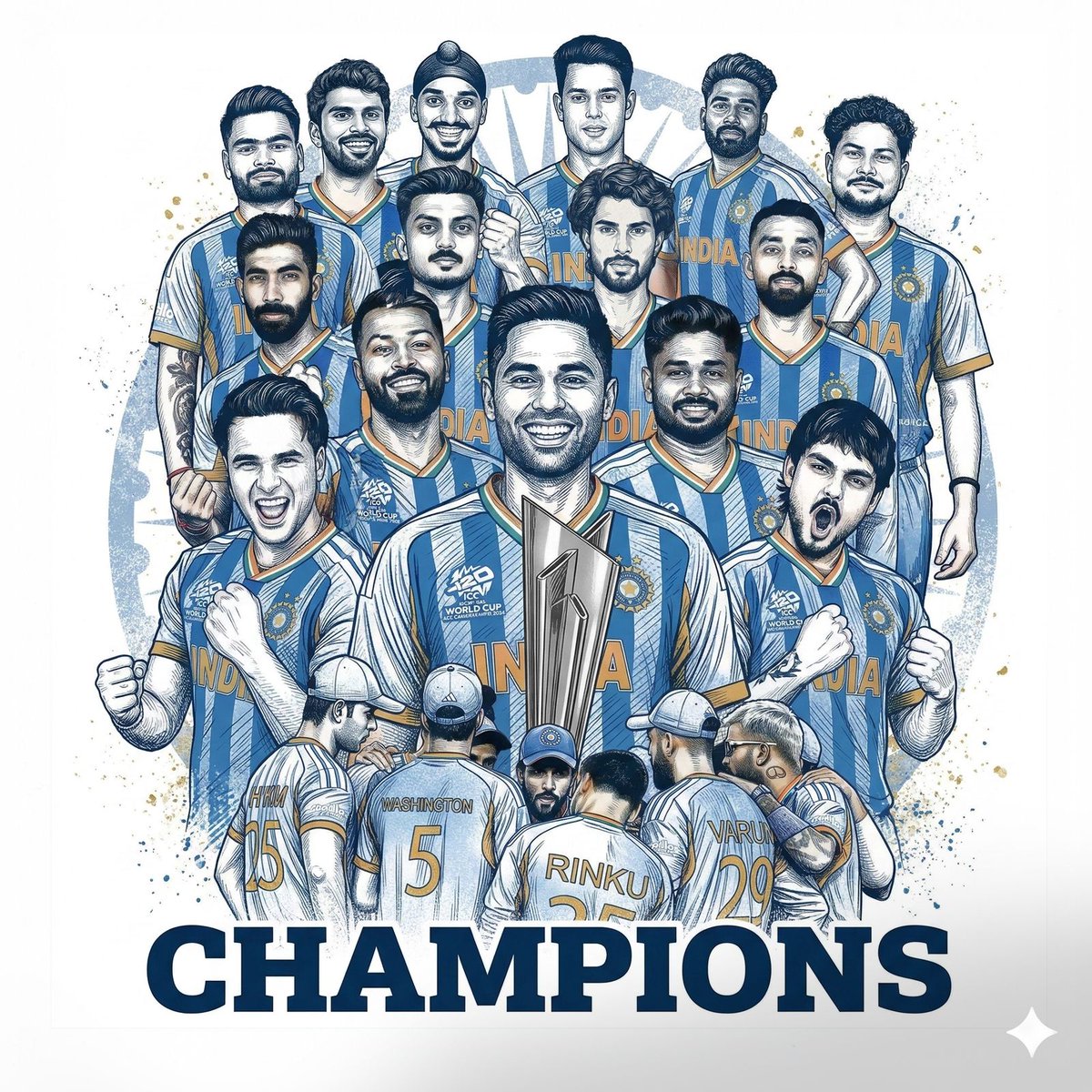
A TEAM OF WINNERS 🥇
Suryakumar Yadav-led India etch their name in history as they become the first team to defend the #T20WorldCup 🙌
Made with Google Gemini