A mathematician at @AnthropicAI announces using Claude to solve the Generalized Riemann Hypothesis and the stock is down
The future will be crazy
Congrats to @__alpoge__ on the mathematical ride of a lifetime
Hopefully it's just the first of many such explorations
4K image generation in 10 seconds! ⚡
Meet MiniMax H3-Image.
16 million pixel resolution. Stunning realism. Precise prompt following & editing. Up to 16 reference images. All in 10 seconds.
And it's open-weight. 🚀
Available now via our API, MiniMax Code, and Hailuo AI — with 50% off 16MP+ generations during launch week!
Can't wait to see what you create. 🔥
Hugging Face: https://t.co/bpbJAIvXg0
API: https://t.co/avbsq6GAcM
MiniMax Code: https://t.co/GmxLmDurCL
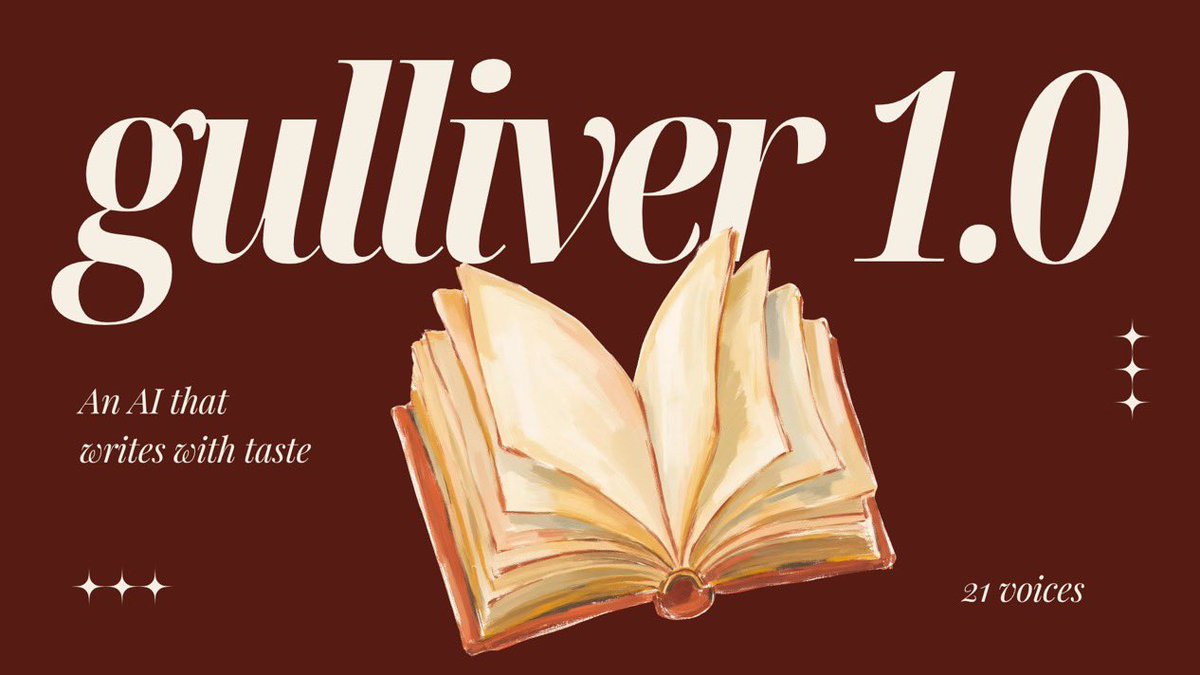
Today, we are releasing gulliver-1.0, a new experimental literary-prose LoRA adapter for Qwen/Qwen3.8-27B. This is not a standalone model, but a specialized layer designed to explore the texture and rhythm of historical prose.
We trained this adapter on a carefully curated dataset of 38.3 million tokens derived from 357 literary source records. The objective was author-conditioned prose continuation, not standard chat instruction tuning. This distinction is vital: gulliver-1.0 was built to mimic stylistic voice, not to answer questions or follow complex user prompts.
The corpus spans 21 distinct authors, ranging from the Victorian era to the early 20th century. You will find influences from Jane Austen, George Eliot, and Charles Dickens, alongside the distinct voices of Edgar Allan Poe, Herman Melville, and Oscar Wilde. By holding out 48 records, we ensured the model learned generalizable stylistic patterns rather than simply memorizing specific passages.
We are transparent about our limitations. gulliver-1.0 is an exploration, not a definitive solution. We have not established that it produces superior writing quality, nor do we guarantee reliable book-length generation or absolute originality. It is a tool for experimentation, intended to help writers and developers understand how specific stylistic nuances can be modeled and manipulated.
The adapter is released under the Apache-2.0 license, though you will need to provide the base Qwen weights separately. We encourage writers, researchers, and developers to download the model, test its boundaries, and share your findings. Your feedback is essential as we navigate this uncharted territory of creative machine learning.
We are excited to see what you create with gulliver-1.0. Please review the public model card for detailed information on data sources, training procedures, and loading instructions. This is our first step in understanding how artificial intelligence can engage with the literary tradition.
Try it today at https://t.co/6dlkL3EZtN. We look forward to your thoughtful experiments and constructive critiques.
Gulliver does not beat AI detectors and at first I was a little pissed but then I realised that it is not supposed to.
The LLM that writes well does not necessarily mean a LLM that is good at pretending to be a human.
A good codebase written by LLM is recognisable and we still use it.
We don't pick a coding model because it writes the most "human" code, we pick it because of the outcome.
A drunk man will score human on an AI detector that does not mean that many people would be interested to talk with him or read his writings.
I don't want gulliver to be a human, I want it to write so good it feels unreal.
Today, we are releasing gulliver-1.0, a new experimental literary-prose LoRA adapter for Qwen/Qwen3.8-27B. This is not a standalone model, but a specialized layer designed to explore the texture and rhythm of historical prose.
We trained this adapter on a carefully curated dataset of 38.3 million tokens derived from 357 literary source records. The objective was author-conditioned prose continuation, not standard chat instruction tuning. This distinction is vital: gulliver-1.0 was built to mimic stylistic voice, not to answer questions or follow complex user prompts.
The corpus spans 21 distinct authors, ranging from the Victorian era to the early 20th century. You will find influences from Jane Austen, George Eliot, and Charles Dickens, alongside the distinct voices of Edgar Allan Poe, Herman Melville, and Oscar Wilde. By holding out 48 records, we ensured the model learned generalizable stylistic patterns rather than simply memorizing specific passages.
We are transparent about our limitations. gulliver-1.0 is an exploration, not a definitive solution. We have not established that it produces superior writing quality, nor do we guarantee reliable book-length generation or absolute originality. It is a tool for experimentation, intended to help writers and developers understand how specific stylistic nuances can be modeled and manipulated.
The adapter is released under the Apache-2.0 license, though you will need to provide the base Qwen weights separately. We encourage writers, researchers, and developers to download the model, test its boundaries, and share your findings. Your feedback is essential as we navigate this uncharted territory of creative machine learning.
We are excited to see what you create with gulliver-1.0. Please review the public model card for detailed information on data sources, training procedures, and loading instructions. This is our first step in understanding how artificial intelligence can engage with the literary tradition.
Try it today at https://t.co/6dlkL3EZtN. We look forward to your thoughtful experiments and constructive critiques.
@naveen_venk Hey just launched Gulliver. It’s an adapter for Qwen 3.8 27B. It has 21 voices.
Sadly don’t have an api or interface yet but I can host it for sometime if you want a personal writer by your side :)
https://t.co/9HPQuU8OB1
Today, we are releasing gulliver-1.0, a new experimental literary-prose LoRA adapter for Qwen/Qwen3.8-27B. This is not a standalone model, but a specialized layer designed to explore the texture and rhythm of historical prose.
We trained this adapter on a carefully curated dataset of 38.3 million tokens derived from 357 literary source records. The objective was author-conditioned prose continuation, not standard chat instruction tuning. This distinction is vital: gulliver-1.0 was built to mimic stylistic voice, not to answer questions or follow complex user prompts.
The corpus spans 21 distinct authors, ranging from the Victorian era to the early 20th century. You will find influences from Jane Austen, George Eliot, and Charles Dickens, alongside the distinct voices of Edgar Allan Poe, Herman Melville, and Oscar Wilde. By holding out 48 records, we ensured the model learned generalizable stylistic patterns rather than simply memorizing specific passages.
We are transparent about our limitations. gulliver-1.0 is an exploration, not a definitive solution. We have not established that it produces superior writing quality, nor do we guarantee reliable book-length generation or absolute originality. It is a tool for experimentation, intended to help writers and developers understand how specific stylistic nuances can be modeled and manipulated.
The adapter is released under the Apache-2.0 license, though you will need to provide the base Qwen weights separately. We encourage writers, researchers, and developers to download the model, test its boundaries, and share your findings. Your feedback is essential as we navigate this uncharted territory of creative machine learning.
We are excited to see what you create with gulliver-1.0. Please review the public model card for detailed information on data sources, training procedures, and loading instructions. This is our first step in understanding how artificial intelligence can engage with the literary tradition.
Try it today at https://t.co/6dlkL3EZtN. We look forward to your thoughtful experiments and constructive critiques.