Using this space to learn in public. I’ll share:
– Papers I’m reading
– Ideas at the intersection of MedTech, biology & computation
– Thoughts on how geopolitics and economics shape research & innovation.
Here to think clearly, ask better questions, and connect dots.
drop Hi!
Why the hell does every Indian military operation need . realtime reporting can b’cm security breach & useful feed for militants & terrorists.
Operations need secrecy, not constant media attention. Report it after the mission is over, not while it’s still unfolding.
#WATCH | Jammu and Kashmir: Heavy shelling and intense firing erupted in the Dorimal forest area of Rajouri as Operation Sheruwali entered a crucial phase. Massive deployment of security forces, along with additional reinforcements and logistical support, has been rushed to the encounter site to tighten the cordon and prevent militants from escaping through the dense forest terrain.
Cancer neuroimmunology is on fire right now. No question neuroimmunology will expand the therapeutic approach to cancer. I push this very hard with many pharma companies now...
https://t.co/qsBrHNn8P3
@austinxwalker Hey Austin! Not a biohacker yet however i do cover rest 2 points you mentioned here.
Your work is interesting, would love to know more about your journey and work.
Glad to connect.
Cardiologist wins 3rd place at Anthropic's hackathon. Out of 13,000 applications. Built in 7 days by Michał Nedoszytko MD. Coded day and night - in the hospital, in the cloud, while flying from Brussels to San Francisco.
A few years ago, it would have been impossible for a doctor to build this alone in just a couple of days. AI changed that.
The project is called https://t.co/wAliajqjVF. It is an AI agentic care platform for patients. Including reverse AI scribe it is a companion that guides the patient from the moment they leave the doctor's office.
Powered by the massive context window of Opus 4.6, it allows patients to explore their full medical history, connected devices, Evidence Based resources and external data sources — all in one place.
Today, the barrier to entry has vanished; even a practicing physician can build an application from scratch.
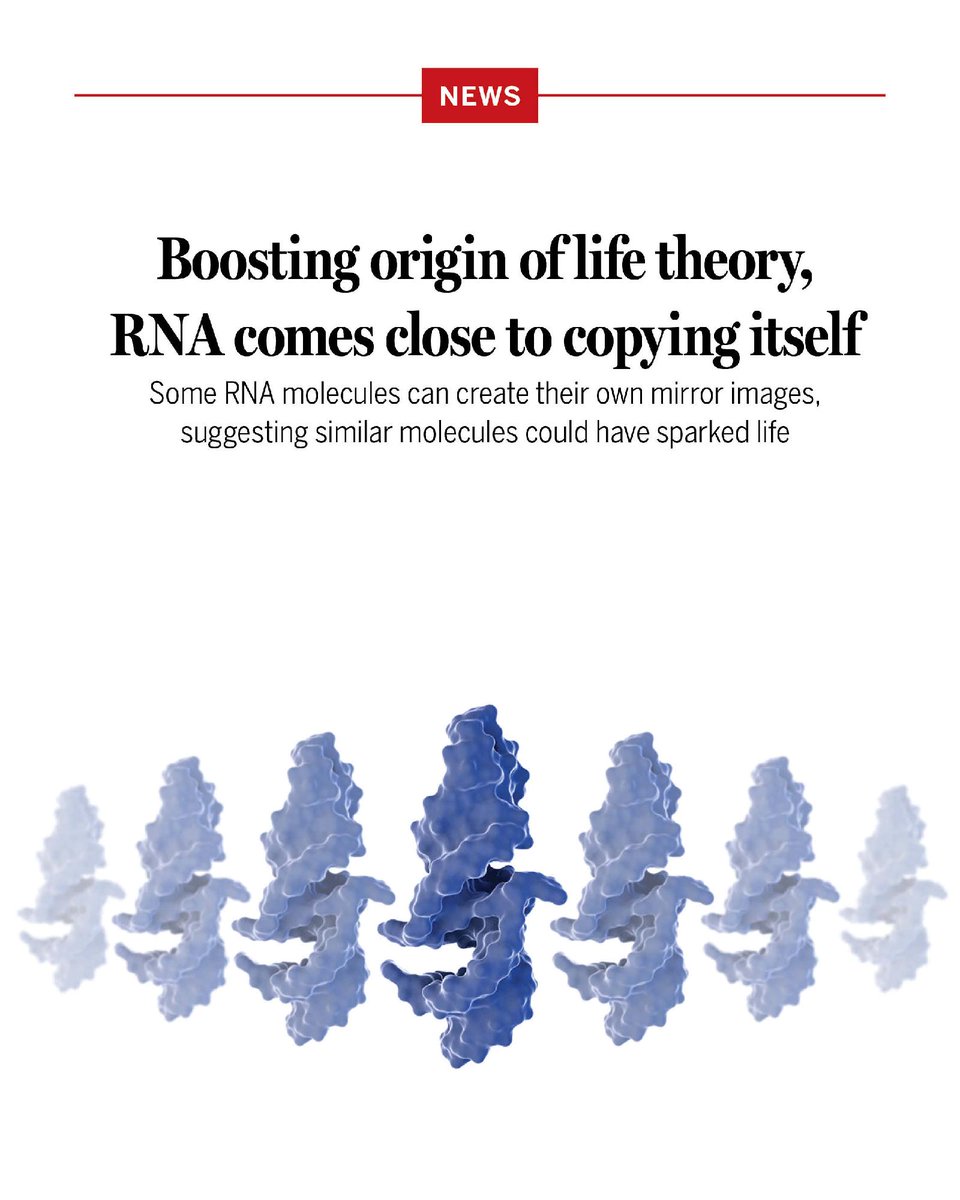
Today RNA may seem overshadowed by its glamorous cousin DNA, but many scientists think RNA molecules were the star players in the origin of life. By both storing genetic information and copying themselves, they might have touched off the march of evolution that produced increasingly complex life forms.
So far, researchers haven’t found RNAs that can replicate themselves, a key feature of living things. But they now have something close.
In a new paper, researchers report creating RNAs that can generate a sort of mirror image of themselves and use that template to generate the original. Learn more: https://t.co/lYjYdSD8X5
Does the noncoding genome actually carry more genetic information than coding seqs? Motivated by this question we mutated every bp in the 10kb MYC locus. Results are even more exciting: Decoding the MYC locus reveals a druggable ultraconserved RNA element https://t.co/MynOLLNvXi
OK, so the $ bio ai assistants are:
Ascent Bio - https://t.co/r9XxxvizqF
Bio Protocol BIOS - https://t.co/ZlU7ueQgzT
Edison Scientific - https://t.co/qioORKVhhG
K-Dense - https://t.co/06tuwxhbsA
Potato - https://t.co/I4mcR5vhPL
SciSpace - https://t.co/4jD6wq5ufn
Did I miss any?
I’m trying to spend more time learning from people doing real work in disease biology, translational research, AI × biology, and MedTech.
If that’s you, I’d genuinely like to follow your work and learn from it.
What are you working on?
One thing reading recent biomedical + AI work keeps reinforcing:
tools are improving faster than judgment.
The edge isn’t access to papers or models anymore —
it’s knowing what to trust, what to test, and what to ignore.
A vaccine isn’t just a lab result it’s a societal intervention.
The recent suspension of a US-funded vaccine trial in Guinea-Bissau highlights how local scientific governance and ethical oversight matter in global health research.
AI made research faster.
It also made source ambiguity easier.
Clarivate Nexus aims to reconnect AI workflows with trusted academic literature.
The open question:
Should AI be optimized for speed, or for epistemic reliability?
@ClarivateHealth@ClarivateAG
For people working on immune engineering or clinical immunology:
How do you assess the trade-offs between immune activation and regulation when designing a therapy? Which Treg-centric strategies feel most promising or risky?
Regulatory T cells (Tregs) are increasingly recognized not just as immunology curiosities, but as therapeutic modulators across cancer, autoimmunity, and transplant medicine. What we choose to regulate often defines outcomes. https://t.co/ri7huviWLT
The editorial highlights that Treg biology is not academic isolation — it’s central to next-gen immunotherapies. As we iterate on CAR-T, checkpoint, and tolerance strategies, Treg insight becomes a systemic lever.