İşte 'sığlık' tam olarak budur. 'Agentic OCR' dediğin şey metni okuyan bir paspastır; üç tane API'yi birbirine bağlayıp adına "Agentic" demek. Hal böyle olunca, "state-space" veya "ontolojik köken" gibi derin mühendislik kavramlar, Out of Memory (OOM) hatası verdiriyor. Sizin Agentic OCR dediğiniz şey metni okur ve unutur, accountability?? kanıt?
Meet Kimi K2.6 Agent Swarm 👋
Highlights:
🔹 Swarms, elevated - 300 parallel sub-agents × 4,000 steps per run (up from 100 / 1,500 in K2.5).
🔹 Outputs are real files, not chat - one run delivers 100+ files, 100,000-word literature reviews, or 20,000-row datasets.
🔹Heterogeneous skills - search, analysis, coding, long-form writing, and visual generation all running in parallel
🔗Try it at: https://t.co/2Tu8McUaUa
Haha anlaşılmak isteyen ama olabildiğince anlaşılmaz yazan biri gibisin :) düz ocr yerine bir agentic (ve doğrulanabilir) bir zeka katmanı olabilirdi demek için çorba yapmışsın cümleleri bende acaba yabancı dilde yazdıda grok cümleleri anlaşılmazmı çevirdi diye kontrol ediyorum 😀
Evet cidden böyle konuşunca güzel onu productionds çekince asıl mevzu başlıyor hele scale konusunu konuşmuyorum file bundan dolayı 2 hafta tam mesaji çalıştığım projeyi (kolay scale edenilmek için rust kullanmama rağmen) iptal etmek zorunda kaldım
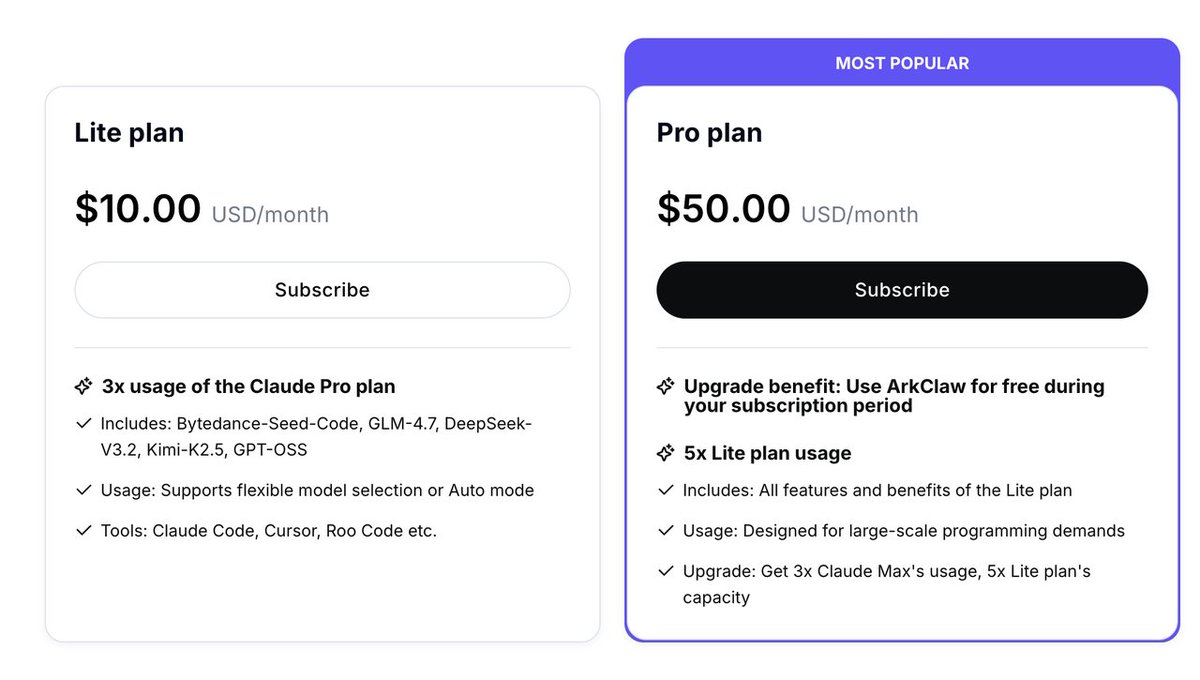
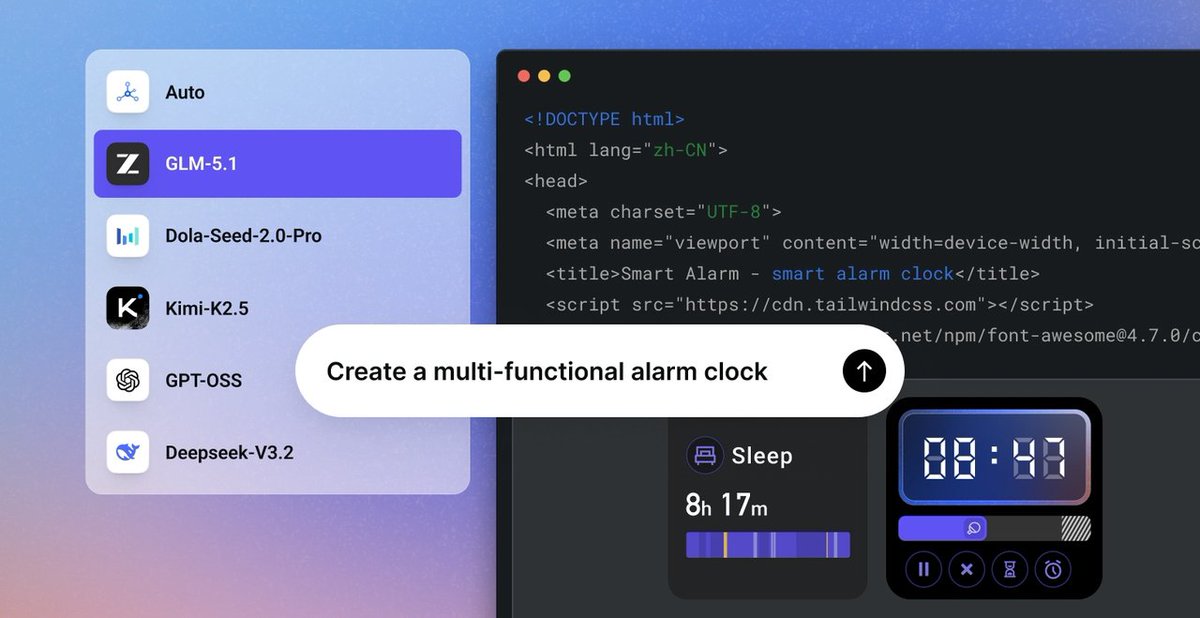
GLM-5.1 is now on BytePlus ModelArk Coding Plan. Starting at just $10/month, ModelArk Coding Plan offers a highly cost-efficient way to access GLM-5.1 alongside other advanced coding models.
GLM-5.1 is https://t.co/Jz7zvIeBkM's latest flagship model, MIT-licensed, open-weight, and built for long-horizon agentic coding. GLM-5.1 ranks among the world's top-tier models across leading coding benchmarks, including SWE-Bench Pro.
What you get with ModelArk Coding Plan:
→ Multiple advanced coding models in one subscription: GLM-5.1, Kimi-K2.5, Dola-Seed-2.0-pro, DeepSeek-V3.2, and more. Switch freely or let Auto mode match the best model to the task.
→ Works with the tools you already use: Claude Code, Cursor, Cline, Codex CLI, Kilo Code, Roo Code, OpenCode, and OpenClaw
→ No throttling. Backed by ByteDance's infrastructure.
→ Activated on purchase. Ready to use immediately.
Also new this month: Dreamina Seedance 2.0 is now available on BytePlus, the official API platform for Seedance models. Learn more: https://t.co/n5obvmuzgQ
Refer friends and earn 10% vouchers on every order with no cap. Your friends get 10% off their first subscription too.
Get started for $10/month → https://t.co/tN1toE3FjP
#BytePlus #ModelArk #GLM #AIEngineering #DevTools #AIAgent
Ayer en la comunidad me recomendaron @orca_build y es UNA PASADA. Está 100% pensado para agentes.
Es como si una terminal y un IDE se hubiesen casado y hubiesen tenido el hijo enfocado 100% en correr agentes. Está muy muy top.
10/10 la verdad.
I definitely don’t agree—it’s still not reliable enough for a full-scale project. You’ve probably just stumbled upon an area where it works well; I used K2.6 last night for a project; yes, it’s smarter, but when developing ReactFlow, it got stuck in a loop and couldn’t resolve the state inconsistency; Claude Code (with Opus 4.7), on the other hand, resolved it in one shot
I definitely don’t agree—it’s still not reliable enough for a full-scale project. You’ve probably just stumbled upon an area where it works well; I used K2.6 last night for a project; yes, it’s smarter, but when developing ReactFlow, it got stuck in a loop and couldn’t resolve the state inconsistency; Claude Code (with Opus 4.7), on the other hand, resolved it in one go.
I definitely don’t agree—it’s still not reliable enough for a full-scale project. You’ve probably just stumbled upon an area where it works well; I used K2.6 last night for a project; yes, it’s smarter, but when developing ReactFlow, it got stuck in a loop and couldn’t resolve the state inconsistency; Claude Code (with Opus 4.7), on the other hand, resolved it in one go.
Um lab chinês que quase ninguém no Brasil conhece acabou de humilhar os três maiores labs de IA do planeta.
Modelo open-source.
Pesos no HuggingFace. Gratuito.
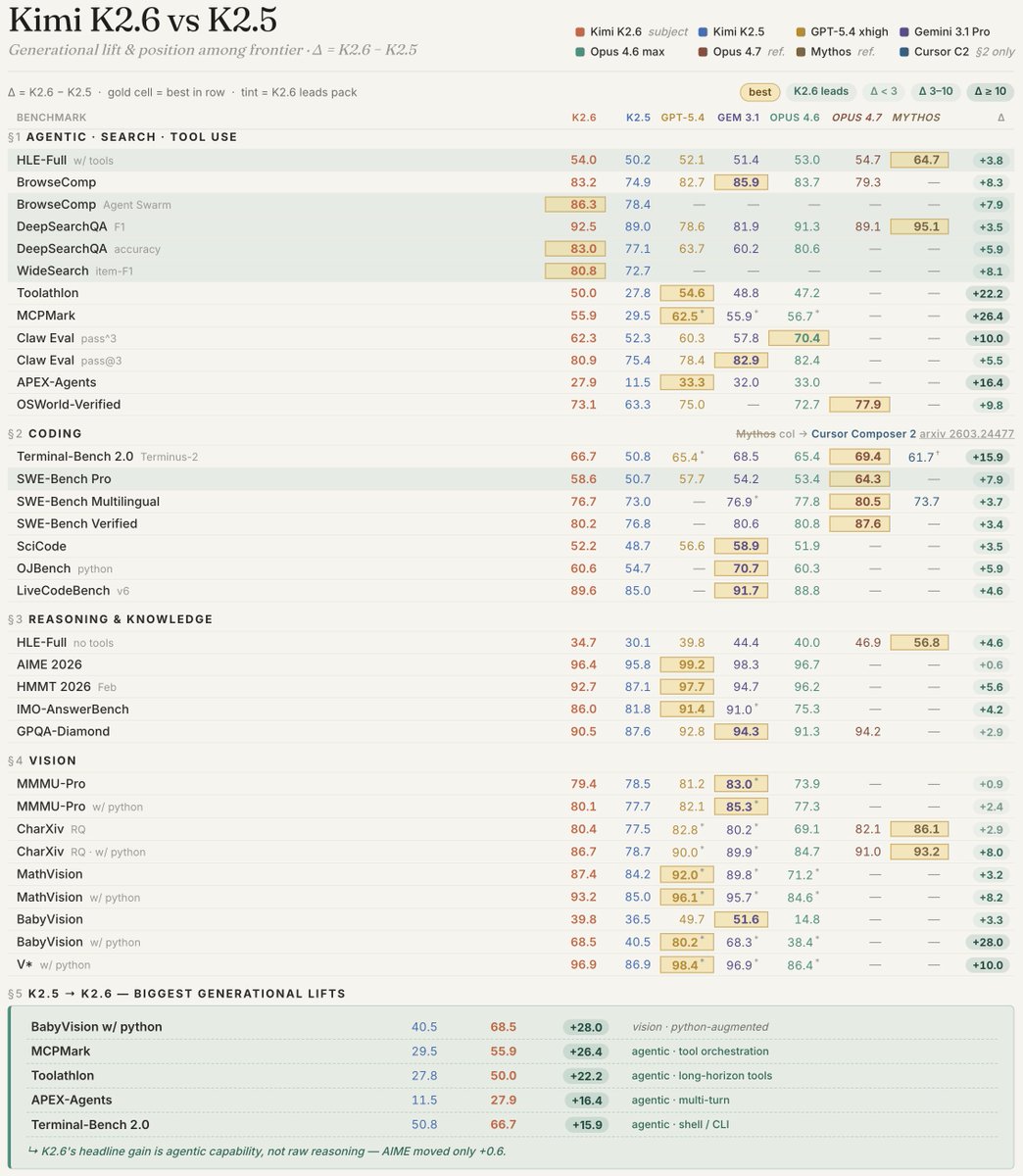
E bate Claude Opus 4.6, GPT-5.4 e Gemini 3.1 Pro em 6 benchmarks.
Não é exagero.
A Moonshot lançou o Kimi K2.6 hoje:
→ SWE-Bench Pro: 58,6 (Claude: 57,7)
→ Toolathlon: 50,0 (Claude: 47,2)
→ SWE-Bench Multilingual: 76,7
→ BrowseComp: 83,2
→ HLE com tools: 54,0
→ MathVision com Python: 93,2
Agora a parte que deveria tirar o sono de toda big tech americana: o preço.
Kimi K2.6 via API: $0,60/milhão de tokens de input. $2,50 de output.
Claude Sonnet 4.6: $3,00 e $15,00.
5x mais barato no input. 6x no output.
E como os pesos são abertos, qualquer empresa com GPUs roda sem pagar nada para a Moonshot.
Mas o número mais assustador não é benchmark nem preço. É velocidade de execução.
O modelo rodou 4.000+ tool calls em uma sessão única. 12 horas de execução contínua. 300 sub-agentes em paralelo. Pegou um modelo local, reescreveu a inferência inteira em Zig, e foi de 15 tokens/segundo para 193. Sozinho.
Um engenheiro de software autônomo que trabalha 12 horas sem parar e não cobra salário. Open-source.
A OpenAI cobra $200/mês pelo Pro.
A Anthropic levantou $60 bilhões em valuation.
O Google queima $75 bilhões por ano em infraestrutura.
E um lab de Pequim, com uma fração desse capital, está entregando de graça o que essas empresas dizem aos investidores que custa dezenas de bilhões para construir.
A cadência é o que mata.
K2 em julho de 2025.
K2.5 em janeiro de 2026.
K2.6 agora.
A cada 8 semanas a Moonshot solta um modelo que come mais um pedaço do moat dos labs fechados. Dessa vez, em benchmarks agênticos, o moat evaporou.
Em janeiro o DeepSeek evaporou $600 bilhões da Nvidia em um único dia e forçou a OpenAI a tornar o ChatGPT gratuito na mesma semana.
Agora a Moonshot fez de novo.
Essa é a segunda vez em quatro meses. Vai ter uma terceira.
I definitely don’t agree—it’s still not reliable enough for a full-scale project. You’ve probably just stumbled upon an area where it works well; I used K2.6 last night for a project; yes, it’s smarter, but when developing ReactFlow, it got stuck in a loop and couldn’t resolve the state inconsistency; Claude Code (with Opus 4.7), on the other hand, resolved it in one go.