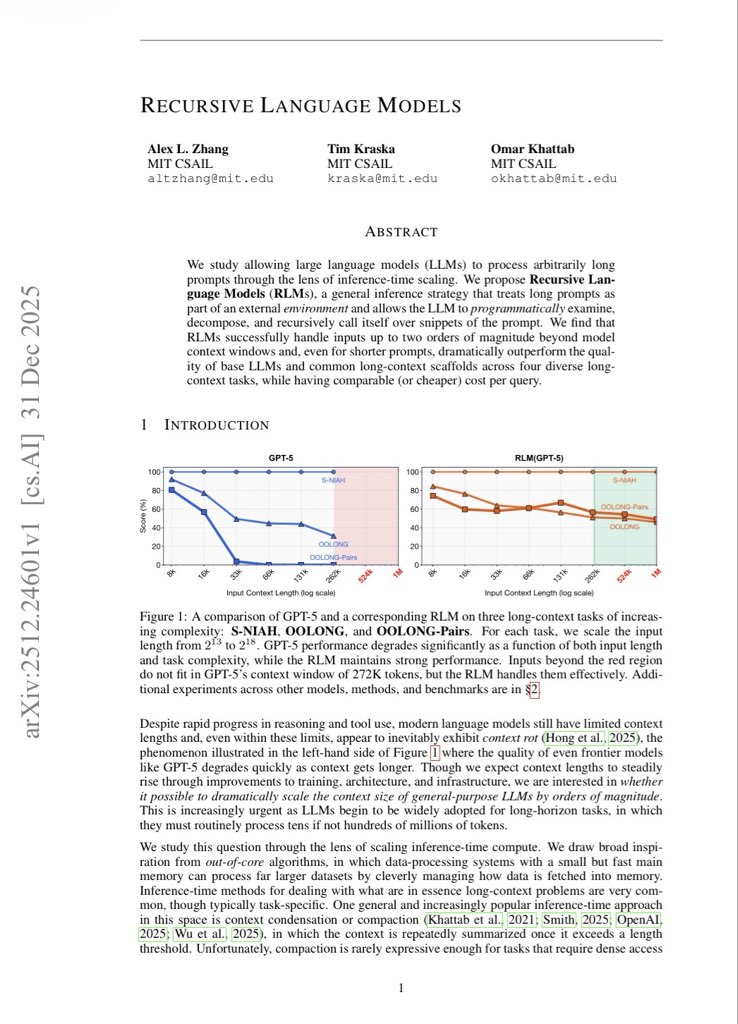
R.I.P. basic prompting.
MIT just dropped a technique that makes ChatGPT reason like a team of experts instead of one overconfident intern.
It’s called “Recursive Meta-Cognition” and it outperforms standard prompts by 110%.
Here’s the prompt (and why this changes everything) 👇
If you’ve never written code before, this is for you. I’ve just launched a course that shows you, in less than 30 minutes, how to describe an idea for an app and build it with AI.
In this course, you'll build a working web application - a funny interactive birthday message generator that runs in your browser and can be shared with friends. You'll customize it by telling AI how you want it changed, and tweak it until it works the way you want. By the end, you'll have a repeatable process you can apply to build a wide variety of applications.
If you want to try vibe coding, this will be the best place to start! Further, you'll be able to use these techniques with whatever tool you're most comfortable with (like ChatGPT, Gemini, Claude, or others) -- we're vendor neutral.
Skills you'll gain:
- How to build web apps with AI - zero coding skills needed
- How to fix and improve your creations by chatting with AI
- A simple process you can use to build other things you can dream up
Building with AI is one of the most fun things in the world. Please join me and take your first step! I think you will be surprised at what you can build. And if you're an experienced engineer, please share this with someone in your life who's been curious about building with AI.
Come build with me! https://t.co/q6gyzlxWFS
(Alert: Slightly longer post- read when free😆)
Brain blood flow, gravity, and wearable tech: a neurologist’s perspective
Recent podcasts featuring entrepreneur Deepinder Goyal wearing a “temple” device, claimed to continuously track cerebral blood flow, have sparked public curiosity. He has also floated an intriguing hypothesis: that gravity, by making the heart pump “uphill” when we sit or stand, may chronically reduce brain blood flow and contribute to ageing.
Innovation deserves curiosity, not dismissal. At the same time, health claims, especially those that could influence how people worry about their brains, deserve context.
Here is an evidence-based, clinician’s view, without taking anything away from the spirit of research behind such ideas.
Does gravity meaningfully deprive the brain of blood in daily life?
In healthy humans, the brain is remarkably protected. Multiple, well-studied mechanisms ensure stable cerebral perfusion across postures and ages:
1. Cardiac reserve: A healthy heart easily generates the pressure needed to perfuse the brain while upright.
2. Cerebral autoregulation: Brain vessels automatically constrict or dilate to keep blood flow stable despite changes in blood pressure or posture.
3. Baroreflexes: Sensors in the carotid arteries and aorta instantly adjust heart rate and vascular tone when we stand up.
This is why most people, from teenagers to octogenarians, can sit, stand, and walk without their brains being “under-perfused.”
When these systems fail, we see symptoms: dizziness on standing, syncope, orthostatic hypotension, autonomic failure, severe heart disease, or advanced vascular pathology. In such settings, posture-related cerebral hypoperfusion is real, but it is clinical, not subtle or silent.
Ageing does affect vessels and reflexes, but there is no good evidence that everyday upright posture, by itself, chronically starves the brain of blood in healthy people.
How do we currently assess cerebral blood flow?
Neurology already has validated tools, each used for specific clinical questions:
1. Transcranial Doppler (TCD): Non-invasive, bedside measurement of flow velocity in major brain arteries.
2. MR angiography / perfusion MRI: Detailed anatomical and perfusion assessment.
3. CT perfusion: Acute stroke settings.
These tests require trained operators and interpretation because numbers alone are not diagnoses. We correlate them with symptoms, examination, blood pressure, heart rhythm, and imaging.
Continuous, real-time monitoring of cerebral blood flow is currently reserved for critical care or research, not routine life.
Where could a wearable “temple” device fit, if validated?
If a wearable sensor can reliably, reproducibly, and safely estimate cerebral perfusion, it could be scientifically interesting, particularly for:
1. Research on sleep, posture, or autonomic disorders
2. Selected neurological conditions
3. Extreme environments (aviation, space medicine)
However, for healthy individuals, constant monitoring raises important questions:
1. Clinical relevance: What actionable decision follows a transient “low” reading in an asymptomatic person?
2. False alarms: Normal physiological variation could be misread as pathology.
3. Health anxiety: Continuous numbers without clinical context often create worry rather than benefit.
4. Cost vs value: Screening tests are useful only when they change outcomes.
History teaches us this lesson repeatedly-from heart rhythm trackers to glucose monitors in non-diabetics-measurement without a clear clinical need can do more harm than good.
✅My view
1. The idea that gravity influences circulation is physiologically true.
2. The leap from that fact to chronic brain under-perfusion causing ageing in healthy people is, at present, unproven.
3. The human body has evolved robust systems to protect cerebral blood flow across postures and decades of life.
4. Any new device must demonstrate not just technological novelty, but clinical usefulness.
Bottom line
Innovation often begins with bold questions, and research devices should be explored with an open mind. But from a neurologist’s standpoint, the healthy brain does not need continuous surveillance.
For most people, the best ways to protect brain health remain reassuringly simple and evidence-based: control blood pressure, stay physically active, sleep well, manage diabetes and cholesterol, avoid smoking, and stay cognitively engaged.
If future research shows a clear, meaningful role for continuous cerebral blood-flow monitoring, neurology will welcome it. Until then, curiosity should be matched with caution and numbers should never replace clinical sense.
Dr Sudhir Kumar
Neurologist, Hyderabad
X: @hyderabaddoctor
4-yr-old boy was killed today by stray dogs in Hyderabad. 21 deaths, over 2 lac dog bites in Kerala in 2022. What’s more effective? Castration of stray dogs or of dog activists?
BS ALERT
Malhotra's "peer reviewed" pseudoarticle is published in "Journal of Insulin Resistance", which appears to be a South African vanity outlet for junk scientists to show a formatted publication to their social media followers.
Plus he is on the pseudojournal's board.
@Akshat_World Don't think that is the possible use case, there are alot implications when it comes cross country transfer, who wants to fed away with USD
This man is a human Segway, with a built in gyroscope in his body! Incredible sense of balance. What pains me, however, is that there are so many like him in our country who could be talented gymnasts/sportspersons but simply don’t get spotted or trained…
The most common question I get from CEOs is to how to move and ship products faster.
They ask me how Facebook famously created a culture that moved so fast (and broke things).
Below are some memories from those days (1/9)