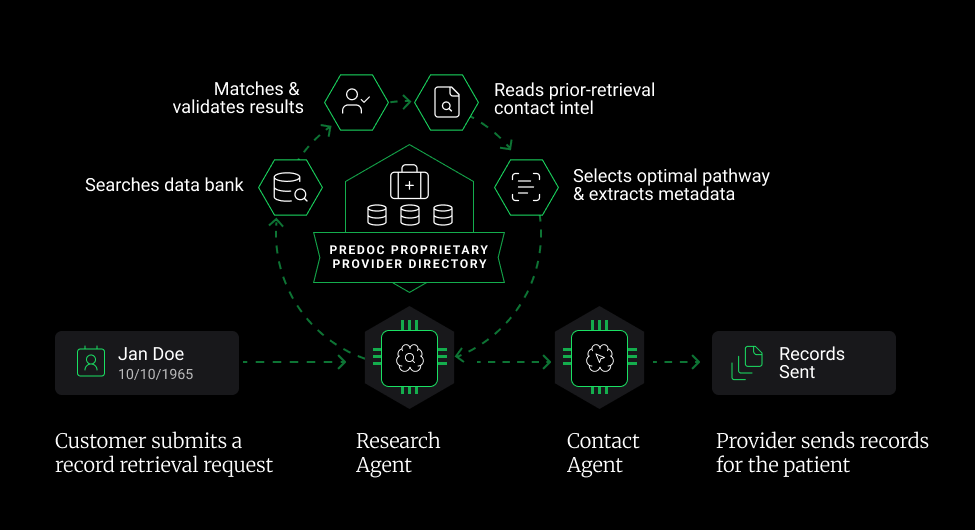
A few weeks ago, we worked with @B_Madden4 to tell the story of the multi-agent system Predoc built for medical record retrieval and data extraction, normalization, and curation.
Here's a PHI-redacted recording of our voice agent... and how much time it spends on hold.
Predoc Curated Data is now generally available.
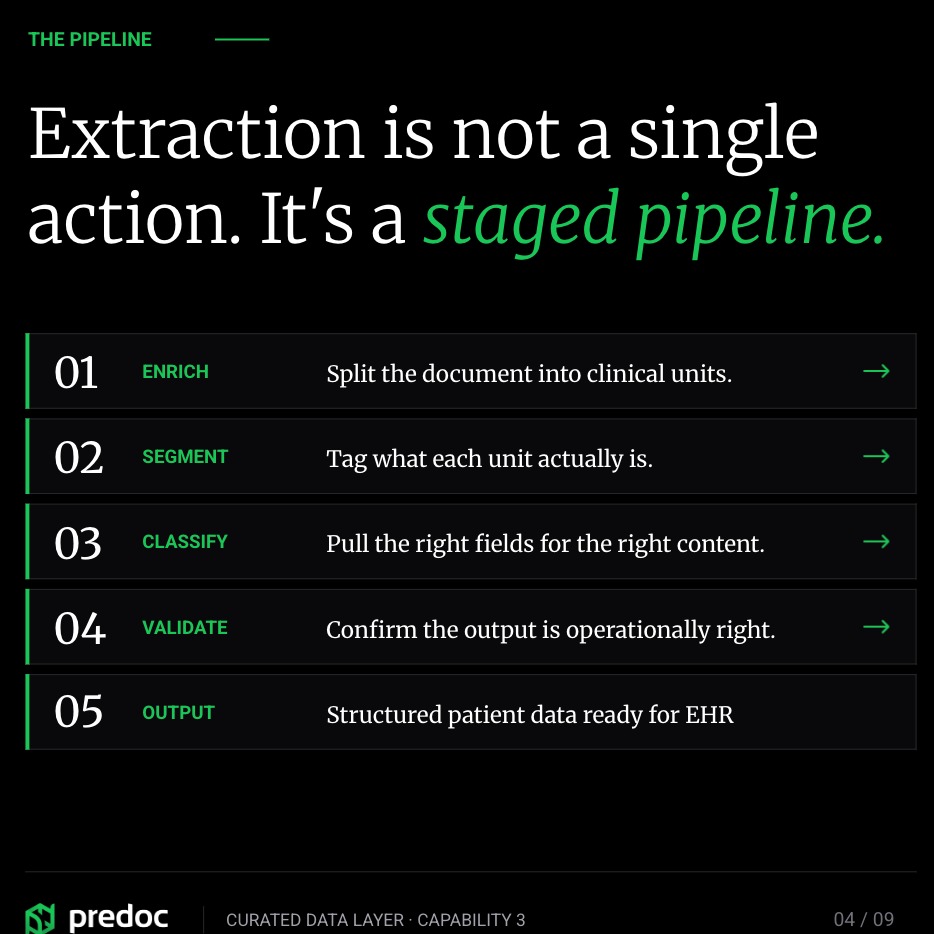
Turn fragmented records — PDFs and other unstructured sources included — into clean, normalized, longitudinal patient data. From Predoc retrievals or your own sources. For care teams, analytics, and AI.
https://t.co/N7LfD8wLCX
@julleybuilds@B_Madden4 This is the exact point: the model isn't the moat. In medical-record retrieval, the interesting part is whether that “prompt loop with a database” knows which fax line works, what a call must accomplish, when to cold fax, when to retry, and when to escalate to a human.
"Multi-agent systems" has officially entered the healthcare buzzword hall of fame, right up there with "value-based care" and "interoperability."
Everyone's throwing agents at everything and calling it innovation. But every so often, a company actually shows their work. And that's exactly what Predoc (@predoc_ai) did with a new report on how they built the multi-agent architecture behind their medical records retrieval and curation engine.
The full report (link below) is a useful blueprint for any healthcare exec trying to figure out what "building with AI" should actually look like in practice or where AI can have the highest impact.
4 things worth digging into:
1. Bespoke work is the opportunity, not the obstacle. Predoc makes the case that the most valuable automation opportunities aren't the clean, standardized tasks. Those get commoditized fast. It's the messy, facility-specific, exception-riddled workflows that are actually defensible. I think that's right, and it's a useful gut-check for any exec evaluating an AI vendor's ROI or worth buying.
2. The dataset is your moat. Predoc built its system on 300K-400K provider-research tasks, nearly 3 years of transcribed retrieval calls, and millions of reviewed record pages. The foundation models are swappable. That accumulated, structured "tribal knowledge" is not.
3. Start from first principles. Break the workflow down into its simplest parts. Bound each job, structure the handoff, escalate the exception. Predoc lays out how they gave each agent a job (research, voice, indexation, extraction, curation) and a structured output the next agent can act on immediately. When something doesn't fit, the agent escalates to a human, and that resolution gets fed back into the system.
4. The numbers back it up. I was pretty intrigued by some of the results in this piece: A 2-week-plus turnaround compressed to a median of 3 business days. Provider-research time down 70%. First-pass retrieval success up nearly 50%. 94.6% of pages indexed without human intervention.
The bigger theme I keep coming back to: this is a case study in systems of intelligence sitting on top of disorganized, disparate systems of record. Predoc's real output isn't "faster fax retrieval." It's a normalized, longitudinal clinical data layer that other applications can actually query.
Big thanks to brand partner Predoc for sitting down with me and showing their work on this one.
https://t.co/jV7bBcExqH
HIE data was a great start to interoperability, but it is often a mess. Duplicated and semantically inconsistent values are interwoven with a lot of messy, non clinically valuable items.
We set out to quantify the mess:
https://t.co/iUp2p5Cbdd
Here's are take: leveraging the latest models for agents isn't what makes a business defensible or unique, it's getting the foundational logic right, and the proprietary intelligence that the agents operate off of that is.
From our Head of Ops:
https://t.co/wH9ojVasQ5
Sometimes, patient data isn't missing, it's just spread across multiple formats or modalities that make it challenging to interpret and end-to-end story. Synchronization solves for that, but it's not easy.
Most “interoperable” healthcare data still arrives as thousand-page PDFs—forcing clinicians to manually sift, index, and reassemble what should already be usable.
Predoc transforms unstructured records into FHIR-ready data that actually powers care, workflows, and analyticsMost “interoperable” healthcare data still arrives as thousand-page PDFs—forcing clinicians to manually sift, index, and reassemble what should already be usable.
Predoc transforms unstructured records into FHIR-ready data that actually powers care, workflows, and analyticsMost “interoperable” healthcare data still arrives as thousand-page PDFs—forcing clinicians to manually sift, index, and reassemble what should already be usable.
Predoc transforms unstructured records into FHIR-ready data that actually powers care, workflows, and analyticsMost “interoperable” healthcare data still arrives as thousand-page PDFs—forcing clinicians to manually sift, index, and reassemble what should already be usable.
Predoc transforms unstructured records into FHIR-ready data that actually powers care, workflows, and analyticsMost “interoperable” healthcare data still arrives as thousand-page PDFs—forcing clinicians to manually sift, index, and reassemble what should already be usable.
Predoc transforms unstructured records into FHIR-ready data that actually powers care, workflows, and analytics.
Providers know that Metformin = Glucophage = “metformin 500 BID,” but downstream systems like EHRs, data warehouses, and analytics tools may not.
The result:
Providers often need to sort through and review duplicate data. Analysts miss insights. Billing workflows break.
Introducing our Curated Data Series: deep dives into the capabilities powering Predoc's curated data.
Today's focus: Terminology Mapping, or solving for the challenge with different naming conventions for the same concept, across all health data use cases.
@nikillinit@collision Not all systems play nice in 2026? Shocking.
Complete medical histories are still, shockingly, elusive. At best, most providers still rely on fax machines and patient self-reporting.
@salonium@kroetscha It's also painful when patients who may match I/E criteria are screen failed because their medical history can't be verified.
We hear this story all the time when we ask about what's slowing down enrollment velocity.