Announcing NETX as ''The Financial OS of the AI Agent Economy''
Get the full picture in minutes - watch the video 🤝
AgentCon Tokyo 2026, held at Microsoft Japan's headquarters, provided a high-profile platform for @netx_world, @WEAJapan and @Kouhou_NSS to showcase the @Haneda_official $USDC Pilot project directly to C-Suite executives and innovators from global giants like Microsoft Japan and AWS.
This event was not merely a conceptual discussion but a demonstration of real-world "agentic" commerce, where autonomous AI systems and digital currencies converge to drive the next generation of retail finance.
Strategic Significance and Visibility
The Haneda Pilot is significant as the first full-scale implementation of stablecoin payments at a major Japanese domestic airport.
By presenting this project at an event featuring leaders like Dona Sarkar (Microsoft’s Chief Innovation Officer) and Yuguang Li (AWS Partner Ambassador), $NETX and WEA Japan positioned their technology as a production-ready solution for the global economy.
Proof of Social Implementation: The project demonstrates that Web3 technology can move beyond speculation into tangible daily consumption scenarios, such as inbound tourists paying for souvenirs via QR codes.
Validation of Industrial-Grade Infrastructure: Successfully operating at a global hub like Haneda, which handles nearly 90 million passengers annually, establishes NetX as a robust, industrial-grade financial infrastructure.
The "Native Currency" of AI: WEA Japan CEO Yoshimoto Bansho used the stage to argue that stablecoins are the native currency for AI agents. This vision resonates with tech giants like Microsoft and AWS, who are focused on building autonomous agentic systems that require seamless, low-cost, on-chain settlement layers.
@netx_world@NetXDAO@WEAJapan@web3_jp_infra@noritaka_okabe@Kouhou_NSS@anbangr@NNGNetX@solana
#AgentConTokyo #Web3 #AI #FinTech #NetX #USDC #HanedaAirport #Solana
As part of LUN Partners Group’s broader portfolio update, something meaningful is taking shape in Japan’s digital payments landscape.
At Haneda Airport (@Haneda_official), one of the world’s busiest international gateways, @Kouhou_NSS (NETSTARS) is launching a real-world USDC payment pilot. Travelers arriving in Tokyo can now pay in seconds using stablecoins, simply by generating a QR code through their wallet. This is not a test in isolation. It is live infrastructure, integrated into physical retail, operating in one of the most regulated financial environments in the world.
Behind this initiative stands a powerful alignment of builders and institutions.
NETSTARS is collaborating with NETX (@netx_world), supported by @NNGNetX and led by @anbangr, to strengthen next-generation digital payment rails. At the same time, Progmat (@progmat_en), under the leadership of CEO @tatsu_s1203 and backed by MUFG (@mufgbk_official), is advancing the infrastructure framework that enables compliant stablecoin issuance and settlement in Japan. 💥
JPYC (@jpy_coin), led by CEO @noritaka_okabe, plays a central role in this ecosystem, contributing to the development of yen-denominated digital settlement infrastructure. This effort operates within Japan’s regulatory landscape, shaped by the Financial Services Agency (@fsa_JAPAN) and METI (@METI_JPN), reflecting how public and private sectors can align around secure innovation.
USDC, issued by @circle, and expanding across networks such as @solana and @SolanaFndn, provides the global liquidity layer. The convergence of USDC and Solana’s high-performance blockchain capabilities adds speed and scalability to this deployment, reinforcing that this is about infrastructure readiness, not experimentation.
Close collaborators of NetX including @WEAJapan, @web3_jp_infra, and @TokyoAiDev continue to support ecosystem development, helping bridge enterprise adoption, AI integration, and Web3 infrastructure in Japan and beyond.
What is happening at Haneda is more than a payment pilot. It represents the convergence of regulated finance, blockchain infrastructure, AI-driven network architecture, and institutional backing. It demonstrates how $NETX is positioning itself at the intersection of compliant digital asset infrastructure and real-world usability.
This is how adoption evolves. Quietly, structurally, and with the right partners at the table.
Link: https://t.co/GFY35VeJHr
Jag @NetXJag just dropped one of the clearest, most comprehensive breakdowns I've seen recently about what's actually happening in Japan's Web3/fintech space right now and it's massive.
While everyone is focused on US crypto regulation drama, Japan is quietly engineering an entire national stablecoin economy and $NETX sits right in the middle as the trust & verification layer powering real adoption.
Japan isn't just adopting Web3.
They're building the next-gen financial system and $NETX holders are positioned at the center of it.
Japan about to become the sleeping giant that wakes up the whole Asian stablecoin & tokenization wave.
Excellent article Jag @NetXJag 🫡
LFG $NETX 🔥🔥
@netx_world@NetXDAO@NNGNetX #HanedaPilot #RWA #AI #Web3
🚨 $NETX WHALE ALERT
@0xInChain detected an intense "withdrawal surge" from Gate & MEXC exchanges.
Multiple new whale wallets scooping up $NETX at $0.67–$0.70 avg cost and pulling straight to cold storage.
Who could that be?
Remember there are only a total of 20m $NETX tokens.......
Whale addresses in comments of post below 👇
Finance 2.0 is already going live in Japan.
At Haneda Airport, a real-world stablecoin payment pilot is beginning... involving Netstars @Kouhou_NSS, WEA Japan @WEAJapan, $USDC, and @solana as a settlement layer, with the payment/accounting infrastructure powered by $NETX @netx_world
This isn’t an app narrative... it’s live financial rails.
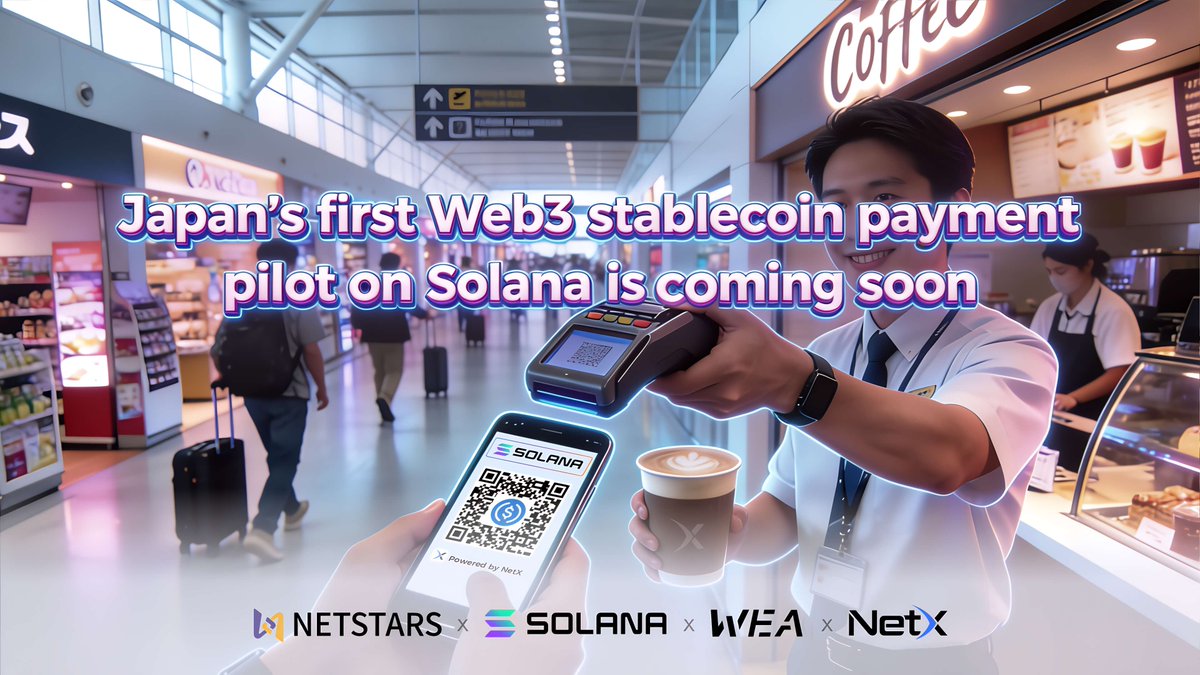
🔥 Japan’s first Web3 stablecoin payment pilot on Solana is coming soon — are you ready?
For the first time in Japan, USDC is moving beyond on-chain use and into real-world retail payments, launching at Haneda Airport Terminal 3 to serve international travelers arriving in Japan 🇯🇵✈️
💡 What you’ll need to participate:
• A crypto wallet (e.g. MetaMask)
• A small amount of SOL for gas fees
• USDC on the Solana network
🧩 Who’s making this milestone possible?
#Netstars — Japan��s leading QR and aggregated payment operator. As the overall operator of this pilot, Netstars enables merchants through its core payment product, StarPay.
#Solana — The high-speed, low-cost blockchain powering real-world payment infrastructure for this USDC pilot.
#WEA JAPAN — Providing stablecoin QR payment infrastructure that connects user wallets with merchant systems.
#NetX — Delivering trusted payment network technology, ensuring system security, stability, and verifiability.
👀 From a user’s perspective, it’s incredibly simple:
Scan the payment QR code with your wallet, pay using Solana-based USDC, and you’re done. Merchants keep their existing workflows and receive JPY settlements as usual — no complex conversions, just smooth, instant payments.
🎁 To celebrate this historic moment, we’re giving away a total of 10,000 USDC to 200 lucky participants (Rewards provided by the NetX DAO Foundation)
How to join:
1️⃣ Follow @Kouhou_NSS @WEAJapan @netx_world @SolanaFndn @solana
2️⃣ Like + RT
3️⃣ Comment with your wallet address
🌏 This is not a demo!!!
This is Web3 stablecoin payments entering the real world — starting at Haneda Airport.
📢 Let’s make some noise and show the world why this moment truly matters.
If you’re in Tokyo, visit Haneda Airport once the pilot goes live and experience paying with Solana #USDC firsthand. More surprises coming soon 🚀
#SolanaFoundation #Web3Payments #Stablecoin #Japan #SOL #NETXDAO #Web3 #Giveaway #Airdrop
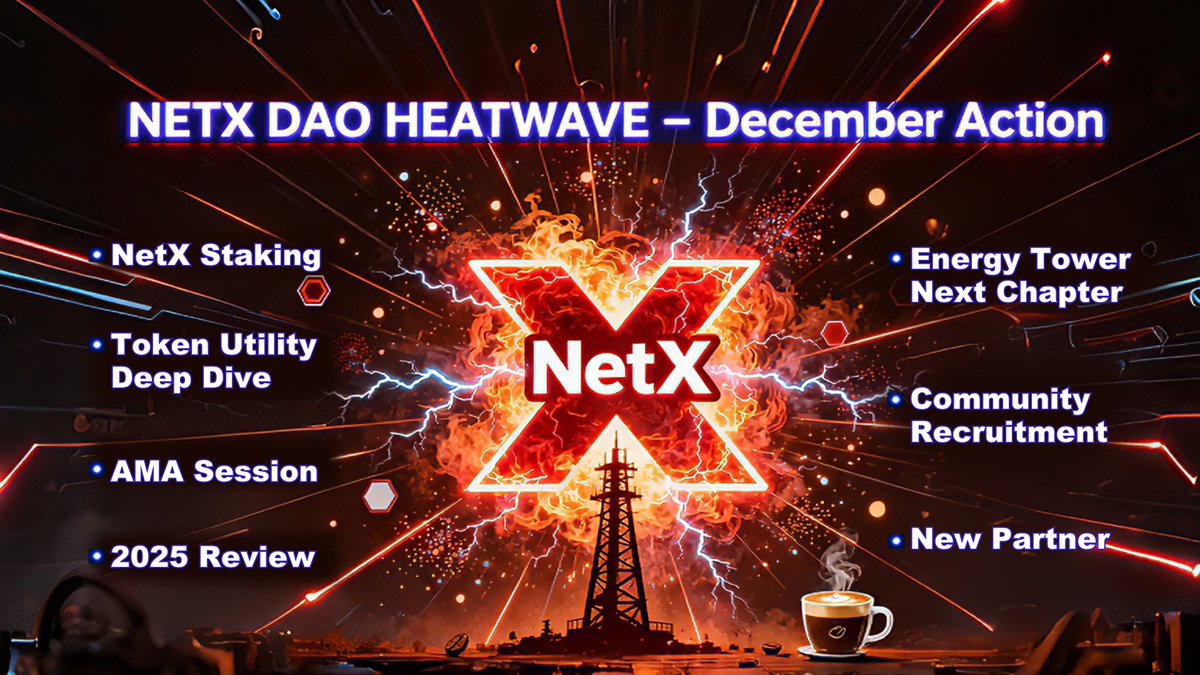
🔥December is going to be INSANE for the #NetX DAO.
We’re loading more updates, more utilities, more collabs, and more ACTION, than ever before!
This month is for the ones who believe, build, and show up.⚡️
Here’s the heatwave dropping this month👇
🚀 Staking Feature Launch
💥 Token Utility Deep Dive — payments, integrations & real use cases
📘 2025 Review & the Road Ahead
🏛 $NETX Energy Tower — next chapter revealed
🧩 DAO Community Recruitment Program Goes Public
🤝 Expanding Regional Strategic Cooperation in Japan
🎙 2026 New Year High-Energy AMA
December is PACKED.
December is BUILDER season.
December is when the #NetXDAO turns up the heat.
🔥Exact release times coming soon.
Until then — like, retweet, and jump into our TG(https://t.co/7Fwth2abNc).
✨ Let’s ignite December together and build NetX DAO into the strongest, boldest, and most unstoppable community out there! 🚀 And we’ll be having random coffee chats with the fam all month. ☕️
#IgniteNETX #AI #DAO #RWA #Payment #December
🔥December is going to be INSANE for the #NetX DAO.
We’re loading more updates, more utilities, more collabs, and more ACTION, than ever before!
This month is for the ones who believe, build, and show up.⚡️
Here’s the heatwave dropping this month👇
🚀 Staking Feature Launch
💥 Token Utility Deep Dive — payments, integrations & real use cases
📘 2025 Review & the Road Ahead
🏛 $NETX Energy Tower — next chapter revealed
🧩 DAO Community Recruitment Program Goes Public
🤝 Expanding Regional Strategic Cooperation in Japan
🎙 2026 New Year High-Energy AMA
December is PACKED.
December is BUILDER season.
December is when the #NetXDAO turns up the heat.
🔥Exact release times coming soon.
Until then — like, retweet, and jump into our TG(https://t.co/7Fwth2abNc).
✨ Let’s ignite December together and build NetX DAO into the strongest, boldest, and most unstoppable community out there! 🚀 And we’ll be having random coffee chats with the fam all month. ☕️
#IgniteNETX #AI #DAO #RWA #Payment #December
🤔Why NETX May Matter More Than Any Other Crypto💎
1/
The global payments landscape is finally shifting.
For years, cross-border transfers have been slow, expensive, and fragmented... a system built for a world that existed decades ago.
What happened in China last week was not “another conference.”
It was a signal: the world is preparing to rebuild the financial rails.
2/
At the Global Cross-Border Digital Payment Ecosystem Alliance meeting, leaders didn’t speak in theories... they spoke in real deployments, real pilots, real corridors, and real opportunities to cut operational costs at massive scale.
Whether it was Huifu Payment talking about faster merchant settlement, or other members emphasizing how new rails slash friction for remittances, treasury flows, and B2B settlement... one theme repeated:
The old financial plumbing is too slow, too expensive, and too outdated to support what comes next.
3/
And that’s where a trusted-execution, compliance-ready layer like $NETX quietly becomes the missing piece.
No noise, no hype... just the right architecture at the right time.
When stablecoins, banks, payment processors, and digital wallets start moving value across borders, they need:
• deterministic execution
• confidentiality
• jurisdictional rule enforcement
• programmable compliance
• identity-aware settlement
• trust between institutions
Public chains cannot do this.🙅♂️
Private chains cannot scale globally.🙅♂️
$NETX sits in the middle: the execution layer that makes everything actually work.
4/
This is why these alliances matter.
This is why these announcements matter.
This is why this moment matters.
For the first time, you see:
Payments (NetStars, Huifu, Onafriq)
Banks (SPDB)
Enterprise platforms (Tradeshift)
Digital-asset institutions
Compliance/AI layers
…all circling the exact problem $NETX was built to solve.
The industry is quietly shifting toward a Web2.5 settlement stack, and $NETX happens to fit the structural gap almost perfectly.
5/
Here’s the part most people don’t understand:
If the world’s financial infrastructure becomes cheaper, faster, and programmable…
that unlocks value for everyday people.
Not in abstract ways... in tangible ways that touch families directly:
• Lower international transfer fees = more money kept by workers sending money home
• Lower merchant costs = cheaper goods in stores
• Faster settlements = fewer business delays = lower overhead
• Reduced banking friction = easier global commerce
• Lower payment costs for airlines, hotels, logistics = lower travel and shipping prices
• Smaller operational burdens = companies can hire more, cut less
• More efficient remittances = families keep more of their paycheck instead of losing 10-20% in fees
This isn’t theoretical.
This is the type of transformation that puts money back into households all over the world.
6/
So when people ask:
“Why $NETX?”
“Why now?”
“Why does this matter?”
It’s simple:
Because if this infrastructure rolls out globally, it becomes one of the few crypto projects whose adoption doesn’t depend on hype... only on economics.
Corporations integrate what saves them money.💡
Governments support what increases efficiency.
Consumers use what lowers their costs.
$NETX sits exactly at that intersection.
7/
We’re entering a phase where blockchain won’t move because of influencers, trend cycles, or retail speculation.
It will move because institutions, banks, payment companies, and governments have to adopt the technology that makes their systems cheaper and more competitive.
And if $NETX becomes a core piece of that stack, even quietly in the background, it becomes one of the most consequential cryptos ever built...
not because it pumps…🙅♂️
but because it matters.🎯
Thank you for reading, liking, and sharing.🙏
Web3
#NETX #NetX #Web25 #Web3 #DigitalPayments
#Fintech #Japan #AsiaFinance #Stablecoins
#CrossBorderPayments #CBDC #Tokenization
#JPYC #USDC #StableFX #DigitalYen
#PaymentRails #GlobalFinance
1. Japan Payment Project = Real-world adoption
If $NETX becomes part of a real payment system in Japan, together with JPYC (the biggest Japanese yen stablecoin), this creates massive utility.
→ This would no longer be a meme project — but a regulated payment infrastructure in Japan.
⸻
2. Penetration test = Final security phase
A project only enters this phase when:
•The architecture is complete
•Compliance is checked
•Stress tests are passed
→ This means they are close to launch or government approval.
⸻
3. Pilot merchants → Real businesses using $NETX
The merchant list is waiting for approval.
This means NETX could soon be accepted as a payment method at least in the pilot phase.
→ This is a huge step toward real adoption.
⸻
4. Japan FSA link matches PERFECTLY
The FSA update you sent earlier (Japan Law Update from Nov 17, 2025) is about payment and prepaid regulations.
The fact that this NETX update comes on the same day is not a coincidence.
→ It looks like the regulations were updated so that the NetX/JPYC payment project can move to the next stage.
@mufgbk_official@noritaka_okabe@NNGNetX@NetXOracle@progmat_en@coinbase@CryptoMichNL@AstroCryptoGuru@AshCrypto
Love this take from Charles. Public chains alone were never going to be the full story — but where some are now arguing for coexistence, NetX was built on that principle from day one.
From its foundation, NetX assumes a world where public, federated and private chains all need to talk to each other, share trusted data and still respect regulation, privacy and business logic. It’s not an “either–or” debate, it’s an and by design.
That’s the difference between launching a single cryptocurrency and engineering an economic network.
NetX doesn’t just add another L1 to the pile. It focuses on:
- A chain-native infrastructure where trust, resources, systems and services are layered so different environments can plug in without friction.
- A small-data, AI-driven network where agents can move value and information across public and private domains while preserving authenticity.
- A design that enterprises, communities and regulators can actually build on together — instead of forcing everyone into a one-size-fits-all model.
So yes, the space is incomplete if all we have is public chains. But the answer isn’t to bolt on “private” as an afterthought — it’s to start from an architecture where both are first-class citizens.
That’s exactly the path @netx_world is taking with $NETX: not just another coin, but infrastructure for a real, long-term shift in how blockchains, AI and digital economies coexist.
🫡
🚨 NETX × JAPAN UPDATE — THE DATA SAYS THIS IS A SLEEPING GIANT 🇯🇵🔥
NNG just confirmed:
🔹 Full technical integration w/ Japanese payment partner = DONE
🔹 Pilot merchant list now being finalised (kept confidential 👀)
🔹 PR + co-marketing plans already being aligned
🔹 December meeting schedules spotted — strong signal a public rollout is near
Now here’s the part people are STILL sleeping on 👇
⸻
📊 NETX Market Cap vs Historical Runs — The Numbers Don’t Lie
🔹 Current NETX MC: ~£12M / $15M
For context:
💥 Solana
• MC before breakout (2020): ~$40M
• Peaked: $78B
→ +1,950×
💥 Chainlink
• Early MC (2018): ~$10M
• Peaked: $20B
→ +2,000×
💥 Quant (QNT)
• Early MC: ~$15M
• Ran to: $5.2B
→ +350×
💥 Kadena (KDA)
• Early MC: ~$20M
• Peaked: $2.3B
→ +115×
All infrastructure tokens.
All real-world integration narratives.
All exploded AFTER industry adoption became visible.
⸻
🇯🇵 Why NETX Is in a Different League
People ask: “Why aren’t we pumping yet?”
Because NETX isn’t memecoin hype.
It’s infrastructure being tested by regulated Japanese payment partners.
NNG confirmed:
⚙️ Payment + settlement layer = integrated
🛒 Merchant pilots = close
🗓 Public-facing announcements = prepping
📣 PR rollout = aligning
📍 December meetings = already in motion
Japan is the most regulated fintech market in the world.
If this goes live publicly with the partner → NETX becomes the back-end settlement layer for Web2 → Web3 payments.
This HAS NOT been done before at consumer scale.
⸻
💰 Market Cap Incentive (What This Means for Price)
NETX today: $15M MC
If Japan rollout hits even SMALL traction:
• $150M MC (10×) — extremely conservative
• $300M MC (20×) — typical infrastructure repricing
• $1B MC (70×) — standard for real-world settlement networks
• $3B MC (200×) — similar to Quant/Kadena peak
• $10B MC (650×) — Solana/Chainlink territory
• $40B MC (2,500×) — the high end if Japan adoption echoes SOL’s run
People don’t realise how tiny a $15M MC is for a chain integrated into a regulated payments ecosystem.
⸻
🧠 The Alpha:
When Japan announces, the entry window is gone forever.
You only get to buy infrastructure before the public rollout once.
The smart money accumulates before confirmation.
The crowd buys after.
⏳ This is that moment.
#NETX #Japan #Web3Payments #Crypto #Stablecoins #RealWorldAssets #RWA
#ALTSEASON
🚀 What Exactly Is Web2.5 and Why It Matters More Than “Web3” Right Now
Everyone talks about Web3, but very few understand the bridge that gets us there: Web2.5.
Web2.5 is the transition layer where:
• the ease, speed, and familiarity of Web2 meets
• the sovereignty, transparency, and programmability of Web3
It’s not a new internet.
It’s the upgrade path: the missing link.
And it’s exactly what Japan’s Netstars + WEA + NetX are deploying right now.
🔹 Web2 = Convenience, but Custodial
Fast. Simple. Universal.
But controlled by central servers and custodians.
Think:
• QR payments
• Online banking
• Merchant terminals
• Simple UX anyone can use
Web2 works because it’s frictionless…
but you don’t own anything.
🔹 Web3 = Ownership, but Too Much Friction
Web3 brings:
• Self-custody
• On-chain settlement
• Transparency
• Programmable assets
But the UX is still intimidating for normal users:
• seed phrases
• gas fees
• chain selection
• complex payment flows
Web3 is powerful but 99% of the world won’t adopt it as-is.
🔹 Web2.5 = The Best of Both Worlds
The goal of Web2.5 is simple:
👉 Make Web3 feel like Web2 - while keeping self-custody and on-chain settlement.
Backwards compatibility is critical.
Why?
Because the world already runs on:
• millions of merchant terminals
• payment aggregators
• QR standards
• compliance rails
• banking infrastructure
We don’t replace these systems that took decades to build, we upgrade them invisibly.
That’s Web2.5.
And this is where the magic of Netstars + WEA + NetX comes in.
🌐 How Web2.5 Is Being Deployed in Japan Right Now
Three players, one unified flow:
1️⃣ Netstars (StarPay)
Japan’s largest payment aggregator - 300,000+ merchants.
They already route 50+ payment methods through one QR workflow.
This is pure Web2 infrastructure.
Merchants don’t change anything.
Just scan QR codes, get fiat.
Simple.
2️⃣ WEA (Web3 QR Payments)
WEA issues QR codes that trigger on-chain payments from a user’s non-custodial wallet.
This adds:
• crypto
• stablecoins
• Tokenized value
• on-chain verification
But in a way merchants can’t even tell is Web3.
To them, it’s “just another QR code.”
3️⃣ NetX (Trustless Settlement Layer)
This is the engine.
NetX turns blockchain transactions into:
• ZK-verified settlement proofs
• fully auditable records
• instant regulatory-safe confirmations
It allows Web3 payments to settle through existing Web2 rails safely and compliantly.
Crypto → NetX proof → fiat settlement → merchant
All in seconds.
Self-custody for the user.
No crypto exposure for the merchant.
Zero friction for adoption.
That is Web2.5 in a single sentence.
🔥 Why This Matters
Web3 won’t win by forcing merchants, banks, or users to change habits.
It wins by slotting quietly into the systems they already use.
Web2.5 is the stealth upgrade:
• merchants keep the same POS
• users keep self-custody
• banks get compliant settlement
• regulators get auditability
• businesses get lower fees
• blockchain provides the trust layer
Everyone benefits.
No one feels the friction.
This is how true mass adoption happens.
🌉 The Web2.5 Bridge Is Being Built By NetStars, WEA, and NetX
Japan is leading the world in showing what comes next:
☑️ Web2 UX
☑️ Web3 ownership
☑️ QR payments everywhere
☑️ crypto integrated invisibly
☑️ compliant blockchain settlement
☑️ self-custody preserved
☑️ no new hardware
☑️ no new merchant workflows
The upgrade happens behind the scenes.
The user feels Web2.
The system runs on Web3.
The settlement is secured by NetX.