Here goes.
This is a high level explanation of the Oil bonds tactic. ( There are always slight nuances but they don't change the rationale).
When oil prices go up, our OMCs start having " under-recoveries", ie, they start making incremental losses, because of ( political) inability to immediately pass on increases to consumers.
The govt at that point, has two options:
1. Raise prices at the pump.
Or
2. Compensate OMCs for the losses incurred.
Now, option 1 often becomes politically unpalatable ( we saw during recent elections too. Prices were not increased). + Can hurt consumption + leads to instant inflation, etc etc etc.
So, a government may decide to go for Option 2.
So what it can do here is: pay the losses outright in cash to the OMCs.
Or,
In order to conserve cash, it can issue the OMCs " Oil Bonds " which are interest bearing debt.
So basically, it tells OMCs " Don't raise prices. We will compensate you. But not immediately. Gradually over time but with interest".
Now, of course, the government can always raise extra debt via G secs and pay OMCs cash immediately.
It doesn't matter either way. Either way, it has to issue debt to fund OMC losses.
So, Oil bonds remain a temporary liability on the overall government b/s, whether explicitly recognized or not.
In effect, the government takes on the liability of oil losses on the national exchequer instead of burdening consumers with the same.
This liability is paid down over time through govt revenues.
Core point is: a consumer may not have the balance sheet or even P&L to absorb high oil prices
BUT
A government b/s and P&L always has many bullets & options ( new taxes, divestments, etc etc) to absorb such losses.
Large companies survive crises better than small. Same principle.
So, one way or another, oil losses have to be paid: either by govt or consumers or some combination of the two.
There is nothing wrong in talking the Oil bonds route when oil rises sharply. Or in hitting consumers.
Both ultimately, are a burden on the exchequer, whether national or individual.
@Iamsamirarora Bridge -> 😂 False assumptions. how can they be a bridge which they don't even know and funny thing is they don't accept this . They don't even know the potential of AI.
@Mitesh_Engr labor arbitrage model will not survive in india Sir @Mitesh_Engr
The shift from Human-in-the-loop to Agent-on-the-tap isn't just coming; for high-end engineering, it’s already here.
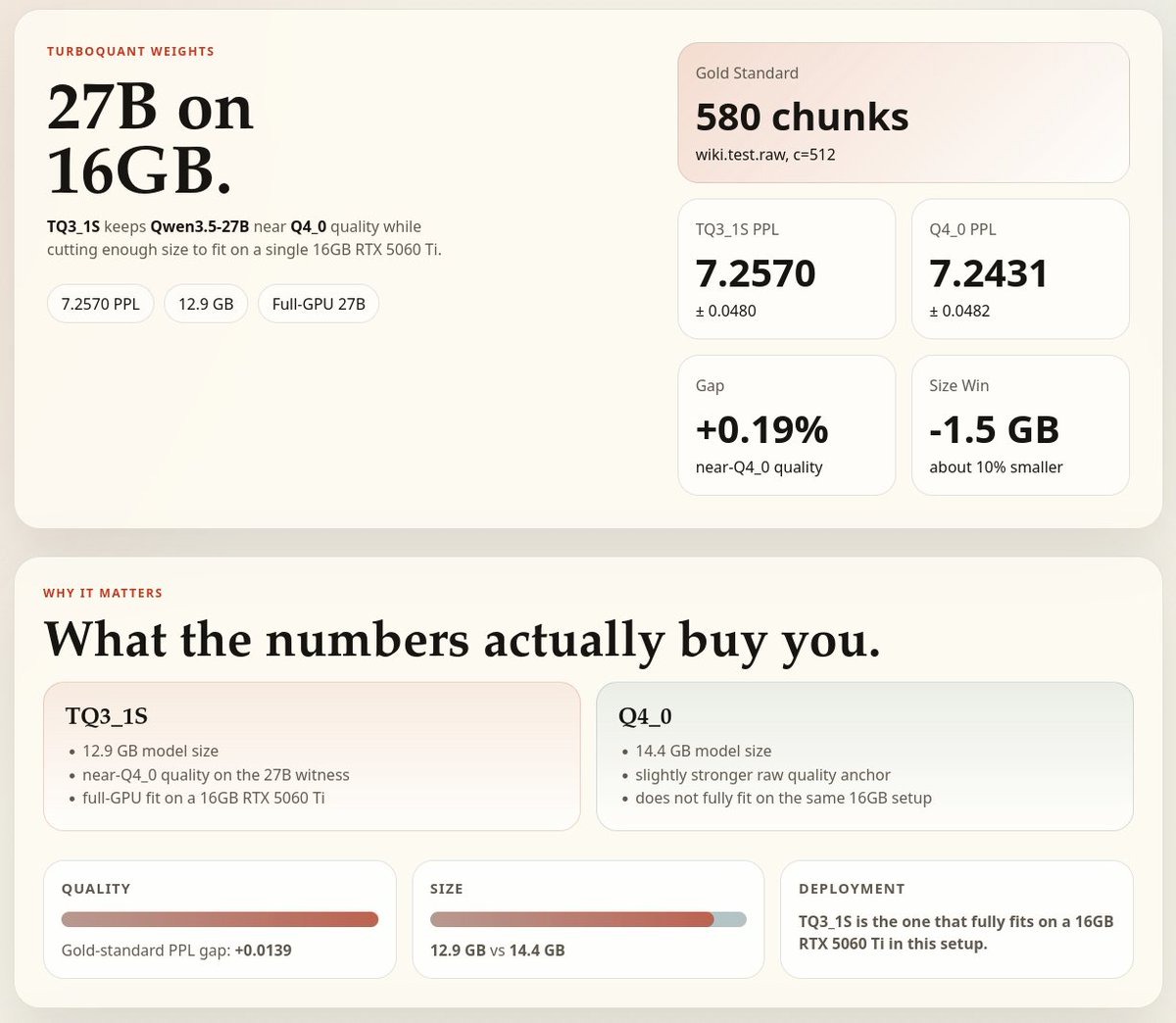
TurboQuant is looking pretty solid. 🔥
> Original idea was to use it just for KV cache where context tokens are stored
> Now it is expanding to be used with models
> On Qwen 3.5-27B it shrinks the model down to 12.9B
> 6X memory savings vs 16-bit precision
> Stays accurate
Today, we release LFM2.5-350M. Agentic loops at 350M parameters.
A 350M model trained for reliable data extraction and tool use, where models at this scale typically struggle.
<500MB when quantized, built for environments where compute, memory, and latency are constrained.
🧵
The Top AI Papers of the Week (March 9 - March 15)
- KARL
- OpenDev
- SkillNet
- Memex(RL)
- AutoHarness
- FlashAttention-4
- The Spike, the Sparse, and the Sink
Read on for more:
Introducing v2 of our Open Deep Research app!
Generate detailed reports on any topic with open source LLMs. Fully free & open source.
We're releasing everything: evaluation dataset, code, app, and blog 🔥
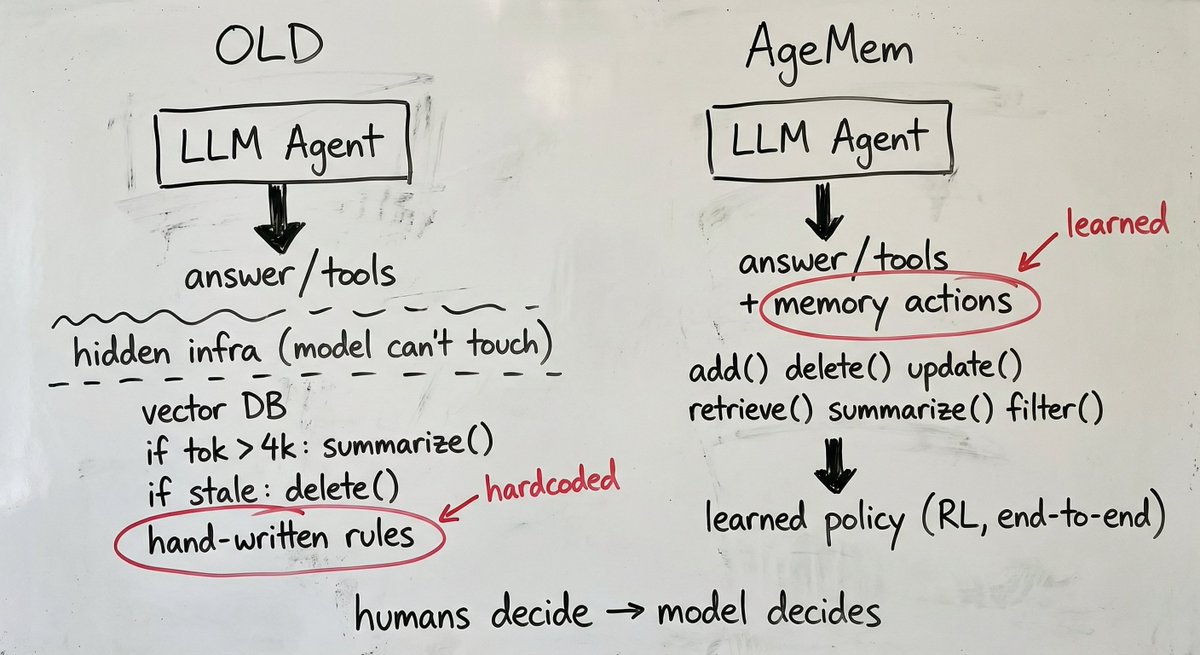
interesting new work from Alibaba and WHU (Agentic Memory).
most agent memory systems now are basically hardcoded infra, vector db + hand-written rules for when to store/delete/summarize. the model never gets to touch any of it.
they made memory ops into actions. add, delete, update, retrieve, summarize, filter, same as calling a tool. then RL trains the whole thing end to end.
the neat part is the model discovers on its own that it should proactively clean up its context when things get noisy. nobody wrote a "if tokens > 4k then summarize" rule. And it just emerged from the reward signal.
makes you wonder how many other parts of the RAG pipeline are secretly just learnable actions we've been hand-coding for no good reason.
https://t.co/TQVW40EZDS
While waiting for DeepSeek V4 we got two very strong open-weight LLMs from India yesterday.
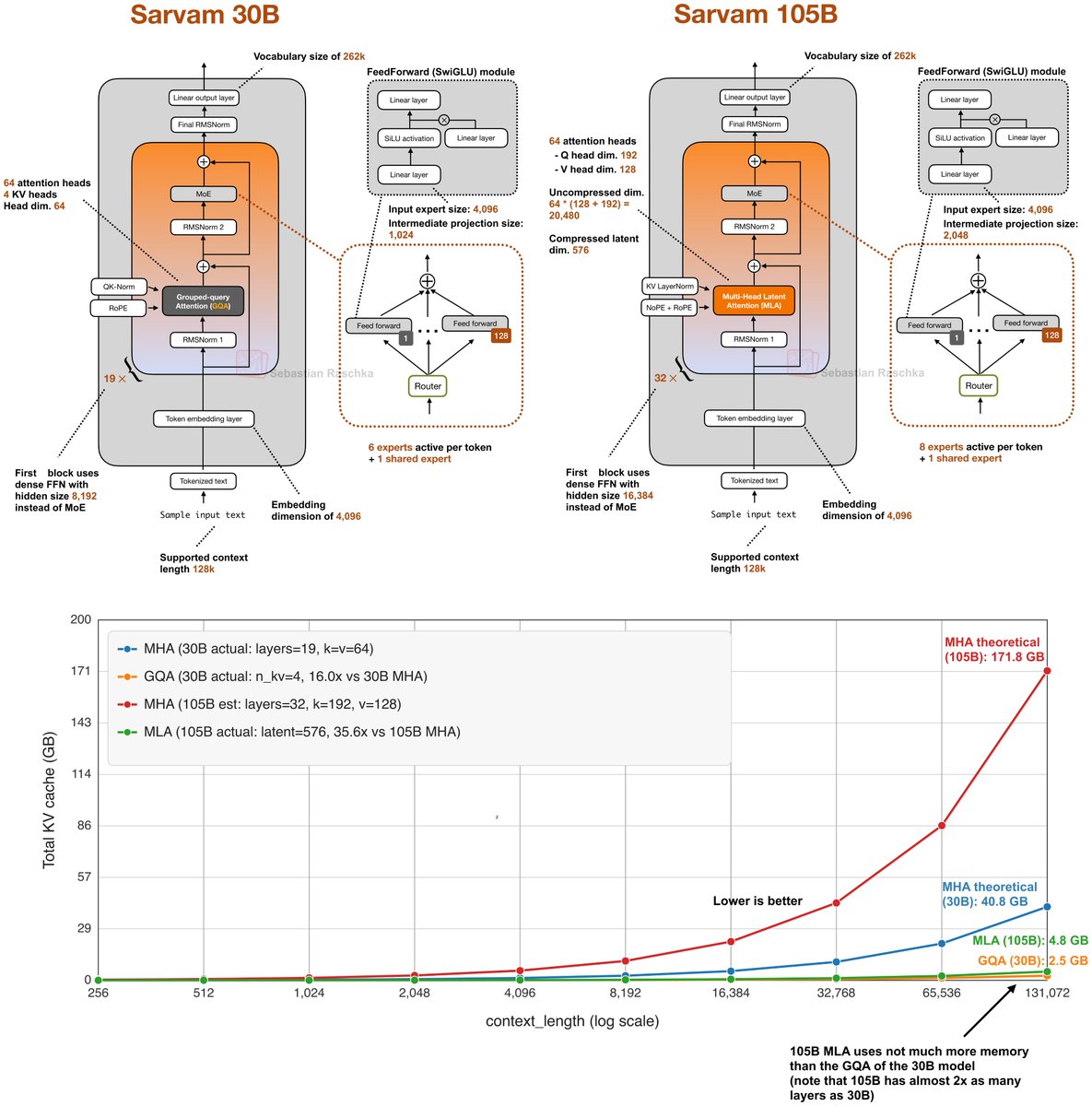
There are two size flavors, Sarvam 30B and Sarvam 105B model (both reasoning models).
Interestingly, the smaller 30B model uses “classic” Grouped Query Attention (GQA), whereas the larger 105B variant switched to DeepSeek-style Multi-Head Latent Attention (MLA).
As I wrote about in my analyses before, both are popular attention variants to reduce KV cache size (the longer the context, the more you save compared to regular attention).
MLA is more complicated to implement, but it can give you better modeling performance if we go by the ablation studies in the 2024 DeepSeek V2 paper (as far as I know, this is still the most recent apples-to-apples comparison).
Speaking of modeling performance, the 105B model is on par with LLMs of similar size: gpt-oss 120B and Qwen3-Next (80B). Sarvam is better on some tasks and worse on others, but roughly the same on average.
It’s not the strongest coder in SWE-Bench Verified terms, but it is surprisingly good at agentic reasoning and task completion (Tau2). It’s even better than Deepseek R1 0528.
Considering the smaller Sarvam 30B, the perhaps most comparable model to the 30B model is Nemotron 3 Nano 30B, which is slightly ahead in coding per SWE-Bench Verified and agentic reasoning (Tau2) but slightly worse in some other aspects (Live Code Bench v6, BrowseComp).
Unfortunately, Qwen3-30B-A3B is missing in the benchmarks, which is, as far as I know, is the most popular model of that size class. Interestingly, though, the Sarvam team compared their 30B model to Qwen3-30B-A3B on a computational performance analysis, where they found that Sarvam gets 20-40% more tokens/sec throughput compared to Qwen3 due to code and kernel optimizations.
Anyways, one thing that is not captured by the benchmarks above is Sarvam’s good performance on Indian languages. According to a judge model, the Sarvam team found that their model is preferred 90% of the time compared to others when it comes to Indian texts. (Since they built and trained the tokenizer from scratch as well, Sarvam also comes with a 4 times higher token efficiency on Indian languages.
Yaay! 🎉 4k+ downloads and 460+ stars!
Building this has been a wild ride. If you have an Apple Silicon Mac and want to fine-tune LLMs locally without changing your original Unsloth code, come join the party.
Got continuous batching working with SSMs in mlx-lm.
Here's four OpenCode agents simultaneously running Nvidia's Nemotron Nano on 64GB M4 Max.
This is a nice model for smaller machines since it's MoE + hybrid attention (small cache).
New post: nanochat miniseries v1
The correct way to think about LLMs is that you are not optimizing for a single specific model but for a family models controlled by a single dial (the compute you wish to spend) to achieve monotonically better results. This allows you to do careful science of scaling laws and ultimately this is what gives you the confidence that when you pay for "the big run", the extrapolation will work and your money will be well spent. For the first public release of nanochat my focus was on end-to-end pipeline that runs the whole LLM pipeline with all of its stages. Now after YOLOing a few runs earlier, I'm coming back around to flesh out some of the parts that I sped through, starting of course with pretraining, which is both computationally heavy and critical as the foundation of intelligence and knowledge in these models.
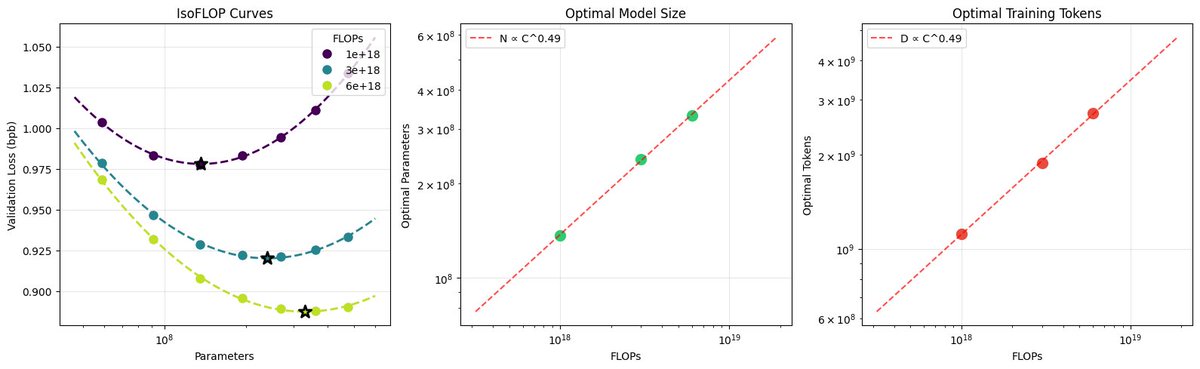
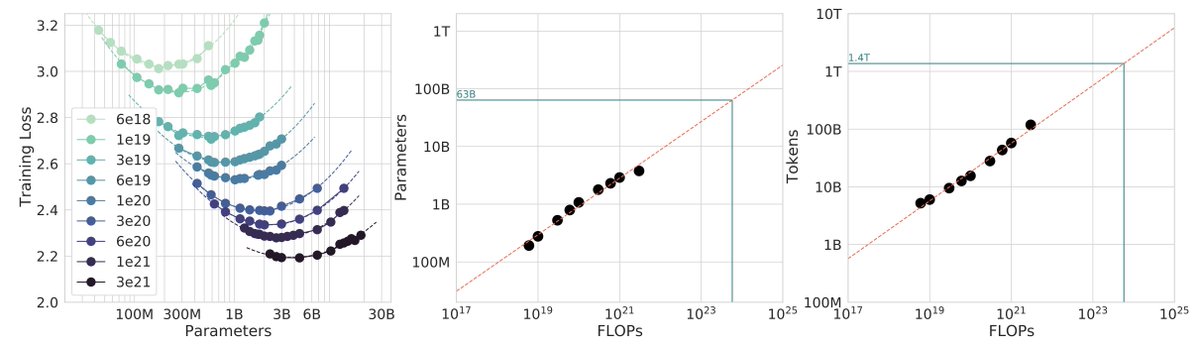
After locally tuning some of the hyperparameters, I swept out a number of models fixing the FLOPs budget. (For every FLOPs target you can train a small model a long time, or a big model for a short time.) It turns out that nanochat obeys very nice scaling laws, basically reproducing the Chinchilla paper plots:
Which is just a baby version of this plot from Chinchilla:
Very importantly and encouragingly, the exponent on N (parameters) and D (tokens) is equal at ~=0.5, so just like Chinchilla we get a single (compute-independent) constant that relates the model size to token training horizons. In Chinchilla, this was measured to be 20. In nanochat it seems to be 8!
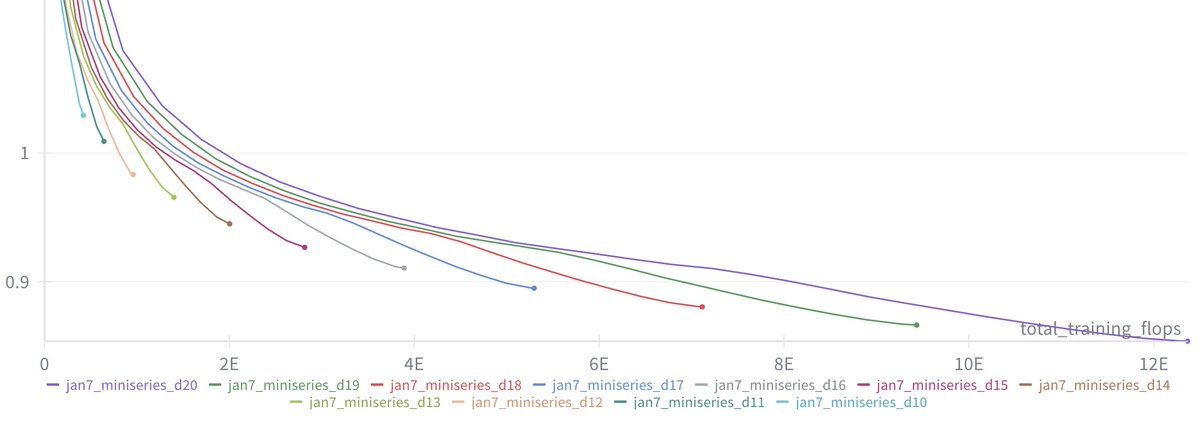
Once we can train compute optimal models, I swept out a miniseries from d10 to d20, which are nanochat sizes that can do 2**19 ~= 0.5M batch sizes on 8XH100 node without gradient accumulation. We get pretty, non-itersecting training plots for each model size.
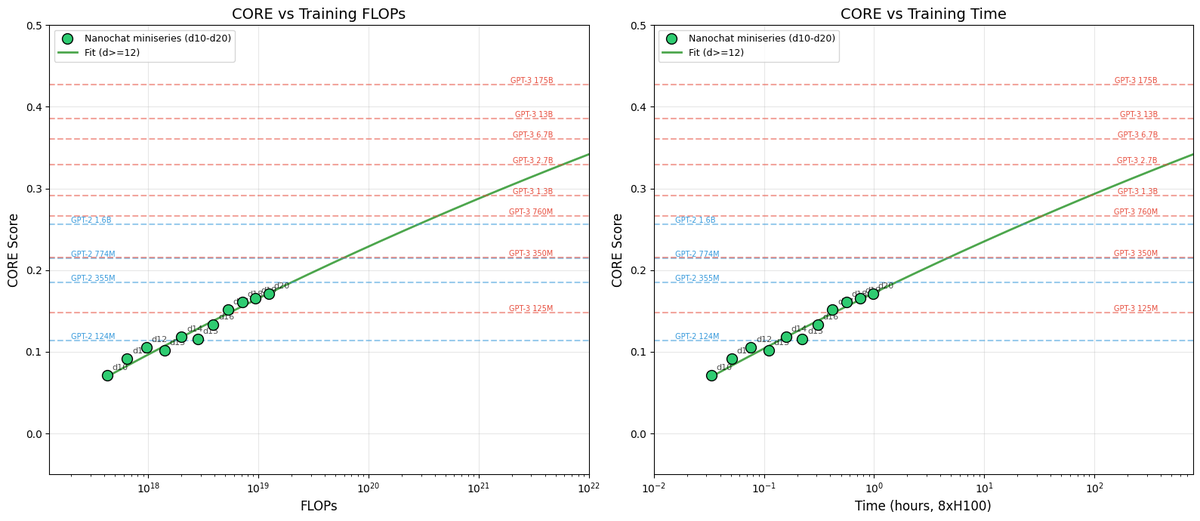
Then the fun part is relating this miniseries v1 to the GPT-2 and GPT-3 miniseries so that we know we're on the right track. Validation loss has many issues and is not comparable, so instead I use the CORE score (from DCLM paper). I calculated it for GPT-2 and estimated it for GPT-3, which allows us to finally put nanochat nicely and on the same scale:
The total cost of this miniseries is only ~$100 (~4 hours on 8XH100). These experiments give us confidence that everything is working fairly nicely and that if we pay more (turn the dial), we get increasingly better models.
TLDR: we can train compute optimal miniseries and relate them to GPT-2/3 via objective CORE scores, but further improvements are desirable and needed. E.g., matching GPT-2 currently needs ~$500, but imo should be possible to do <$100 with more work.
Full post with a lot more detail is here:
https://t.co/na8zVLqWLf
And all of the tuning and code is pushed to master and people can reproduce these with scaling_laws .sh and miniseries .sh bash scripts.