Today Bitcoin was recognized as a strategic tool on the world stage, confirmed by the U.S.’s most senior commander responsible for our posture against China.
This is the result of years of policy work and educational initiatives. I’m beyond proud of the BPI team and the years of effort that it took to get us to this point.
Yes, I think each of those individual arguments is under the pro-freeze umbrella. I sympathize with not wanting to get market dumped on. One of the reasons i *could possibly* be persuaded by some version of hourglass/rate limiting. But imo a full freeze hurts long term value more than a one time mega-dump, however unlikely that mega-dump would be.
For example, I don’t think anyone would be opposed to “bitcoin, exactly as it works today, but also happens to be quantum resistant”. From there’s it all a discussion about specific tradeoffs you’re not willing to make. No new cryptographic assumptions? Great, let’s use hash-based. Too large? Reduce number of sigs. etc. We can’t resolve every tradeoff but at least then we’re debating actual variables.
It’s at least a reasonable *starting spot* for a heated debate about very specific tradeoffs, redlines and how we can mitigate them (no HD wallets, LN / Ark impacts if any, multisig functionality?). Sharp disagreement on the tradeoffs we can’t make at least gives “the devs” something to optimize for. We might be surprised what clever workarounds smart folks working on specific well-defined problems can come up with.
@nic_carter My position has not changed:
- Quantum is the first/last meaningful technical issue BTC faces
- The timelines are likely materially longer than the quantum bulls think
- Bitcoin community should quite obviously prioritize quantum safety with a credible plan immediately
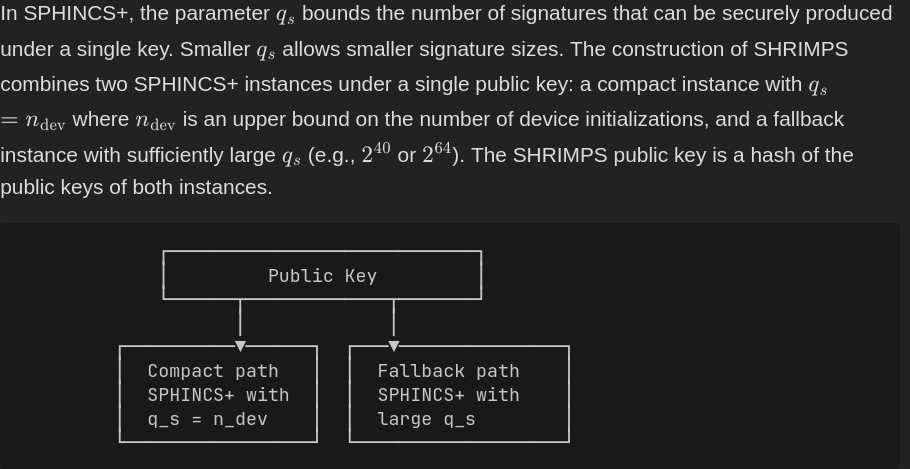
Please welcome SHRIMPS🦐 to the family of stateful PQ signatures:
2.5 KB hash-based sigs across multiple devices.
SHRINCS🛋️ gave ~324-byte sigs but is single-device. SHRIMPS🦐 addresses multi-device; any device loaded from the same seed creates sigs 3x smaller than SLH-DSA
Upgrading Bitcoin to be quantum safe is no longer optional.
"but the threat is overblown!!"
All that matters is the perception of the threat.
And right now, the perception of the threat is enough to scare serious capital away.
Denial / ostrich mode on this is not going to help.
The good news is that a successful upgrade is a real bull catalyst for an asset starving for new bullish catalysts.
And it's something that is entirely in our control.
But we need rapid progress on this.
And that starts with all of us acknowledging the threat.
Or at the very least, acknowledging the reality of the perception of the threat.
The fact that we're below the 2021 highs after the most bullish developments imaginable (massive ETF inflows, non-stop buying from Saylor...) is proof that something is broken.
Quantum safe Bitcoin is a $1 million+ asset.
Quantum vulnerable Bitcoin is not.
Humanity needs finite money that cannot be seized or debased.
If quantum risk removes seizure resistance, then Bitcoin cannot fulfill its promise.
Simple as that.
It is our right as Americans to publish code, to operate neutral networks, and to enshrine our values of openness and privacy into the infrastructure of tomorrow.
If the Senate wants America to be the crypto capital of the world, then it must protect the devs, pass the BRCA
Is quantum computing a risk to Bitcoin?
@dpuellARK and @Unchained's @dhruvbansal and @tom_honzik dive into this question in a brand new white paper. Read here.
https://t.co/ce60oRSbm2
The math on this project should mass-humble every AI lab on the planet.
1 cubic millimeter. One-millionth of a human brain. Harvard and Google spent 10 years mapping it. The imaging alone took 326 days. They sliced the tissue into 5,000 wafers each 30 nanometers thick, ran them through a $6 million electron microscope, then needed Google’s ML models to stitch the 3D reconstruction because no human team could process the output.
The result: 57,000 cells, 150 million synapses, 230 millimeters of blood vessels, compressed into 1.4 petabytes of raw data. For context, 1.4 petabytes is roughly 1.4 million gigabytes. From a speck smaller than a grain of rice.
Now scale that. The full human brain is one million times larger. Mapping the whole thing at this resolution would produce approximately 1.4 zettabytes of data. That’s roughly equal to all the data generated on Earth in a single year. The storage alone would cost an estimated $50 billion and require a 140-acre data center, which would make it the largest on the planet.
And they found things textbooks don’t contain. One neuron had over 5,000 connection points. Some axons had coiled themselves into tight whorls for completely unknown reasons. Pairs of cell clusters grew in mirror images of each other. Jeff Lichtman, the Harvard lead, said there’s “a chasm between what we already know and what we need to know.”
This is why the next step isn’t a human brain. It’s a mouse hippocampus, 10 cubic millimeters, over the next five years. Because even a mouse brain is 1,000x larger than what they just mapped, and the full mouse connectome is the proof of concept before anyone attempts the human one.
We’re building AI systems that loosely mimic neural networks while still unable to fully read the wiring diagram of a single cubic millimeter of the thing we’re trying to imitate. The original is 1.4 petabytes per millionth of its volume. Every AI model on Earth fits in a fraction of that.
The brain runs on 20 watts and fits in your skull. The data center required to merely describe one-millionth of it would span 140 acres.
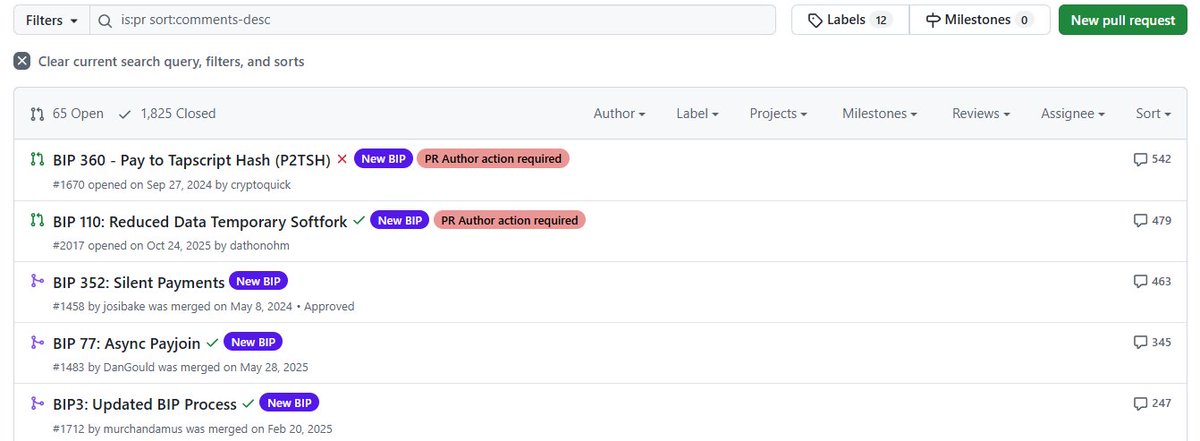
@GuerillaV2@nic_carter@kale_abe@cryptoquick@isabelfoxenduke Core has engaged with BIP 360.
BIP 360 has more comments than any other BIP so far in history of BIPs. Not all are from core devs but many are. @murchandamus esp. spent sufficient time and effort on reviews. These comments from core and other people are extremely helpful. /1
Hash-based signatures for Bitcoin's post-quantum future? with Jonas Nick | SLP713
Bitcoin researcher @Blockstream and bitcoin/secp256k1 contributor, @n1ckler joins me to discuss how quantum computing could impact Bitcoin’s security. We explore post-quantum cryptography, hash-based signatures, impact on hardware wallets, the controversial block size trade-offs and more.
(00:00) - Intro
(01:49) - How real is quantum risk to Bitcoin?
(04:39) - When could quantum pose a threat to Bitcoin’s cryptography?
(09:56) - Long range vs Short range attacks
(12:37) - How many coins are vulnerable to Long range attacks?
(14:12) - Different types of cryptography and exploring Hash-based signature schemes
(17:00) - Categories of Hash-based signature scheme and their pros & cons
(23:42) - How do Hash-based signatures work?
(32:14) - Would Lightning, Multi-sig, Taproot, Silent Payments, Atomic swaps work in a post-quantum world?
(38:50) - What are Adaptor signatures & how do they affect atomic swapping?
(41:27) - Will we need new Bitcoin hardware wallets?; Signature production & verification
(44:41) - Signature size and Bitcoin block capacity implications
(46:52) - Should we revisit the block size conversation?
(54:57) - Overview of SPHINCS+ & SHRINCS
(59:49) - Transitioning to post-quantum signature schemes; Overview of BIP 360
(1:09:06) - Closing thoughts
Update to BIP-360 toward quantum resistant addresses. If bitcoin is going to be thousand year money, devising one or more opt-in paths to avoiding possible Q threats likely arriving sometime in the next hundred years is relevant.
Prepared > scared.
@muhkayfabe@adam3us@An__OG@JavierHermosa21 Yes, now's the time to talk about it! I just submitted an update to the mailing list but you can also read it on Delving:
https://t.co/dyLkmfX9Ym