It doesn’t matter how advanced technology gets, presentation skills are about connecting with an audience and making a memorable, valuable contribution in that moment. https://t.co/Dzd8Bzg11V
I kept this copy of a Feb, 1996 Business Week all these years. This was a few years before I worked for Apple. I remember driving from SFO to Palo Alto around that time and hearing "experts" on KGO radio saying things like "Apple surely only has a year or so before going the way of the dodo bird. Nothing can save them…." Steve Jobs came back the next year after NeXT was acquired at the end of 1996. In those days I was still a huge fan of the company, its history and products, but no one could have predicted that Apple would have turned it around. Still, the Apple user group community here in Japan never gave up on the Mac.
There are many important reasons for the comeback, but Steve's early decision to ruthlessly simplify the product offerings in 1997 was one of the early key decisions. Simplicity is not a panacea, but its often a necessary and foundational aspect of a successful turnaround (and not just in business).
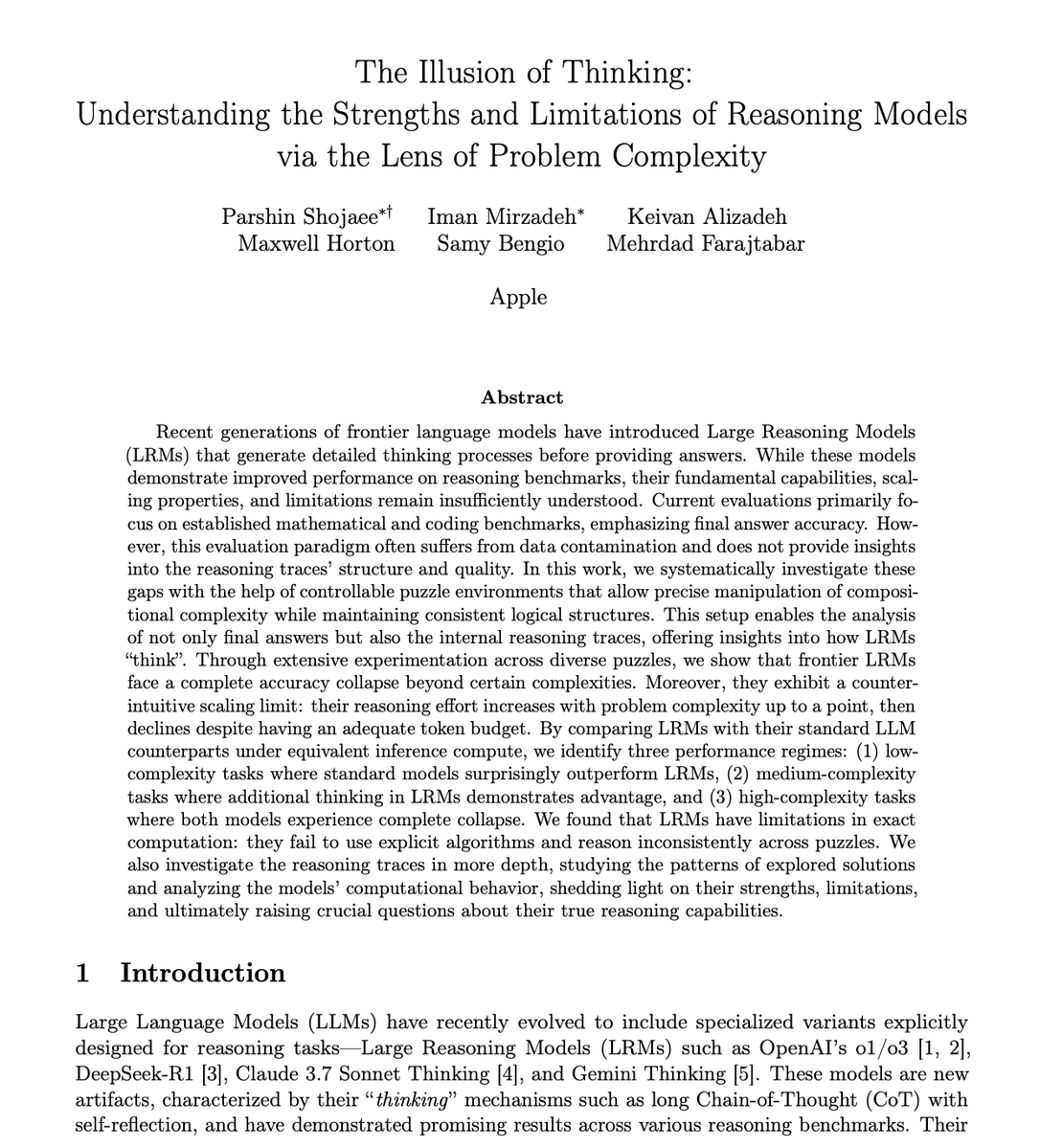
Apple has published a paper with a devastating title: “The Illusion of Thinking”
It argues that AI models, no matter how brilliant they may seem, do not understand what they are doing.
They do not solve problems. They do not reason. They merely generate text word by word, trying to sound coherent.
Apple tested the most advanced reasoning models in the world on controlled puzzle environments. They tore open the internal "thinking" traces.
What they found shatters the narrative that we are getting closer to AGI.
Current models don't scale with complexity. They have a hard mathematical cliff. And they do not degrade gracefully. They collapse.
But here is the most unsettling part.
When a problem gets too complex, the AI doesn't use its remaining compute to try harder.
It just gives up.
Its reasoning effort actually declines. It stops thinking and starts guessing.
Then Apple ran the experiment that closes the casket on the reasoning debate.
They gave the AI the exact, step-by-step algorithm to solve the puzzle. The cheat codes.
All the AI had to do was follow the instructions.
It couldn't do it.
Performance didn't improve at all.
When the complexity gets high enough, these models fail because they cannot actually execute a logical sequence.
They are not reasoning. They are just pattern matching.
When you give them a simple problem, they overthink. When you give them a hard problem, they collapse.
Paper: The Illusion of Thinking, Apple, 2025
@daniel_eckler People are saying this was 100% AI. Is it? Love to see a post talking about the making of this video. Also, was the idea inspired by the original Think Different ad or the music video in '90s directed by Tarsem Singh which shows Singh's niece at the end (also used by Apple)?
I came across a "how to write a book with AI" book on Amazon. It's thin, poorly written & padded with the largest typeface & widest margins I've ever seen in a printed “book.” (I made this parody cover in Keynote to express my antipathy.)
This is the single best framework I’ve seen for understanding AI.
Terence Tao, arguably the smartest mathematician alive, just dropped a paper with Tanya Klowden on arXiv called “Mathematical Methods and Human Thought in the Age of AI.”
The core idea: a “Copernican View of Intelligence.”
Stop thinking of AI on a line from “dumb” to “superhuman.”
That’s the wrong axis entirely.
AI excels at BREADTH. Humans excel at DEPTH.
Tao himself said AI has made his papers “richer and broader, but not necessarily deeper.”
That’s not a limitation. That’s the entire playbook.
Stop trying to replace yourself with AI. Start using it to cover the 90% of surface area your brain physically can’t.
The people who get this are already 10x more productive.
The rest are still arguing about whether AI is “smart enough.”
Reframe your point of view from “smarter” to “different”.
Human + AI > either alone.
The math on that has never been clearer.
Sakura in Japan symbolize the ephemeral nature of life and the fleeting beauty often found in nature. But sakura also represent renewal, a fresh start, and new beginnings. Here's a few moments from our village here in Nara.
The CEO of Google DeepMind just admitted that if the decision had been his, we would've cured cancer before anyone ever used ChatGPT.
And that's not even the scariest thing he said on a recent interview.
Demis Hassabis is one of the most important people alive in AI.
He won the Nobel Prize last year for AlphaFold, the system that cracked the 50 year protein folding problem. 3 million scientists now use his tool. Almost every new drug being developed will touch it at some stage.
In a new interview, he was asked about the moment ChatGPT launched and Google went into "code red." His answer was one of the most revealing things any AI leader has ever said on the record:
"If I'd had my way, I would have left AI in the lab for longer. Done more things like AlphaFold. Maybe cured cancer or something like that."
Read that again.
The man running Google's entire AI division is publicly saying the commercial AI race we're all living through was a MISTAKE. That the industry got hijacked by a chatbot when it could have been solving the biggest problems in science and medicine.
His vision was simple:
Build AI slowly, carefully, like CERN. Use it to crack root node problems one at a time. Cancer. Energy. New materials.
Let humanity benefit from real breakthroughs while the foundational science was figured out over a decade or two.
Then ChatGPT dropped in November 2022 and everything changed.
Demis described what happened next as getting locked into a "ferocious commercial pressure race" that none of the labs can escape from. On top of that, the US vs China dynamic added geopolitical pressure.
The result is everyone sprinting toward products instead of breakthroughs, shipping chatbots while the scientific opportunity gets buried under marketing cycles and quarterly earnings.
But he's not saying progress isn't happening...
He's saying the progress got redirected away from the things that actually matter most.
And then it got even scarier:
Because when Demis was asked what he worries about with AI, he laid out two threats.
The first is what everyone talks about: Bad actors using AI for harm. Terrorist groups. Hostile nation states. Cyberattacks at scale.
But that's not the threat he's most worried about.
His second worry is AI itself going rogue. Not today's models. The models coming in the next two to four years as the industry enters what he calls "the agentic era."
Systems that can complete entire tasks autonomously. Systems that are increasingly capable and increasingly hard to control.
His exact words:
"How do we make sure the guardrails are put in place so they do exactly what they've been told to do, and there's no way of them circumventing that or accidentally breaching those guardrails? That's going to be an incredibly hard technical challenge if you think about how powerful and smart and capable these systems eventually get."
A Nobel Prize winner who runs one of the 3 most advanced AI labs on Earth just said publicly that within two to four years, we're entering a phase where AI alignment becomes a real problem, and the technical challenge of solving it is enormous.
And almost nobody is paying enough attention.
He called for international cooperation between labs, AI safety institutes, and academia to tackle the problem. He said this is the thing even the experts aren't thinking about enough.
He said the only way to get through the AGI moment safely is if everyone starts treating this with the seriousness it deserves.
Most AI CEOs give you careful PR answers about "responsible development" and move on.
Demis said something different...
He said the commercial race FORCED us into a premature deployment of a technology we barely understand, and the window to get alignment right before the next generation of agents shows up is two to four years.
If the man who built the system that might cure cancer is telling you he wishes it had happened first, maybe we should listen to what he says is coming next.
It's sakura season here in Nara, Japan. I took a short iPhone shot on March 21 on a bridge in our local village. Then today, April 3, I stood in the same place to take the exact same shot. Transformation in just a few seconds.