🔥🚨 CLAIMING YOUR LATE PARENT GIFTED YOU LAND? The Court of Appeal Has Sent a Powerful Message To You
A child cannot inherit family property exclusively by merely claiming that a deceased parent gifted it to them during their lifetime. That question has now been firmly settled by the Court of Appeal in Nabea v Kaburu (Civil Appeal No. 87 of 2019) [2026] KECA 1470 (KLR). In this case, the dispute arose after one daughter argued that her late father had gifted her Plot No. 33 Maua Municipality because she had developed the property, managed it for years, and collected rent during his lifetime. She relied on an alleged gift inter vivos and persuaded the High Court that the plot belonged to her alone. Her sister appealed, insisting that no valid gift had ever been proved and that the property should instead be shared equally among all the beneficiaries.
The Court of Appeal agreed with the appellant and overturned the High Court's decision. It held that a person alleging a gift inter vivos bears the burden of proving it with credible evidence. In this case, there was no transfer of ownership, no reliable documentary proof that the deceased intended to permanently surrender the property, no evidence proving that the respondent solely developed the premises, and, most importantly, the deceased himself had previously challenged the alleged gift in court and accused the respondent of relying on fraudulent documents. The Court emphasized that while Kenyan law recognises both complete and incomplete gifts inter vivos, courts will only enforce them where the evidence clearly establishes the donor's intention and the gift itself. Mere occupation, management of property, family sacrifices, or collecting rent cannot replace proof.
This decision is likely to reshape countless succession disputes across Kenya, where relatives often emerge after a loved one's death claiming, "Mum gave me this land," or "Dad promised me that plot." The Court has made it clear that family promises alone do not override the law of succession. If you are facing a dispute over inherited land, an alleged lifetime gift, or the distribution of a deceased relative's estate, this judgment offers important guidance on your legal rights. Sometimes, knowing where the law truly stands is the difference between losing family property and protecting what the law entitles you to.
Kindly repost🙏🙏
🚨 FAMILY TIES NO LONGER BEAT A TITLE DEED. THE COURTS HAVE DRAWN THE LINE.
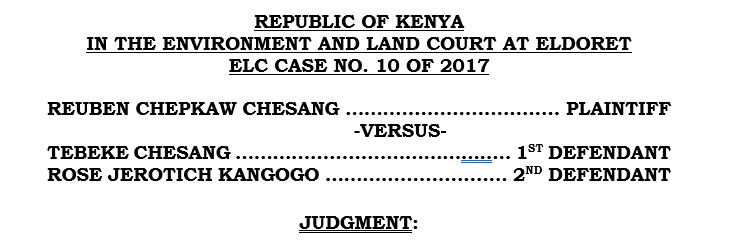
The Environment and Land Court has sent a clear message in Reuben Chepkaw Chesang v Tebeke Chesang & Another (ELC No. 10 of 2017): being a relative does not automatically give you rights over another person's registered land. A brother and niece argued that the registered owner was merely holding the land in customary trust because their late father allegedly bought it using proceeds from the sale of goats. But the Court found there was no documentary or credible evidence proving the land was ever family land before registration. It held that customary trust is recognized in Kenyan law, but it must be proved - not presumed. The registered proprietor's title remained protected, and the Court permanently barred the defendants from laying any further claim to the land.
The judgment reinforces an important principle under the Land Registration Act and the Supreme Court's decision in Isack M'Inanga Kiebia: a title deed is not defeated by family relationships, village meetings, or oral history alone. Anyone alleging customary trust must satisfy the legal threshold with evidence showing the land was family, clan, or group land before registration. Without that proof, the law protects the registered proprietor's title as absolute and indefeasible.
For ordinary Kenyans, this is a wake-up call. Too many families have spent decades fighting over land based on assumptions that "we are brothers," "our father bought it," or "everyone knows it belongs to the family." This judgment reminds every mwananchi that courts decide land disputes on evidence, not family pressure, rumours, or tradition unsupported by proof. If you believe land is held in trust, gather the evidence before going to court. If you own registered land, know that the law will stand behind your title unless someone proves, in law and with evidence, why it should not.
Kindly Retweet🙏
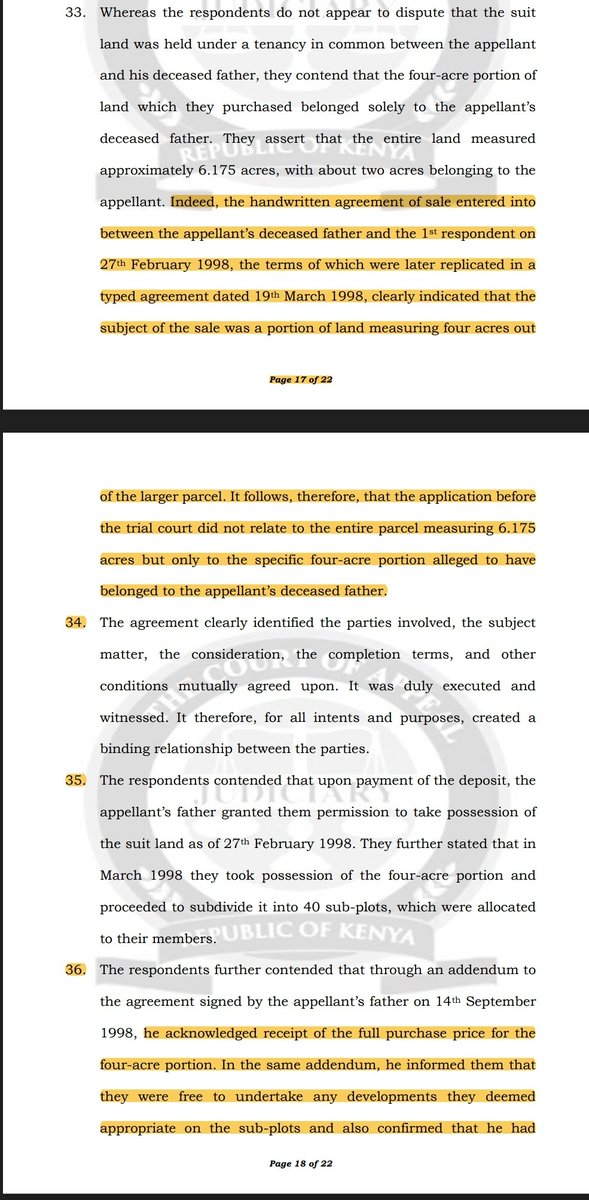
Once a CLE Civi Litigation Q1: When does the statutory period for adverse possession begin to run where adverse possession arises out of a sale agreement?
CoA: Only after full payment: upon full payment of purchase price occupation is no longer by permission granted by seller.
Shift in Jurisprudence:
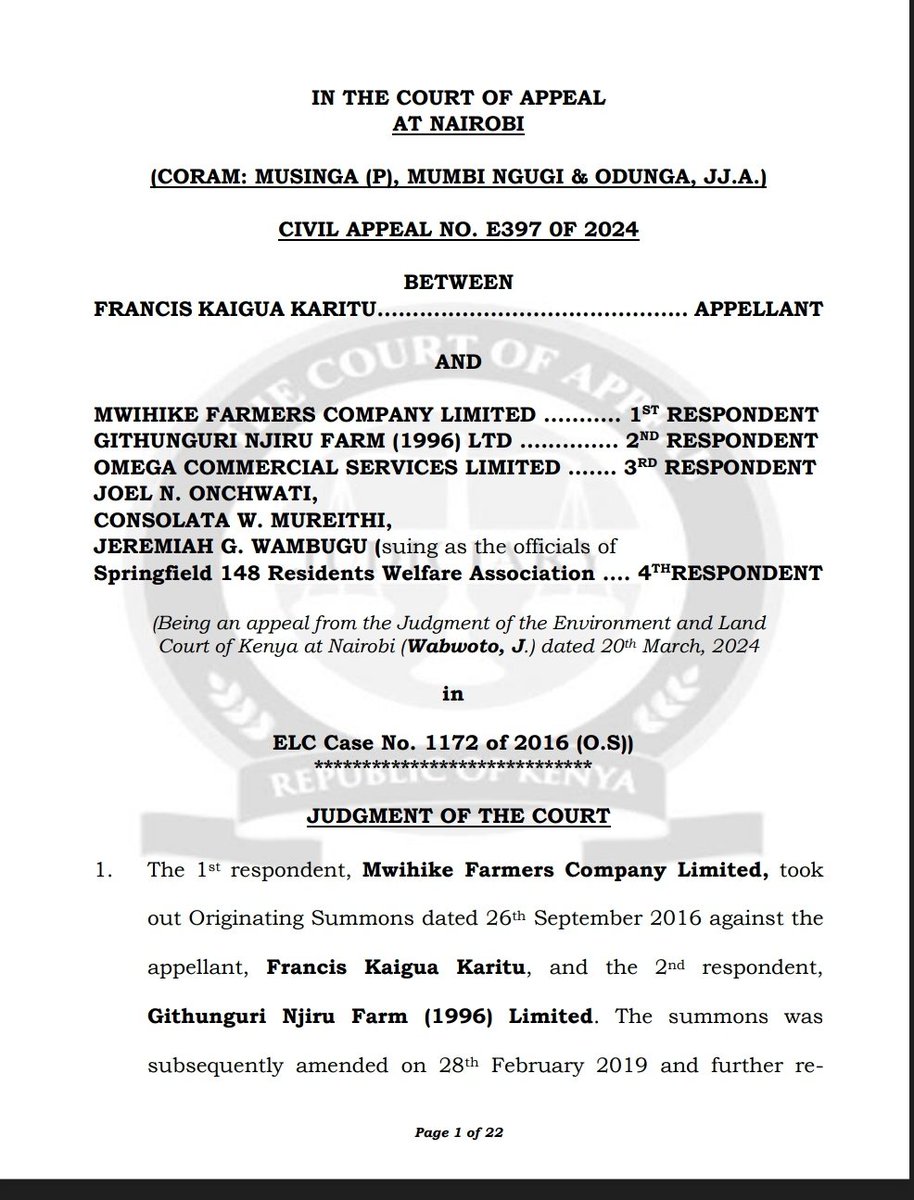
Court of Appeal has reiterated that in contempt of court proceedings,' the jurisprudence has shifted from strict personal service to the contemnor’s knowledge of the order'.
Knowledge of the existence of the order is sufficient.
https://t.co/dFIZMeDQ1a
Sir, I have a question for you. For context, this is not in any way a defense against accountability or recovery of lost funds.
Now, here is my concern: if the Cabinet, at that time including the then Deputy President, now President Ruto deliberated and approved the acquisition of the land, and Parliament appropriated the money, what happens next?
Will the @EACCKenya and other investigative and prosecutorial agencies pursue them as well?







![AssociatesRoba's tweet photo. 🔥🚨 CLAIMING YOUR LATE PARENT GIFTED YOU LAND? The Court of Appeal Has Sent a Powerful Message To You
A child cannot inherit family property exclusively by merely claiming that a deceased parent gifted it to them during their lifetime. That question has now been firmly settled by the Court of Appeal in Nabea v Kaburu (Civil Appeal No. 87 of 2019) [2026] KECA 1470 (KLR). In this case, the dispute arose after one daughter argued that her late father had gifted her Plot No. 33 Maua Municipality because she had developed the property, managed it for years, and collected rent during his lifetime. She relied on an alleged gift inter vivos and persuaded the High Court that the plot belonged to her alone. Her sister appealed, insisting that no valid gift had ever been proved and that the property should instead be shared equally among all the beneficiaries.
The Court of Appeal agreed with the appellant and overturned the High Court's decision. It held that a person alleging a gift inter vivos bears the burden of proving it with credible evidence. In this case, there was no transfer of ownership, no reliable documentary proof that the deceased intended to permanently surrender the property, no evidence proving that the respondent solely developed the premises, and, most importantly, the deceased himself had previously challenged the alleged gift in court and accused the respondent of relying on fraudulent documents. The Court emphasized that while Kenyan law recognises both complete and incomplete gifts inter vivos, courts will only enforce them where the evidence clearly establishes the donor's intention and the gift itself. Mere occupation, management of property, family sacrifices, or collecting rent cannot replace proof.
This decision is likely to reshape countless succession disputes across Kenya, where relatives often emerge after a loved one's death claiming, "Mum gave me this land," or "Dad promised me that plot." The Court has made it clear that family promises alone do not override the law of succession. If you are facing a dispute over inherited land, an alleged lifetime gift, or the distribution of a deceased relative's estate, this judgment offers important guidance on your legal rights. Sometimes, knowing where the law truly stands is the difference between losing family property and protecting what the law entitles you to.
Kindly repost🙏🙏](https://pbs.twimg.com/media/HOin3obXEAAHNLd.jpg)