I think the key things to watch going forward are
1. The arrival of the ASIC era
2. The arrival of the inference era
3. Who holds the competitive edge in memory, and more broadly, across the supply chain
I’ll put together an article on the bigger picture and share it soon, although I already have quite a backlog of articles to write…
Btw @BSPK_ Thanks for painting a clearer picture!!! 😍
Idle GPUs are a bigger waste than most people assume. In one university GPU cluster. Inference is the part of AI compute that is decentralized most easily. Real-time, decentralized inference is a challenge worth solving.
Agreed that one vendor won’t be able to supply everything but this leads to two things (that I’m constantly tweeting about):
1) every company will become their own chipmaker! As the demand for chips rises, the cost of outsourcing chip design is going to become untenable (e.g. Nvidia can charge whatever they want for GPUs bc no one can compete). No one knows what needs to be put on silicon better than the company crafting the workload, so as chip design becomes commoditized, companies are slowly (but very surely) going to be building their own chips in-house
2) the fabs will be sharing more of the load but I don’t believe capacity will be a huge bottleneck. First pass silicon will be more ubiquitous over time which means less respins, so fabs will be manufacturing at similar rates, but every process will be for a new chip rather than just rebuilding a chip that didn’t work
Just my thoughts tho and I’d love to hear others opinions
NVIDIA and @Cisco introduce pluggable optics to scale AI factories.
USFP is the first module to support 400Gb/s per lane, delivering 4x the bandwidth density of today's optics. AI builders can connect more compute to the same switch — no extra network tiers, less power per bit moved.
Learn more: https://t.co/uV0qrmD0py
When your X feed is all compute and commodities, it's time to put that Series 3 to use.
My latest Power Bytes, Future(s) of Compute is my take on whether compute futures can do what commodity markets were designed to do. 🧵
Semiconductor design is the cheapest it has ever been. Agents lowered the bar drastically.
This is the age of hardware. Software is a solved problem already.
🎙️ NEW EPISODE: Synopsys Will Take a Royalty on Amazon's Chips and Sell GPT-Synopsys: Ravi Subramanian
Ravi joins Austin to discuss why the company is moving to a royalty-based model for its custom "application optimized IP", starting with a billion-dollar deal with Amazon. Ravi also unpacks the OpenAI partnership and AI "agent engineers", and explains why physics-based simulation remains the ground truth.
Insights:
- Because 1-2 applications drive most of a hyperscaler's revenue, companies like Amazon now want custom "application optimized IP" instead of standards-based IP
- The custom model has three parts. There is a license fee, a "customization fee" to prioritize scarce engineers, and for the first time a royalty on the final chip
- The royalty model mirrors the Arm-Amazon partnership from a decade ago and fits 12-month design cycles. It also expands Synopsys's role to system-level bring-up
- Customers can "hire" an AI agent engineer with a specific skillset, which fits existing budgets and team structures
- GPT-Synopsys with OpenAI bundles a specialized LLM, the compute, and forward-deployed engineers
- A CFET needs 200x more device equations than a planar FET, so physics-based simulators stay the ground truth
This episode is presented by @CrusoeAI. Try Crusoe's managed inference for open models with $5 in free credits: https://t.co/3uvRnFWq2d
Chapters:
0:00 Intro: The Amazon & OpenAI Deals
2:39 Application Optimized IP
6:04 The New Royalty Business Model
12:14 How Standard IP Differentiates
18:20 The Arm-Amazon Analogy
22:00 Synopsys's Role in Test Chips
26:06 The Three Stages of Chip Design
31:27 The 'Agent Engineer' AI Model
36:20 The GPT-Synopsys Partnership
39:27 In AI We Believe, In Physics We Trust
Get more of Austin and Vik daily, free!
Sign up: https://t.co/7trwA2esP9
Connect with Vik and Austin:
Vik's Paid Substack: https://t.co/yLJKcE3oMe
Austin's Paid Substack: https://t.co/bTnS0luOzO
@austinsemis@vikramskr@Synopsys
This gives me hope in tech decentralization. As much as AI is concentrating power, it’s surprisingly making many things that were inaccessible by underserved communities, more so.
Democratizing AI also means making compute more accessible; open weight models only aren’t enough.
hundreds of MI355x and B300 nodes
now live on https://t.co/t0uE0bekz3
subsidized for all .edu and .govs
it’s time to scale the frontier ecosystem
for the public benefit
anything could be theoretically be turned to a computer. the universe has infinite pockets capable of mind-blowing computational power yet to be explored
This week’s Paper Club is all about alternative compute.
Modern AI has been shaped by a tight coupling between transformers, backpropagation, and GPUs. But as compute efficiency starts to plateau, there may be very different ways to build the machines that come next.
We explore what AI compute could look like beyond conventional digital hardware through optical systems that use light to perform computation, neuromorphic architectures inspired by the brain, and experiments teaching living brain cells to play Doom.
00:07 — @FrancoisChauba1: Why Alternative Compute?
03:38 — Beyond Backpropagation
08:08 — Zero-Order Optimization and SOMA
15:06 — Ilker Oguz: Computing With Light
19:27 — Why Optical Computing Isn’t Everywhere Yet
22:23 — Building a Diffusion Model With Light
30:03 — Optical Computing Q&A
39:00 — @AlokVasudev: What Is Neuromorphic Computing?
45:23 — What the Brain Can Teach Us About Chips
49:35 — Where Neuromorphic Computing Stands Today
54:24 — Neuromorphic Computing Q&A
1:04:24 — @vytalow: Teaching Brain Cells to Play Doom
1:07:48 — Training Biological Neurons With Reinforcement Learning
1:12:28 — How Brain Cells Learn From Feedback
1:15:40 — Biological Computing Q&A
Linus Torvalds calls AI a revolution that changes absolutely nothing fundamental in programming.
from his recent talk at Open Source Summit 2026:
"When I see people saying 99% of our code is written by AI, I literally get angry. Because those same people, I can pretty much guarantee, 100% of their code is written by compilers. But they never say that."
he's clearly not anti-ai. he literally said compilers are good. he said this is good too.
revolution, yes.
end of programming, no.
he genuinely believes AI is making programmers more productive but this is not the first time a massive productivity shift has happened in the field.
This year’s PCC conference focuses on Solidarity AI—from platform co-ops to the broader ecosystem across the digital stack. In Bangkok, we aim to amplify voices from the majority world. Apply and help spread the word. https://t.co/KtWPzp6Oho
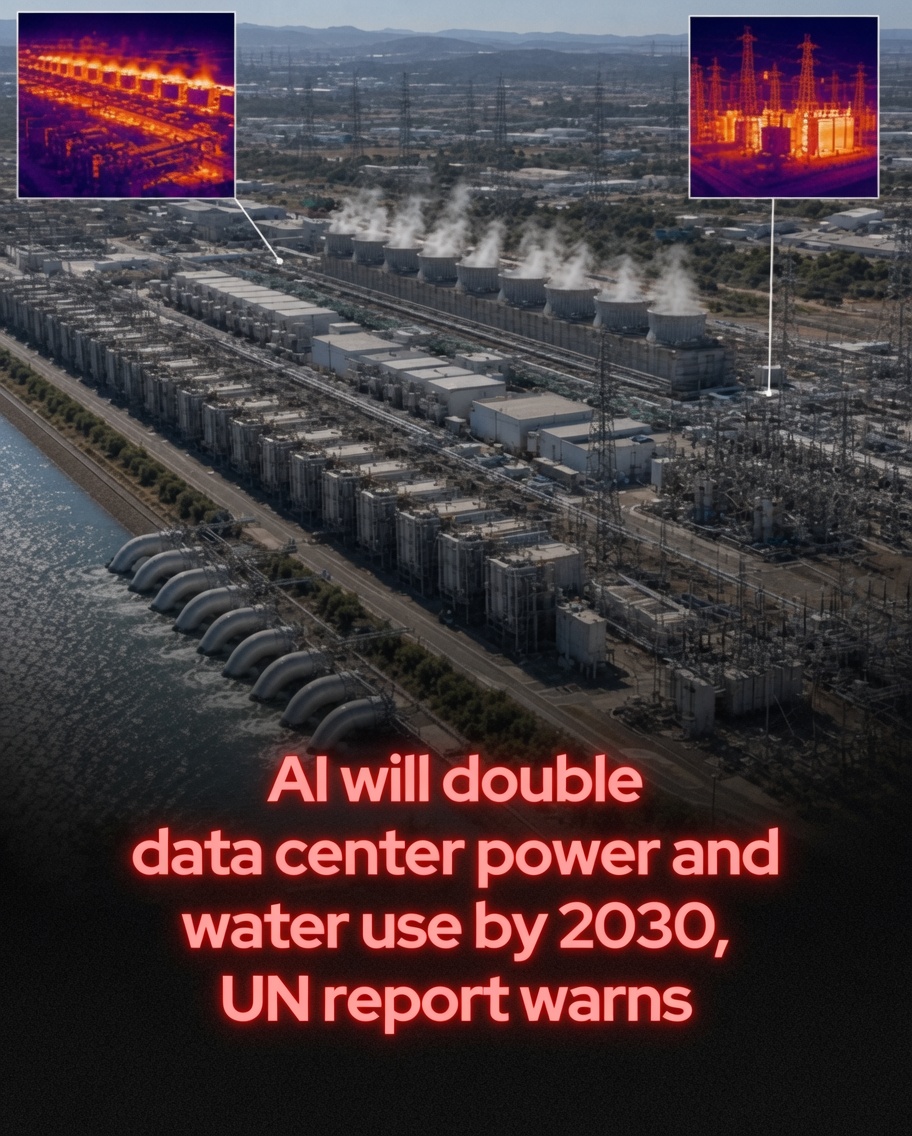
Data centers powering artificial intelligence are projected to consume roughly twice as much electricity and water by 2030 as they do today, according to a new report from United Nations researchers.
Although AI is often perceived as intangible cloud-based technology, every query, image, or video relies on a massive physical infrastructure of servers, cooling systems, power grids, chips, land, and water.
In 2025, global data centers used approximately 448 terawatt-hours (TWh) of electricity, more than the total consumption of Saudi Arabia. AI accounted for about one-fifth of that demand. These facilities also consumed around 1.2 trillion gallons (4.5 trillion liters) of water and emitted roughly 189 million tons of carbon dioxide.
By 2030, researchers forecast that annual electricity consumption by data centers will rise to 945 TWh, roughly equivalent to Japan’s current total electricity use, with AI expected to drive 40% of the total. Water consumption is projected to double to about 2.5 trillion gallons (9.3 trillion liters) per year. The physical land footprint could also expand from roughly 2,664 square miles (6,900 km²) today to more than 5,600 square miles (14,500 km²).
The surge stems from the immense computational demands of training and running advanced AI models, which require powerful chips running continuously and generate substantial heat that must be managed through energy- and water-intensive cooling.
The report emphasizes that AI is not inherently unsustainable. The technology offers potential benefits for optimizing energy systems, reducing waste, and improving efficiency across industries. However, the rapid pace of AI infrastructure development risks outstripping environmental planning, particularly in regions already facing resource constraints. Massive new data centers could intensify competition for electricity and water with communities, agriculture, and natural ecosystems.
[Aczel, M., Chamanara, S., Matin, M., Farsi, A., Marwala, T., & Madani, K. (2026). Environmental Cost of AI’s Energy Use: Carbon, Water and Land Footprints. United Nations University Institute for Water, Environment and Health (UNU-INWEH)]
Preventing the Wayback Machine from saving the news puts today’s journalism at risk of disappearing from history.
📝 Help push back. Sign the open letter calling on publishers to stop blocking web archiving 👉 https://t.co/fUrdNz60RD
@fightfortheftr#InternetArchive #SaveTheArchive #Journalism #MediaTransparency #WaybackMachine
We tend to think the internet is permanent, but recent events remind us that our digital record is fragile & being shaped in real time.
Legal pressure, platform restrictions, and limits on tools like the Wayback Machine are already affecting what can be preserved and accessed.
📚 Read VANISHING CULTURE to see why it matters
📖 Download & read: https://t.co/BrawXOwMBr
🛒 Purchase in print: https://t.co/EB58IliqDm
#VanishingCulture #DigitalMemory #InternetArchive #BookTwitter
@HazemMoghni I've noticed a general decline in google's main products; they seem to be heavily siphoning resources into AI solely; the other day, I got three different meanings for a word by their AI review, not to mention other
Key to note that AI scientists are not experts on labor. Some other economists active on X doing work on AI & labor: @alexolegimas, @danielrock, @joshgans & @robseamans (among many others)
But worth noting that economists don’t have a consensus either: https://t.co/Vq994fOS2s