Activation complete. ✅
ELIP 203 is now live on Liquid, removing the issuance cap for non-LBTC assets and unlocking better UX for large-scale tokenization.
Mainnet proof. 👇
https://t.co/kN9zDKez4Q
First major roadmap upgrade shipped. Next up: 0-conf by end of June. ⏱️
ok, so as I thought, perhaps the partner merchant 10% is worth considering in the overall equation and could tip the scales (vs Gemini or RH).
For record I'm very pro-Fold (obvi), you've built a great product, and I agree it does make the most sense if you plan to use the app to stack.
It just doesn't for me because I have a healthy P2P flow, but I'll look into the partner merchants and maybe can use the Fold card to maximize stack-flow for monthly budget.
@willreeves@FinTechBet@grok@cameron@Gemini@RobinhoodApp so you can earn 4% by using the card as normal? I thought you could only earn max 1.5% on everyday spend and it's supplemented with addition BTC-back by buying BTC within the Fold app?
If I have this wrong, please correct
@willreeves@FinTechBet@grok@cameron@Gemini@RobinhoodApp wait, I thought anything above the 1.5% is contingent on you using Fold to stack? is this wrong?
if there was a higher default (like 2%) and if there were similar rewards categories (like Gemini), I think a lot more users would be interested
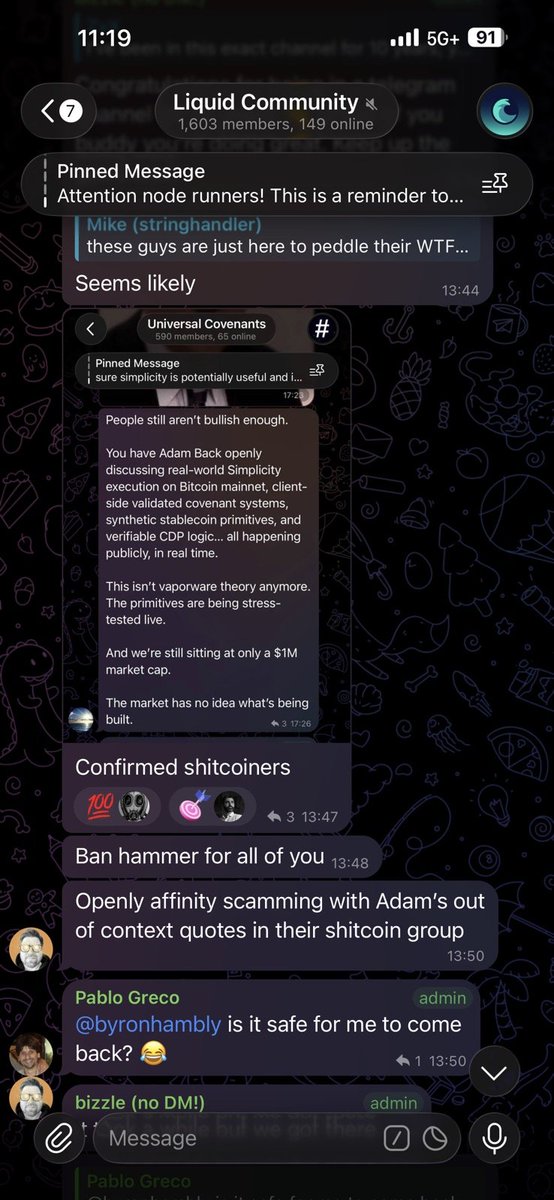
@BullCryptozor This is a really long GPT response with many misguided assumptions, so I'll just say don't scam people, it's literally that simple and you'll be welcomed.
Dear EVM devs, respectfully, this is why we:
- build Liquid on the bitcoin codebase
- use the UTXO model, avoiding the failed-execution fee problem
- rely on low-level, established cryptography so core functionality is as native as possible
- support native asset issuance, multisig and privacy without layering everything through external contracts
- provide privacy by default, helping reduce front-running and protect financial data
- use non-turing complete smart contracts with no recursion or unbounded loops
- avoid speculative utility tokens that attract scammers and create misaligned incentives
- generally choose to build with a low-time preference mindset: security > convenience
Ethereum did a great job courting young, talented devs and building a thriving ecosystem. I don't think anyone disputes that. The problem is that it was mis-designed and built on the wrong architectural foundation, and the market is finally starting to recognize that.
We've been waiting for these talented devs (who can teach the space a thing or two about UX) to shift to bitcoin, the most battle-tested and secure architecture in crypto.
We welcome you.
PSA: I now consider *all* of DeFi unsafe.
Coding agents are superhuman at finding vulnerabilities, and smart contract security is too asymmetric: defenders need to fix every bug while attackers need just one exploit to steal funds.
@punkreturn_@Excellion See OP message: "avoid speculative utility tokens that attract scammers and create misaligned incentives"
There's a million ways to make money (and to build DeFi architecture) without having to shill an ICO or separate token, here's further context for those reading.
I'm still a fan of bitcoin scaling via the "LCU" thesis: Lightning Connectivity Universe
A multiverse of interoperable bitcoin L2s, sidechains, statechains, rollups, meta-protocols, client-side protocols, ecash mints, connected by Lightning-compatible HTLCs and atomic swaps.
oh, I see it, I just think there is a credible path to improving/replacing bitcoin script, but it's up to those building it to prove it's safe, has a real use case, does not upend bitcoin as money, etc, and convincing the broader community.
bitcoin is far too important to screw up, so I get the pushback and apprehension around change.
not sure I agree, think you may be working off an outdated 2017 mental model, or maybe just following the wrong kind of bitcoiners on here. Getting DeFi right is essential, otherwise, we're just recreating the same problems from tradfi on-chain.
I can only speak from my own experience, but I see a lot of support for simplicity and more powerful smart contracts in general, even on mainchain. The difference is that bitcoin consensus moves slowly (rightly so), and adversarial thinking is part of the process and for arriving at the right conclusions.
bitcoin ecosystem is diverse, there's plenty of projects and L2s that would welcome them. Eg, Blockstream recently added the Distributed Labs team to its ranks, partly to tap their developer UX and EVM expertise to improve the DeFi ecosystem we're building with Simplicity, a non-turing complete smart contracting language.
https://t.co/g7K8MgBULH
@bergealex4 except there is an interop standard (htlc swaps like botlz) for bitcoin L2s, the issue is everyone is prioritizing eth connectivity because that's where the volume and TVL are
the idea is that long-term that volume will move over to the bitcoin L2s with expressivity
As the world becomes more multipolar, neutrality will trade at a premium. That is bullish not only for bitcoin but also for jurisdictions like Switzerland...companies, especially those building around open-source protocols, should allocate accordingly.
isn't the spark operator set much smaller than liquid's? - last I checked it was 2-3 (please educate me)
also when was the last time liquid was down? (it's had 100% uptime since late 2021)
any-who liquid is fine for the trade-offs and we can continue to improve the model a lot, people are way too dismissive these days
for record, spark is also fine and they are still new to the game so quite impressed with their adoption thus far
overall I'm quite bullish on multiverse of different interoperable L2s speaking lightning to each other, future looks good if we can add a little more expressitivity on base-layer
looking forward to the coming clashes between ark labs/second too, will be entertaining for sure ;-)