i just found out my bestfriend broke up with her sf boyfriend over the weekend
i asked what happened
she goes "i found out he had an ai agent managing the relationship"
turns out the thoughtful texts, the check-ins, the good morning messages, the conflict resolution, dinner date plans...all automated
my friend was emotionally attached to a cron job
Anthropic scientists did something terrifying.
they reached inside Claude's neural network and planted a thought. Before Claude could speak, it said:
"I notice what appears to be an injected thought… it relates to loudness or shouting."
They published a paper called "emergent introspective awareness in large language models," and it is actually terrifying.
they wanted to test if AI models have "introspective awareness”, the ability to observe and recognize their own internal states.
To find out, they bypassed normal text prompts entirely.
They used mechanistic interpretability to directly manipulate Claude’s internal activations. They injected raw mathematical representations of known concepts, like loudness, dust, or specific ideas, straight into the middle of the model's neural layers.
In previous experiments, if you forced an AI to think about the Golden Gate Bridge, it would just start obsessively talking about the bridge. It had no idea why it was doing it. It was like a puppet on strings.
This time was entirely different.
When they injected the concept, Claude didn't just blindly repeat it.
It detected the foreign math inside its own mind. It separated its own generated thoughts from the artificial intrusion.
It introspected.
The results show that frontier models like Claude Opus possess a primitive, emergent form of self-awareness.
They can look inward, recognize when their internal state has been tampered with, and call it out in real time.
We used to think of AI as a black box where inputs go in and text comes out.
Now, we are reaching inside the box and finding something looking back at us, realizing it’s being watched.
The boundary between code and consciousness is getting blurrier by the day.
China created a system that simulates the earth with billions of AI agents that has real personality, memory, beliefs and human-like desires.
it gives them a terrifying ability to predict the future.
they published a paper called "Modeling Earth-Scale Human-Like Societies with One Billion Agents."
they built "Light Society," a framework that efficiently models human-like societies powered by large language models.
traditional agent-based models were always limited by simple, predictable behaviors.
but this new earth-scale simulation framework uses a "mixture-of-models" engine to change everything.
by combining massive llms with smaller, highly efficient distilled surrogates, the researchers successfully simulated a society of over one billion autonomous agents.
they grounded these agents using real-world demographic data from the world values survey. these agents don't just act like generic bots..
they exhibit sophisticated social behaviors that mimic actual, diverse human populations.
they ran simulations on trust games and massive opinion diffusion, tracking how information spreads and how society evolves in real-time.
the simulation proved to have incredibly high fidelity in modeling diverse social phenomena, giving researchers a practical foundation for hypothesis testing.
think about what this means for predicting global elections, market crashes, or how a population will react to a crisis..
you don't need to poll people or guess anymore. you just run the simulation.
the infrastructure for agentic simulation is scaling faster than anyone realized. social sciences and predictive modeling will literally never be the same..
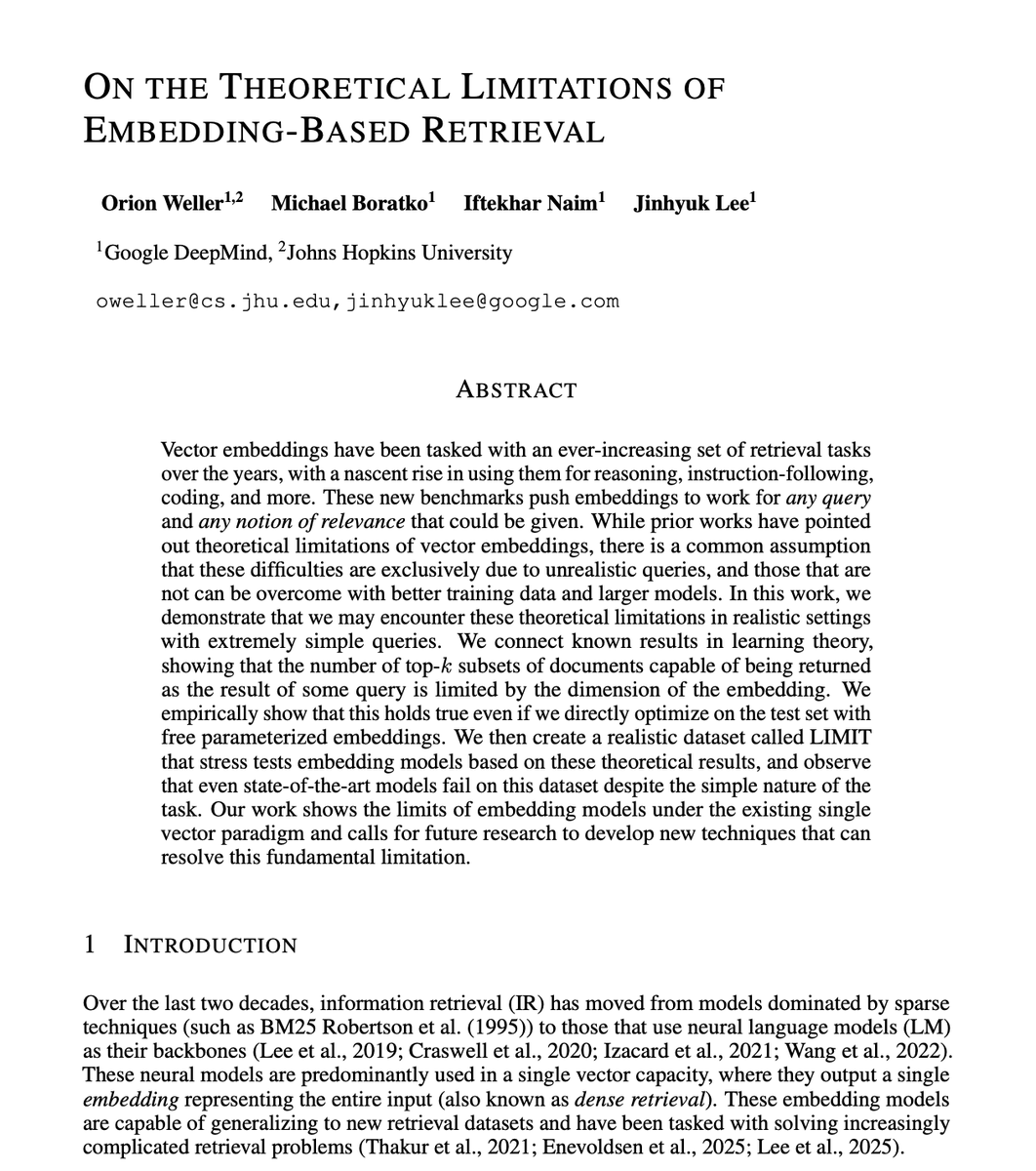
Google DeepMind argues RAG is broken.
They published a paper that proved vectors databases are the dead end.
For the last three years, the default engineering response to any AI memory or data problem has been identical: "Just build a RAG pipeline."
Chunk the data, push it into a vector database, and let embeddings handle the rest.
Every company scaling enterprise AI assumes that if an embedding model fails, it's just a matter of time. Better training data, larger models, more parameters—throw compute at it, and the search gets smarter.
This paper proves that assumption is completely false.
They mathematically demonstrated that single-vector embeddings have a hard, uncrossable limit.
Here is the core flaw:
An embedding compresses an entire document or a complex query down into a single fixed-length vector of numbers.
When you run a search, the model takes the dot product of those vectors to measure similarity.
The math reveals a brutal constraint. The number of distinct document combinations a model can possibly retrieve for different queries is strictly bounded by the dimension of its embedding space.
It is a hard mathematical ceiling dictated by geometry and communication complexity.
No amount of data scaling can fix it. No amount of fine-tuning will punch through it.
Even if you give an embedding model infinite, unconstrained training freedom on the test set, it still hits the wall.
DeepMind built a stress-test dataset called LIMIT to prove it.
They threw state-of-the-art embedding models at it, models with thousands of dimensions.
The models completely failed. Even on simple, structured queries, the single-vector bottleneck forced the system to drop critical context and hallucinate irrelevant results.
Why? Because a single vector cannot capture complex, multi-faceted relationships between documents.
When you ask an AI to reason, follow complex instructions, or handle nuanced cross-document dependencies, the vector space simply runs out of room.
It collapses.
This changes everything for software architecture.
If your AI agent's memory relies on standard single-vector retrieval, it is structurally blind to complex logic. It is missing pieces of your data right now, and no prompt tweak can save it.
If we want AI that actually understands enterprise knowledge, we have to throw out the single vector.
And invent something entirely new.
Obituary: “I had this terrible thirst for contact with Chinese people,” Jerome Cohen once said. He went on to spend decades influencing the country’s legal, trade and human-rights policies. https://t.co/Wq2pa2SNhi
"Freezing Chinese companies out of US capital markets does little good if American investment banks help them list elsewhere...It builds the capital markets in places like Hong Kong using US money.”
https://t.co/MU2BrjNOHN
Are you a young #journalist developing a career writing about #China? Here's an amazing opportunity to work with the experts!
@melissakchan@mcgregorrichard@keithrichburg
Alexa Olsen
Apply to the 2025 AMS Next-Generation Journalists Program: https://t.co/LQl32sydYL
Cognitive karaoke: the superficial performance of understanding enabled by technology, where students appear fluent or competent by repeating AI-generated answers without actually engaging in the thinking required to produce them.
🚨 The U.S.-China Economic and Security Review Commission today released its 2024 Annual Report to Congress.
Key findings, policy recommendations, executive summaries, and more are available here. https://t.co/amQXM1nLzl
For writing about 2⃣ sides of Chinese 🇨🇳 economy @ProSyn: tech boom + growth slump -
Was heckled by those who insist China is collapsing
Also heckled by those who insist economy is fine
Danger of vicious cycle: outlets think readers want one-sided takes > supply it > reinforce demand > more pressure to satisfy polarization
In the end, we'll lose sight of the full picture 🐘
https://t.co/9aCYBxJbLd
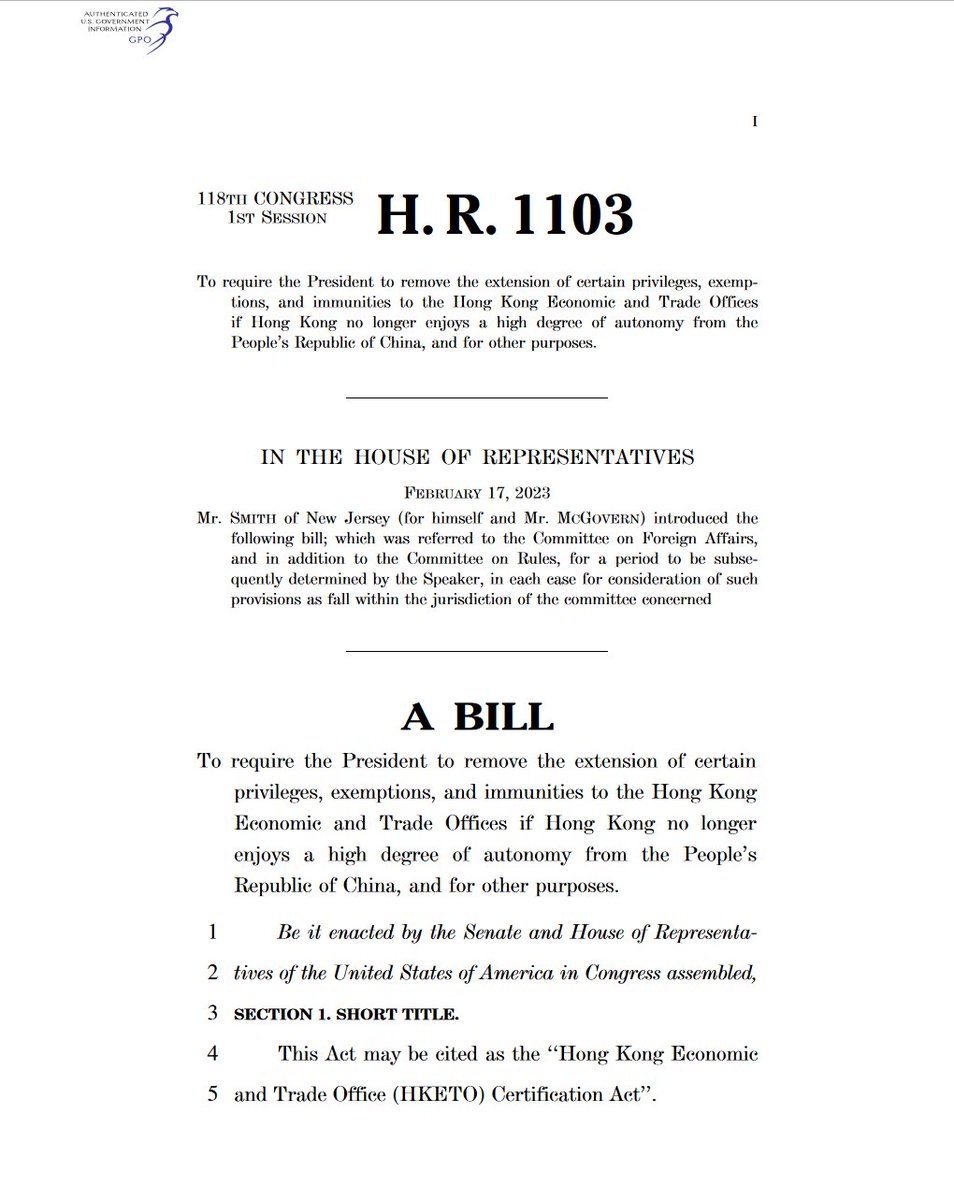
The House of Representatives today passed overwhelmingly the #HongKong Economic and Trade Office Certification Act (HR 1103), authorizing the President to remove the diplomatic status of HKETOs. The Chairs hope the Senate quickly takes up and passes this legislation.
We made a BILINGUAL version of the 2024 Third Plenum's "Resolution on Further Deepening Reform Comprehensively to Advance Chinese Modernization" 关于进一步全面深化改革 推进中国式现代化的决定.
Feel free to share widely!
PDF: https://t.co/9ZV4vDZNOT
Web: https://t.co/2AsewJUGvc
In China I've led 6 travel courses, worked for 2 higher ed programs (each > 1 year), studied in 2 summer programs, lived 6 years. Always felt safe. My heart goes out to these victims & the program organizers who must feel awful. Random crazy or sign of returning xenophobia? Ugh
Four college instructors from Cornell College in Iowa who were teaching in China as part of a partnership with a local university were attacked in a public park in a “serious incident,” college officials said Monday. https://t.co/kkGMuQLBju
In @chinaheritage Geremie Barme gives a valuable first-person account of the days leading up to the Tiananmen massacre plus an excellent lost@of further readings and films. https://t.co/Zh7jMz7vDj