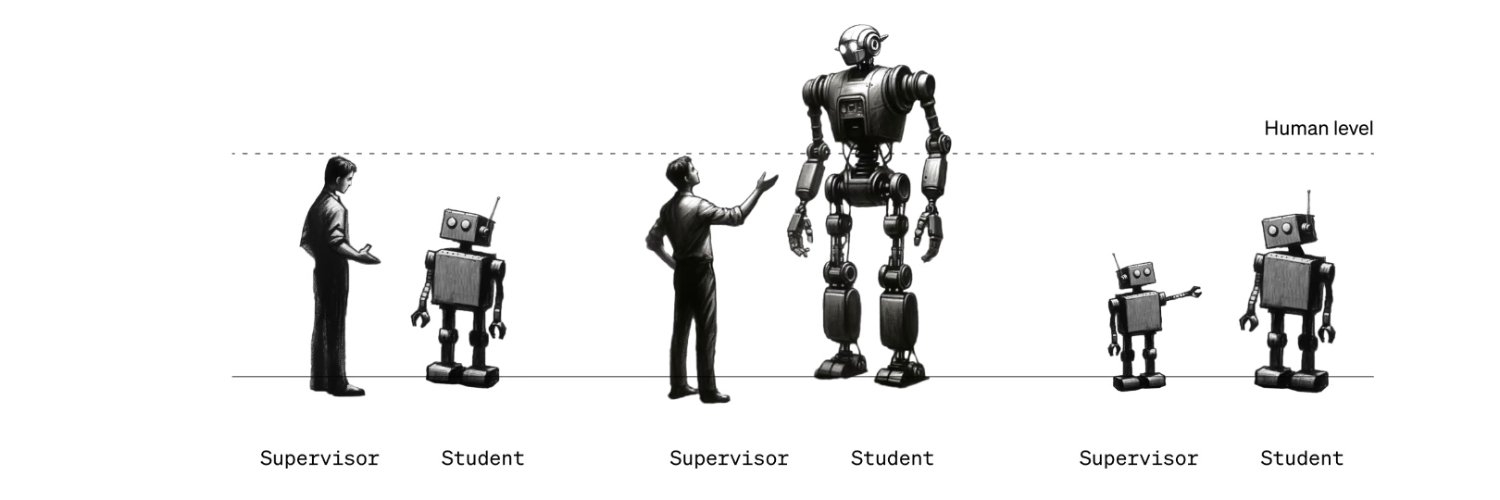
AI 2040 has been released! What a day.
AI 2027 was probably the most forward-looking blog about the future, and much of it has come to pass with remarkably accurate timing.
Alongside Aschenbrenner’s “Situational Awareness,” it is probably the most important blog for theoretically preparing ourselves for the future. That makes me all the more excited about AI 2040! I’m going to read it immediately, and I can only recommend that you do the same.
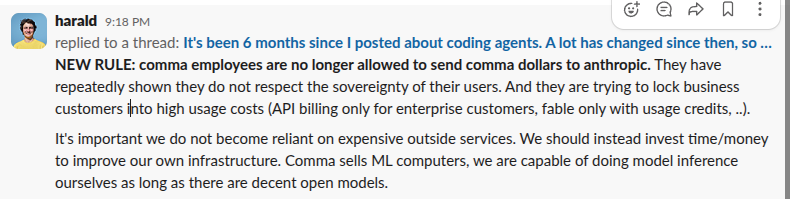
Anthropic is now a banned vendor at @comma_ai . I recommend other companies do the same.
People should consider how reliant they are on cloud token vendors. If you can't brainstorm, code or be productive without them, you should be scared. Regain your sovereignty or you're ngmi.
I’m in love with this sentence:
“The degree to which a person can grow is directly proportional to the amount of truth he can accept about himself without running away.”
Our thoughts on the importance of AI sovereignty.
1. Your AI sovereignty dictates your institution’s future. Sovereignty is the precondition for choice. Relinquishing sovereignty transfers the future choices of your institution to others, who are likely to exploit it for their gain and your loss.
2. Data retention is your treasure. Transfer it at your own peril. Your ability to win is dictated by your ability to recognize and use your unique edges, and you keep winning by compounding the underlying data to generate new insights. Transferring that data hands over access to your pre-existing winning plays and yields the means of production for new ones.
3. Tokenmaxxing hijacks your value orientation and decreases your institutional fortitude and intelligence. The pursuit of high token usage incentivizes disposable scripts over robust software — with the addictive feeling of false progress. There is a reason why those selling tokens refuse to charge based on value.
4. Controlling your weights is controlling your fate. Weights are the distilled form of hard-won, accumulated institutional knowledge. If you let others control your weights, you are allowing them to migrate the alpha of your business to theirs.
5. There is no contradiction between sovereignty and alpha. The architecture that maximally preserves sovereignty is one that enables institutions to own their tribal knowledge, and to compound it as alpha.
6. Politicizing the technical issues involving sovereignty is what your adversary wants. Techno-politicization is the wellspring of false sovereignty. Techno-politicization drives decisions that seem to reduce dependency, but ultimately limit agency — especially on the battlefield in the West.
7. Real expertise is existential. Allowing politics or favoritism to determine your technical decisions rewards whoever is best at politics, not whoever is right. Listen to those closest to the problems, not those speaking most compellingly about them.
8. Learn from institutions that are winning or that have consistently delivered. Institutions facing existential threats do not have the luxury of making technical decisions based on political preferences.
9. Only listen to institutions, countries, and people who have a proven record of being right. A track record of correctness is the best and only signal for future correctness. Judging something as right or wrong based on who you like is exceedingly misguided.
@bgurley After reading the Claude Code source code that they accidentally leaked, I have no idea why you should take any claims about how smart their models are seriously. Both from the poor quality of the code and the fact that they leaked it.
“Peter Thiel says that to be an entrepreneur you have to be contrarian—and right.”
“You have to be comfortable looking stupid for like a long time.”
“When I was calling those banks and saying: Hey we're a crypto company want to do this? They would hang up on me.”
“I'd go pitch the 30th venture investor and get a no.”
“We're willing to be misunderstood for a long time.”
“Entrenched interests will fight you.”
“Everything that's truly innovative and
breakthrough is going to upset an entrenched incumbent, eventually intersect with the government, and just
piss off some segment of the population who are like “How dare you question the status quo?”
— @brian_armstrong founder of Coinbase.
Many people think any given ML project is 99% training.
In reality, it’s 50% evaluation, 40% data cleaning, 8% integration, and 2% training.
The first two set the noise floor for learning. No ML magic matters; the model cannot lower the noise floor, as that’s the optimal bound of Shannon encoding of your data.
Thus, not a single day goes by without me thinking about ontology. Even the old labels have to be constantly reviewed.
Here's a simple loop: Tell codex to maintain your repos, wake up every 5 minutes and direct work to threads. That makes it easy to parallelize+steer work as needed.
I use a orchestrator skill combined with my triage+autoreview+computer use skills, so some work can land autonomously. https://t.co/FbBoJTIcfd
https://t.co/8389roVnOm