Finance Professor. Formerly Chair/Pres. European Finance Assoc. & Public-Sector CEO. Research: Financial Markets, Corp. Gov., etc. Views are purely personal.
When does arbitrage become market manipulation? India crackdown brings globally important issue into focus. Excellent coverage by @LeeYingShan who interviewed me for @CNBC. Empirical resolution is feasible with a forensic examination of actual trades. https://t.co/8HucnkPb1R
Satya Nadella was asked what Microsoft does when its AI revenue 10x's from $13B to $130B. He refused to answer in revenue - and named the only AGI benchmark he says counts
"The first thing we have to observe is GDP growth. There's only one governor in all of this"
"This is where a little bit of, we get ahead of ourselves with all this AGI hype"
"The developed world is what, 2% growth? And if you adjust for inflation, it's zero. We have a real growth challenge"
"When we say this is like the Industrial Revolution - that type of growth means to me 10%, 7%, developed world inflation adjusted, growing at 5%. That's the real marker"
"The big winners here are not going to be tech companies. The winners are going to be the broader industry that uses this commodity"
"Us self-claiming some AGI milestone - that's just nonsensical benchmark hacking to me. The real benchmark is the world growing at 10%"
The CEO with one of the largest AI infrastructure bets on earth just told you to ignore every model benchmark and watch a single number: world GDP.
By that test, nothing has happened yet. Developed-world growth is flat, and no lab's press release moves it. Real AGI shows up as the economy compounding at Industrial Revolution rates - or it isn't real.
A historic milestone for India-UK relations.
Delighted to note that the India-UK Comprehensive Economic and Trade Agreement will enter into force on 15th July 2026.
This agreement will significantly boost our bilateral trade and investment.
It will also unlock numerous opportunities for Indian farmers, workers, MSMEs, startups and innovators and contribute meaningfully to the realisation of Viksit Bharat 2047.
Both PM Starmer and I, who are in Evian for the G7 Summit, are naturally very happy with the significant momentum being added to our economic ties.
@Keir_Starmer
NSE of India, the operator of the world’s busiest derivatives market, has filed draft documents for what’s on track to be one of the largest initial public offerings in India’s history https://t.co/6yBD6r32ty
India just launched a flagship scheme to recruit top Indian-origin researchers living abroad and bring them back to India to conduct high impact, cutting-edge research. The scheme offers research grants, relocation support, and access to advanced research infrastructure.
📅 Last Date: July 15, 2026
A landmark study has found that two years of regular, structured exercise can dramatically rejuvenate the aging heart, effectively turning back the clock by as much as 20 years in previously sedentary middle-aged adults.
Conducted by researchers at the University of Texas Southwestern Medical Center and published in the journal Circulation, the trial involved healthy but inactive adults aged 45–64. Participants followed a supervised exercise program four to five days per week, combining moderate aerobic training (such as walking, cycling, or swimming), high-intensity intervals, and strength sessions.
After two years, the exercise group showed significant improvements in cardiovascular function. Their hearts became more elastic and efficient at filling with and pumping blood, changes that made their heart performance resemble that of people 15–20 years younger. The control group, which did not exercise, showed continued age-related decline in heart stiffness.
This NIH-funded study is one of the longest and most rigorous trials demonstrating that it’s never too late to start exercising in middle age, and that consistent effort can produce profound, measurable reversal of age-related heart changes.
[Howden EJ, Sarma S, Lawley JS, et al. Reversing the Cardiac Effects of Sedentary Aging in Middle Age—A Randomized Controlled Trial: Implications for Heart Failure Prevention. Circulation. 2018;137(15):1549-1560. doi:10.1161/CIRCULATIONAHA.117.030617]
Switzerland is rich partly because it is a hub for international business. It will struggle to remain so if it is closed to foreign brains https://t.co/MFCDijAhW1
Sepsis kills more people in American hospitals than heart attacks. 350,000 deaths a year, and the reason is brutally simple: the early warning signs are almost invisible.
A slightly elevated heart rate. A small temperature shift. A lab value drifting in the wrong direction. Each one looks like noise on a busy ward. By the time the pattern is obvious to a human, the patient is hours into a cascade toward organ failure, and every hour of delayed antibiotics raises mortality.
Tampa General built a system on Palantir's Foundry that watches roughly 1,000 inpatients continuously. Vitals, labs, medication records, clinician notes, all scanned in real time for the pattern no single nurse can see across 12 beds at 3am. When risk crosses a threshold, a rapid response team gets paged. Humans still make every treatment decision. The software just compresses detection from hours to minutes.
The results since 2022: overall sepsis mortality cut in half, 48-hour deaths down 68%, length of stay down 30%, roughly 900 lives saved. At one hospital.
Now run the national math. There are about 6,100 hospitals in the US. If even the 500 largest matched these numbers, you'd be looking at tens of thousands of lives a year from a single use case. The treatment for sepsis hasn't changed. Antibiotics and fluids, same as decades ago. The entire gain comes from starting them earlier.
The hardest problem in medicine was never the cure. It was noticing in time.
Come on. No question pricing is ridiculous and extortionary. But, an LLM can't teach you the people and life skills that you gain in college. It can help with what you can learn, but it can't teach you how to learn. It can't teach you to stand up in front of a class and make a presentation, to show some semblance of responsibility and it can't hold you accountable for anything.
AI should definitely be part of every college experience. It can ampllify it in new and unique ways.
But, it won't ever hold your legs in a keg stand
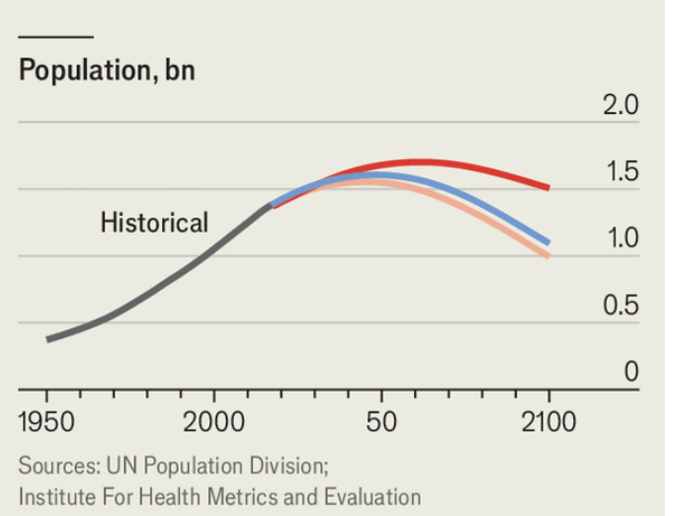
Our cover story in Asia this week is India's baby bust. Fertility rates are falling remarkably fast across the country-- in several states women are now having the same number of children as those in Scandinavia. That means we should think differently about India's future:
This new research on US unicorn startups is really interesting.
Some key facts from the report:
1. Immigrants founded or cofounded 455 of America’s 775 privately held billion-dollar startups, equal to 59% of all US unicorns.
2. 66% of all US unicorns were founded or cofounded by immigrants or the children of immigrants.
3. 79% of US unicorns have either an immigrant founder or an immigrant in a key leadership role.
4. The 455 immigrant-founded US unicorns have a combined valuation of $5 trillion.
5. That $5 trillion valuation is larger than the total stock-market value of companies listed in all but 7 countries.
6. Including immigrant-founded unicorns that went public since 2016 pushes the total value above $5.8 trillion.
7. The number of immigrant-founded US unicorns rose from 50 in 2018 to 455 in 2026.
8. 24% of US unicorns have a founder who first came to America as an international student.
PM Carney tells immigrants to leave behind the feuds of their homelands:
"We don't welcome the world's hatreds"
"When you come to Canada you bring your faith, your tradition, your language, your story - you leave behind your animosities"
The wild part of Clint Eastwood at 96: he made nearly half his movies after turning 70.
40 features as a director. 19 of them came at 70 or older, the last at 94. Most directors are long done by then. His cadence held flat across five decades and actually tightened in the middle of it.
Look at the years he shipped two films at once. Flags of Our Fathers and Letters from Iwo Jima in 2006. Changeling and Gran Torino in 2008. Jersey Boys and American Sniper in 2014. The 15:17 to Paris and The Mule in 2018. Every one of those double years came after he turned 76.
The engine was a method. He shot one or two takes and moved on. Matt Damon said you had to hound him for a second. That discipline brought four decades of films in under budget and ahead of schedule, which is how a 70-year-old keeps directing like a 40-year-old.
So the quiet exit fits. Warner Bros gave Juror #2 a token release and pushed it to streaming, he did zero press and skipped his own AFI premiere. Not one public complaint. A director who never needed a second take was never going to need a farewell tour.
96 today, and he closed it the way he ran every set: no waiting around.
Three women stood on the same set in Rome in September 2003, roughly equal in fame. Twenty-two years later, the gap between them is $850 million.
Pepsi flew Beyoncé, Britney, and Pink to Rome to shoot a three-minute gladiator commercial on a fake coliseum they built down the street from the real Colosseum. Pink later called the whole production "Pepsi money," because it was. The director, Tarsem Singh, had actually created CGI coliseum effects for Nike years earlier. Ridley Scott's team bought that VFX company and used it to shoot Gladiator. The movie visually mimicked the commercial director, not the other way around.
Pepsi spent a fortune on the ad. Then executives decided it "wouldn't work for American audiences" and pulled it from the Super Bowl. The three-minute spot never aired in the United States. Not once. It ran exclusively overseas, became a cult hit through early internet sharing, and eventually generated one of the most widespread Mandela effects in advertising history. Millions of Americans are certain they watched it during the 2004 Super Bowl. They didn't.
But the real story is what happened to the three women on that set.
Beyoncé took the Pepsi money, built Parkwood Entertainment, kept ownership of her entire catalog, and turned two touring cycles into roughly $1 billion in gross revenue between 2023 and 2025 alone. Forbes confirmed her as a billionaire in December 2025. Net worth today: $1 billion.
Britney signed her Pepsi deal for $8 million in 2001. By 2008, a conservatorship placed her finances under her father's control for 13 years. She ended it in 2021. In December 2025, the same month Beyoncé crossed the billionaire threshold, Britney sold her entire music catalog to Primary Wave for an estimated $170 million. Net worth today: roughly $150 million.
Pink never stopped touring. Nine albums, no conservatorship, no billionaire status, no catalog sale. Steady career. Estimated net worth around $200 million.
Three women on the same set, same year, same Pepsi contract, same level of fame. The variable was ownership. Beyoncé built the infrastructure to own everything she created. Britney had her ownership stripped by a legal structure she didn't choose. The commercial that never aired in America accidentally captured the exact moment their trajectories diverged.
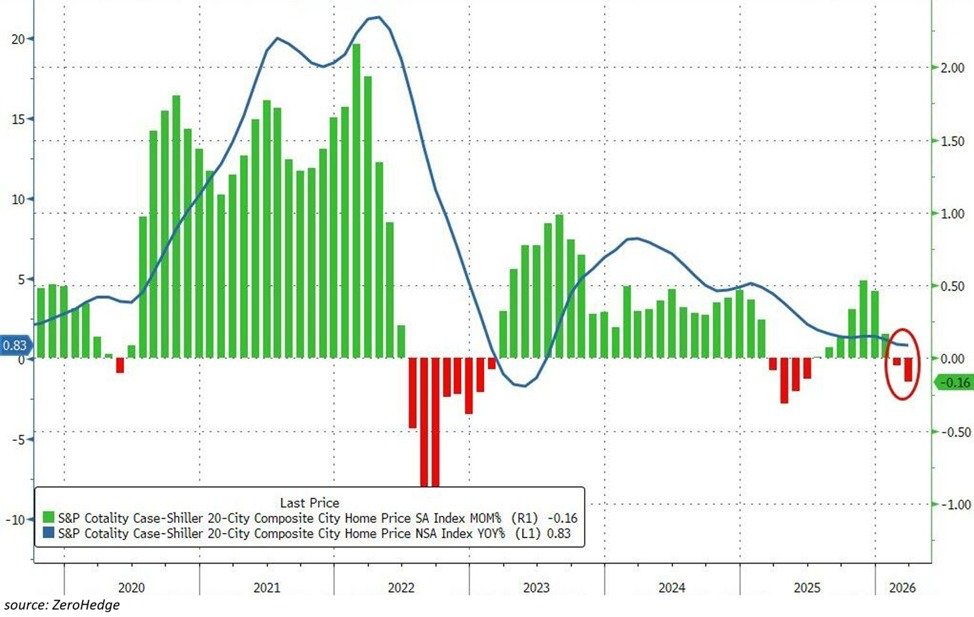
BREAKING: Home prices across America's 20 largest cities fell -0.16% MoM in March, the 2nd-consecutive monthly decline after 6-straight monthly increases.
YoY, prices rose +0.83%, the weakest annual gain since July 2023.
This comes as over half of the 20 major US housing markets posted YoY price decreases.
Seattle posted the steepest decline at -2.5%, followed by Denver at -2.0%, Tampa at -1.9%, Dallas at -1.7%, and Los Angeles and Phoenix at -1.6%.
Meanwhile, the spread between the strongest and weakest markets stands at 8.6 percentage points, highlighting how uneven the housing slowdown has become.
In real terms, home prices fell for their 10th consecutive month, as inflation continued to outpace nominal price gains.
The US housing market is cooling.





![Rainmaker1973's tweet photo. A landmark study has found that two years of regular, structured exercise can dramatically rejuvenate the aging heart, effectively turning back the clock by as much as 20 years in previously sedentary middle-aged adults.
Conducted by researchers at the University of Texas Southwestern Medical Center and published in the journal Circulation, the trial involved healthy but inactive adults aged 45–64. Participants followed a supervised exercise program four to five days per week, combining moderate aerobic training (such as walking, cycling, or swimming), high-intensity intervals, and strength sessions.
After two years, the exercise group showed significant improvements in cardiovascular function. Their hearts became more elastic and efficient at filling with and pumping blood, changes that made their heart performance resemble that of people 15–20 years younger. The control group, which did not exercise, showed continued age-related decline in heart stiffness.
This NIH-funded study is one of the longest and most rigorous trials demonstrating that it’s never too late to start exercising in middle age, and that consistent effort can produce profound, measurable reversal of age-related heart changes.
[Howden EJ, Sarma S, Lawley JS, et al. Reversing the Cardiac Effects of Sedentary Aging in Middle Age—A Randomized Controlled Trial: Implications for Heart Failure Prevention. Circulation. 2018;137(15):1549-1560. doi:10.1161/CIRCULATIONAHA.117.030617]](https://pbs.twimg.com/media/HKyBM7mWIAAqrdh.jpg)