https://t.co/4zxxCZez7f
Kwame Nkrumah:
Behind the Microphone of Freedom.
A Series of Translations.
6th March 1957
•Ga
•Asante
•Ahanta
•Eʋegbe
•Fantse
project_Sankofa
our History; our Culture; its Future
enjoy our progress
#Nkrumah#NkrumahNeverDies#NkrumahMemorialDay
The Black Volta: A River That Gave Life & Took It.
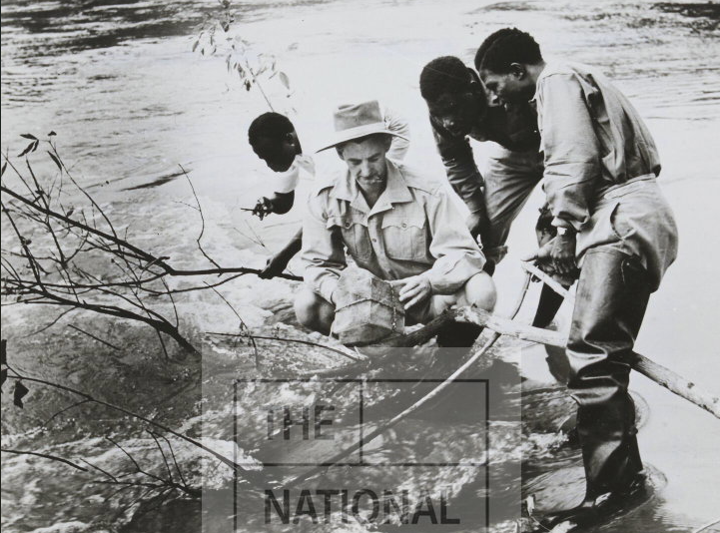
1. Crouched over the Black Volta, examining a cage of Simulium flies. Tiny, almost invisible insects that were quietly blinding an entire generation of Ghanaians.
2. The disease was onchocerciasis. River blindness. And in the Northern Territories alone, present-day Northern Ghana, about 600,000 people were infected.
3. 40,000 of them had already lost their sight. Not from old age, not from injury, but from a fly breeding in the rivers they depended on to survive.
4. So British researchers moved in. Literally.
5. They bred the flies for study, mapped the rivers where they thrived, and rolled out mass treatment programmes using drugs like hetrazan and suramin.
6. Where medicine could not reach fast enough, they turned to prevention. Dousing rivers and streams with DDT to destroy the breeding grounds before the flies could claim another pair of eyes.
7. By 1957, the Gold Coast Government had committed £5,500,000 to health and hospital services under the 1951 Development Plan.
8. And a race against time began.
9. A river that gave life was also taking it. And someone had to stop it.
🎥: Black Volta River. Gold Coast. January 1957.
Subscribe: https://t.co/XtwS80FlXQ
Dansinkran: Dancing Crown
1. Circa 1960.
2. Seen here are women of the royal household at Manhyia wearing the dansinkran, a hairstyle that began traditional life originally named kentenkye.
3. To understand how the kentenkye came to be known as dansinkran, one would need to travel back to 1935.
4. The story is told that, during the restoration of the Asante Confederacy, Nana Konadu Yiadom II, Queen Mother & sister of Agyemang Prempeh II, performed the Adowa dance in her kentenkye hairstyle.
5. This inspired the then Governor, Sir Arnold Hodson, to describe her hairstyle as a "dancing crown" because of its visual effect during the dance.
6. The phrase has since then been corrupted as 'dansinkran', which has become the popular name of the hairstyle.
📹: willis e. bell
no, she wasn't. matilda essi forster beat her to it.
1. matilda was called to the english bar in 1945 and to the gold coast bar in 1947.
2. annie was still a student at LSE and was called to the bar in 1949.
3. what annie jiagge gets credit for is being the first african woman to qualify as an appeal and high court judge in ghana and in the commonwealth.
4. she also did good work in women’s economic empowerment by cofounding the women’s world banking. and a street in the netherlands is named in her honour.
5. but these feats by annie come as no surprise when you find out who her antecedents were.
6. she was born in lomé, togo, as annie ruth baëta, to reverend robert dominngo baëta, who was an icon in the e.p. church.
7. her older brother, rev. prof. christian gonçalves kwami baëta, was ghana's first professor of divinity.
8. he raised the initial capital of £897,000 from donations by cocoa farmers and presented it to the cocoa marketing board, now the ghana cocoa board, to help establish legon, ghana's first university.
9. but their primary roots, inherited wealth, and privilege came from a portuguese slave trader.
10. as a lasting memory of baëta, the first well in anlo, which he built to quench the thirst of his slaves before their final journey to the ships, still stands in atorkor.
if you care for more of these stories, subscribe for free here: https://t.co/9hhN9LIf1w
This is our Engineer Hikma Hamza testing the @KhayaAI Voice Assistant in Ewe. You can chat with it right now!
Glad to be playing a small role in mentoring future leaders like Hikma in this important space 😊😊
https://t.co/pENOK1E1js
The Akan word ‘Saman’, commonly translated as “ghost” or “spirit of the dead,” carries layers of meaning that reveal how Akans traditionally understood life, death, and the world beyond.
Most Ghanaians don't know the legendary status of @pazunre. Let me share a short story. While working at Google, a colleague, whom I had just met that week, scheduled for us to have lunch to get to know more about what we each did at work.
During our conversation at lunch, I got to find out he was a team lead for some projects covering Google translate. He spoke of the complexity getting their AI engines to understand the nuances embedded in translating African languages.
Knowing the momentous work @pazunre is doing with @GhanaNLP and Khaya app, I mentioned that I had a friend who had built an app for Ghanaian languages, and was expanding to other countries; he went to MIT and had a PhD. My colleague interjected with, "is it Paul? With the Khaya App?".
My colleague then mentioned that indeed Khaya App had the best translation on the market for Ghanaian languages and that Paul is someone who has an incredible reputation amongst the AI, ML research scientists at Google.
They knew who he was. And had such reverence for him. This guy spoke of Dr. Pushkin and @moorekwesi like some legends in the game. That was a very proud Ghanaian moment for me.
Where am I going with all this? Let's leverage such brains as a country. Cos others have seen what they have to offer and are seriously considering of poaching them.There many like Dr. Pushkin n Dr. Moore out there who can help shape the future fortunes of Ghana.
#GhanaMoments
If I told you that back in the 1700s, British plantation owners in Jamaica were so terrified of enslaved Ghanaians that they tried to pass an actual law in parliament to ban the import of people from the Gold Coast, you’d think I’m lying . Below is the story of the Coromantees…
Olowe of Ise — a Yoruba master sculptor whose carvings were so extraordinary that British colonial officials carried his works across the ocean and displayed them in London as masterpieces of world art.
Born in the late 19th century, Olowe transformed wood into movement, royalty, philosophy, and memory. His figures did not stand stiff like ordinary carvings; they leaned, stretched, danced, commanded space, and breathed life. Every sculpture carried the energy of Yoruba civilization itself.
He carved palace doors, veranda posts, ancestral figures, and royal shrines for kings across Yorubaland — from Ikere to Akure, Ilesa to Idanre. His most famous work, the palace door of the Ogoga of Ikere, stunned audiences at the 1924 British Empire Exhibition in Wembley. British curators reportedly called it one of the finest examples of African carving they had ever seen.
But what makes Olowe important is not just artistic skill. It is the fact that he shattered the colonial myth that African artists were “anonymous craftsmen.” Yoruba oral tradition remembered his name. Kings sought him specifically. Patrons recognized his signature style instantly. He was not invisible. He was celebrated.
Today, his works sit in museums like the British Museum, the Smithsonian, and the Metropolitan Museum of Art, proof that long before modern design schools and global galleries, Yoruba artists had already mastered perspective, symbolism, architecture, storytelling, and motion in sculpture.
Olowe of Ise was not merely a carver.
He was one of the greatest artists Africa ever produced.
We are seeking out the original names of the villages, now turned suburbs: East [of] Legon.
Shiashie
Bawaleshie
Adjiringanor
Otinshie
Ogbogbo
I’m sure there're so many more.
Add what u know & describe with a popular landmark.
Cc
@Ga_Spaces@MantseBi_Ago@CunnisElijah
.
.
Re aL
https://t.co/k1Vh2jobBU
see above for :
A L M _ .
Cyc_T | the C W I .
3Dcraft_Ghana .
project_Sankofa .
S O A | NKNe | KO .
al_bertoid
we programme ;
ideas, brands, prototypes, teams, startups, projects, policies
: | :
He’s essentially where the confusion in the literature begins. He’s the earliest known writer to attempt elevating “Twi” as a label for what all Akan people speak. Even then, he admitted in his own work that this wasn’t widely accepted, since groups like Fante, Ahanta, Nzema and others have never used “Twi” as the name for their language.
Johann Gottlieb Christaller (19 November 1827 – 16 December 1895) was a prominent German missionary, philologist, and linguist recognized for his foundational work on the Twi language in the Gold Coast (modern-day Ghana). He was a Basel Misionarist as well.