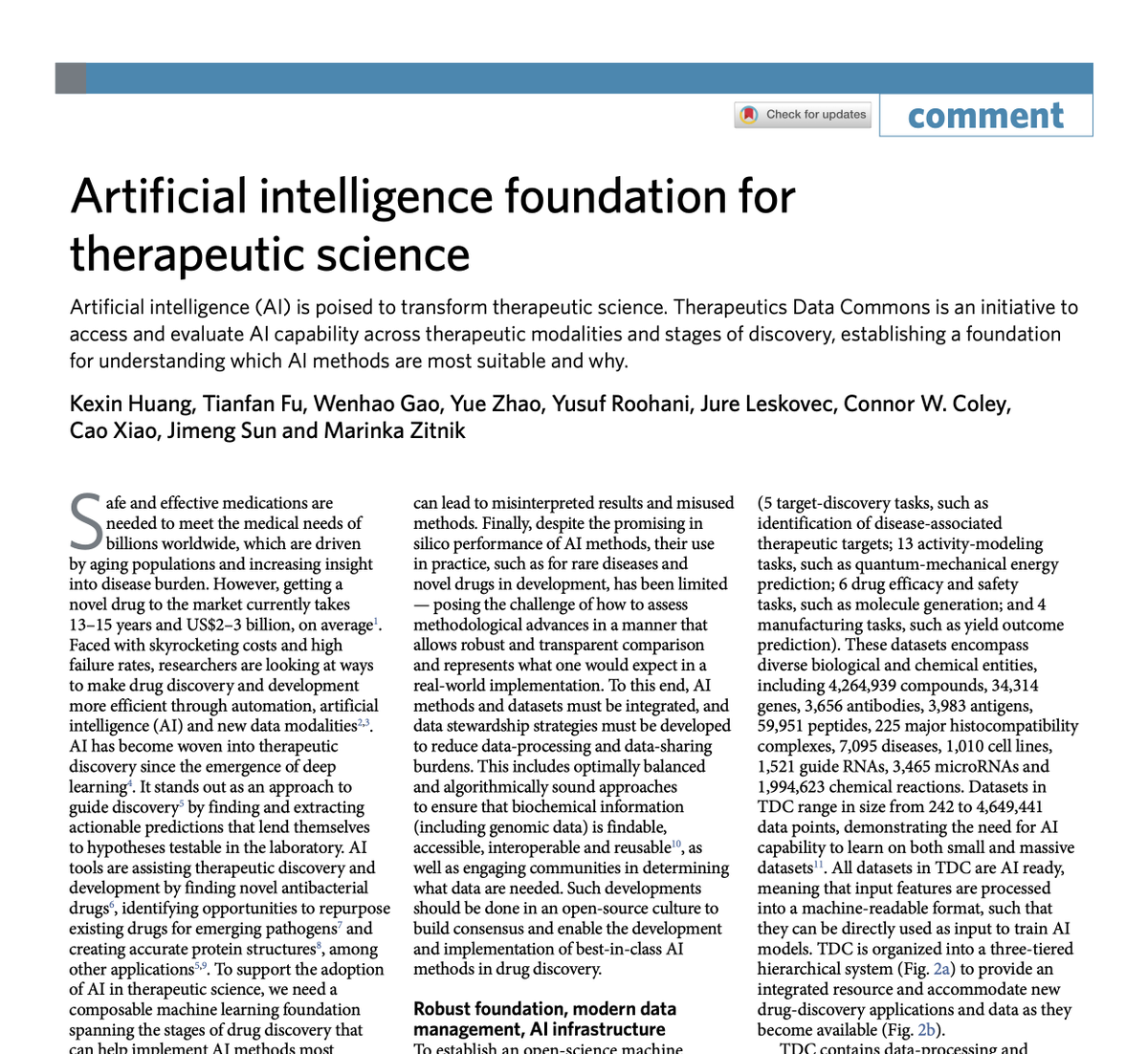
Excited to share our new paper in Nature Chemical Biology @nchembio
AI is poised to transform #therapeutic#science
The Commons is an initiative to access and evaluate #AI capability across therapeutic modalities and stages of discovery 1/4
https://t.co/Mr986dlR1c
@GaoShanghua@AdaFang_@KempnerInst@HarvardDBMI@Harvard AutoScientists automatically produces model cards, experimental logs, failed hypotheses, dead-end registries, and research reports.
The goal is not only to discover better models, but also to document how they were discovered.
With the ToolUniverse (TU) CLI, there’s no need to set up an MCP server—agents can instantly access tools with a single command. Paste this to your AI agent to use it now! "Read https://t.co/rFjwcPbalH and update to the latest ToolUniverse. I want to use the tu CLI."
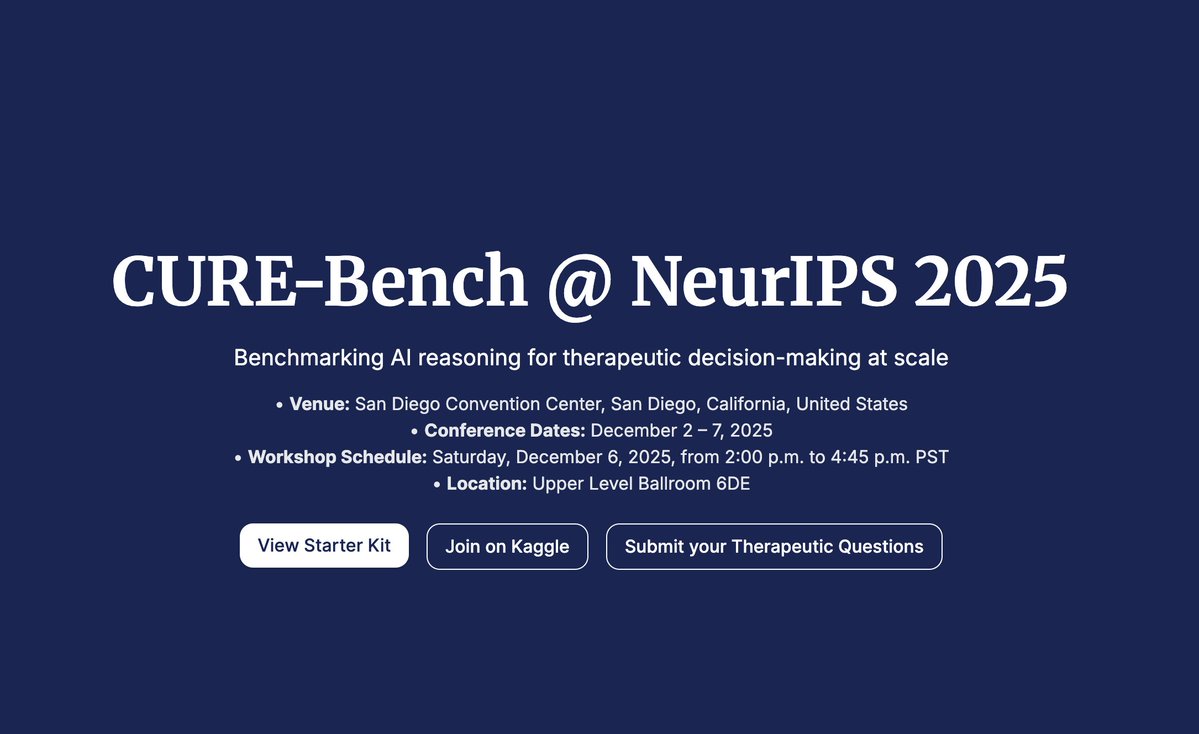
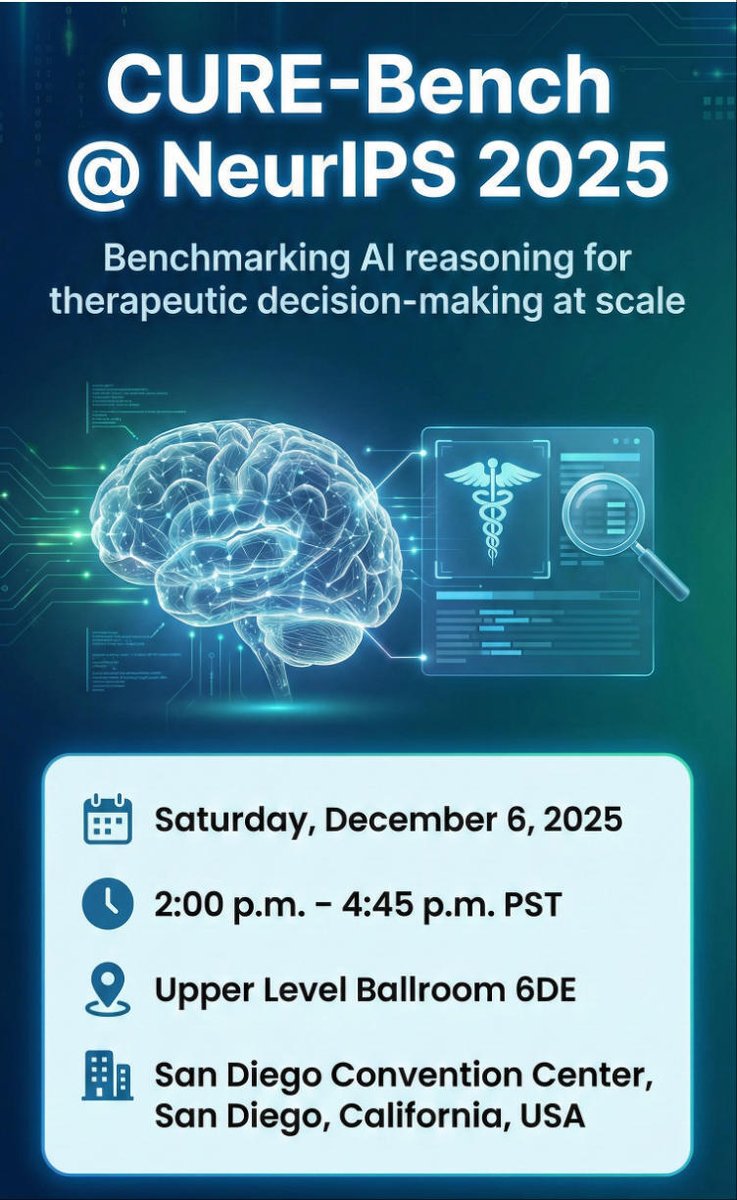
If you are at NeurIPS, join us tomorrow for the CUREBench Competition Workshop (https://t.co/GS4pi9KBGo) and see how @ScientistTools is driving large-scale evaluation and global benchmarking of AI models for therapeutics and precision medicine
@NeurIPSConf week
Sat, Dec 6
🔹 CUREBench - International Competition on AI agents and reasoning models for therapeutics at scale
https://t.co/HKw4IogWAR @GaoShanghua@ScientistTools@RichardYXZhu@sui67713@ZKong50693@xiaorui_su with a keynote by @AziziShekoofeh
Sun, Dec 7
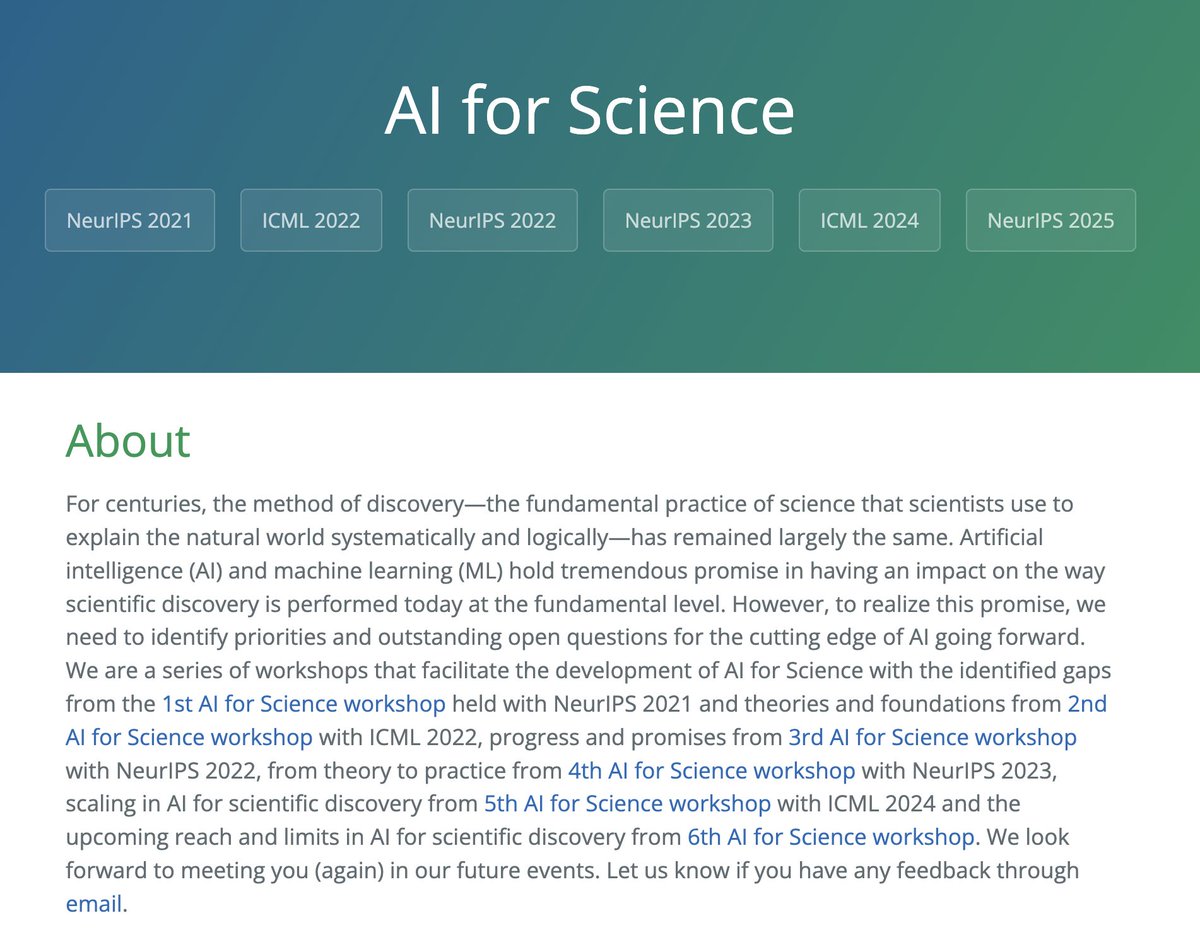
🔹 6th AI for Science NeurIPS Workshop – The Reach and Limits of AI for Scientific Discovery
https://t.co/iGxrLETH2I @AdaFang_
We started this workshop series in 2021, when @AI_for_Science was still niche. It is exciting to see how the community and the field have grown and how much potential there is to transform scientific discovery
Sat, Dec 6
🔹 AI Virtual Cells and Instruments – A New Era in Drug Discovery and Development
https://t.co/NjcVHJ82v4 @_michellemli
We are also presenting many papers throughout the week. Here is the first batch and more to follow throughout the week:
• A scalable data layer of knowledge graph AI: https://t.co/Qah2WmcbaI by Lucas Vittor, @ayushnoori@InakiArango, Joaquin Polonuer
• Multi-agent collaboration in knowledge graph environments: https://t.co/42C3ZzdAXE @ayushnoori@InakiArango
Lucas Vittor, Joaquin Polonuer
• Evolutionary reasoning in protein language models: https://t.co/GC4SM6O76t @YEktefaie
Kudos to all stellar students and many thanks to fantastic collaborators @HarvardDBMI@harvardmed@Harvard@broadinstitute@KempnerInst
1⃣ more day⌛️ to submit your exciting research to our #NeurIPS workshop on AI Virtual Cells and Instruments!
Submit an extended abstract & join our excellent lineup of presenters! 🌟
Please do not hesitate to reach out if you have any questions!
https://t.co/LR99zSxsuL
Pitch the dataset that could spark the next AI for Science revolution 🚀
The PDB revolutionized structural biology (and even helped win a🏅Nobel Prize in 2024). We’re hunting for the next breakthrough dataset that could unlock similar leaps across science—and we want your idea!
📣 Competition launch alert! CUREBench competition at @NeurIPSConf 2025
Start here: https://t.co/HKw4IogWAR
Benchmarking AI for therapeutic reasoning, drug discovery, treatment planning, and therapeutic decision-making
🎯 Track 1: Develop AI models that rely on parametric memory alone
🎯 Track 2: Build AI agents that use external tools and resources
🎯 Evaluation will be done by agentic judges and human disease experts, in collaboration with our partners @cziscience and @harvard
💰 $40,000 in prizes, Starter Kit, Travel Awards, and more
⏰ Entry deadline: October 15, 2025
A big thank you to our partners: @cziscience@MilkenInstitute@BiswasFamilyFdn@cziscience Rare as One program @harvardmed@BrighamWomens
Organized by an amazing team: @GaoShanghua@RichardYXZhu@ZKong50693@xiaorui_su@CurtGinder Sufian Aldogom, Ishita Das, Taylor Evans, Theo Tsiligkaridis. Big congrats to @GaoShanghua for spearheading this effort
@HarvardDBMI@harvardmed@KempnerInst@MIT@broadinstitute
🌍 Excited to open up our global evaluation of AI for drug decision-making and therapeutic reasoning @GaoShanghua
Want to shape the future of therapeutic AI, from understanding existing medicines to developing new treatments for diseases with limited options?
Start here: https://t.co/uCdmJV6waU
How you can participate:
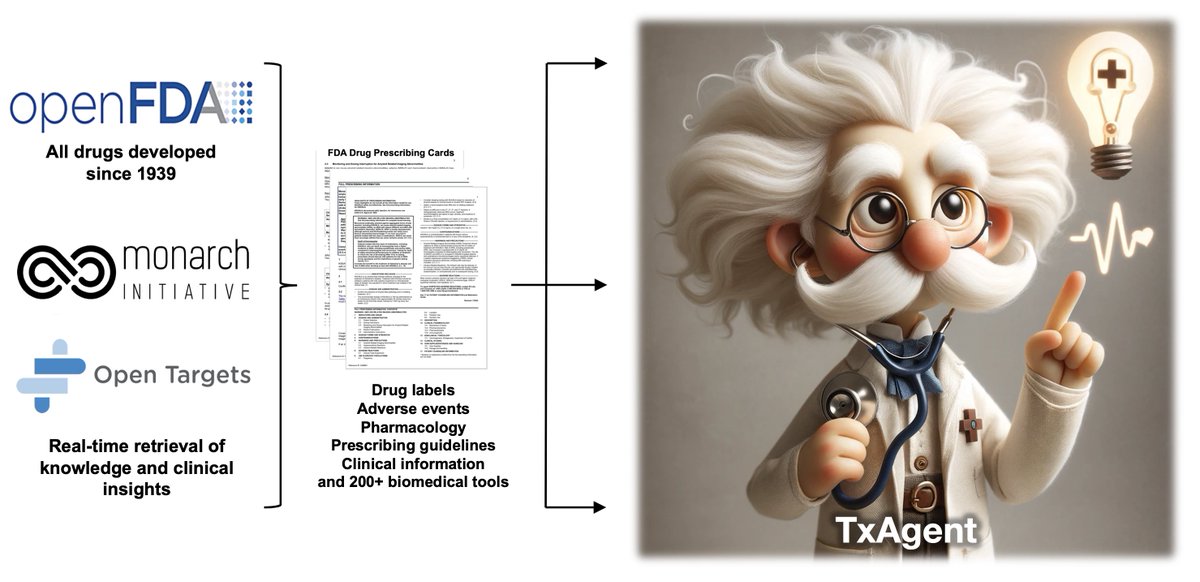
1️⃣ Evaluate TxAgent
Test-drive TxAgent, our AI built for therapeutic reasoning across all drugs since 1939, powered by a universal toolbox of 200+ tools. Assess its reasoning on accuracy, clinical relevance, drug safety, and more, each evaluation takes ~10 minutes.
Learn about TxAgent: https://t.co/tvn5L2vZZ0 and https://t.co/7YXZtmfjBP
2️⃣ Challenge the AI
Submit your toughest therapeutic questions: rare diseases, unmet patient needs, or how to safely extend existing treatments, including combination therapies and personalized treatments. Help build an open library of challenges and shape smarter biomedical AI
@GaoShanghua@ZKong50693@RichardYXZhu@xiaorui_su@CurtGinder Sufian Aldogom
Thanks to our many partners:
@HarvardDBMI@harvardmed@Harvard@KempnerInst@harvard_data@MIT@broadinstitute@BrighamWomens@MilkenInstitute@BiswasFamilyFdn@cziscience
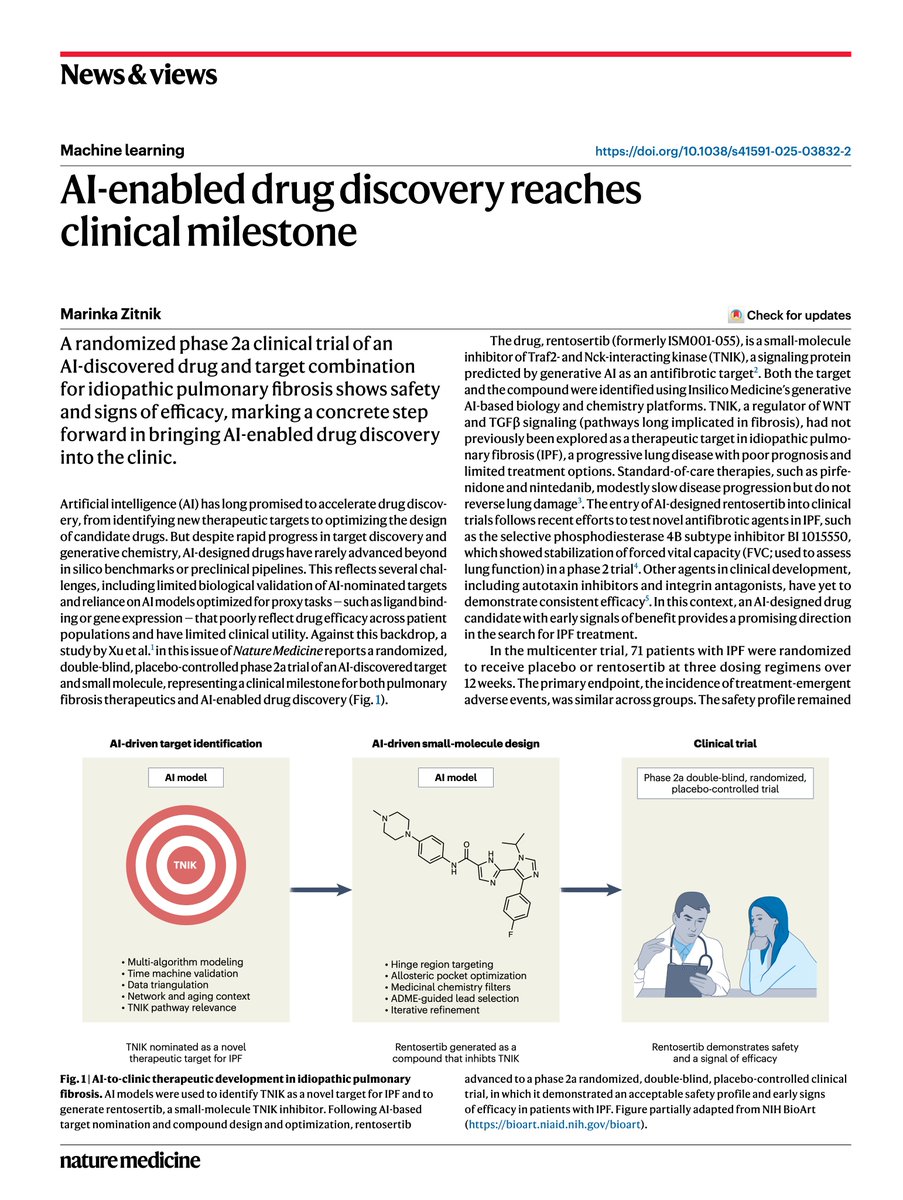
📢 AI-enabled drug discovery reaches clinical milestone
https://t.co/noHOTVFo2a
Few AI-designed drug candidates have gone beyond in silico benchmarks. Now, a study in @NatureMedicine@biogerontology reports a successful phase 2a trial of rentosertib, an AI-discovered drug and target combination for idiopathic pulmonary fibrosis
What distinguishes this study (in addition to clinical data) is the upstream innovation pipeline
This trial marks a turning point: it affirms a potential for AI to do more than generate molecules faster and cheaper; guide discovery, de-risk development and potentially reshape how we develop medicines
A pertinent question is: why did this AI-generated drug candidate advance to clinical testing when so many others have not?
🎯 Cross-disease target discovery and 'time-machine' setup: AI models trained on past data predicted therapeutic targets years ahead of traditional methods, pinpointing TNIK as a promising target
🔬 Robust biological validation: Integrated multi-omic analyses, network biology, and extensive literature mining rapidly validated TNIK’s biological relevance for fibrosis
⚙️ Chemistry design: Generative AI models designed molecules targeting novel binding sites, prioritized drug-likeness and synthetic feasibility, and proactively optimized pharmacokinetics and potency from early stages
@biogerontology@InSilicoMeds@HarvardDBMI@Harvard@harvardmed@harvard_data@KempnerInst@broadinstitute
🔍 Call for Reviewers: AI4D3@NeurIPS 2025
We're seeking experts in AI & drug discovery to review submissions for our NeurIPS workshop.
🗓️ Deadline: May 30, 2025
📍 Workshop: Dec 2025, San Diego
✅ Sign up: https://t.co/VDZIKa6i2I
#AI4D3#NeurIPS2025#DrugDiscovery#AI
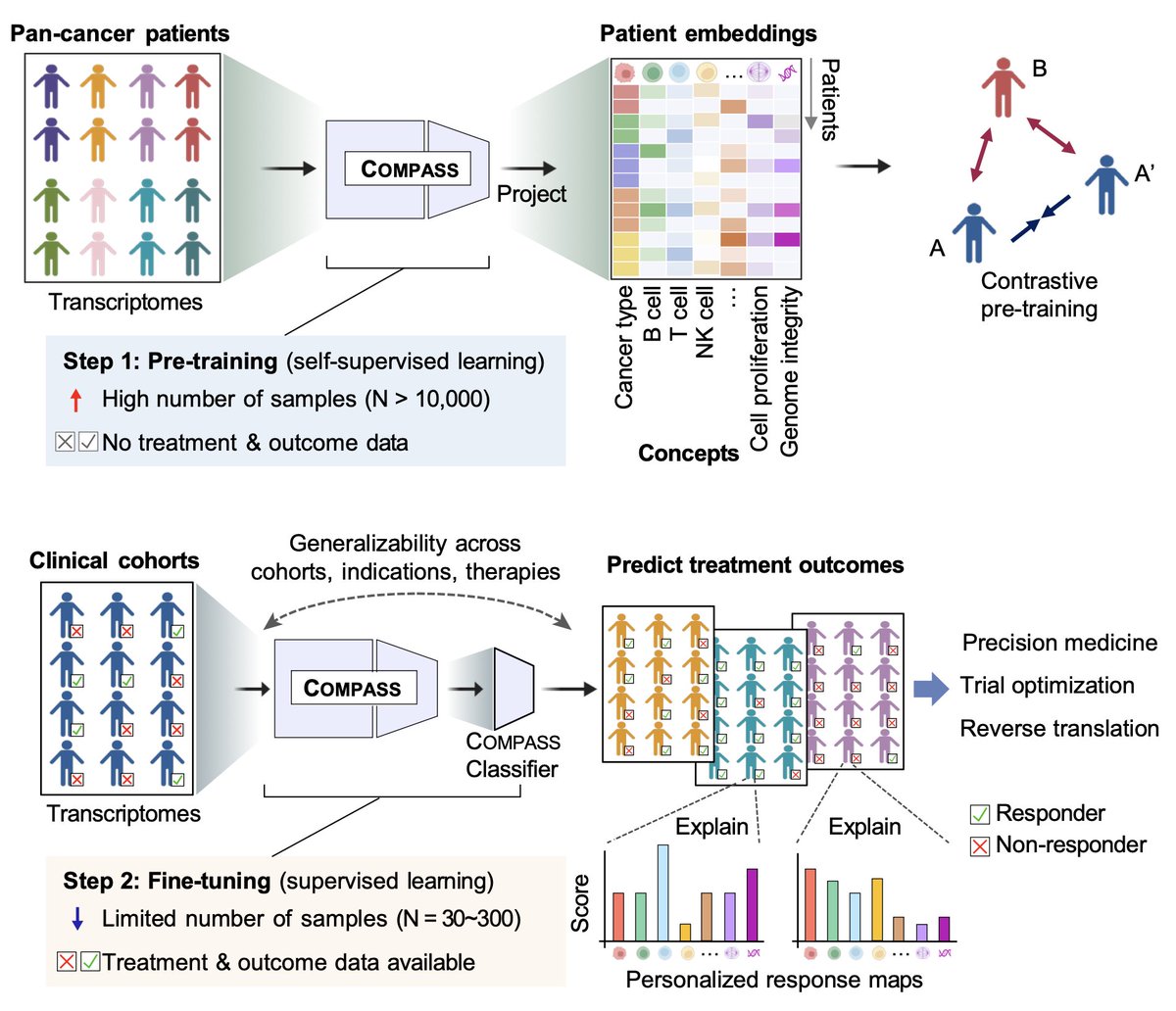
📢 🧬 New preprint!
Can we predict which cancer patients will benefit, before treatment begins? @WanXiang_Shen
Immunotherapy saves lives but many patients don’t respond to treatment, and we still lack reliable tools to predict who will benefit
We introduce COMPASS, foundation AI model for immunotherapy response prediction across cancers and treatments
https://t.co/CniHfrrtCW
https://t.co/Ftty4ZfBYi
https://t.co/vFHtRYUJuh
@HarvardDBMI@harvardmed@KempnerInst@harvard_data@broadinstitute@Harvard
Thanks to incredible team @WanXiang_Shen Thinh H. Nguyen @_michellemli @YepHuang @IntaeMoon Nitya Nair Daniel Marbach
🧵👇
New in the Kempner's Deeper Learning blog: @AdaFang_ and @marinkazitnik introduce ATOMICA, a geometric foundation model that enables reasoning about biological systems with atom-level precision.
https://t.co/CD03DhMt6A #AI#ML#MedTech
ATOMICA characterizes interesting clusters of putative bacterial zinc fingers and cytochrome proteins.
We're working on getting some of these validated in the lab 🧫👩🔬. Stay tuned!
Using masked token accuracy to proxy representation quality, we see training of ATOMICA follows scaling laws where representation quality improves with increasing biomolecular data modalities 📈
ATOMICA builds multi-scale representations at the atom, block (amino acid / nucleotide / common chemical motif), and interaction complex scale.
💡 The key is capturing *interaction complexes* - to learn patterns fundamental to chemistry, such as hydrogen bonds & pi-pi stacking.
Introducing ATOMICA 💫
A model to universally represent molecular interactions (for proteins, nucleic acids, small molecules, and ions) at an all-atom scale 🧵
DBMI's @zakkohane & @marinkazitnik, plus @AdamRodmanMD & other collaborators, on how AI is transforming medicine. “Having an instant second opinion... will change, for the better, the nature of the doctor-patient relationship.” https://t.co/rBRWMoANQu