I’m thrilled to share that our paper, “Machine learning for genetics-based classification and treatment response prediction in cancer of unknown primary (CUP)”, has been published in Nature Medicine today! https://t.co/AWNaF8Z78n
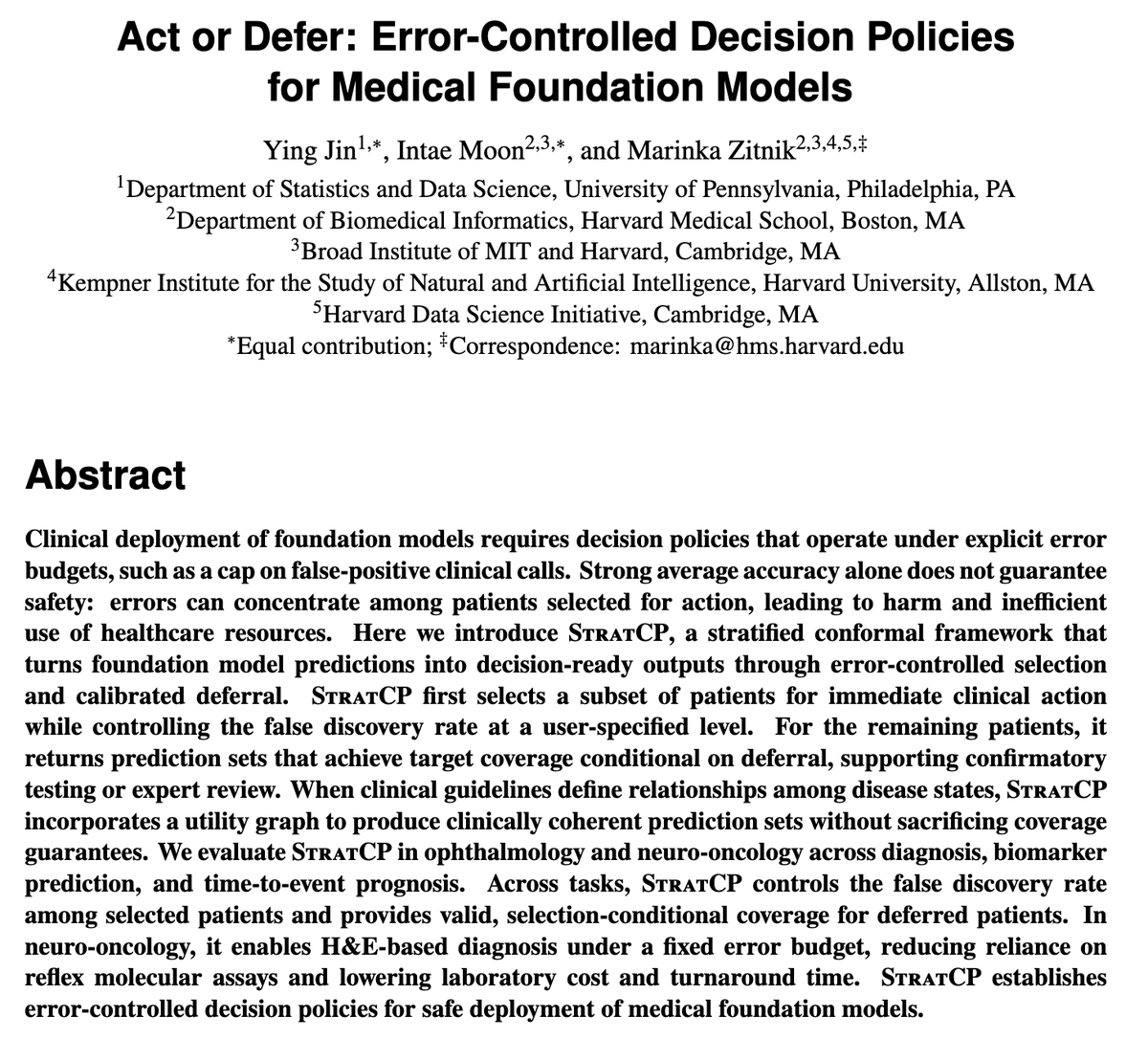
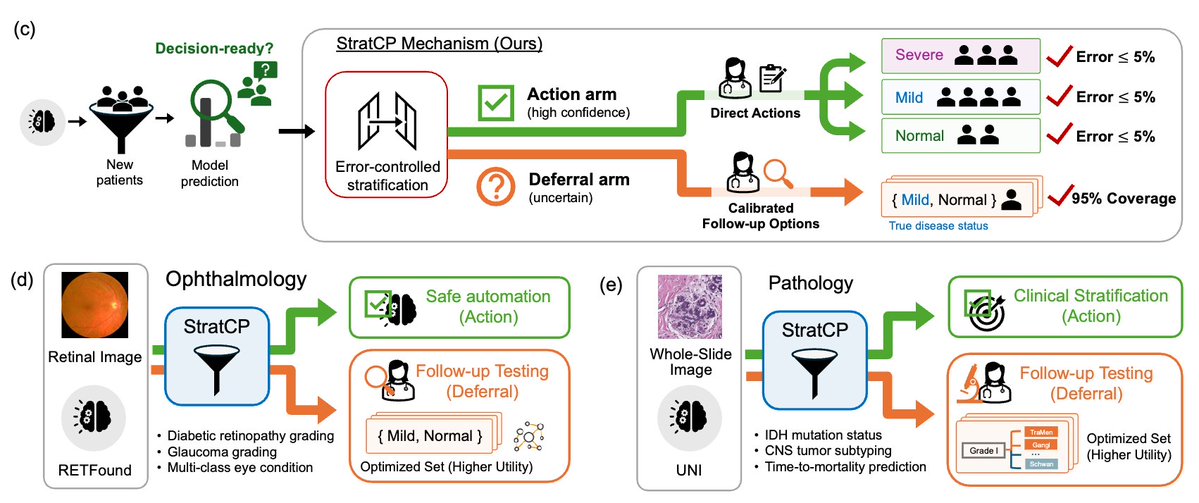
Average accuracy of medical foundation models does not answer the operational question: Is this prediction reliable enough to act on for this patient, now? And what if not? This requires not only uncertainty quantification for AI predictions, but also mechanisms to turn UQ into actionable decisions.
📢 Excited to share StratCP, a two-step conformal inference mechanism that decides when to act/defer, and what to do next for deferred cases, given any AI model. https://t.co/qwFbDKU0a5
StratCP has two stages:
✅Action arm: Selects "correct" predictions for immediate action with error control (e.g., 5%).
❓Deferral arm: Returns prediction sets that contain the true disease status for most (e.g., 95%) of uncertain cases to guide confirmatory testing or expert review.
StratCP enables identifying
- 🎯 Accurate AI disease classification,
- ❤️🩹 Long survivors based on time-to-event predictions,
- 🧬 Rapid H&E-based AI diagnoses that can safely bypass costly genomics tests, and
- 🩺 Suggest clinically coherent candidate labels
A fun collaboration with the amazing @marinkazitnik@IntaeMoon ! #uncertainty #AI #conformalprediction #medicalAI #reliableAI
📢 🧬 New preprint!
Can we predict which cancer patients will benefit, before treatment begins? @WanXiang_Shen
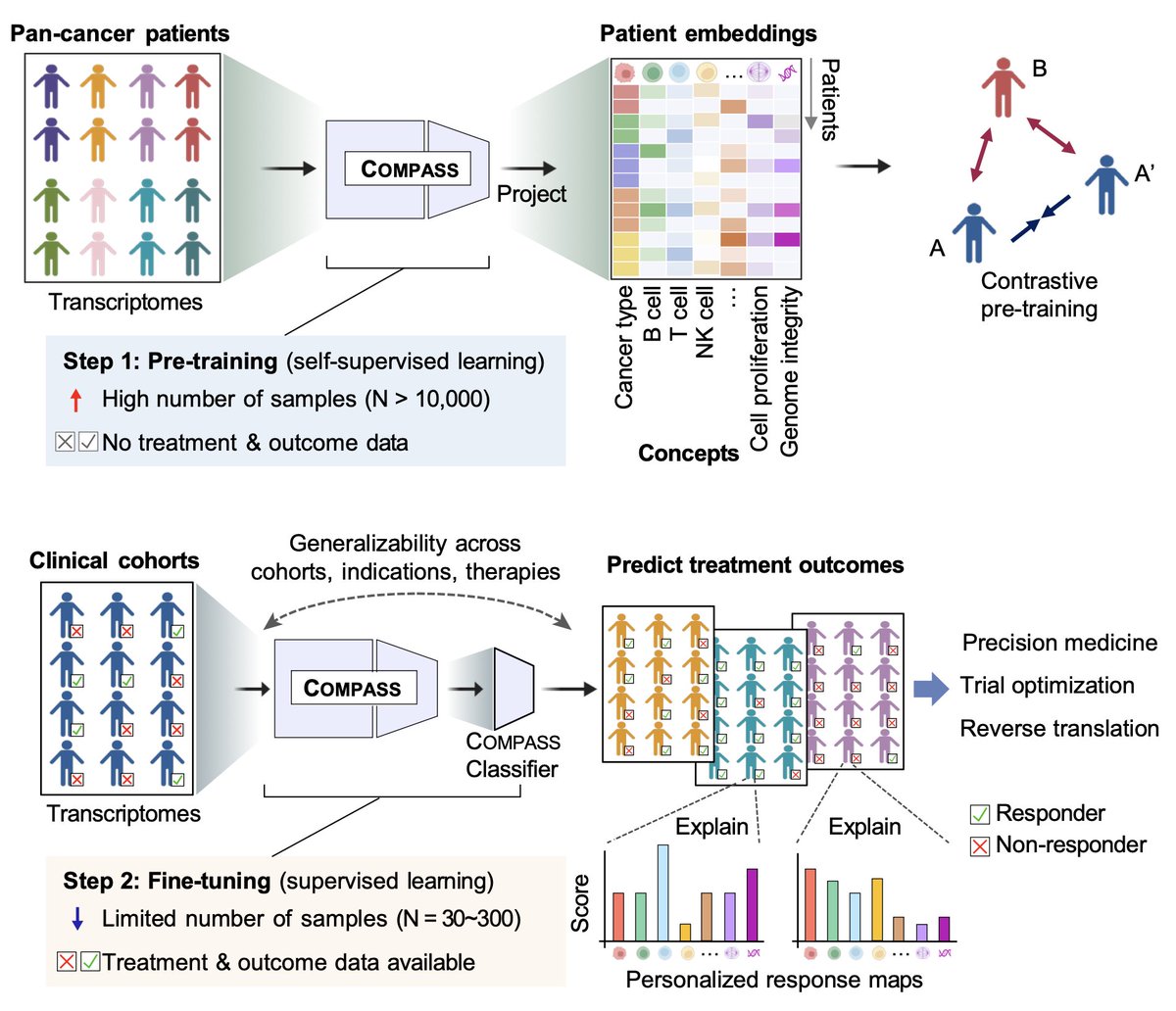
Immunotherapy saves lives but many patients don’t respond to treatment, and we still lack reliable tools to predict who will benefit
We introduce COMPASS, foundation AI model for immunotherapy response prediction across cancers and treatments
https://t.co/CniHfrrtCW
https://t.co/Ftty4ZfBYi
https://t.co/vFHtRYUJuh
@HarvardDBMI@harvardmed@KempnerInst@harvard_data@broadinstitute@Harvard
Thanks to incredible team @WanXiang_Shen Thinh H. Nguyen @_michellemli @YepHuang @IntaeMoon Nitya Nair Daniel Marbach
🧵👇
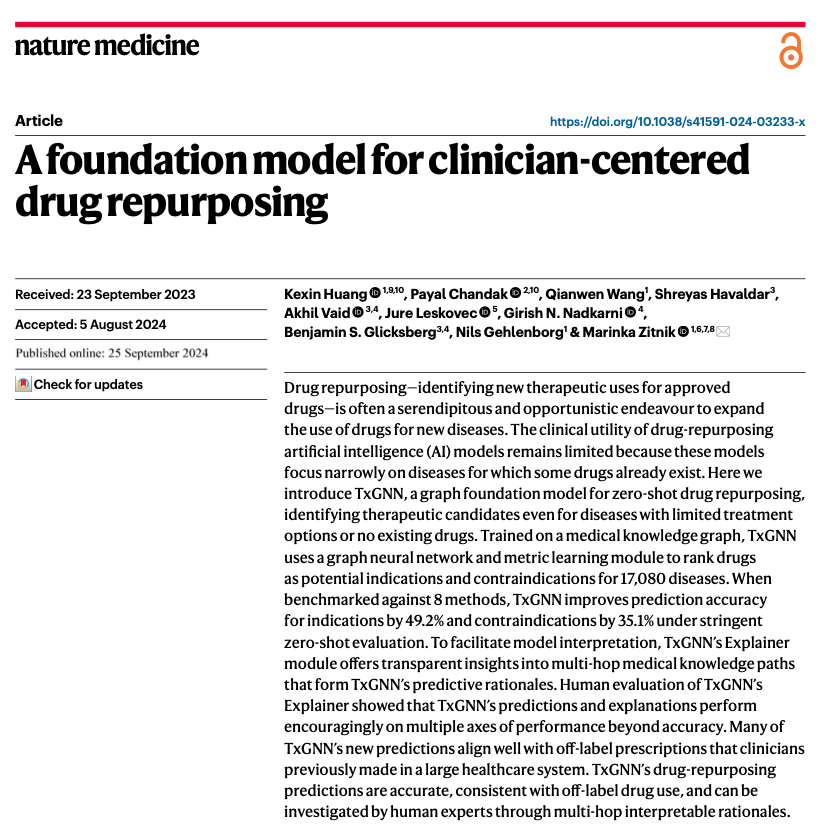
Excited to share TxGNN, a model that identifies potential therapies from existing medicines for thousands of diseases. Trained across 17,080 diseases, TxGNN predicts drug candidates for conditions with limited or no treatment options, including rare diseases
@NatureMedicine paper: https://t.co/TZcKGqjSba
Globally, there are over 7,000 rare and undiagnosed diseases, yet only 5 to 7 percent have treatments, leaving the majority untreated or undertreated. Even for more common diseases, new drugs could offer alternatives with fewer side effects or replace drugs that are ineffective for certain patients
TxGNN generates new insights on its own in the form of multi-hop interpretable rationales, applies them to diseases it was not trained for, and offers explanations for its predictions
Human evaluation showed that TxGNN's predictions perform well across multiple axes of performance
Many of TxGNN's predictions align with off-label prescriptions used in a large healthcare system
Many thanks to a fantastic research team @KexinHuang5@payal_chandak@WangQianwenToo@_toolazyto_@AkhilVaidMD@jure@girish_nadkarni@BenGlicksberg@HarvardDBMI@harvardmed@KempnerInst@harvard_data@broadinstitute@cziscience@harvardmed News and Gazette: https://t.co/xpr28o3n0n Thanks @EkaterinaPeshev
In case you missed it: @MarzyehGhassemi (@MIT_IMES,@MITEECS) and Alexander Gusev (@DanaFarber) comment on limiting bias in AI models for improved and equitable cancer care.
Check it out: https://t.co/ypidFxVJZP
I'm excited to share our panel sequencing-based cancer type prediction and visualization tool (https://t.co/AJW9G1zvi8), based on our recent @NatureMedicine publication (https://t.co/Ndls4R612S)! Learn more by checking out our short tutorial.
As panel sequencing increasingly becomes a routine part of care, we hope our work helps advance precision oncology for challenging cancer cases. Shoutout to MIT undergrad @JenniferZh23211 for her excellent implementation efforts, and to PI @SashaGusevPosts for guidance!
I am tremendously excited to announce that my work on 3D computational pathology has been published in @CellCellPress !! 🥰🎉
This has been truly a wonderful journey for the past few years. I really want to thank my wonderful mentors Professors @AI4Pathology and @jonliu123
I'm hiring a postdoc at @UVA to edit and detoxify LLMs!
This is an exciting opportunity to join a vibrant research community and to collaborate with @StevenLJohnson and @MaartenSap
Feel free to get in touch and please help spread the word!
https://t.co/bcqFFWvm0g
Decades of hard work has gone into making commercial aviation shockingly safe.
What lessons can we draw to plan ahead for safe and reliable deployments of AI for Health?
Check out our new paper at #EAMMO2023!✈️
https://t.co/XsG4uX7vlB
Super excited to see our review paper on AI for computational pathology finally out!! We provide an extensive coverage of how AI has and will shape the field of pathology.
Such a fun experience with my co-author @GuillaumeJaume, and @AI4Pathology
Link: https://t.co/yDoXl9qvZe
Excited to present UNI - a general-purpose self-supervised visual model for #CPath pretrained using 100M+ images across 100K+ WSIs!
Co-led with @TongDing99@MYLu97 @DFKW_MD @AI4Pathology@harvardmed
Summary: https://t.co/roQbwnwXX2
Preprint: https://t.co/BZYW44kZxp
1/
I’m thrilled to share that our paper, “Machine learning for genetics-based classification and treatment response prediction in cancer of unknown primary (CUP)”, has been published in Nature Medicine today! https://t.co/AWNaF8Z78n
A huge thanks to my PI, @SashaGusevPosts , for his invaluable support and mentorship, and to our exceptional clinical collaborators at DFCI: Jaclyn LoPiccolo, @SylvanBacaLab, @lmsholl, @kenlkehl, Michael Hassett, @dliu_ccb, and Deborah Shrag!
CUP accounts for 3–5% of all cancers and has very poor outcomes due to limited treatment options. Our study showed that CUP tumors share genetic and prognostic characteristics with known cancer types and may benefit from treatments guided by genetics-based classification.
A significant challenge in cancer diagnosis in not knowing the primary site of origin in 3-5% of patients. That's changing with #AI, along with the ability to come up with an accurate prognosis
https://t.co/hLqn93XbqE
@NatureMedicine@DanaFarber@IntaeMoon@MITEECS & colleagues