⚠️ Limited seats remaining for MLx Representation Learning & Generative AI at Oxford Maths Institute + Online (15–18 July).
Join leading researchers and practitioners exploring frontier models, scaling laws, modern architectures, generative AI systems, representation learning, and AI products.
Some of the Featured Lectures:
Why formalize mathematics— Kevin Buzzard (Imperial College London)
Intelligent Data Gathering— Tom Rainforth (University of Oxford)
Multi-Robot and Multi-Agent Learning— Amanda Prorok (University of Cambridge)
Embodied Multimodal Intelligence with Foundation Models— Oier Mees (Microsoft)
Multimodal AI— Paul Liang (MIT)
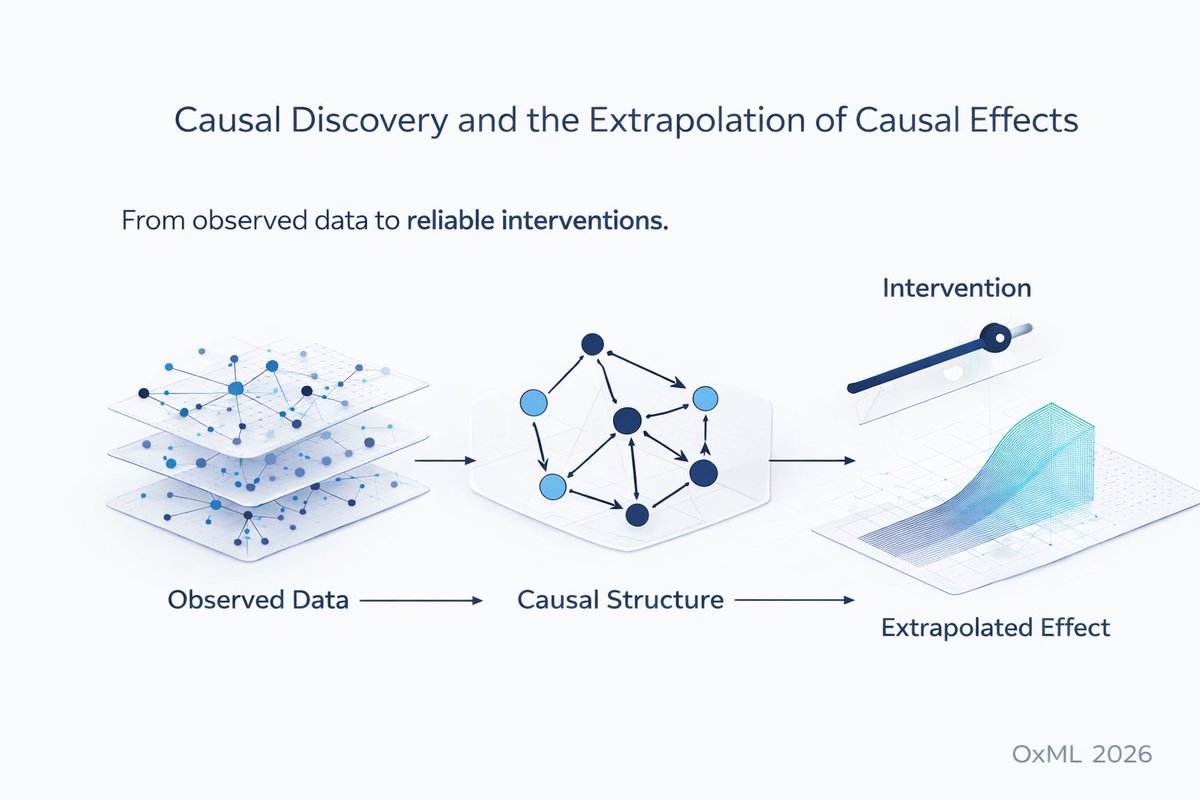
On Causal Discovery and the Extrapolation of Causal Effects— Ricardo Silva (UCL)
A theoretical view with Arena's data—Peter Gostev (Arena AI)
Petar Veličković (Google DeepMind)
Fazl Barez (University of Oxford)
Tim Rocktäschel (UCL)
Alexander Tong (Aithyra)
Tony Feng UC Berkeley
Register now before seats fill up.
https://t.co/4k5K5w4kRq
@FazlBarez@AlexanderTong7@_rockt@petergostev@pliang279@oier_mees@aprorok@tom_rainforth
#MachineLearning #GenerativeAI #RepresentationLearning #AI #OxML
We are delighted to welcome Prof. Tim Rocktäschel (UCL and Co-Founder of
Recursive Superintelligence) to OxML 2026 🙌
Tim’s work spans world models, representation learning, open-endedness, self-improving AI systems, grounded language understanding, and automated scientific discovery — all central directions in the future of AI.
This will be a particularly exciting session at OxML 2026, taking place this July in Oxford.
⌛ Registration deadline: 22 May
👉 https://t.co/scc2YpFduY
@GlobalGoalsAI
#OxML2026 #AI #MachineLearning #WorldModels #RecursiveSuperintelligence
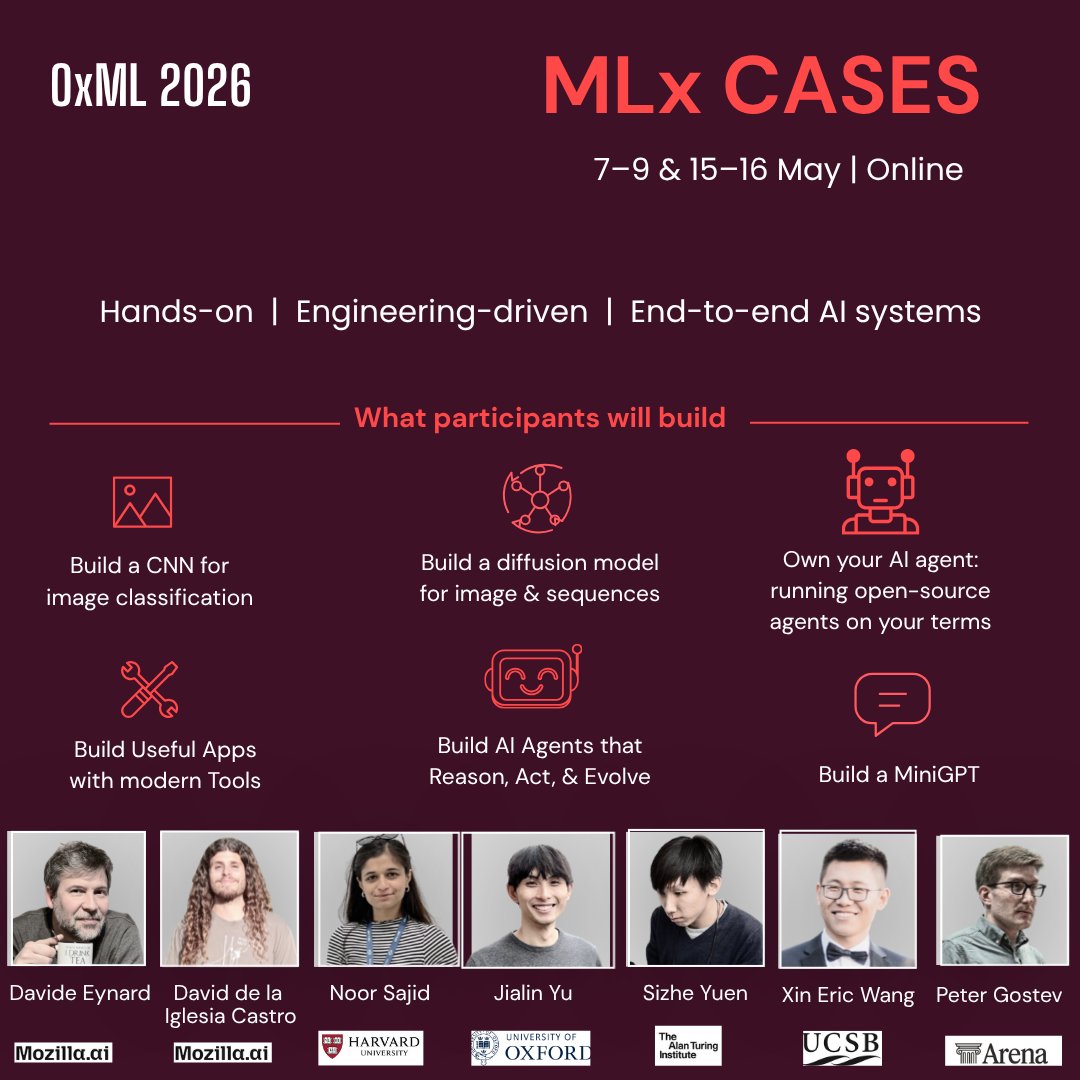
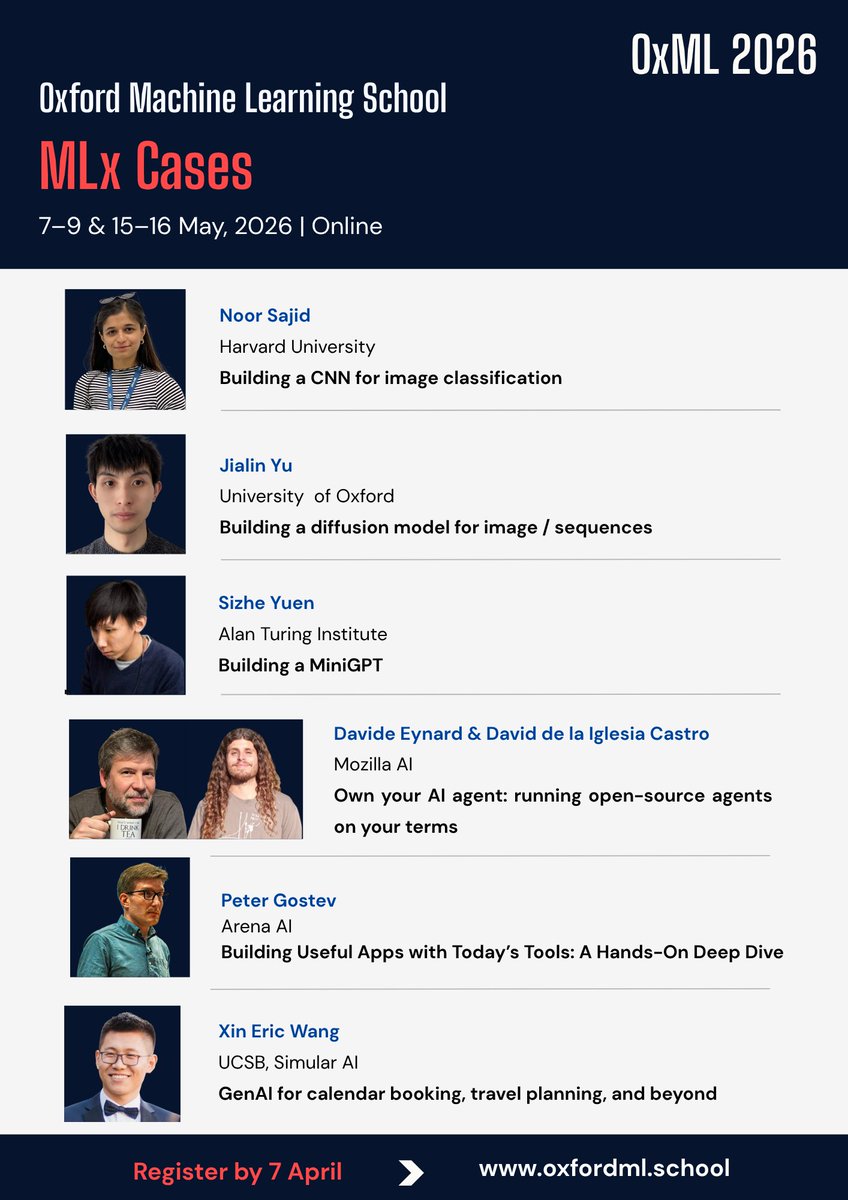
Today we begin MLx Cases at OxML 2026.
A hands-on, engineering-driven module focused on building real end-to-end AI systems — from CNNs and diffusion models to MiniGPT, open-source agents, and AI systems that reason, act, and evolve.
At a time when the hardest problems in AI increasingly sit around the model, this is exactly the kind of practical training that matters.
Looking forward to a great module with an outstanding group of instructors and participants.
#OxML2026 #OxML #MachineLearning #AI #ML
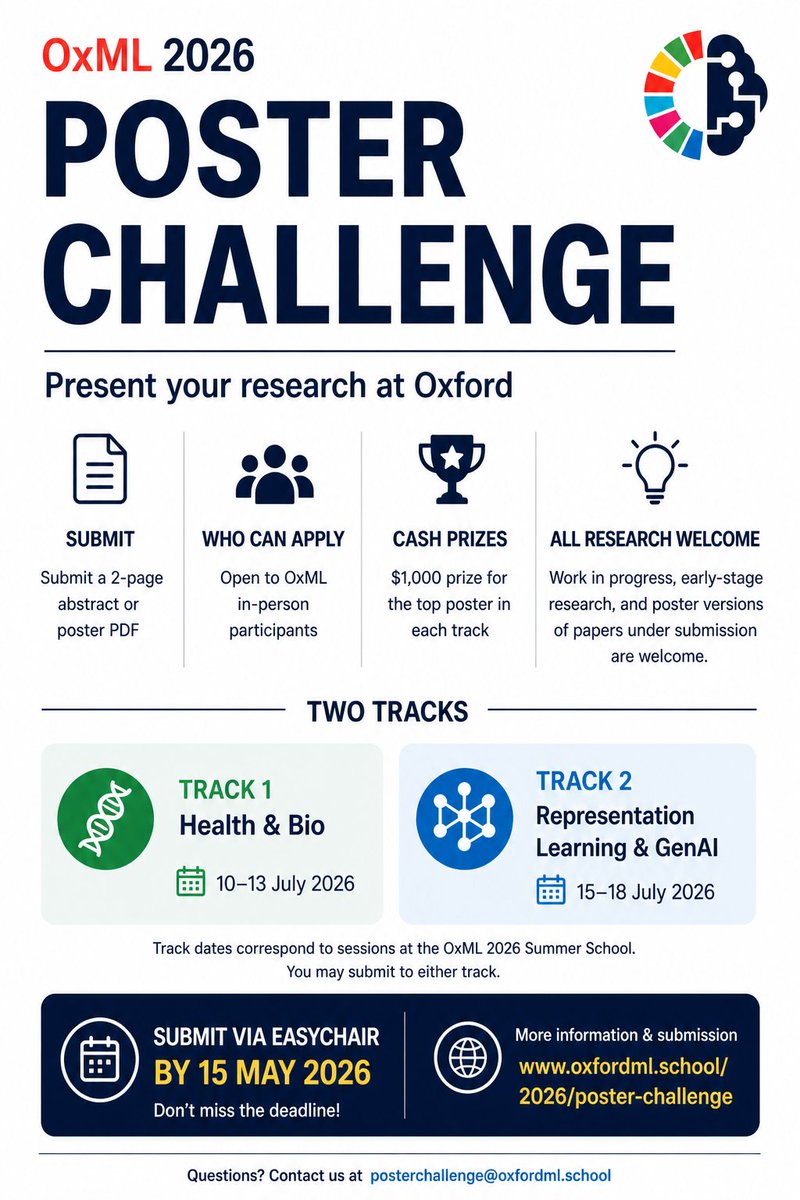
⏳ CALL FOR SUBMISSIONS
The deadline for the OxML 2026 Poster Challenge is fast approaching — don’t miss your chance to present your research in Oxford this July.
Whether it’s early-stage work, ongoing research, or a paper in progress, we welcome submissions across both tracks:
MLx Health & Bio (10–13 July)
MLx Representation Learning & GenAI (15–18 July)
$1,000 prize for the top poster in each track
Open to all in-person OxML participants
Submit by 15 May 2026 via EasyChair
This is your opportunity to share your work, get feedback from leading researchers, and connect with a global ML community.
👉 Apply now: https://t.co/cMbloY2x3S
#OxML2026 #MachineLearning #AIResearch #PosterChallenge #GenAI #HealthAI #AcademicResearch
⏳ Last call for MLx Cases — registration closes tomorrow, 24 April.
One of the clearest shifts in AI right now is that, in many domains, the hardest problems sit around the model: evaluation, multi-step system behaviour, tool use, constraints, and surfacing failure modes early.
These are the skills that increasingly differentiate strong ML practitioners.
That is exactly why MLx Cases matters. It is the most practical module of OxML 2026: hands-on, engineering-driven, and focused on building real end-to-end AI systems.
If you want to move beyond models and notebooks to building systems that actually work in practice, this is a very valuable module.
📅 Register by tomorrow, 24 April:
👉 https://t.co/ugGdoKJs7O
#OxML2026 #OxML #MachineLearning #AI #DeepLearning #GenerativeAI #MLx #DataScience
🚨 Limited slots left for OxML 2026 – MLX Cases
MLX Cases is a hands-on, engineering-driven track designed to help you go beyond theory and actually build end-to-end AI systems from scratch.
Over two intensive weekends, you’ll work through practical case studies covering:
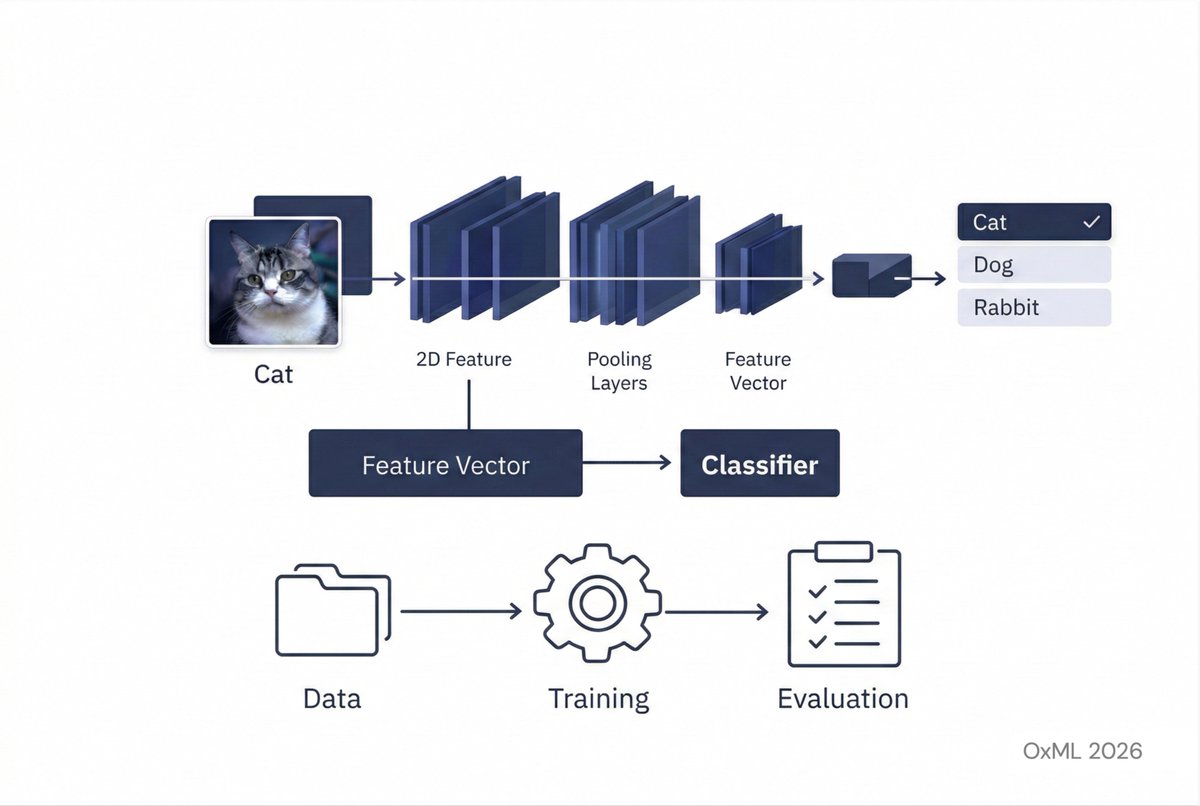
• Training CNNs for image classification
• Building diffusion models for images and sequences
• Implementing a MiniGPT
• Designing and running your own open-source AI agent
• Creating real-world GenAI applications (travel planning, scheduling, and more)
This is not just about learning concepts — it’s about understanding how modern AI systems are engineered, deployed, and made useful in practice.
You’ll learn directly from experts across industry and academia, and leave with working systems and a deeper intuition for how everything fits together.
📅 7–9 & 15–16 May | Online
👉 Register now: https://t.co/4k5K5w4kRq
David de la Iglesia Castro, Davide Eynard, Noor S., Xin Eric Wang, Peter Gostev, Jialin Yu, Sizhe Yuen
Yali Du, Mona Alinejad, D.Phil. (Oxon), Reza Khorshidi, D.Phil. (Oxon)
Oxford Internet Institute, University of Oxford, Oxford Women in Engineering Network
#MLxCases #OxML #AI2026 #AIProduct #ML #minigpt #CNN #AIAgent
@petergostev@xwang_lk@aittalam@Harvard@UniofOxford@turinginst
@nsajidt
📣 From models to real-world impact — build, deploy, and scale.
MLx Cases at the Oxford Machine Learning School (OxML 2026) is designed for those who want to go beyond theory and actually build—from CNNs and diffusion models to AI agents and production-ready apps.
Hands-on. Practical. Cutting-edge.
If you're ready to turn ideas into working AI systems, this is where it happens.
7–9 & 15–16 May 2026 | Online
Register by 7 April
Speakers:
Noor Sajid (Harvard University) – Building a CNN for image classification
Jialin Yu (University of Oxford) – Building a diffusion model for images/sequences
Sizhe Yuen (The Alan Turing Institute) – Building a MiniGPT
Davide Eynard & David de la Iglesia Castro (Mozilla AI) – Own your AI agent: open-source agents on your terms
Peter Gostev (Arena AI) – Building useful apps with today’s tools
Xin Eric Wang (niversity of California, Santa Barbara & Simular AI) – GenAI for calendar booking, travel planning & beyond
Build real systems. Learn by doing. Join a global community pushing AI forward. www. https://t.co/J3cctNP8dX
#OxML2026 #MachineLearning
#GenerativeAI #AIEngineering #DeepLearning #AIApplications
@petergostev@xwang_lk@aittalam@Harvard@UniofOxford@turinginst @nsajidt
Yali Du, Mona Alinejad, D.Phil. (Oxon), Reza Khorshidi, D.Phil. (Oxon)
A major frontier in AI is its growing role in scientific discovery.
At #OxML 2026, Prof. Christopher Bishop will discuss how AI can accelerate discovery, from fast emulators trained on synthetic data to new approaches across biology, healthcare, chemistry, & physics
@MSFTResearch
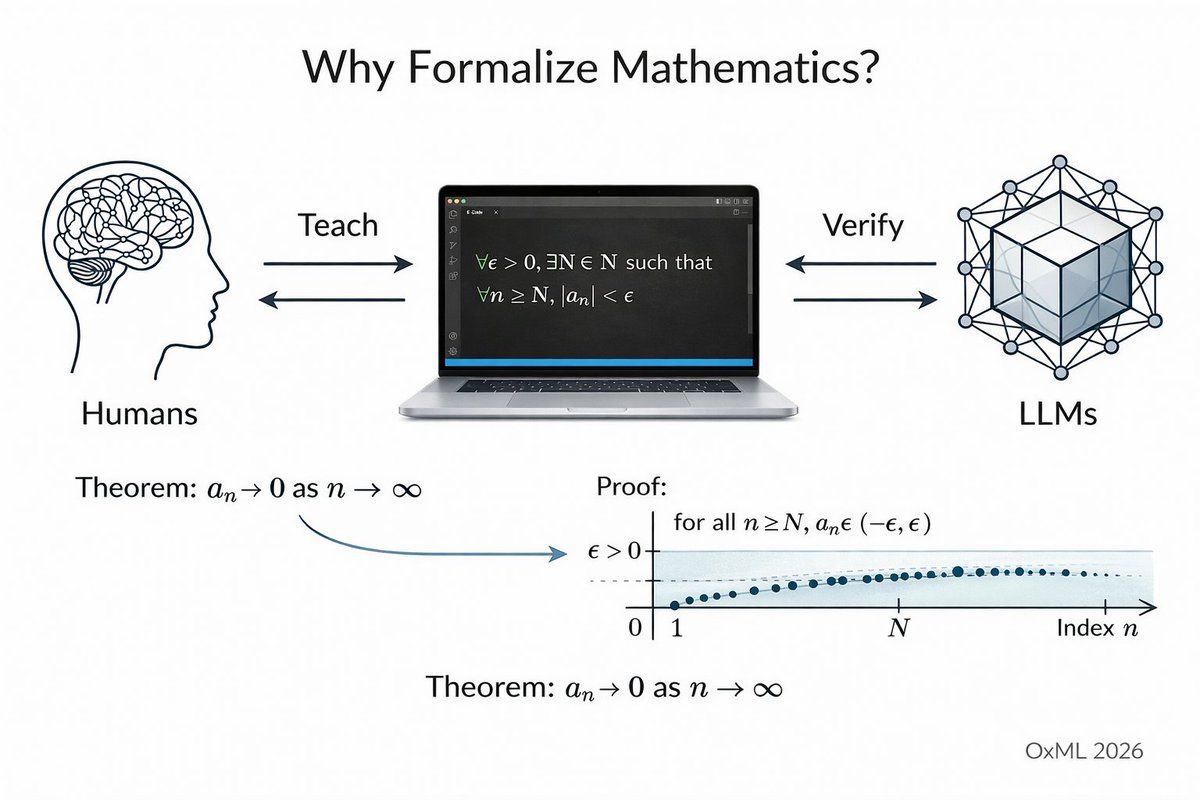
Why formalise mathematics?
As humans & LLMs get better at teaching maths to computers, the implications for verification & discovery are growing fast.
At OxML 2026, Prof. Kevin Buzzard will explore why this matters.
👉https://t.co/B7ubq8XCoX
#OxML#AIforMaths, @imperialcollege
Speaker Announcement:
We’re excited to welcome Amanda Prorok (University of Cambridge) to the MLx Representation Learning & Generative AI track this July in Oxford.
Her lecture on Multi-Robot and Multi-Agent Learning will explore:
• Introduction to multi-robot and multi-agent problems
• Learning to synthesize cooperative behaviors and interaction strategies
• Tackling computationally hard multi-agent challenges through learning
Join us at MLx Representation Learning & Generative AI — July 2026, Oxford.
📌 Plus, don’t miss the opportunity to present your research in our Poster Challenge.
Register now: https://t.co/4k5K5w4kRq
#OxML #MachineLearning #GenerativeAI #MultiAgentSystems #Robotics #AIResearch #Oxford #AICommunity @aprorok@Cambridge_Uni
A major frontier in AI is not just making single systems more capable, but understanding how agents learn, coordinate, and act together.
At OxML 2026, we'll explore multi-robot and multi-agent learning, from cooperative behaviours to hard coordination problems in the real world.
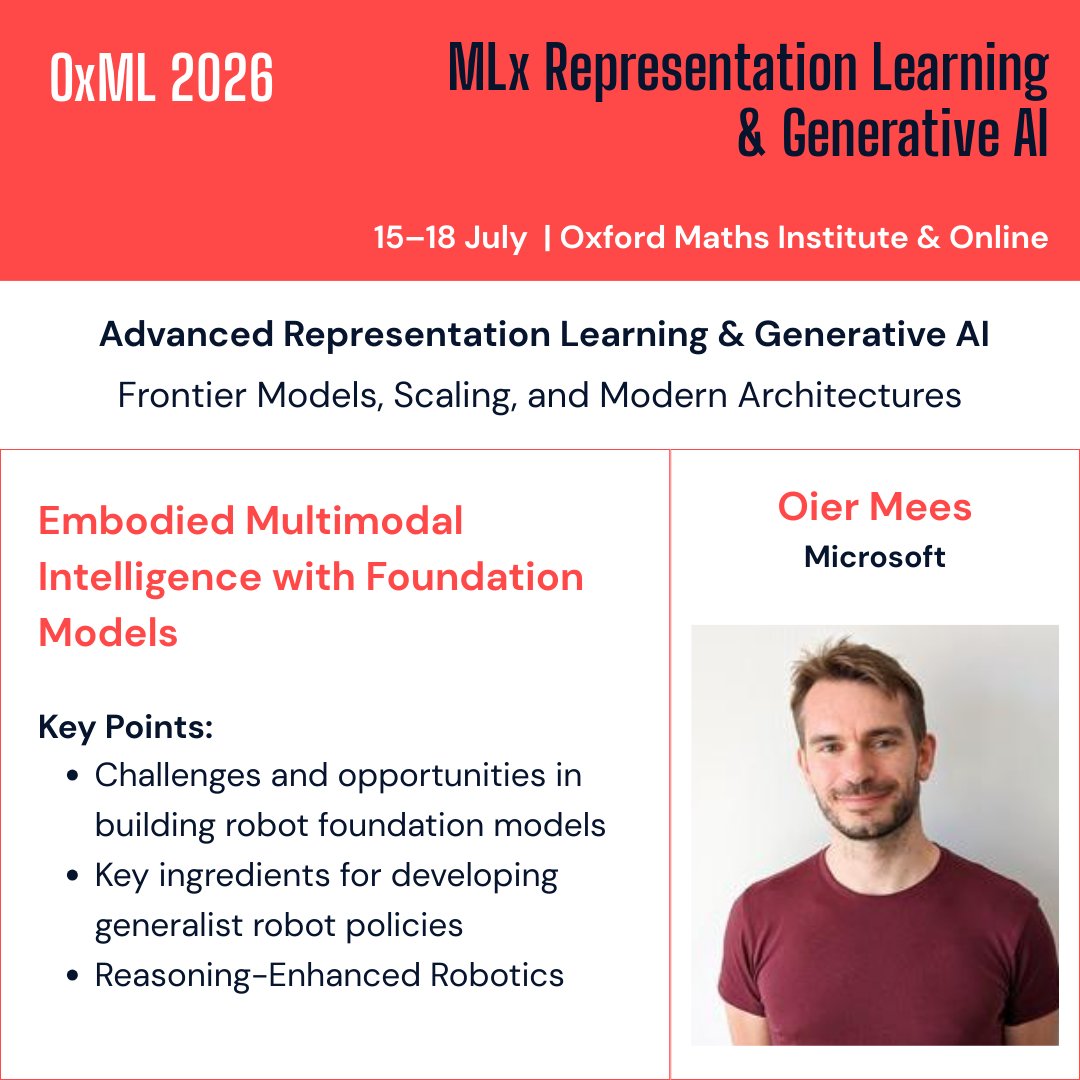
Explore how AI systems can perceive, reason, and act in the real world.
Join Oier Mees (Microsoft, ETH Zürich) for a deep dive into Embodied Multimodal Intelligence with Foundation Models, where vision, language, and action come together to shape the next generation of intelligent agents.
MLx Representation Learning & Generative AI
University of Oxford Mathematics
Discover how foundation models are moving beyond text and images into real-world interaction.
Secure your place: https://t.co/yW3jFwDCpB
In-person seats are limited. Register by 22 May 2026.
#OxML #MultimodalAI #RepresentationLearning #FoundationModels #Robotics
@oier_mees@Microsoft@ETH_en@OxUniMaths
One of the most important frontiers in AI is turning foundation models into systems that can perceive, reason & act in the real world.
At #OxML 2026, we'll explore embodied multimodal intelligence, generalist robot policies & reasoning-enhanced robotics.
https://t.co/NsctmOnHAu
Causal inference becomes much harder when the structure is uncertain.
Estimating effects from off-policy data is not enough on its own.
At #OxML 2026, Prof. Ricardo Silva (@ucl) will explore causal discovery and the extrapolation of causal effects.
👉https://t.co/NsctmOnHAu
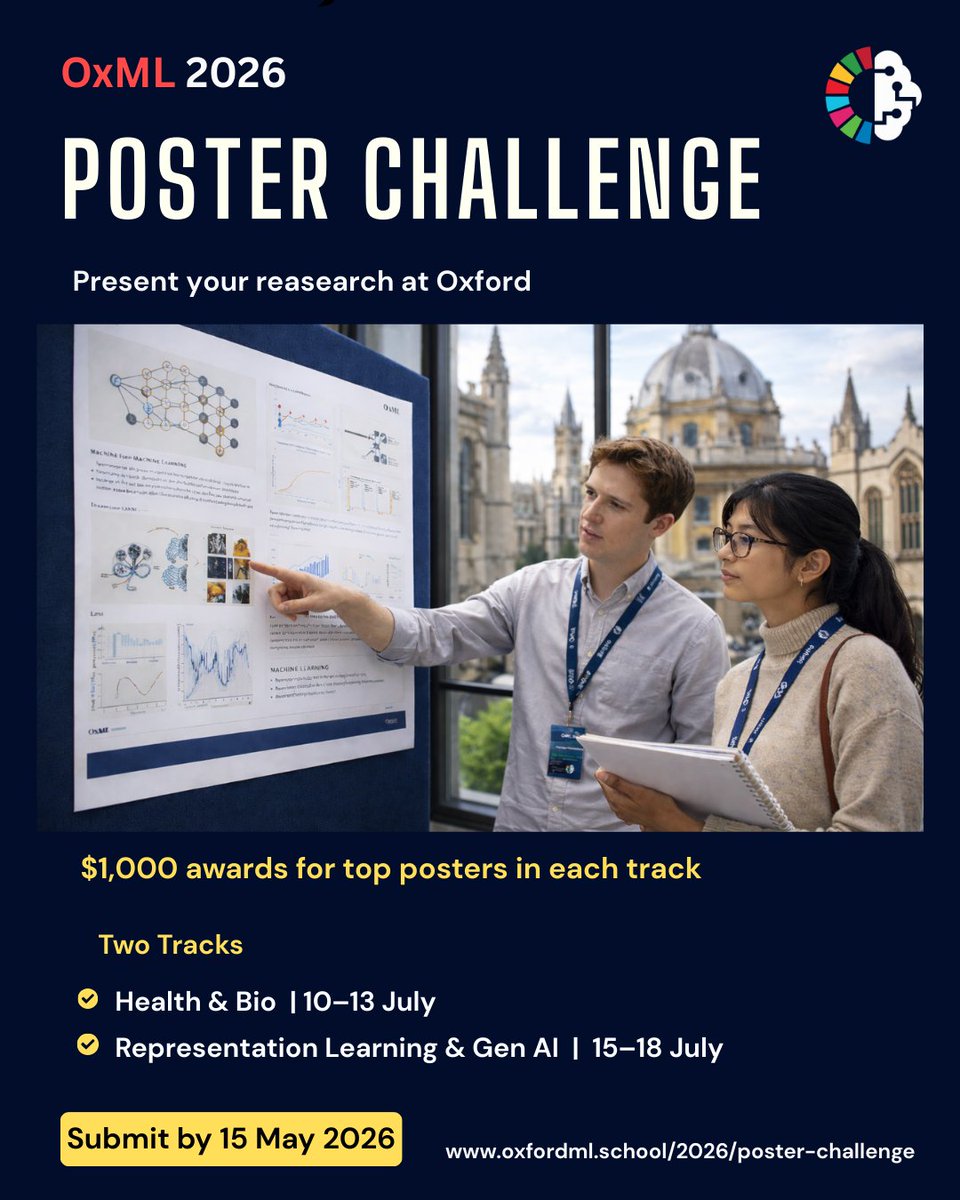
📣 Announcing the OxML 2026 Poster Challenge
We are excited to launch the OxML 2026 Poster Challenge, taking place this July at the Mathematical Institute, University of Oxford.
The challenge highlights outstanding research and applied work across machine learning and AI, and offers a platform to present your work, receive feedback, and engage with the OxML community.
Submissions are invited in two tracks:
🟢 MLx Health & Bio
🟢 MLx Representation Learning & Generative AI
🏆 Top posters in each track will receive $1,000 awards.
📅 Submission deadline: 15 May 2026
We particularly encourage submissions from researchers preparing or submitting work to venues such as NeurIPS, ICML, ICLR, and ACL, as well as early-stage and applied contributions.
Submit via EasyChair:
https://t.co/UpRCDQaTPS
Full call for posters:
https://t.co/U3tjrqMBD8
#OxML2026 #OxML #MachineLearning #AI #GenerativeAI #RepresentationLearning #HealthAI #BioAI, @GRESEARCHjobs
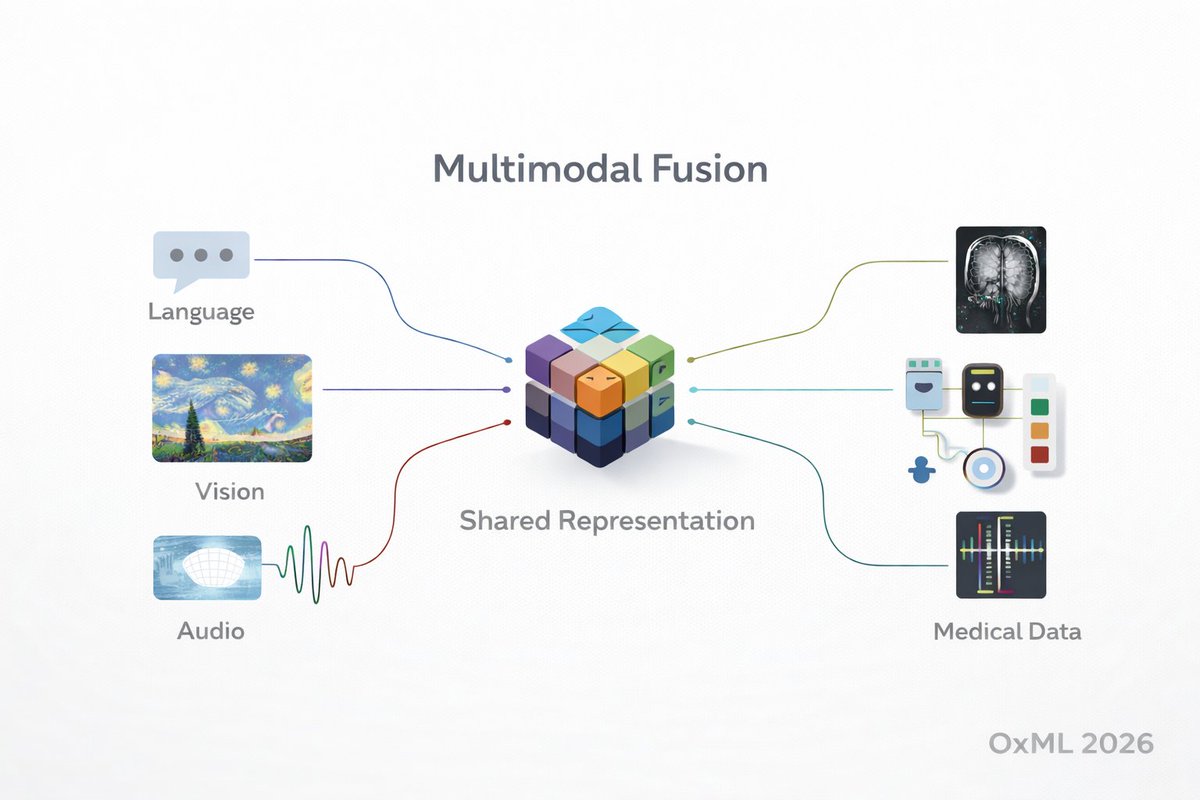
Multimodal AI will shape the next phase of ML.
As AI moves beyond single-modality systems, stronger foundations in fusion, alignment, reasoning, & generation will matter even more.
At #OxML 2026, we’ll explore the principles behind multimodal AI.
👉https://t.co/co72IIM0Qm
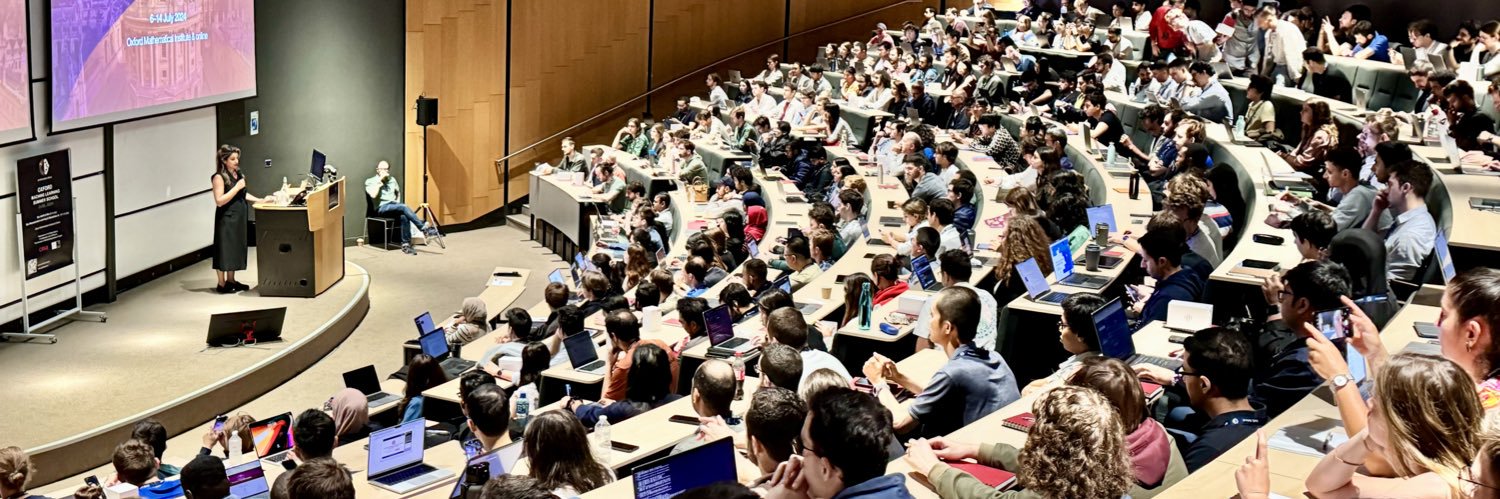
Looking back at OxML 2025 – MLx Representation Learning & Generative AI.
A week filled with inspiring lectures, engaging discussions, and meaningful connections. With participants joining from 100+ countries, it was amazing to see such a global community come together to learn, share ideas, and explore the future of representation learning and generative AI.
We’re excited to continue building this community at OxML 2026.
Registrations are open: https://t.co/4k5K5w4kRq
2025 Speakers featured:
Ashley Edwards, Edward Johns,Christian Rupprecht, Aymeric Dieuleveut, Gerhard Neumann, Yingzhen Li, Xuan-Son Nguyen, Fazl Barez, Mergen Nachin, Abdul Fatir Ansari
2025 Committee:
Mona Alinejad, D.Phil. (Oxon), Reza Khorshidi, D.Phil. (Oxon), Yali Du, Karo Moilanen
#OxML2026 #OxfordMachineLearning #MachineLearning #RepresentationLearning #GenerativeAI #DeepLearning #AICommunity
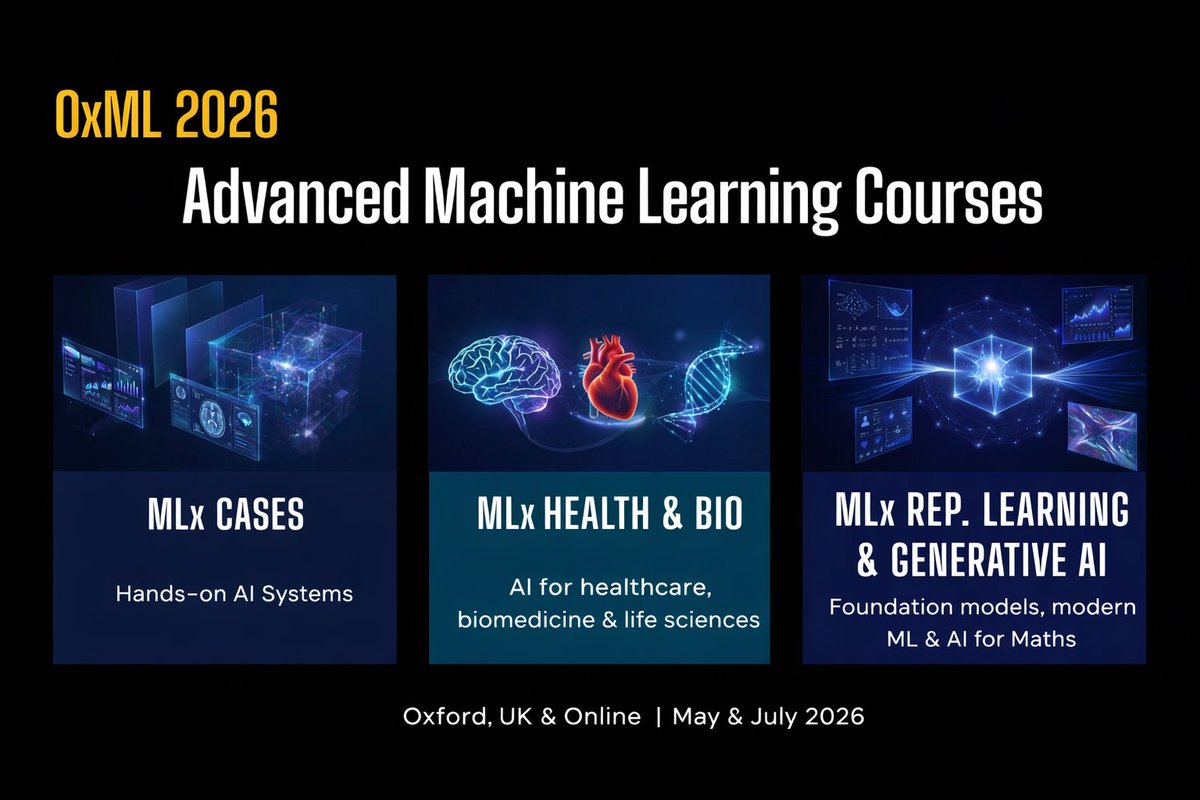
Oxford Machine Learning School (OxML) returns for its 7th edition in 2026, bringing together leading researchers and practitioners in artificial intelligence and machine learning.
The programme offers advanced, research-driven courses taught by world-class AI scientists and designed for PhD students, researchers, and industry practitioners who want to deepen their expertise in modern machine learning.
Participants can choose from three specialised tracks:
• MLx Cases – Hands-on development of generative AI systems and real-world applications
• MLx Health & Bio – AI for healthcare, biomedicine, and life sciences
• MLx Representation Learning & Generative AI – Foundation models, modern machine learning, and AI for mathematics
Courses combine theoretical foundations with practical system-level insights, providing a rigorous learning experience at the intersection of research and applied AI.
📍 Oxford, UK & Online | May & July 2026
🔗 https://t.co/J3cctNP8dX
#OxML #OxML2026 #MachineLearning #AI #DeepLearning #GenerativeAI
@CIFAR_News@oxmartinschool@OxUniMaths
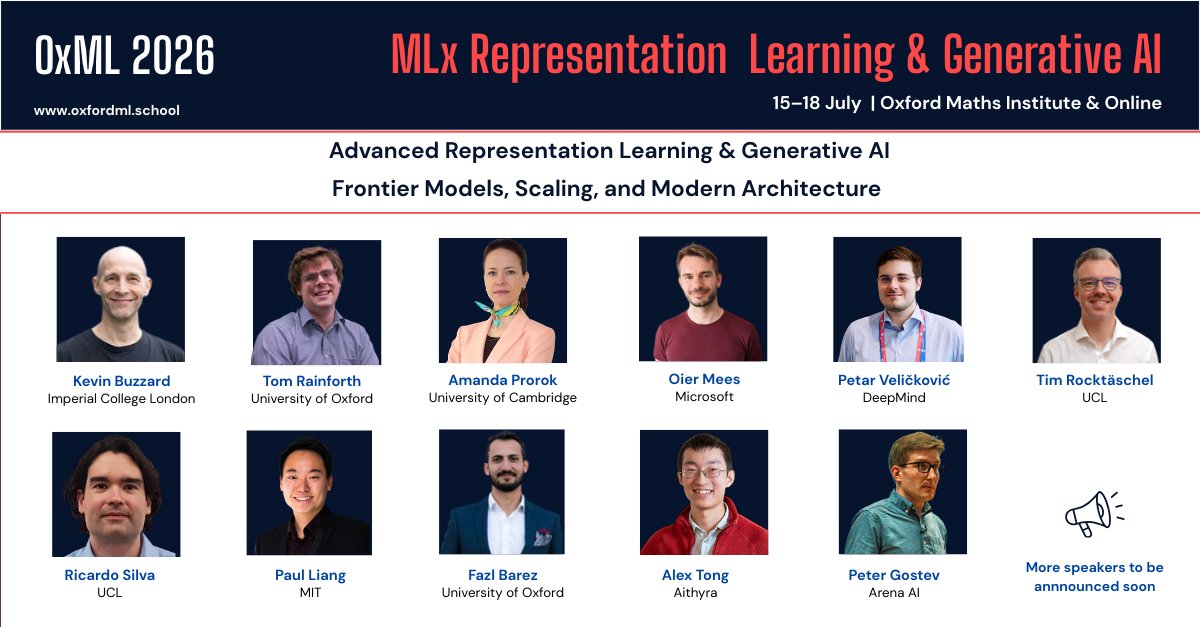
We’re excited to share the speaker lineup for MLx Representation Learning & Generative AI at OxML 2026.
MLx Representation Learning & Generative AI explores the latest advances in representation learning and the rapidly evolving landscape of generative AI and frontier models.
The program also features the OxML 2026 Poster Challenge, a competitive research poster session where researchers, students, and practitioners present and discuss new work across machine learning and AI.
📍 Oxford Mathematical Institute & Online
📅 15–18 July 2026
📝 Register by May 22. https://t.co/Lr3ykYw95n
Current speakers include:
• Kevin Buzzard — Imperial College London
• Tom Rainforth — University of Oxford
• Amanda Prorok — University of Cambridge
• Oier Mees — Microsoft, ETH Zürich
• Petar Veličković — Google DeepMind
• Tim Rocktäschel — UCL
• Ricardo Silva — UCL
• Paul Liang — Massachusetts Institute of Technology
• Fazl Barez — University of Oxford
• Alexander Tong— Aithyra
• Peter Gostev — Arena AI
Join us in Oxford to learn, exchange ideas, and connect with the global ML community.
#OxML #MachineLearning #GenerativeAI #RepresentationLearning #AIResearch #OxfordML
@UniofOxford@Cambridge_Uni@MIT@MSFTResearch@ucl@arena@aprorok@FazlBarez@_rockt@tom_rainforth@AlexanderTong7@pliang279@PetarV_93@oier_mees
Foundation models didn’t replace fundamentals — they scaled them.
The people who move into research and system-level roles aren’t just using models.
They understand how they learn, optimise, and fail.
At #OxML2026 — #MLxCases, we build from first principles.
User → Builder.