I‘m happy to share our work on laser flash melting to overcome preferred orientation in cryo-EM samples! 🥳❄️🔬
More infos on the underlying mechanism of particle redistribution and the use for preferred orientation issues in the 🧵 or here:
https://t.co/mpdxzbfNpQ
Our latest preprint is out🥳
https://t.co/7MfsLjMEPU
We performed DMS on EfrCD to determine the drug efflux activity profile of 1539 single variants!
Many interesting findings🔎, amongst which, that single mutations (!) can convert the exporter into a drug-specific ABC importer!
TTYH proteins, AKA Tweeties, have long been mistaken for chloride channels. Unraveling the possible functional relation of the Tweety family to lipid transport and metabolism in our new paper out in @NatureComms: https://t.co/3TaP8prn58
Happy to say our cryo-EM structure of Mtb MmpL3 is now out in @Structure_CP! (https://t.co/7DKGUi3ZLk). Thank you to all co-authors for your hard work (@justindeme85, @S_M_Lea, @philipwfowler, @inwardopen & twitterless Joanne Parker)!
Nice structural work on a new protein family from the Dutzler lab! 👏🏻 Pushing the size limit of membrane protein cryoEM! 👀 Great use of sybodies (@seegerlab) and cryoSPARC (@structurabio). https://t.co/z0baWHeBiG
Continuous flexibility is the next frontier for #cryoEM.
We are thrilled to introduce 3D Flexible Refinement, a new deep generative model that solves both detailed non-rigid motion, and high-res structure of flexible proteins!!
https://t.co/k3y6LTThvL
https://t.co/rorutueufG
1/
Agonist-bound OX2R cryo-EM structure in complex with a conformation-specific sybody👏
https://t.co/D5QrsjpGM6
We are proud to have contributed to this seminal study of Kaspar Hollenstein from @Merck by generating a conformation-selective high-affinity (600 pM) sybody💪
Currently our institute is an island on the ocean of constructions🚧 Imre recorded and edited a video of our old lab building being teared down. CAUTION: catchy tune!😅😅 (song credit: Parry Gripp)
📢Further progress at our COVID-19 front: six sybodies now characterized; decent binding affinities (20-180 nM); five sybodies strongly compete with RBD binding to ACE2; a sybody pair can bind simultanously.
Find the updated manuscript on @biorxivpreprint: https://t.co/q0RFr4iQYu
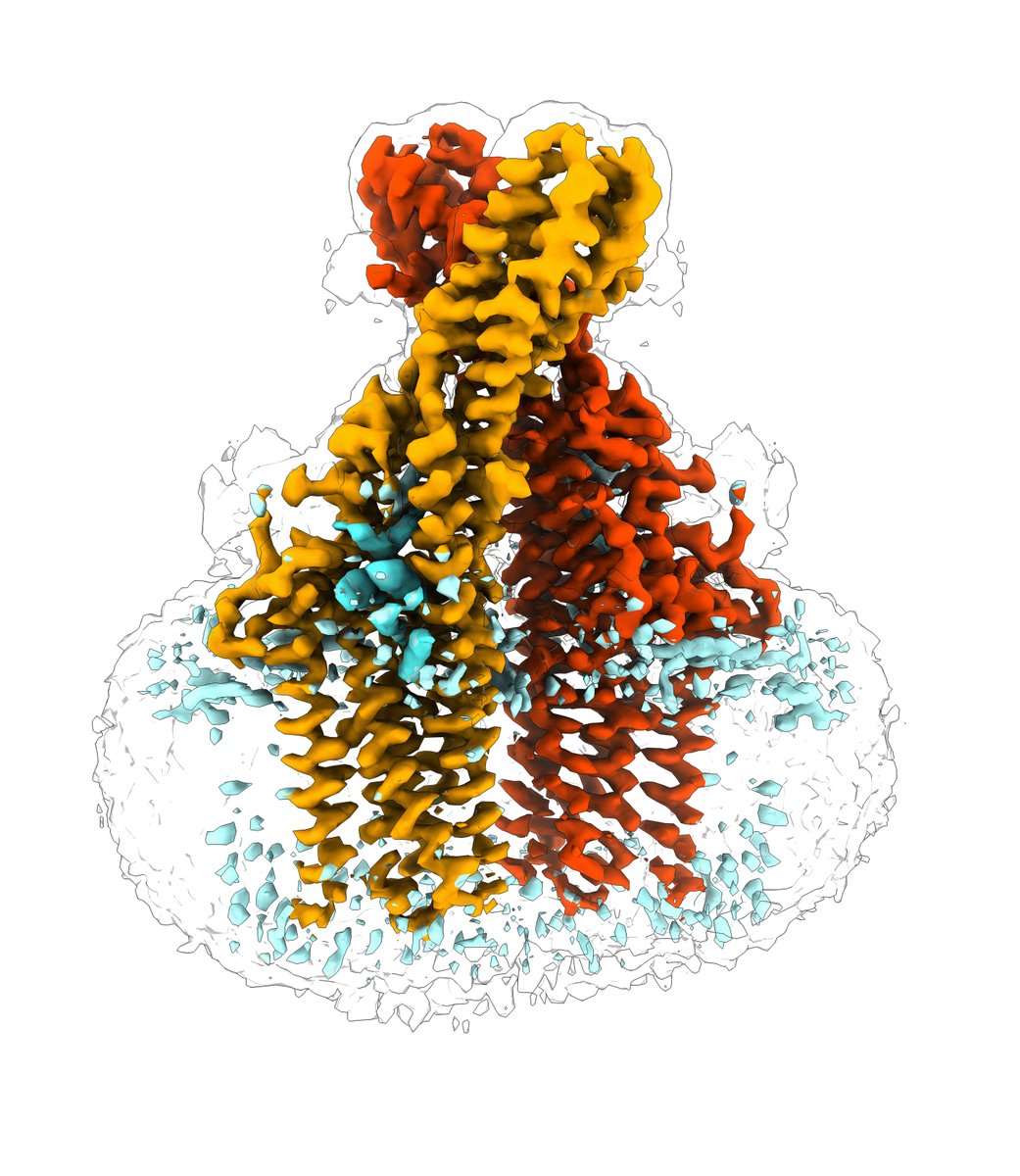
📽️IrtAB, an ABC transporter with an exporter fold, imports iron-bound mycobactins while the cytoplasmic domain (blue) reduces it to facilitate iron release. Our structure reveals a partially collapsed inward-facing substrate-binding cavity. Full story: https://t.co/1nCkcmsi5n