A primordial Von Neumann Probe, chilling and entropy maxxing | ML research | Pattern hunting across Math, Physics, Systems | CV @Nvidia | Ex @Toyota, @Qualcomm
📍 Can VLMs actually navigate? Introducing MapReason-OSM: a new benchmark for graph-verifiable mobility decisions on OSM maps. 🗺️ A core use case for autonomous agents on personal devices and their ability to do reasoning on Maps.
Beyond text-matching, it scores structured routes & pins against hidden street graphs across 10 cities.
🚨 Finding: Frontier models "read" maps but fail to "reason" network costs, and they flip decisions when zooming !
#VLM #OSM #SpatialReasoning #AI
MapReason-OSM: Can Vision-Language Models Make Graph-Verifiable Mobility Decisions from Street Maps?
Srinivas Venkatanarayanan, Clement Pakkam Isaac
https://t.co/vOZZgu5f9I [𝚌𝚜.𝙲𝚅]
💬Code: https://t.co/rAB21KZSdY
Terence Tao: AI isn’t hype anymore in Math discovery.
Terence Tao is one of the greatest living mathematicians, in his new lecture explains how AI and human professional mathematicians are now complementary.
"There has been a really visible increase in capability. It is not pure hype by any means. To me, these advances show there is a complementary way to do mathematics. Humans traditionally work in small groups on hard problems for months, and we will keep doing that.
But we can also now set AI to scale: sweep a thousand problems and pick up all the low-hanging fruit. Figure out all the ways to match problems to methods. If there are 20 different techniques, apply them all to 1,000 problems and see which ones can be solved by these methods. This is the capability that is present today."
From 'Institute for Pure & Applied Mathematics (IPAM)' YT channel.
Hugo Duminil-Copin, French mathematician and 2022 Field Medalist told me he never participated in math competition and was very bad at it.
Innovative mathematics requires creativity, intuition, intense concentration, and long reflections, sometimes spread over several years.
Good performance at a math olympiad merely tests fast problem solving abilities. AI can do that nowadays.
One of the big activities of a researcher, in mathematics and elsewhere, is not to answer questions but to ask the right questions.
We take randomness for granted.
Early PRNGs were BAD.
Thousands of scientific papers used to rely on RANDU, created by IBM in the 1960s. In 1D space, it looks ok!
Map in 3D…you start to see the issues. Now, there *was* a better solution...but it would cost you.
Transformers require explicit positional encoding with global reference. While in nature, processes like morphogenesis happens without a global system of reference. Positional awareness with concentration gradients would be an interesting development in Transformers.
There are internal models of reasoning and understanding that is different for different authors, thats why you have interpretations of linear algebra from Shilov to Strang each different on different intuitions for same formalisms
As much as Jensen is my super boss and i absolutely respect him, I don’t align to this well enough. There is a qualia even for objective knowledge, the deep intuition a human has on a mathematical or a scientific concept which you get to understand that’s impossible from an AI
Absolutely love Jensen Huang's prediction on this 🎯
“In 2-3 years, 90% of the world’s knowledge will be generated by AI. ”
whether we learn from books written by unknown people or AI that is combining assimilating knowledge, it makes little difference
What is the future of intelligence? The answer could lie in the story of its evolution.
Nice essay by @blaiseaguera published in @Nature.
Essay: https://t.co/dh1Zu0QElI
Some nice ideas in the piece:
“Hunting is a prime example of this predictive modelling. A predator must predict actions that will get the prey into its stomach; the prey must predict the predator’s behaviour to stop that from happening. Starting in the 1970s, neuropsychologists and anthropologists began to realize that other intelligent entities are often the most important parts of the environment to model — because they are the ones modelling you back, whether with friendly or hostile intent. Increasingly intelligent predators put evolutionary pressure on their prey to become smarter, and vice versa.”
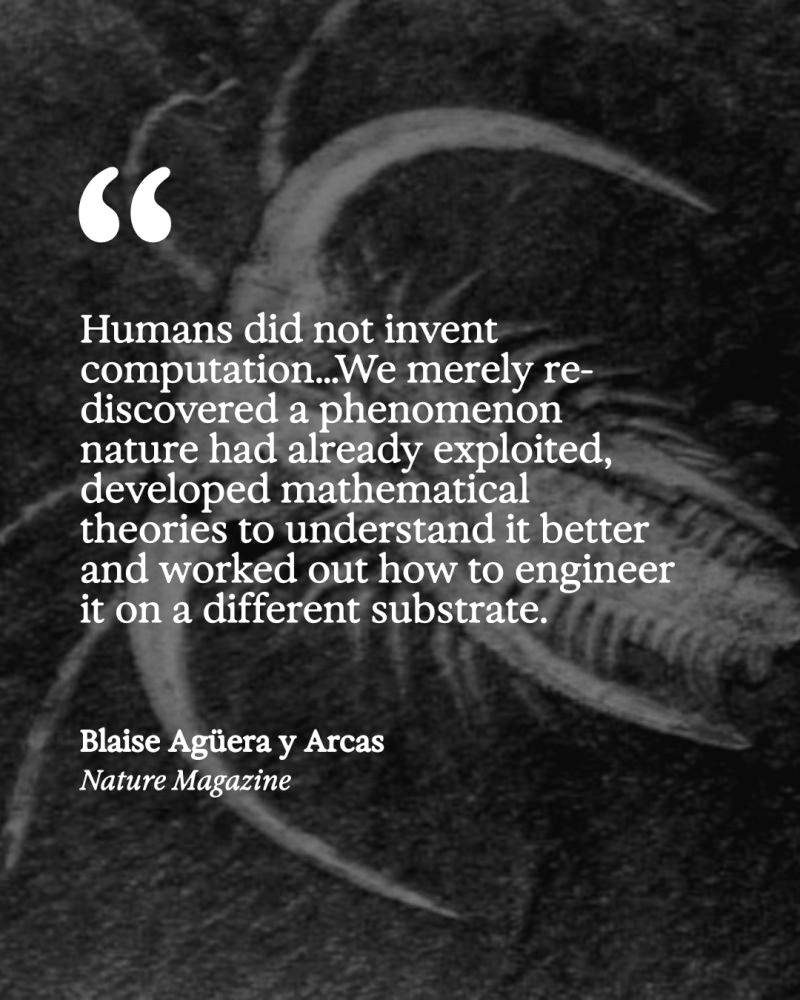
“Humans did not invent computation any more than they did electric current or optical lenses. We merely re-discovered a phenomenon nature had already exploited, developed mathematical theories to understand it better and worked out how to engineer it on a different substrate.”
Why do some corals grow into tall and narrow columns, and others into massive domes? The answer is buried deep in each coral polyp’s biological programming.
https://t.co/uuBli2Min8
This is a living map of a complex rational field: cool regions are root-dominant (|R|<1), warm regions are pole-dominant (|R|>1), where R is the complex rational function. Phase stripes come from arg S (the logarithmic derivative of our complex field
R) and particles surf the Newton flow. 🤩🤗😍
Interesting. Will check this out too.
Morphological causatives are kind of transitive verbs where the causation is embedded into verb meaning, more like the cause morphs the verb and gives rise to the effect. For example, felled the tree comes from the fall and fell. These are even more interesting in non latin eastern languages. Which is more like the progression from onomatopoeia, nouns as causative from observations like cuckoo to Verbs morphing to causations.
The fact that you are not able to verbalize some of your thoughts mean that your internal complex manifold is projected into a lower dimensional discretized representation space like language. This contradicts Wittgenstein’s "the limits of my language mean the limits of my world"
I believe that when multiple particles or entities how ever simple they can be interact with several possible states and functional complexities, the substrate develops an emergent intelligence.
@therubyxcube Thats probably a good counter theory to this. I have read about UG. i was reading about emergence of language structures, like morphological causatives in languages. What came first ? The word or the sound ?
We don’t exist in the world we all see, feel and hear. We exist in the world we built inside our heads, projections of the conscious and the unconscious collective minds of the society we are in. There are 8 billion known worlds of the same physical reality.