No fire boat spraying escort.
No whistle salutes from Mobile port.
No dipping the ensign.
No small craft flotilla.
No send off ceremony.
Sad indeed.
#SSUnitedStates#newsfeed
The SS United States will be intentionally sunk off Florida's gulf coast to become the world's largest artificial reef.
The sinking date was moved up by one day due to the weather.
The ship that still holds the record for the fastest crossing of the Atlantic was towed from the Delaware River waterfront last year.
@walterkirn There are two of them in Morristown TN. Also the best bacon/ham breakfast biscuit in the universe. And they send you off with “have a blessed day”. I wish they had a bigger territory but that might spoil the magic.
Shout out to the people that aren’t fans of the Brewers or the Rays, but they’re still up at midnight watching the 12th inning of the World Series because it might be the last chance to watch baseball for 5 months. The true baseball fans.
@john_keim In 1981, the Bobby Beathard/Joe Gibbs team drafted Mark May and Russ Grimm and picked up Joe Jacoby as a free agent, the beginning of the Hogs and some good years. Beathard and Gibbs understood the need for an o-line.
@walterkirn@AdamLovejoy Charles Portis is known for True Grit but I think Norwood (serialized in the Saturday Evening Post as Traveling Light, which is where I read it as a kid) was his real masterpiece. Great ear for his region. I still miss the Saturday Evening Post as it was before it zombified.
Auto manufacturers are now engineering cars in a way they if you break one small thing, a massive repair is needed
Example: This door handle on the inside of this new 2023 vehicle broke, you would think you just need a new door handle. Wrong
You now have to replace the entire door panel because they have manufactured it so that the door handle can not be removed
So now instead of paying a small amount of money for a new door handle, you have pay insane amounts of money for a whole door panel
This should be illegal. We need much stronger right to repair laws in America
That water clarity is an engineering decision, and the math behind it is wilder than the video.
Roman aqueducts ran on gravity alone. No pumps, no pressure systems. Engineers carved channels with a gradient so shallow it borders on absurd. The Pont du Gard in southern France drops 2.5 centimeters over 275 meters. That's roughly the thickness of a coin over the length of three football fields. They surveyed that accuracy with plumb lines and wooden leveling instruments.
The clarity you're seeing is a direct product of flow velocity. Too steep and the water erodes the channel walls, picks up sediment, turns brown. Too flat and it stagnates. Roman engineers targeted a slope of about 20 centimeters per kilometer, which kept the water moving fast enough to stay fresh but slow enough to stay clear. Before the water reached the city, it passed through multi-chamber settling tanks where velocity dropped near zero. Suspended particles sank. Clean water flowed out the top into the next chamber. Repeat three or four times.
Pliny specified the minimum slope in writing. Vitruvius published the exact mortar ratio for hydraulic cement: one part lime to two parts volcanic ash for underwater work. The pozzolana from Pozzuoli reacted with water to form a calcium-aluminum-silicate compound that actually gets stronger the longer it sits submerged. Modern concrete degrades in water. Roman concrete bonds with it.
Scale the whole system and it gets harder to process. Eleven aqueducts fed Rome at its peak. Combined output: roughly 1 million cubic meters of water per day. That works out to about 250 gallons per person for a city of one million. Modern New York delivers about 125 gallons per person per day. Ancient Rome had access to double the per capita water supply of the largest city in the United States, running entirely on slope and stone.
The Trevi Fountain in Rome is still fed by one of them. Two thousand years, same source, same gravity, same water.
Every academic publisher on Earth has lobbied to keep this software off university recommendation lists for the last 15 years.
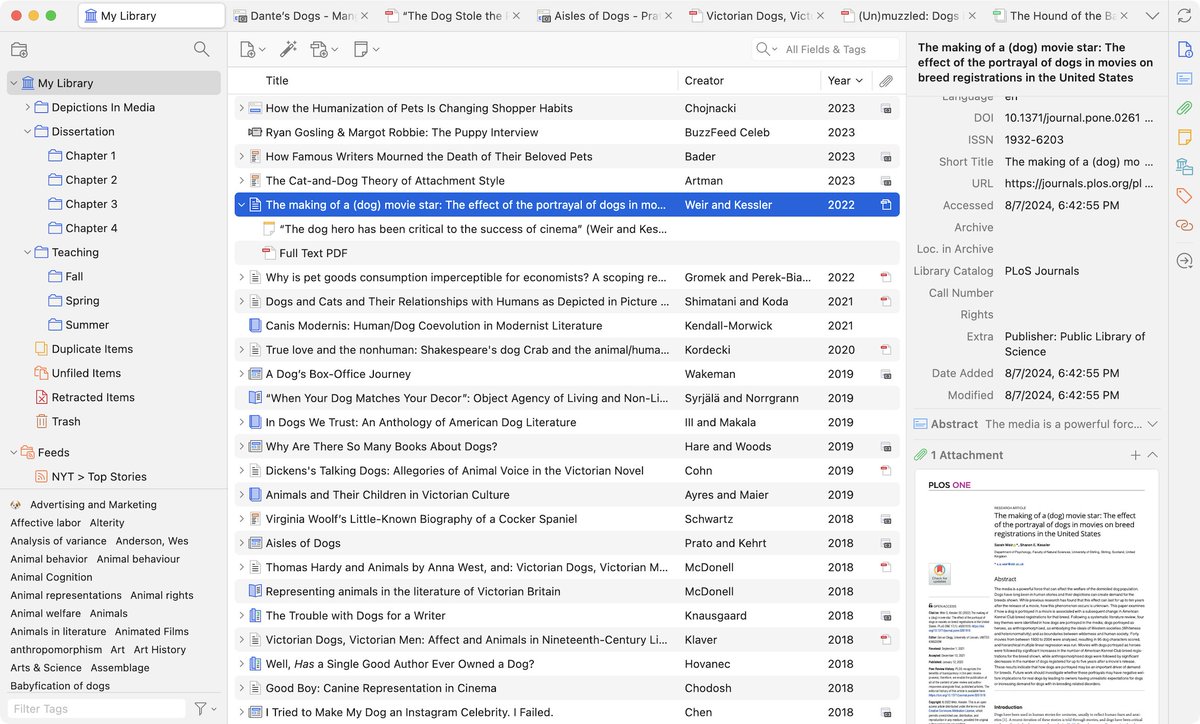
It's called Zotero, and it is the one citation manager Elsevier, Springer, and Wiley cannot acquire, paywall, or kill.
A non-profit organization built it in 2006 and gave it away.
The browser extension rips the full metadata, PDF, and DOI off any paper on JSTOR, Elsevier, ScienceDirect, or Wiley in one click.
You can annotate inside the reader. Cite into Word, Google Docs, LibreOffice, or OnlyOffice in 10,000+ styles.
100% Opensource.
https://t.co/uDbX72w2XK
@walterkirn (1) The moral conflicts;
(2) The geopolitical backdrop of the late 1940’s; the strange liminal nature of post-WW2 Vienna and Austria - between WW2 and Cold War in time, between West and East in politics, etc.;
(3) The zither tune;
(4) Vienna itself. Visit if possible.