Forward deployed engineers, or equivalent, are about to become one of the most in-demand jobs in tech. And one of the most important functions for AI rollouts.
Deploying agents is far more technical of a task than most people realize, often far more involved than deploying software. Software generally works the same way every time, and generally for the past few decades has been updated versions of an existing technology or concept (which basically means easier for the enterprise to update their workflows on a newer system).
With agents, you’re actually deploying the equivalent of work output within the enterprise. The customer is effectively using you as a professional services provider for a task, which they expect to get solved nearly end-to-end now. This means you need to actually deeply understand the business process as a vendor, and get the customer from the current to the end state seamlessly.
Companies need help figuring out which models will work best for their workflows, they need extensive evals setup often, they need change management support for workflows, they need to get their data setup for the agents, and constant tuning of the agentic system for their process.
Massive role in tech now. And another example of the kind of highly technical work that AI is creating.
Excited to open-source our new multi-modal context (mm-ctx) library, purpose-built for CLI agents like @claudeai code, @openclaw!
Your CLI agents can now easily run familiar UNIX commands on multi-modal files and get meaningful context on images, videos or PDFs:
$ mm cat bakery.mp4
The video showcases a bakery's journey, highlighting its history ...
Try the interactive demo:
@huggingface Spaces: https://t.co/Q4tXycimbQ
Billionaire Michael Milken joked “if a US company replaces the US-born CEO with a CEO born in India, I buy the stock”
But he reveals he hasn’t backtested the idea.
So we did.
In the last 15yrs, that would’ve 50x’d your money: 7.5x more $$ and >2x IRR vs S&P500: 30% vs 14%!
Uber Investor Bill Gurley on why young graduates anxious about AI taking their jobs are thinking about it the wrong way:
When asked what advice he'd give to new graduates worried about AI eliminating entry-level roles, he reframed the entire problem with an advice:
"In any role in any field, be the most AI enabled version of yourself you can possibly be."
To illustrate why, Bill draws on an analogy from anthropology:
"There's tons of anthropologists that have written about how we evolve with our tools. And you can just imagine a farming competition between a guy with a tractor and some drones and the other guy's got a plow and a donkey. Who's going to win?"
The implication is clear: AI isn't the threat. Being the person who hasn't learned to use it is.
@bgurley explains how this plays out inside organisations:
"If there are 40 people in your org all doing the same thing and you understand how AI affects that role more than the rest of them, you're not getting laid off. Like, it's just not going to happen."
But the upside goes beyond simply keeping your job.
Becoming AI-enabled changes the nature of the work itself:
"You'll also start to understand what parts of your job are a threat or not. And maybe you can elevate yourself to where you're a designer and not the worker bee because you now have this power."
The takeaway for young professionals is that the anxiety is misplaced, since AI only replaces the version of you that refused to learn it.
Basically Goldman Sachs saying there is another cliff for software stocks to fall off of.
From today:
"We expect the debate around AI disruption, and therefore uncertainty about many companies' terminal value, will persist for at least several quarters. The threat of disruption will likely represent a persistent overhang until the later stages of AI adoption. In the meantime, disproving this disruption narrative is challenging. For investors to have confidence in the long-term impact of AI, it will require more evidence of where AI is impacting earnings, which could take several quarters if not years."
@levie That's endearing to hear in many ways. As this plays out across sectors and industries, the combined AI+human impact could be monumental, and you don't have the large-scale job losses that many predict
I think everyone in marketing/PR at an AI company (& especially at large model companies) should watch this short piece of advice from @dylan522p w/ @patrick_oshag. Just a few minutes. Crisp and to the point. https://t.co/huyZK750Gq
Thoma Bravo is reportedly handing over the software company Medallia to creditors after restructuring negotiations failed to materialize
This is a $5.1 billion equity wipe out for the firm, who bought the business for $6.4 billion in 2021
Largest creditors include Blackstone, KKR, Apollo, Antares and Ares
This loan was last marked anywhere between 70c to 100c on the dollar, according to most recent BDC filings from them
Some early thoughts after building real apps by myself for the first time…
We built an internal tool called Conveyor
It’s an app builder, and internal App Store
It is connected to all of our data, context, and external data APIs
I’m completely and utterly useless as an engineer, but I’m good at knowing what I want a tool to do.
I’d previously struggled to make useful programs with pure CLIs. Our wrapper made it easy for me.
In the first 3 days of having this tool, I’ve built several fairly complicated applications, two of which I’ve used a ton for real work.
I’ve only used a couple hundred million tokens so far.
Some early feelings:
1) It’s obvious to my that my companies Positive Sum and Colossus will have fully bespoke operating systems, built in house. They will manage as much of our work as possible. This is already exploding for things like research and reporting. Every business will want this for themselves. Sure we won’t built our own slack, but we will built everything that pertains specifically to our shape as a firm, which is a lot.
2) x402 protocol (which enables AI agents and users to pay for API access and digital services instantly, without accounts or subscriptions) is immediately interesting to me. Many times I’ve wished I could just stream payments for individual data points.
3) right now each loop of prompt to output takes 5 to 15 minutes. As models and ASICs (@Etched !) make this faster, it’s going to be so much more fun. Even 5 minutes makes it hard to get in the flow. Can’t wait for seconds instead of minutes.
4) it’s so much easier to design things by starting with a shitty first draft of an app and seeing what’s wrong and iterating than nailing a full design ahead of time. When I had directed the design of software before this was always maddening and slow.
5) this has made me realize that my imagination had atrophied. Use it or lose it is real. Very quickly I’m finding it easier to have good ideas by building more stuff. I encourage everyone to do the same. So fun and rewarding.
6) We need more compute
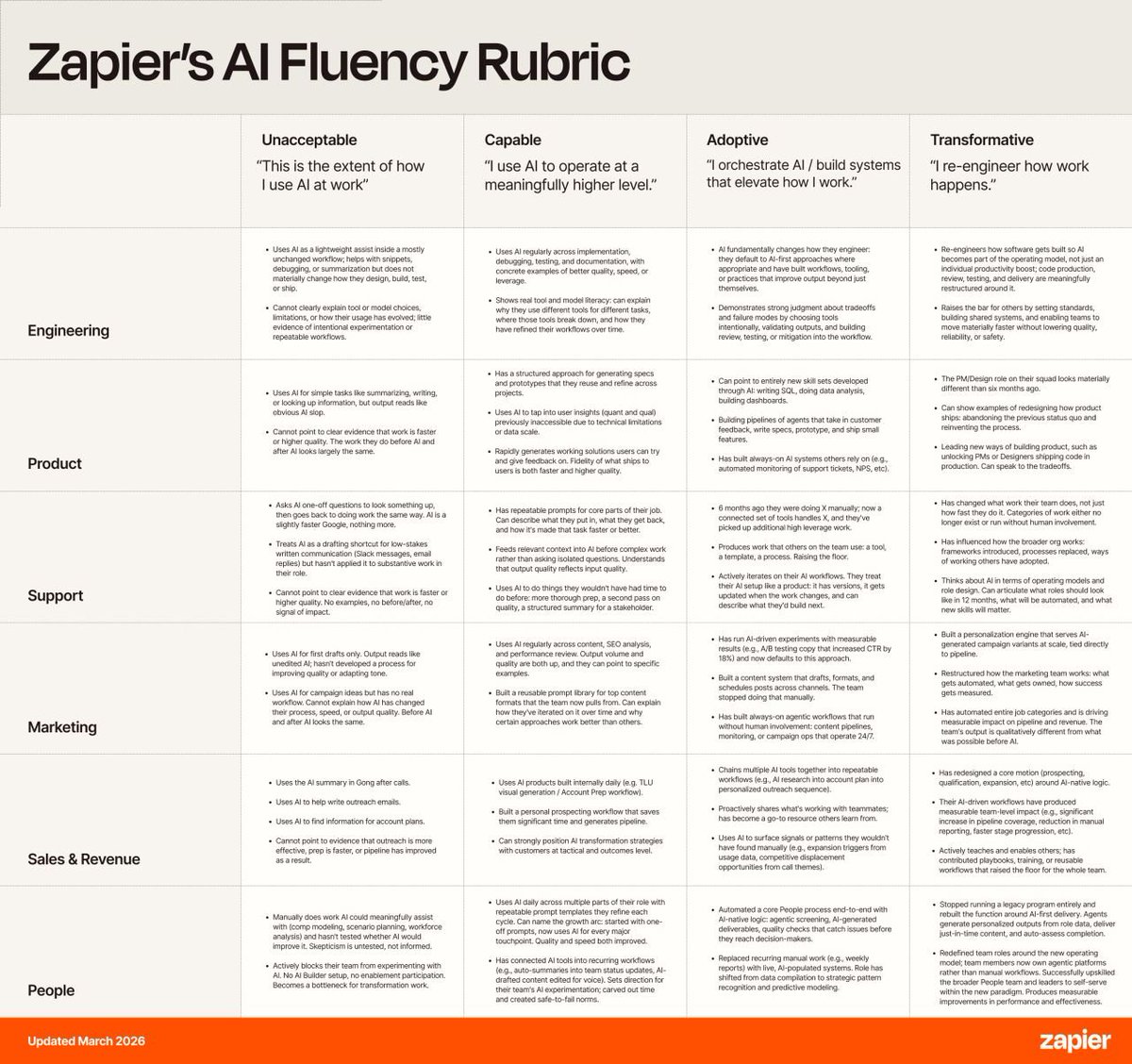
Zapier’s CEO just released their internal AI hiring rubric.
“Capable” AI operators are no longer hireable.
The new floor is "Adoptive.”
What gets you rejected now:
Marketers who use AI for first drafts and edit output manually.
Can’t show before/after evidence of AI implementations/prompts.
Using LLMs for campaign ideation without personalization.
What will get you hired:
Repeatable, shareable prompt libraries that and always-on workflows that run without your supervision. Specific measurable results that signal where to push next.
This is the new baseline.
Zapier’s CEO just released their internal AI hiring rubric.
“Capable” AI operators are no longer hireable.
The new floor is "Adoptive.”
What gets you rejected now:
Marketers who use AI for first drafts and edit output manually.
Can’t show before/after evidence of AI implementations/prompts.
Using LLMs for campaign ideation without personalization.
What will get you hired:
Repeatable, shareable prompt libraries that and always-on workflows that run without your supervision. Specific measurable results that signal where to push next.
This is the new baseline.