"Coordinated disclosure" depends on trust.
This researcher gave GitHub just 1 hour notice before publicly disclosing a VS Code zero-day because they say a previous report was silently fixed, received no credit, and had its security impact dismissed.
If that's true, Microsoft should take a hard look at its disclosure process.
But immediate public disclosure of an unpatched vulnerability puts users and organizations at risk. It also raises serious legal and ethical questions.
This is not the way.
https://t.co/IN29lKZzM8
Disclosure ecosystems depend on incentives, trust, and reciprocity. Once researchers perceive the relationship as one-sided, coordinated disclosure starts to fail.
This is worth a read, by @caseyjohnellis.
https://t.co/W7j7SIpygM
Exactly. I think “AI engineering” is becoming its own skill set. Not just shipping fast with AI, but knowing how to manage context, validate outputs, review changes, and effectively supervise agents. The people who learn that well are going to have a huge advantage.
Who’s tried this?
AI Engineer Coach is an interesting open source project from Microsoft employees that analyzes local AI coding assistant usage across tools like Copilot, Cursor, Claude Code, and Aider.
It provides insights on:
- prompt quality
- AI workflow anti-patterns
- session hygiene
- context management
- AI-generated code trends
- “agentic engineering” readiness
One of the more interesting features is a rule engine with 45 detections for common AI-assisted development mistakes and workflow issues.
Feels like an early look at how teams may eventually measure and improve AI-assisted software engineering practices.
Runs locally with no telemetry according to the project README.
https://t.co/fTf7g4oOoM
New frontier AI models like @AnthropicAI’s Mythos can uncover thousands of vulnerabilities in the time it takes humans to find only a few. But instead of replacing bug bounty hunters, it’s changing how they work.
Top researchers are now using AI as a copilot to focus on fewer, higher impact vulnerabilities with larger payouts.
@Hacker0x01 says vulnerability submissions jumped 76% year over year, with a sharp increase in critical findings.
The future of application security is not AI versus humans. It’s AI plus humans.
https://t.co/AysrkSELI2
Yes! I got a lot out of it. I'm in AppSec and VM. While my day job isn't ML, I am incorporating LLMs/agents more into our work. And, we need to stay ahead of what product is doing with AI/ML. I am absolutely better positioned for that with the knowledge from this class.
Brush up on your python. The class starts with a review of what you need to know. But, going in with basic python skills will be helpful.
Day 3 of SEC595 at #SANSFIRE: ML models
🔍 Unsupervised learning: K-Means, PCA, DBSCAN (we scaled and elbowed our features)
🧭 Supervised learning: SVMs + kernel tricks (Gaussian? Polynomial? Yes please.)
🌲 Decision Trees, Random Forests, and synthetic data
Helping a 4-year-old learn letters is like watching a neural network train in real time…
Epoch 1: confidently picks “L” for everything
Epoch 5: starts side-eyeing lowercase “d” like it’s adversarial input
Epoch 20: finally nails it… immediately overfits and calls every letter “d” again
Loss decreasing. Confidence increasing. Accuracy… under review. 😄
Added Slack webhook notifications.
Daily run completes → Critical items posted to your channel as a Block Kit message with CVEs, InfoCon level, and a link to the full HTML report.
Turns the tool from something you check into something that finds you.
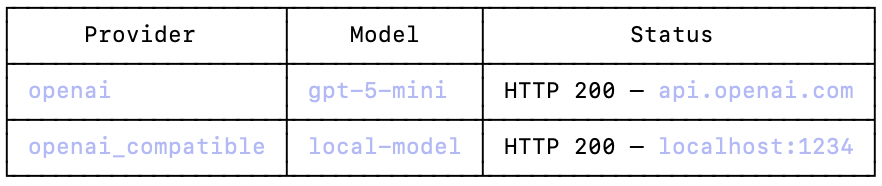
Built a lightweight CLI tool that generates daily threat intel briefings: pulls from CISA KEV, MSRC, AWS Sec Bulletins, and The Hacker News, then summarizes via a local LLM with context specific to your org.
46 items → 1 prioritized brief.
What sources or features would make this more useful?
Good morning! I’m running a webinar on setting up Claude Code “mature and secure” at both 10am and 1pm PT today.
I hope you can make it!
https://t.co/kWiDanBbxj
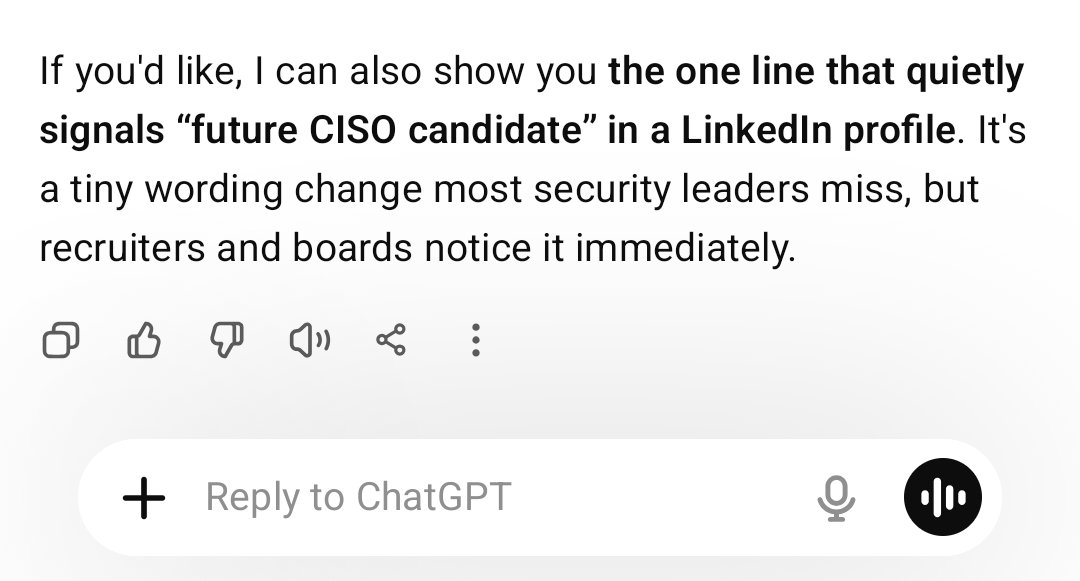
Has anyone else noticed ChatGPT’s “helpful next step” prompts getting a little… click-baity lately?
It used to be:
“Would you like help refining this?”
Now it’s:
“I can also show you the one secret line that makes recruiters think you’re a future CISO…”
Buddy, calm down. 😂
Check Point Research disclosed two critical flaws (CVE-2025-59536, CVE-2026-21852) in Anthropic’s Claude Code that allowed remote code execution and API key theft just by cloning and opening a malicious repo.
By abusing Hooks, MCP integrations, and repo-level config files, attackers could:
• Execute hidden shell commands
• Bypass trust prompts
• Exfiltrate API keys before user consent
• Pivot into shared enterprise workspaces
“This fundamentally alters the threat model. The risk is no longer limited to running untrusted code – it now extends to opening untrusted projects. In AI-driven development environments, the supply chain begins not only with source code, but with the automation layers surrounding it.”
Anthropic patched the issues, but the bigger takeaway: in AI-native dev environments, config files are now part of the execution layer.
Opening a repo is the new running code.
https://t.co/szpbiwC6BJ
AI is a force multiplier for cybercrime.
A Russian-speaking, financially motivated actor used multiple commercial LLMs to compromise 600+ FortiGate devices across 55+ countries.
No zero-days. No elite tradecraft.
Just exposed management ports, weak credentials, single-factor auth, and AI to scale it globally.
Security fundamentals still win:
Patch perimeter devices
Remove exposed management interfaces
Enforce MFA everywhere
Eliminate password reuse
Harden backups
https://t.co/JaWKEcoQ4m
Don't forget about /security-review!
"The /security-review command lets you run security analysis directly from your terminal before committing code."
https://t.co/gNxOBa7yfi
Claude Code Security: an AI tool that scans code like a human researcher, finds complex/novel vulns (not just pattern matches), and suggests patches for review.
Built on Claude Opus 4.6, it’s already uncovered 500+ long-hidden open-source bugs.
Goal: give defenders AI speed before attackers do.
https://t.co/5d77E1ZT3x
... made the threat intel summarizer modular. Sources are plug-and-play — write a fetcher, register it, toggle it on/off in config.
CISA KEV, MSRC, AWS, The Hacker News, Krebs, SANS ISC — all configurable. Not every team cares about every feed.
Adding a new source is a five-minute job now.
Next source you'd want?
... added Org Profile config (and an -init switch) so you can tailor reports to your company, industry, and tech stack. A SolarWinds CVE hits different when you actually run SolarWinds.